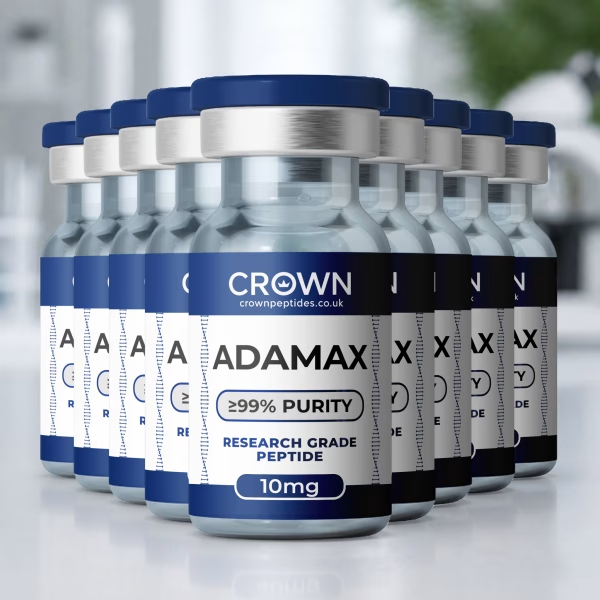
Adamax Research Peptide
A research peptide studied in Semax-analogue and adamantane-modification research. Coming soon in 10mg, with every batch independently tested and dispatched from the UK.
Out of stock
Supplied for laboratory research purposes only — not for human consumption or for medical, veterinary or diagnostic use.
Product Overview
Adamax peptide UK is Crown Peptides’ synthetic, adamantane-modified Semax analogue research compound, coming soon in 10mg for laboratory research.
- Studied in research involving ACTH(4-10)-derived Semax analogues
- Studied in research involving Semax-family BDNF and trkB signalling
- Studied in research involving adamantane modification of short peptides
- Studied in research involving mood and stress-response behavioural models
- Batch-specific quality documentation available
About Adamax Peptide UK
Adamax is a synthetic peptide described by suppliers as a modified form of Semax, the seven-residue peptide Met-Glu-His-Phe-Pro-Gly-Pro (MEHFPGP). Its defining feature is an adamantane group, a compact, cage-shaped ring of ten carbon atoms, joined to the Semax sequence, which is where the name comes from. It sits alongside Semax, Selank and the Semax 5mg + Selank 5mg (Blend) in the neurocognitive research area.
Also known as: Adamax peptide, adamantane-modified Semax, adamantylated Semax analogue, Semax analogue
Unlike Semax, Adamax has no published discovery paper, patent or named developer that we have been able to find, and it is not the subject of any study indexed on PubMed. Supplier descriptions also differ on its exact structure: most describe an N-acetylated Semax chain carrying an adamantane group at the end, while one catalogue listing gives a slightly longer acetylated sequence with no adamantane at all. For that reason, researchers usually treat Adamax as an exploratory analogue and rely on batch mass spectrometry to confirm exactly what they are working with.
Adamax Research
There are, as yet, no peer-reviewed studies of Adamax itself, so its research context comes from its parent compound. Semax is an analogue of the hormone fragment ACTH(4-10), and its effects on the BDNF and trkB system in the rat hippocampus are among the best documented in the field. (Learn more) The findings below were reported for Semax, or for adamantane-containing peptides in general, not for Adamax. Related neurocognitive compounds include Pinealon and DSIP.
- BDNF and trkB signalling (parent compound)
- Peptide breakdown and stability
- Focal ischaemia gene-expression models (parent compound)
- Mood and stress-response behavioural models (parent compound)
Where the story starts: ACTH(4-10) and Semax
ACTH is a pituitary hormone, and its short fragment ACTH(4-10) was studied for decades for its effects on learning in animals. Semax keeps the first four residues of that fragment, Met-Glu-His-Phe, and replaces the last three with the tripeptide Pro-Gly-Pro, which is why it is also written ACTH(4-7)PGP. In 2006, a Moscow group found specific, calcium-dependent binding sites for labelled Semax in membranes from the rat basal forebrain, with a dissociation constant of about 2.4 nanomolar, and showed that BDNF protein rose in that region within three hours of intranasal application, but not in the cerebellum. (Learn more)
The BDNF and trkB system
In the companion study in the rat hippocampus, a single application of Semax produced a 1.4-fold rise in BDNF protein, a 1.6-fold rise in activation of its receptor trkB, and a three-fold increase in one form of BDNF messenger RNA. Treated rats also made more conditioned avoidance responses in a learning task. (Learn more)
Why analogues are made: how Semax is broken down
Short peptides are cut up quickly by enzymes, and much analogue work aims to slow that down. Using Semax labelled at every residue, researchers tracked how it was broken down by rat basal forebrain cell cultures and membranes. Removal of the first two residues (Met-Glu) or the last two (Gly-Pro), leaving five-residue fragments, was the main route, and glial and neuronal cells left different patterns of products. (Learn more)
Why adamantane?
Adamantane is one of the most widely used building blocks in medicinal chemistry. A major review calls it the “lipophilic bullet” because adding it makes a molecule more fat-soluble and bulkier, which can change how it interacts with membranes and enzymes. (Learn more) The approach has been tested on peptides before: in 2010, a short peptide called P21 that incorporates adamantane improved learning and memory tasks and increased new neuron formation in the dentate gyrus of normal adult mice. P21 is a different molecule from Adamax and does not share its sequence. (Learn more)
Monoamine systems
In rodent studies, Semax raised the serotonin breakdown product 5-HIAA in the striatum, by about 25% in tissue and up to 180% of baseline outside the cells over one to four hours. On its own it did not change dopamine levels, but it strongly enhanced the dopamine release and movement produced by amphetamine. (Learn more)
Focal ischaemia models
After a permanent blockage of the middle cerebral artery in rats, a genome-wide study compared gene activity in the cortex with and without Semax at 3 and 24 hours. More than half of the genes Semax altered were linked to the immune response, notably chemokines and immunoglobulins, and a further group was linked to blood vessel formation. (Learn more)
Stress-response models
In a 2021 study, Semax or the related peptide ACTH(6-9)PGP was given to rats 30 minutes before acute restraint stress. Both reduced the stress-induced behavioural changes, and RNA sequencing of the hippocampus showed that they largely reversed the gene expression changes caused by the stress, raising genes that stress had lowered and vice versa. (Learn more)
Taken together, Adamax is best understood as an early-stage research analogue: it builds on a parent peptide with a substantial body of rodent and cell data, and on a well-established chemical modification, but its own properties have not yet been characterised in the published literature.
Specifications
- Product
- Adamax
- Classification
- Synthetic adamantane-modified Semax analogue research compound
- Available strength
- 10mg (coming soon)
- Form
- Research material supplied according to product label
- Purity / assay
- ≥99% (HPLC), batch-specific; refer to Certificate of Analysis
- Verification
- HPLC and Mass Spectrometry where analytically appropriate
- Also known as
- Adamax peptide, adamantane-modified Semax, adamantylated Semax analogue, Semax analogue
- Product Name
- Adamax
- Structure
- Described by suppliers as an N-acetylated Semax sequence (Met-Glu-His-Phe-Pro-Gly-Pro) carrying an adamantane group; no structure has been published in the peer-reviewed literature, so refer to the batch Certificate of Analysis for the confirmed mass
Purity and Testing
Crown Peptides Adamax will be supplied with batch-specific quality documentation appropriate to the material. Because Adamax has no published reference structure and supplier descriptions differ, identity matters as much as purity: HPLC shows how clean a batch is, while mass spectrometry confirms the molecular mass of the material in the vial and whether the adamantane modification is present. The Certificate of Analysis should be used as the definitive source for identity, assay, purity and relevant impurity information.
Storage Conditions
- Store unreconstituted material at -20°C ± 5°C in a cool, dry environment
- Prepared research solutions should use validated storage conditions appropriate to the compound and study design
- Protect from unnecessary heat, direct light and repeated temperature fluctuations
Related Compounds
Researchers working with Adamax may also be interested in Semax, its documented parent compound, as well as Selank, Semax 5mg + Selank 5mg (Blend), Pinealon and DSIP — other compounds studied in neurocognitive, stress-response and mood research.
Adamax Frequently Asked Questions
About Adamax7 questions
What is Adamax?
Adamax is a synthetic research peptide described as a Semax analogue with an adamantane group attached. Semax itself is a seven-residue peptide based on a fragment of the hormone ACTH. Adamax is used in exploratory laboratory work on how chemical modification changes a Semax-type peptide, and it has not yet been characterised in peer-reviewed studies.
How is Adamax related to Semax?
Adamax is built on the Semax sequence, Met-Glu-His-Phe-Pro-Gly-Pro, with an acetyl group on the front and an adamantane group added. Semax has been studied for decades in rodent and cell models, while Adamax has no published studies. Researchers comparing the two therefore treat Semax as the documented reference compound and Adamax as the modified test compound.
What is adamantane, and why attach it to a peptide?
Adamantane is a rigid, cage-shaped molecule of ten carbon atoms, the same shape as a tiny piece of diamond lattice. Chemists add it to drug-like molecules to make them more fat-soluble and bulkier, which can change how they cross membranes and how quickly enzymes reach them. Whether it does either for Adamax has not been tested in published work.
Why do descriptions of Adamax’s structure differ?
Adamax is a supplier name rather than a compound defined in a paper or patent, so there is no single agreed reference structure. Most suppliers describe an acetylated Semax chain with adamantane at the end, but one catalogue listing gives an acetylated nine-residue sequence with no adamantane. That is why batch mass spectrometry is the most useful document for this compound.
Has Adamax been studied in published research?
Not under that name. A PubMed search in October 2026 returned no papers on the Adamax peptide; the results that do appear refer to a computer algorithm of the same name. There is also no CAS number or PubChem compound record. All published biological data in this area relate to Semax and other compounds, not to Adamax.
What does ACTH(4-7)PGP mean?
It is the scientific shorthand for Semax. “ACTH(4-7)” means residues 4 to 7 of the hormone ACTH, Met-Glu-His-Phe, and “PGP” is the Pro-Gly-Pro tail added in place of the hormone’s own residues 8 to 10. Adamax keeps this same seven-residue core, so papers indexed under ACTH(4-7)PGP form the main background reading for it.
Is Adamax related to the peptide P21?
Only by approach. P21, also written P021, is a separate research peptide that incorporates adamantane and was reported in 2010 to improve learning tasks and new neuron formation in mice. Suppliers sometimes mention it because it shows adamantane being used in a short peptide, but it has a different sequence and is not derived from Semax.
Findings in research models4 questions
What did Semax do to BDNF in the rat hippocampus?
BDNF is a growth factor that supports nerve cells and the connections between them, and trkB is its receptor. In a 2006 rat study, a single application of Semax raised hippocampal BDNF protein 1.4-fold, trkB activation 1.6-fold and one form of BDNF messenger RNA three-fold. These are parent-compound findings and have not been measured for Adamax.
How is Semax broken down, and why does it matter for analogues?
When Semax was incubated with rat brain cell cultures and membranes, enzymes mainly clipped off the first two residues or the last two, leaving five-residue fragments. Knowing where a peptide is cut tells chemists where a modification such as acetylation or a bulky end group might slow breakdown, which is the reasoning usually given for analogues like Adamax.
What have Semax studies in focal ischaemia models examined?
Researchers blocked the middle cerebral artery in rats and measured activity across the whole genome in the cortex at 3 and 24 hours. In animals given Semax, more than half of the altered genes were linked to the immune response, and others to blood vessel formation. Similar work has not been reported for Adamax.
Why does an Adamax batch need mass spectrometry as well as HPLC?
HPLC shows how pure a sample is, but not which molecule it is. With Adamax, the structures described by suppliers differ, and plain Semax or N-acetyl Semax could look similar on HPLC. Mass spectrometry measures the actual molecular mass, so researchers can confirm that the adamantane-modified material in the vial matches the batch’s Certificate of Analysis.
Buying, testing & storage4 questions
Is Adamax legal to buy in the UK?
Adamax is not a controlled drug under the Misuse of Drugs Act 1971, and it is not a licensed medicine in the UK. It is sold in the UK as a research compound for laboratory use only, which is how Crown Peptides supplies it. This is general information, not legal advice.
Where can I buy Adamax in the UK?
Adamax is coming soon to Crown Peptides in 10mg vials, available singly or in packs of 3, 5 or 10 with a saving on every vial. Orders ship from the UK, and every batch is independently tested, with its Certificate of Analysis, including the mass spectrometry result, published on this page once stock arrives.
How far does a 10mg vial go?
Supplier-reported molecular weights for Adamax are close to 1,000 daltons, so 10mg is roughly 10 micromoles; the exact figure depends on the mass confirmed on your batch’s Certificate of Analysis. Semax binding sites were measured at nanomolar concentrations, so one vial covers a good deal of in vitro work, and the 5 and 10-vial packs keep a longer project on one batch.
How should Adamax be stored once it arrives?
Keep the unreconstituted powder at -20°C ± 5°C, dry and away from light. The sequence begins with methionine, an amino acid that oxidises readily on exposure to air and moisture, so vials are best kept sealed until use. Prepared solutions should follow storage conditions validated for your study design, and each batch’s Certificate of Analysis documents the material as dispatched.
Read the batch certificate before you order
Every batch is published openly — identity, purity and batch number, with no account needed.
View lab reports- Laboratory research only
- Not for human or clinical use
- Not for human or veterinary consumption
Supplied for laboratory research purposes only — not for human consumption or for medical, veterinary or diagnostic use.
Other Research Peptides
 Musculoskeletal researchBPC-157 + TB-500 Blend (Wolverine Stack)5mg / 5mg · 2 strengths ›