SS-31 Research Peptide
A high-purity research peptide studied in mitochondrial research.
In stock
Supplied for laboratory research purposes only — not for human consumption or for medical, veterinary or diagnostic use.
Product Overview
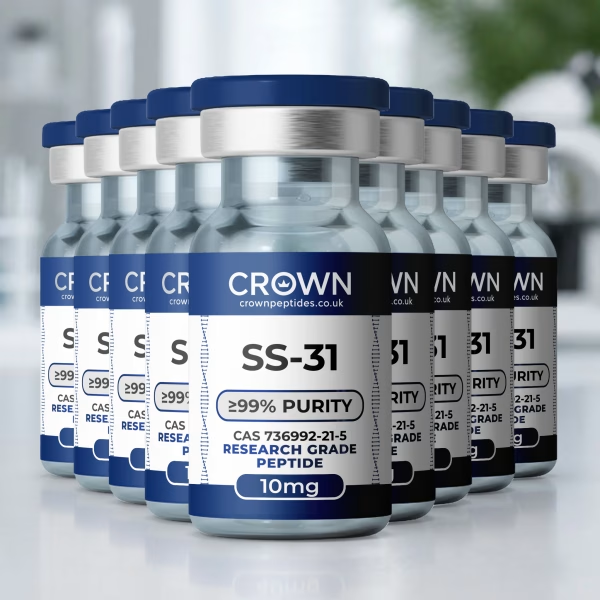
SS-31 peptide UK is Crown Peptides' mitochondria-targeted tetrapeptide, also known as elamipretide, available in 10mg and 50mg strengths for laboratory research.
- Studied in research involving cardiolipin binding and membrane research
- Studied in research involving inner mitochondrial membrane function
- Studied in research involving oxidative-stress models
- Studied in research involving mitochondrial bioenergetics
- Batch-specific quality documentation available
About SS-31 Peptide UK
SS-31 is a mitochondria-targeted aromatic-cationic tetrapeptide also known as elamipretide. Its structure promotes association with the inner mitochondrial membrane, where much of its research centres on cardiolipin interactions and mitochondrial bioenergetics.
Also known as: SS 31, SS31, elamipretide, MTP-131.
SS-31 Research
SS-31 has been investigated in models of mitochondrial membrane organisation and lipid bilayer binding (Learn more), cardiolipin-associated protein function, electron-transport efficiency, reactive-oxygen-species generation and cellular stress. The peptide is widely used alongside other mitochondrial bioenergetics MOTS-c research because its membrane-targeting properties allow direct study of processes occurring at the inner mitochondrial membrane.
- Cardiolipin binding and membrane research
- Inner mitochondrial membrane function
- Oxidative-stress models
- Mitochondrial bioenergetics
Cardiolipin: the inner-membrane lipid SS-31 seeks out
Cardiolipin is an unusual phospholipid. It carries four fatty-acid tails instead of the usual two, and in mammalian cells it sits almost entirely in the inner mitochondrial membrane. There it helps fold the membrane into cristae, the tightly packed ridges where ATP is made, and holds the respiratory complexes together in larger working units called supercomplexes. Cardiolipin also governs how cytochrome c behaves: normally bound, cytochrome c carries electrons along the respiratory chain, but when the lipid environment is disturbed it can turn into a peroxidase that attacks cardiolipin itself.
SS-31 research is built around this lipid. Early work from Hazel Szeto’s laboratory reported that peptides of this class concentrate around 1,000-fold in the inner mitochondrial membrane. A 2013 study in the Journal of the American Society of Nephrology then used a fluorescent SS-31 analogue to show high-affinity binding to cardiolipin. The SS-31–cardiolipin complex held back cytochrome c’s peroxidase activity, and in a rat model of kidney ischaemia the peptide helped preserve cristae and sped up the recovery of ATP.
How a four-residue peptide finds its target
SS-31 belongs to the Szeto-Schiller family, developed by Hazel Szeto and Peter Schiller around one simple design rule: alternate aromatic and positively charged residues. Its sequence, D-Arg-Dmt-Lys-Phe-NH2, follows that pattern exactly. The D-arginine at the front is the mirror-image form of the amino acid, which protein-cutting enzymes recognise poorly. Dmt (2′,6′-dimethyltyrosine) is a modified tyrosine. The amidated C-terminus removes a negative charge, leaving a net charge of +3 at physiological pH in a peptide small enough to cross cell membranes.
Biophysics has sharpened the picture. A 2020 Journal of Biological Chemistry study (Learn more) found that SS-31 settles into the interfacial region of lipid bilayers, with binding that tracks surface charge, and that it tunes the surface electrostatics of model and mitochondrial membranes, including where calcium ions gather. A 2022 eLife structure–activity study compared SS-31 with three analogues and found that changing the side chains or their order changed both membrane behaviour and activity in cell-stress assays.
Beyond the lipid: SS-31’s protein neighbours
Cardiolipin never works alone. Dozens of inner-membrane proteins depend on it, so researchers have asked which of them SS-31 actually meets. A 2020 study in PNAS answered that with chemical cross-linking and mass spectrometry in isolated mitochondria. Every SS-31 partner the team identified was a known cardiolipin-binding protein, and they fell into two groups: components of oxidative phosphorylation, the machinery that produces ATP, and enzymes of 2-oxoglutarate metabolism within the Krebs cycle.
Many of the cross-linked sites lay close to the regions where those proteins touch cardiolipin. That supports a model in which SS-31 works at the boundary between lipid and protein, steadying the local environment of the respiratory machinery rather than switching on a single receptor. It also explains why SS-31 is such a useful probe for anyone studying how membrane organisation shapes electron transport and ATP output.
Ageing heart and muscle models in mice
Some of the most cited SS-31 work comes from ageing research. In a 2013 Aging Cell study, 27-month-old mice showed skeletal-muscle mitochondrial energetics restored toward young levels within one hour of SS-31, measured in living animals with optical and phosphorus magnetic resonance spectroscopy. Young muscle was unaffected, and after eight days of treatment whole-animal endurance improved.
The heart tells a similar story. A 2020 eLife study reported that eight weeks of SS-31 substantially reversed diastolic dysfunction in old mice, alongside reduced proton leak and lower mitochondrial reactive oxygen species in heart muscle cells. Old mice engineered to express a mitochondria-targeted catalase gained nothing extra from SS-31, which points to mitochondrial oxidative stress as the shared mechanism. Together, these studies made SS-31 a reference compound for asking whether age-related decline in mitochondrial function can be reversed late in life, not just slowed.
Elamipretide: from research peptide to approved medicine
SS-31 stands out among research peptides because the same molecule, as elamipretide, has completed the journey to an approved drug. Developed by Stealth BioTherapeutics, and earlier known in trials as MTP-131 and Bendavia, elamipretide received accelerated approval from the US Food and Drug Administration on 19 September 2025 under the brand name Forzinity. It is approved for Barth syndrome in patients weighing at least 30kg, and was the first FDA-approved medicine for that condition, a rare inherited disorder caused by faults in the TAFAZZIN gene needed to build mature cardiolipin. The approval rests on improved knee-extensor muscle strength, and the FDA requires a confirmatory trial; Stealth’s parent company, Mighty Therapeutics, announced in July 2026 that the Phase 4 confirmatory study had enrolled its first patient.
Not every programme has succeeded. The MMPOWER-3 trial in primary mitochondrial myopathy showed no significant overall benefit, though a subgroup with nuclear DNA variants prompted further analysis, and a Phase 3 study in dry age-related macular degeneration is under way. Crown Peptides’ SS-31 is a research-grade peptide, separate from the licensed medicine.
Specifications
- Product
- SS-31
- Classification
- Mitochondria-targeted tetrapeptide also known as elamipretide
- Available strengths
- 10mg and 50mg
- Form
- Research material supplied according to product label
- Purity / assay
- 99% (HPLC), batch-specific; refer to Certificate of Analysis
- Verification
- HPLC and Mass Spectrometry where analytically appropriate
- Also known as
- Elamipretide (MTP-131)
- CAS Number
- 736992-21-5
- Molecular formula
- C32H49N9O5
- Molecular weight
- 639.79 Da
- Sequence
- D-Arg-Dmt-Lys-Phe-NH2
- Peptide length
- 4 amino acids
- Product Name
- SS-31
- Commonly referenced CAS Number
- 736992-21-5
- Alternative name
- Elamipretide
Purity and Testing
Crown Peptides SS-31 is supplied for controlled laboratory research with batch-specific analytical documentation. High-Performance Liquid Chromatography (HPLC) can assess chromatographic purity, while Mass Spectrometry provides molecular information used to support identity verification.
The batch-specific Certificate of Analysis is the definitive source for the exact purity result, identity data and analytical specification of the material supplied.
Storage Conditions
- Store unreconstituted material at -20°C ± 5°C in a cool, dry environment
- Prepared research solutions should use validated storage conditions appropriate to the compound and study design
- Protect from unnecessary heat, direct light and repeated temperature fluctuations
Related Compounds
Researchers working with SS-31 may also be interested in MOTS-c, NAD+, GHK-Cu, Epitalon and 5-Amino-1MQ — other compounds studied in mitochondrial function, cellular energy and ageing-related research.
SS-31 Frequently Asked Questions
About SS-317 questions
What is SS-31?
SS-31 peptide UK from Crown Peptides is a mitochondria-targeted tetrapeptide also known as elamipretide. Its four residues, D-Arg-Dmt-Lys-Phe-NH2, give a molecule of just 639.79 Da that is studied for how it binds the inner mitochondrial membrane.
Where does the name SS-31 come from?
“SS” stands for Szeto-Schiller, after Hazel Szeto and Peter Schiller, whose collaboration produced a numbered series of aromatic-cationic peptides. SS-31 became the lead compound of that series and entered clinical development under the code MTP-131, also branded Bendavia, before taking the international name elamipretide.
Are SS-31, SS 31, SS31, elamipretide and MTP-131 the same thing?
All five point to one molecule, D-Arg-Dmt-Lys-Phe-NH2. SS 31 and SS31 are simply spelling variants of the laboratory name, elamipretide is the international non-proprietary name, and MTP-131 was the development code used in early clinical trials. Forzinity is different again: it is the brand name of the licensed medicine, not another name for the research peptide.
Is SS-31 the same as Forzinity?
Forzinity is the brand name under which elamipretide is marketed in the US, after the FDA granted it accelerated approval in September 2025 for Barth syndrome in patients weighing at least 30kg. The active molecule is the same sequence, but Forzinity is a licensed pharmaceutical product made and regulated as a medicine. Crown Peptides SS-31 is research-grade peptide, characterised by its own batch Certificate of Analysis.
Why does SS-31 gather at the inner mitochondrial membrane?
Its aromatic-cationic structure is drawn to cardiolipin, a negatively charged lipid found almost only in the inner mitochondrial membrane. The three positive charges pull the peptide toward that anionic surface, while the aromatic Dmt and phenylalanine rings help it sit within the membrane’s interfacial layer.
What does “Dmt” mean in the SS-31 sequence?
Dmt is 2′,6′-dimethyltyrosine, a tyrosine with two extra methyl groups on its ring. It is not one of the 20 standard amino acids. In the early 2004 work on these peptides, analogues lacking Dmt failed to reduce mitochondrial reactive-oxygen-species production, which is why the residue is considered central to the design.
Why does SS-31 start with D-arginine rather than ordinary arginine?
Natural proteins are built from L-amino acids, and the enzymes that break peptides down are shaped to recognise them. Placing the mirror-image D-form of arginine at the front makes SS-31 a poor fit for those enzymes, helping such a short peptide survive in research systems, while still contributing one of its three positive charges for cardiolipin binding, electron transport and oxidative-stress work.
SS-31 in mitochondrial research4 questions
How is SS-31 different from MOTS-c?
The two come at mitochondria from opposite directions. SS-31 is a synthetic tetrapeptide, built in the lab, that travels into mitochondria and binds the inner membrane. MOTS-c is a natural 16-amino-acid peptide encoded by mitochondrial DNA that travels the other way, out of mitochondria, acting as a signal to the rest of the cell. Researchers interested in membrane structure tend to use SS-31; those studying mitochondrial signalling tend to use MOTS-c.
Why does Barth syndrome come up so often in SS-31 research?
Barth syndrome is caused by faults in TAFAZZIN, the gene for an enzyme that remodels cardiolipin into its mature form. Because SS-31’s research identity is built on cardiolipin binding, a disorder of cardiolipin itself was a natural test case, and it became the condition for which elamipretide was first approved in the US.
Is SS-31 an antioxidant?
It was first described as one. The 2004 paper introducing these peptides called them cell-permeable peptide antioxidants, crediting the Dmt residue with scavenging activity. Later work shifted the emphasis to cardiolipin binding, membrane electrostatics and cytochrome c, so SS-31 is now usually described as a cardiolipin-targeted membrane peptide whose effect on reactive oxygen species is one part of a broader mechanism.
Which experimental models has SS-31 been studied in?
Published work covers model lipid bilayers, isolated mitochondria, neuronal and other cell lines, ex vivo heart preparations, rat kidney ischaemia, and aged-mouse heart and skeletal muscle. As elamipretide it has also been tested in human clinical trials, including MMPOWER-3 and studies in Barth syndrome.
Strengths & analysis3 questions
When does the 50mg SS-31 vial make more sense than the 10mg?
Membrane-binding assays, isolated-mitochondria experiments and cell work use very little material per run, so the 10mg vial is usually plenty. The 50mg vial earns its place in rodent studies and long experimental series that would otherwise get through many small vials. You can buy either size one vial at a time, or save by taking five or ten together.
Why can SS-31 show up twice in a mass spectrum?
Small as it is, SS-31 carries several basic groups that each pick up a proton during electrospray ionisation. Alongside the singly charged ion near m/z 640.4, a doubly charged ion near m/z 320.7 is often seen, and both trace back to the same formula, C32H49N9O5, with an average molecular weight of 639.79 Da and a monoisotopic mass of about 639.39 Da. The batch Certificate of Analysis records the observed result.
Why does the SS-31 documentation mention salt form?
Being strongly basic, SS-31 is isolated as a salt, typically with acetate or trifluoroacetate counter-ions bound to its positive groups. Those counter-ions add weight, so the net peptide content of a vial differs slightly from the gross powder mass. That is why the exact salt form should be confirmed from the batch documentation.
Read the batch certificate before you order
Every batch is published openly — identity, purity and batch number, with no account needed.
View lab reports- Laboratory research only
- Not for human or clinical use
- Not for human or veterinary consumption
Supplied for laboratory research purposes only — not for human consumption or for medical, veterinary or diagnostic use.
Other Research Peptides
 Musculoskeletal researchBPC-157 + TB-500 Blend (Wolverine Stack)5mg / 5mg · 2 strengths ›