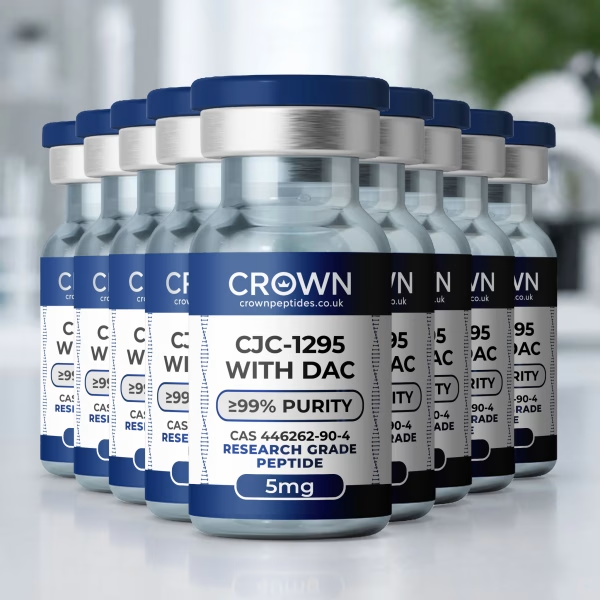
CJC-1295 (With DAC) Research Peptide
A high-purity research peptide studied in long-acting growth-hormone research.
In stock
Supplied for laboratory research purposes only — not for human consumption or for medical, veterinary or diagnostic use.
Product Overview
CJC-1295 with DAC UK is Crown Peptides' long-acting synthetic growth-hormone-releasing hormone analogue, available in 5mg strength for laboratory research.
- Studied in research involving GHRH receptor signalling
- Studied in research involving pituitary growth-hormone release
- Studied in research involving IGF-1-related endocrine pathways
- Studied in research involving Drug Affinity Complex and prolonged peptide persistence
- Batch-specific quality documentation available
About CJC-1295 with DAC UK
CJC-1295 with DAC is a synthetic analogue of growth-hormone-releasing hormone designed with a Drug Affinity Complex that can bind circulating albumin. The DAC modification is central to its research profile because it changes peptide persistence compared with shorter-acting GHRH analogues such as Sermorelin.
Also known as: CJC 1295 DAC, CJC1295 DAC, CJC-1295 DAC, DAC:GRF.
CJC-1295 with DAC Research
CJC-1295 with DAC is studied in endocrine research examining GHRH-receptor signalling, pituitary growth-hormone release, and prolonged stimulation of GH and IGF-1 secretion in controlled human research (Learn more). The albumin-binding DAC modification makes the compound particularly useful for comparing short- and long-duration GHRH signalling against peptides like Ipamorelin and Tesamorelin in controlled models.
- GHRH receptor signalling
- Pituitary growth-hormone release
- IGF-1-related endocrine pathways
- Drug Affinity Complex and prolonged peptide persistence
The Drug Affinity Complex: a chemical hook for albumin
Strip away the branding and the DAC turns out to be a small piece of chemistry with a very large job. CJC-1295 starts from the 29-residue tetrasubstituted GRF(1-29) backbone and adds one extra lysine at the C-terminus, position 30. Fixed to the side-chain amine of that lysine is a 3-maleimidopropionamide group, and its maleimide ring is the business end of the molecule: it reacts quickly and selectively with free thiol (–SH) groups to form a stable thioether bond.
In plasma, the largest pool of free thiol belongs to serum albumin. Human albumin contains 35 cysteines, and 34 of them are locked into 17 disulphide bridges, leaving one unpaired residue, Cys34. The DAC is designed to find that cysteine, so the peptide ends up covalently tethered to albumin once it reaches the circulation. Albumin itself survives around three weeks in human blood, because the neonatal Fc receptor rescues it from breakdown inside cells, and the attached GHRH analogue shares in that protection. Rather than redesigning the peptide to resist every enzyme, the DAC borrows the body’s own long-lived carrier.
Inside ConjuChem: how CJC-1295 was chosen
The compound came out of ConjuChem, a Montreal biotechnology company built around albumin bioconjugation. In a 2005 paper in Endocrinology, Jetté and colleagues described three maleimido derivatives of human GRF(1-29) and first coupled them to human serum albumin outside the body. All three conjugates resisted dipeptidyl peptidase-IV, the enzyme chiefly responsible for inactivating native GHRH in plasma, and all three still released GH from cultured rat anterior pituitary cells (Learn more).
In live rats the standout was the version carrying its maleimide on a C-terminal lysine. That compound, CJC-1295, produced a four-fold larger GH area under the curve over two hours than unmodified GRF(1-29) and was still detectable in plasma beyond 72 hours. Western blotting located it on the albumin band within 15 minutes, where it remained beyond 24 hours. ConjuChem went on to apply the same chemistry to GLP-1, and that second compound, CJC-1131, showed a half-life of roughly 9 to 15 days in healthy volunteers: good evidence that the DAC concept carries across unrelated peptide hormones.
Days instead of minutes: the healthy-volunteer trials
The core human pharmacology comes from Teichman and colleagues, who ran two randomised, double-blind, placebo-controlled, ascending-level trials lasting 28 and 49 days in healthy adults aged 21 to 61. After a single exposure, mean plasma GH rose 2- to 10-fold for six days or more and mean IGF-1 rose 1.5- to 3-fold for 9 to 11 days, both in proportion to the amount given. The estimated half-life of CJC-1295 was 5.8 to 8.1 days. With repeated exposure, mean IGF-1 stayed above its starting level for up to 28 days, the authors noted a cumulative effect, and no serious adverse reactions were reported.
Those figures put the compound in a different league from native GHRH and Sermorelin, whose activity is measured in minutes. Under the name DAC:GRF, ConjuChem then moved into a Phase II study in HIV-associated abdominal fat, but that trial was stopped in July 2006 and the molecule never reached approval. The GHRH analogue that did gain approval in that field is a different peptide altogether, Tesamorelin.
Raised troughs, intact pulses: the overnight sampling study
A constant GHRH signal might be expected to blur growth hormone’s natural bursts into a flat line. Ionescu and Frohman put that to the test in healthy men aged 20 to 40, drawing blood every 20 minutes across a 12-hour overnight window, once before CJC-1295 with DAC and again a week afterwards. The number and size of GH pulses did not change. What changed was the floor between them: basal, or trough, GH rose 7.5-fold, mean GH climbed by 46% and IGF-1 by 45% (Learn more).
The two exposure levels tested gave statistically similar responses, and the rise in IGF-1 did not correlate with any individual measure of GH secretion, so the authors singled out the elevated trough as an important contributor to IGF-1 production. For anyone modelling how the shape of GHRH exposure feeds through to IGF-1, that separation between pulses and baseline is the headline result.
Specifications
- Product
- CJC-1295 with DAC
- Classification
- Long-acting synthetic growth-hormone-releasing hormone analogue
- Available strength
- 5mg
- Form
- Research material supplied according to product label
- Purity / assay
- 99% (HPLC), batch-specific; refer to Certificate of Analysis
- Verification
- HPLC and Mass Spectrometry where analytically appropriate
- CAS Number
- 863288-34-0
- Molecular formula
- C165H269N47O46
- Molecular weight
- 3647.3 Da
- Also known as
- CJC 1295 DAC, CJC1295 DAC, CJC-1295 DAC, DAC:GRF
- Product Name
- CJC-1295 with DAC
- Commonly referenced CAS Number
- 863288-34-0
Purity and Testing
Crown Peptides CJC-1295 with DAC is supplied for controlled laboratory research with batch-specific analytical documentation. High-Performance Liquid Chromatography (HPLC) can assess chromatographic purity, while Mass Spectrometry provides molecular information used to support identity verification.
The batch-specific Certificate of Analysis is the definitive source for the exact purity result, identity data and analytical specification of the material supplied.
Storage Conditions
- Store unreconstituted material at -20°C ± 5°C in a cool, dry environment
- Prepared research solutions should use validated storage conditions appropriate to the compound and study design
- Protect from unnecessary heat, direct light and repeated temperature fluctuations
Related Compounds
Researchers working with CJC-1295 with DAC may also be interested in CJC-1295 No DAC + Ipamorelin, Ipamorelin, GHRP-6, Sermorelin and Tesamorelin — other growth-hormone-releasing peptides studied in the same endocrine research pathway.
CJC-1295 with DAC Frequently Asked Questions
About CJC-1295 with DAC6 questions
What is CJC-1295 with DAC?
It is a 30-residue analogue of growth-hormone-releasing hormone carrying a maleimide-based Drug Affinity Complex that fastens it to albumin, supplied by Crown Peptides as 5mg of research material per vial. ConjuChem developed it and used the name DAC:GRF in its clinical work; CJC 1295 DAC and CJC1295 DAC are simply spelling variants. Take away the extra lysine and its hook and you are left with Mod GRF 1-29, the short-acting peptide in our CJC-1295 No DAC + Ipamorelin blend.
What does DAC mean in CJC-1295?
DAC stands for Drug Affinity Complex. Chemically it is a maleimidopropionyl group attached to the side chain of an added C-terminal lysine. It plays no part in activating the GHRH receptor; its only role is to latch the peptide on to circulating albumin, and that is what gives the compound its albumin-binding, multi-day research profile.
Why does the DAC attach to albumin rather than to other blood proteins?
Partly chemistry, partly sheer numbers. Maleimides react with free thiol groups, and albumin offers one at cysteine 34 while its other 34 cysteines are tied up in disulphide bridges. Albumin is also by far the most plentiful protein in plasma, so its Cys34 is the dominant thiol partner available. ConjuChem’s rat work confirmed the result, detecting CJC-1295 on the albumin band of a Western blot within a quarter of an hour.
Can CJC-1295 still activate the GHRH receptor while it is attached to albumin?
The published evidence says it can. When the maleimido GRF analogues were coupled to human serum albumin before testing, the conjugates still triggered GH secretion from cultured rat anterior pituitary cells, and they had become resistant to dipeptidyl peptidase-IV along the way. The bulky carrier sits at the C-terminal end, well away from the N-terminal residues whose loss inactivates GHRH.
Who developed CJC-1295 with DAC, and what happened to its clinical programme?
ConjuChem Biotechnologies of Montreal. After its healthy-volunteer pharmacology studies, the company began a Phase II trial in HIV-associated visceral fat and finished enrolling 192 participants in June 2006. The following month it halted the study after one participant died at a site in Argentina, released the findings of its investigation that August, and the compound was not taken forward to approval.
Has the DAC approach been used on other peptides?
It has, most notably on GLP-1. ConjuChem’s CJC-1131 was a DPP-IV-resistant GLP-1 analogue carrying the same type of albumin-reactive group. In mice it activated the GLP-1 receptor and lowered blood glucose, an effect missing in mice lacking that receptor, and in a single rising-level study in healthy volunteers its half-life ranged from 8.9 to 14.7 days. Seeing the hook work on two unrelated hormones is what makes the DAC a platform rather than a one-off.
Published human and animal studies3 questions
How long did CJC-1295 with DAC stay active in healthy volunteers?
Far longer than any unmodified GHRH fragment. Its half-life was estimated at 5.8 to 8.1 days, which fits neatly with albumin carriage. GH remained elevated for at least six days after one exposure and IGF-1 for well over a week, and with repeated exposure IGF-1 sat above baseline for up to four weeks.
Why did trough growth-hormone levels matter so much in the CJC-1295 pulse study?
That is where nearly all the change happened. Overnight sampling one week after exposure showed GH pulses of unchanged number and height, while the baseline between pulses climbed 7.5-fold. Because IGF-1 went up by 45% without tracking any pulse measure, the authors pointed to the higher trough as a key driver of IGF-1 output, an argument that shapes how any long-acting GHRH analogue is interpreted.
What did CJC-1295 with DAC do in GHRH knockout mice?
Mice lacking the GHRH gene grow poorly, and in earlier work even twice-daily treatment with a conventional GHRH analogue failed to correct this. In a five-week study beginning at one week of age, CJC-1295 given every 24 hours produced normal body weight and length, while spacing it to every 48 or 72 hours improved growth without fully normalising it. Pituitary GH mRNA rose and somatotroph cells multiplied (Learn more).
Chemistry & lab work3 questions
Why can CJC-1295 with DAC show up 18 Da heavier than expected?
That shift is the fingerprint of the maleimide ring opening. In water, and faster as pH rises above neutral, the ring can hydrolyse to a maleamic acid, gaining one molecule of water (18 Da) and losing its ability to react with thiols. Mass spectrometry spots this cleanly, which makes it the most telling identity check for this molecule: a parent mass without the extra 18 Da shows the DAC is present and still intact. The batch certificate gives the HPLC purity and mass spectrometry result for the material supplied.
The same reactivity explains a practical point. Thiol-containing additives such as DTT, 2-mercaptoethanol or free cysteine will consume the maleimide, so they are best kept out of buffers unless conjugation is the aim.
How does CJC-1295 with DAC differ structurally from Sermorelin?
Sermorelin is GRF(1-29) amide, the unaltered first 29 residues of human GHRH. CJC-1295 with DAC keeps that length but swaps four residues, at positions 2, 8, 15 and 27, then extends the chain by one lysine carrying the albumin hook. Sermorelin is the natural choice for short-exposure designs and is available separately.
How does a multi-day half-life affect how many vials a project needs?
Every vial holds the same 5mg, so the decision is purely about quantity. Because a single exposure is followed for a week or more, CJC-1295 studies tend to stretch over long timelines, and staying on one manufacturing lot for that whole span keeps comparisons clean. Boxes of five or ten vials share a single batch and certificate and bring the price per vial down, while one vial is plenty for setting up a method or a pilot.
Read the batch certificate before you order
Every batch is published openly — identity, purity and batch number, with no account needed.
View lab reports- Laboratory research only
- Not for human or clinical use
- Not for human or veterinary consumption
Supplied for laboratory research purposes only — not for human consumption or for medical, veterinary or diagnostic use.
Other Research Peptides
 Musculoskeletal researchBPC-157 + TB-500 Blend (Wolverine Stack)5mg / 5mg · 2 strengths ›