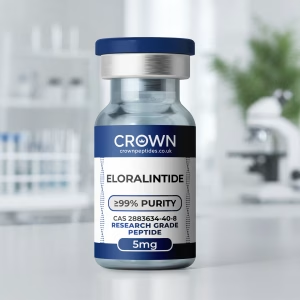
Eloralintide vs Retatrutide: Why the Bigger Number Is Not the Whole Story
Retatrutide reached -24.2% body weight at 48 weeks and eloralintide -20%. We state that plainly, then look at what the bigger number costs in heart rate and what happened when eloralintide was added to an approved dual agonist in a 367…
On this page
- The Number That Settles Nothing
- What Maximum Force Actually Costs
- The Compound That Moves the Pulse the Other Way
- The Tolerability Question Nobody Can Settle Yet
- The Result That Changed the Argument
- Why Twenty-Three Per Cent in a Diabetes Trial Is Bigger Than It Looks
- Two Philosophies: Three Receptors, or One Lever in the Brainstem
- The Technical Breakdown: Selectivity Ratios, Estimands and Why Percentages Are Not Interchangeable
- Identity Comes First: Testing a Lipidated Peptide
- Related Compounds Worth Knowing About
- Common Questions About This Comparison
- The Compound You Add, Not the Compound You Beat
- References
In 1987, biochemists at the University of Oxford went looking inside the pancreases of three people with type 2 diabetes. They were after the building block of islet amyloid, the insoluble deposit that silts up the insulin-making islands of a diabetic pancreas. Out of extracts that were 20 to 50 per cent amyloid they pulled a 37-amino-acid peptide, weighing 3,905 daltons and 46 per cent identical to calcitonin gene-related peptide, absent from all six non-diabetic pancreases they checked. They named it diabetes-associated peptide (PMID: 3317417). It was found as wreckage, the stuff nobody wanted. Almost four decades later, a selective analogue of that same hormone is one of the most closely watched molecules in metabolic research, and our Eloralintide Research Peptide sits in the Metabolic Research Peptides category alongside the rest of its field.
This is the comparison researchers keep searching for, so let us settle the obvious part first. Across two separate 48-week phase 2 trials in adults with obesity and no type 2 diabetes, retatrutide at 12 mg produced a mean weight reduction of 24.2 per cent, and eloralintide at 9 mg produced 20 per cent. The bigger number belongs to the triple agonist. Every compound named here that Crown Peptides supplies, our Eloralintide Research Peptide included, is laboratory research material sold for research use only, and this article is written for people who want the data. So why is the interesting argument still the one about the amylin analogue? Because of what the bigger number costs, and because of what happened in a trial where the amylin analogue was not asked to compete on its own at all.
The Number That Settles Nothing
Retatrutide's phase 2 trial was published in the New England Journal of Medicine. It enrolled 338 adults with a body mass index of 30 or above, or between 27 and 30 with at least one weight-related condition, and ran weekly doses against placebo for 48 weeks. The least-squares mean change in body weight at 48 weeks rose with dose, from minus 8.7 per cent at 1 mg to minus 22.8 per cent in the combined 8 mg groups and minus 24.2 per cent at 12 mg, against minus 2.1 per cent on placebo. At the top dose every participant lost at least 5 per cent of their body weight and 83 per cent lost at least 15 per cent (PMID: 37366315).
Eloralintide's phase 2 trial was published in The Lancet. It enrolled 263 participants across 46 research centres in the United States, on near-identical entry criteria (body mass index 30 or above, or 27 or above with a weight-related condition) and explicitly without type 2 diabetes: 78 per cent female, mean weight 109.1 kg, mean body mass index 39.1. Weekly doses ran for 48 weeks across six active arms, two of them escalation schemes. On the efficacy estimand, the mean change in body weight at 48 weeks ran from minus 9 per cent at 1 mg to minus 18 per cent at 6 mg and minus 20 per cent at 9 mg, with the 6 to 9 mg escalation also reaching minus 20 per cent, against minus 0.4 per cent on placebo (PMID: 41207310). A 2026 narrative review of the amylin class puts the figure at up to 20.1 per cent without saying which analysis produced it (PMID: 42803913).
Two trials, the same 48 weeks, broadly the same kind of participants, four percentage points apart in retatrutide's favour. Notice, though, how different the two placebo arms were: minus 2.1 per cent in one and minus 0.4 per cent in the other. These were never the same experiment, and there has never been a head-to-head trial of the two compounds. What follows is not an attempt to argue the four points away, but an argument that the scale was always the least interesting column in the table.
- Eloralintide
- LY3841136. A long-acting amylin analogue selective for the amylin 1 receptor, given weekly in trials
- Retatrutide
- LY3437943. One peptide acting at three receptors: GIP, GLP-1 and glucagon
- Best published 48-week result
- Eloralintide 9 mg: minus 20 per cent. Retatrutide 12 mg: minus 24.2 per cent. Both without type 2 diabetes
- Heart rate direction
- Reviews of eloralintide's early studies describe pulse-rate reductions; retatrutide's phase 2 reported dose-dependent heart-rate increases peaking at 24 weeks
- Head-to-head data
- None. No trial has compared the two directly
- Research status
- Both investigational. Neither holds a licence as a medicine in the UK, the EU or the United States
- Where the argument turns
- A 48-week phase 2 trial in 367 adults with obesity or overweight and type 2 diabetes: arms adding eloralintide to an approved dual agonist reached minus 23.3 per cent
What Maximum Force Actually Costs
Retatrutide is a single peptide that pulls three levers at once. It activates the glucose-dependent insulinotropic polypeptide receptor, the GLP-1 receptor and the glucagon receptor, and the glucagon arm is the one that makes it unusual: it is thought to raise energy expenditure as well as lowering appetite. Pile three mechanisms into one molecule and you get the biggest number in the published literature. You also get everything that comes with three mechanisms.
The trial authors reported it plainly. The most common adverse events in the retatrutide groups were gastrointestinal, dose-related, mostly mild to moderate, and partly mitigated by starting at 2 mg rather than 4 mg. And then the line worth sitting with: dose-dependent increases in heart rate peaked at 24 weeks and declined thereafter (PMID: 37366315).
A rise in resting heart rate is not a footnote in metabolic research. It is a cardiovascular signal, and in a field whose whole justification is reducing cardiovascular risk, a compound that lowers weight while raising pulse carries a question it has not yet answered.
A 2026 review of where obesity pharmacology is heading sets out the limits that have emerged across GLP-1-based compounds as a group: weight-loss plateaus, wide variation between individuals, and regain after the compound is stopped. The same review notes that the field is shifting from pure appetite suppression towards body composition and metabolic quality as the things worth measuring (PMID: 41948476). That is the context in which the amylin pathway stopped looking like a historical curiosity.
The Compound That Moves the Pulse the Other Way
A 2026 review in Cardiology in Review gathered the early clinical work on eloralintide and asked whether its effects looked relevant to cardiovascular risk. The profile it describes is reductions in body weight, pulse rate, blood pressure, inflammatory markers and lipid parameters, together with preferential loss of fat mass. The authors single out one finding: the reduction in pulse rate, because it runs opposite to the heart-rate increase associated with GLP-1 receptor agonists (PMID: 42745233).
Opposite directions on the same measurement, in two compounds aimed at the same outcome. That is the strongest honest thing anyone can say in favour of the amylin approach today.
The same authors set the ceiling on it themselves. The evidence is preclinical work plus phase 1 and phase 2 studies with small samples and short durations, and no amylin receptor agonist, eloralintide included, has been evaluated in a dedicated cardiovascular outcomes trial, so whether any of it translates into fewer cardiovascular events is unknown (PMID: 42745233). An early signal pointing the right way is worth a great deal in research. It is not proof, and nothing here is a claim that one compound is safer than the other.
The body-composition half of that profile has a preclinical foundation. In diet-induced obese rats, eloralintide reduced food intake and lowered body weight in a dose-dependent way, and the weight came off primarily through fat mass (PMID: 41109426). Whether that holds in people over long periods is one of the questions the field most wants answered.
The Tolerability Question Nobody Can Settle Yet
The case for amylin analogues is often made on tolerability, and the early data support it. A 12-week phase 1 multiple ascending dose study at three United States centres gave 100 participants weekly eloralintide or placebo. Most treatment-emergent events were mild, with no deaths and one serious adverse event judged unrelated to the compound (PMID: 41559929).
Across longer trials, nausea is the adverse event reported most often with this class. A 2026 review in Peptides describes the pattern: gastrointestinal effects, nausea especially, cluster around the start of treatment and the stepping-up of doses, and mostly settle as treatment continues (PMID: 41747885). That shape matters more than any single percentage, because it tells you when the difficulty arrives and that it tends to pass.
The most useful number here is a different one. A network meta-analysis of six trials covering 4,642 participants over 12 to 68 weeks found nausea, vomiting and constipation more common at high doses across the class, and eloralintide was not among the agents in that analysis that increased discontinuation because of adverse events (PMID: 42175595). People stayed on it.
The comparator has the same issue from the other direction: gastrointestinal events were the most common adverse events across retatrutide’s trials too, dose-related and mostly mild to moderate (PMID: 37366315, PMID: 37385280). Different trials, different populations, different ways of counting. Nobody can rank these two compounds on gastrointestinal tolerability from the published record, and a review of the whole class adds a question still open across all of them: whether reduced food intake reflects ordinary satiation or something closer to aversion (PMID: 42586227). The pulse-rate contrast is real. A tolerability league table is not.
The Result That Changed the Argument
Lilly ran a phase 2, parallel-group, double-blind, placebo-controlled study with ten arms, registered as NCT06603571. It enrolled 367 adults who had obesity or overweight and type 2 diabetes, with a body mass index of at least 27 and glycated haemoglobin between 7.0 and 10.5 per cent. The primary endpoint was percentage change in body weight at week 48, and the arms tested eloralintide on its own, an approved dual agonist alone as the active comparator, several combinations of the two, and placebo. The registry records primary completion on 1 July 2026 and study completion on 14 September 2026, and the trial has not yet appeared in a peer-reviewed journal.
The results were presented at the European Association for the Study of Diabetes annual meeting on 30 September 2026 and summarised by the sponsor (Lilly, EASD 2026 congress summary). Read them with the caution conference data deserve, and note the basis the sponsor gives for them, the efficacy estimand, which measures what happened in people who stayed on treatment:
- Tirzepatide 15 mg on its own, at 48 weeks: minus 14.8 per cent body weight.
- Arms containing eloralintide: a range from minus 8.2 per cent to minus 23.3 per cent, with the combination arms reaching the top of that range.
- Eloralintide on its own in this population: up to around 12 per cent.
- Placebo: minus 3.0 per cent.
- Glycated haemoglobin: down 1.06 to 2.91 percentage points across eloralintide-containing arms, against 2.41 points for the dual agonist alone and 0.29 points on placebo.
In a population where the comparator managed 14.8 per cent, arms that added the amylin analogue on top reached 23.3 per cent, and the blood-sugar result went further too. On its own, the amylin analogue was the weakest of the three approaches here, at around 12 per cent. It was not trying to win alone. It was the thing that made the other compound finish somewhere it does not normally finish.
The safety summary belongs with the headline, or the headline is dishonest. Across the 367 treated participants, 77.7 per cent had at least one treatment-emergent adverse event, 6.5 per cent had at least one serious adverse event, 11.4 per cent stopped treatment because of an adverse event, and one death occurred. The most frequent events overall were nausea 25.9 per cent, diarrhoea 24.3 per cent, constipation 21.0 per cent, fatigue 13.6 per cent, decreased appetite 11.7 per cent and vomiting 9.0 per cent. The sponsor reports that nausea, fatigue and vomiting were higher in the highest combination arm than with the dual agonist alone, and that treatment completion ranged from 59.5 to 92.1 per cent across arms. Discontinuation and adverse-event figures were not broken down by arm, so the per-arm picture is not yet public.
This section is not a description of what anyone should do; it is an account of how a registered trial was designed and what its sponsor reported. Combining research compounds is a question for trial protocols and ethics committees, and our article on peptide stacking in research covers how such designs are built.
Why Twenty-Three Per Cent in a Diabetes Trial Is Bigger Than It Looks
To an outside reader, 23.3 per cent and 24.2 per cent look like a dead heat. That would be a sloppy conclusion. The reason the combination figure is striking has nothing to do with closing a four-point gap: it is that weight loss in people with type 2 diabetes is routinely and substantially smaller than in people without it, with the same compound at the same dose.
The cleanest demonstration comes from one drug studied twice. In a 72-week phase 3 trial of 2,539 adults with obesity and without diabetes, tirzepatide 15 mg produced a mean reduction of 20.9 per cent (PMID: 35658024). In a 72-week phase 3 trial of 938 adults with obesity and type 2 diabetes, the same drug at the same dose produced 14.7 per cent (PMID: 37385275). Same compound, same dose, same duration, both read on the treatment-regimen estimand; six percentage points of difference. Diabetes status is the headline difference between the two populations, not the only one: the trials ran in different countries, set different entry thresholds, and differed in baseline weight, baseline body mass index and participant mix.
Retatrutide shows the same pattern in its own programme. In a phase 2 trial across 42 United States centres, 281 adults with type 2 diabetes received weekly retatrutide, placebo or dulaglutide 1.5 mg as an active comparator. At 36 weeks, body weight fell by 16.94 per cent in the 12 mg escalation group, against 3.00 per cent on placebo and 2.02 per cent on dulaglutide, with glycated haemoglobin down 2.02 percentage points at 24 weeks (PMID: 37385280). Seventeen per cent in a diabetic population, from the compound that reached 24.2 per cent in a non-diabetic one.
So the fair comparison is not 23.3 against 24.2. It is 23.3 in a diabetic population against the high teens, roughly where the ceiling has sat for the strongest single compounds in that kind of group. One caveat has to travel with that, and it is the one this article warns about further down: 23.3 is an efficacy-estimand figure, while 14.7 comes from the treatment-regimen estimand, which almost always reads lower, and 16.94 is a least-squares mean. The trials also differ in length and design, and one is a conference presentation, so this is an observation about where the numbers sit rather than a measured difference, and the gap it suggests is if anything flattered. It is still the most interesting number in the amylin literature.
Two Philosophies: Three Receptors, or One Lever in the Brainstem
Strip away the percentages and these are two different bets about how to change how much an animal eats.
The triple agonist bet is additive force. Three receptors, three mechanisms, one molecule, with the GIP, GLP-1 and glucagon arms all pointing at the same outcome from different angles (PMID: 37366315). It is the pharmacological equivalent of pressing harder.
The amylin bet is a different lever altogether. Amylin comes from the same pancreatic beta cells as insulin; a Swedish group at University Hospital Uppsala showed in the same year as the Oxford work that it is a normal component of those cells across several species, structurally related to calcitonin gene-related peptide and almost certainly hormonal (PMID: 3328723). It slows gastric emptying, suppresses glucagon release and promotes satiation through the central nervous system, by mechanisms a 2026 review describes as distinct from the incretin pathway (PMID: 42586227).
The receptor itself is unusual, and it is why selectivity is the whole story in this family. There is no dedicated amylin receptor gene: a calcitonin core receptor pairs with a receptor activity-modifying protein, RAMP1 or RAMP3, to build the amylin receptor subtypes, and one of amylin's primary binding sites is the area postrema in the caudal hindbrain. In a mouse proof-of-concept study, deleting the calcitonin core receptor locally in the hindbrain abolished the marker of neuronal activation amylin normally produces there and blunted its effect on food intake (PMID: 32497530). Pull that lever and you are signalling into a brainstem circuit that evolved to end meals.
That circuit comes with a built-in brake, one of the more elegant findings in the field. In male rats under hyperinsulinaemic glucose clamps, amylin's ability to reduce food intake was blunted when blood glucose was held low, extending to eating the fail-safe already described for its effects on gastric emptying and glucagon (PMID: 33933418). A satiety signal that stands down when fuel is short is a different kind of design from one that simply presses harder.
Eloralintide was engineered to pull that lever as cleanly as possible. In cell lines expressing human receptors, it preferentially activated the amylin 1 receptor, 12-fold over the calcitonin receptor and 11-fold over the amylin 3 receptor, although in rats it activated both amylin receptor subtypes more potently than the calcitonin receptor (PMID: 41109426). Two 2026 reviews now call compounds of this kind the next major class in weight-loss research and the field's organised attempt at better-tolerated alternatives to the incretins (PMID: 42452898, PMID: 42586227). The first to reach the clinic, pramlintide, was built on non-aggregating rat amylin and proved the principle decades ago, but its modest effect and frequent administration kept it a niche adjunct (PMID: 41747885). The mechanism detail sits in our Eloralintide guide; for how the incretin side of the field grew up, start with Is Ozempic a peptide? and our overview of peptide hormones.
The Technical Breakdown: Selectivity Ratios, Estimands and Why Percentages Are Not Interchangeable
For readers who want the mechanics, here they are. Nothing above depends on this section.
What a selectivity ratio does and does not say
The 12-fold and 11-fold figures are potency ratios measured in engineered cell lines expressing one human receptor at a time (PMID: 41109426). They say how much more readily the molecule activates one receptor than another in that system. They do not say what share of a weekly dose reaches each receptor in a living animal, and the same paper shows why that matters: the rat pattern differed from the human one. Species differences in this receptor family are a live methodological problem, not a footnote.
Why the headline percentages cannot be lined up
Trials report weight change under different statistical rules about what to do with people who stop early or start other treatments. The retatrutide phase 2 reported least-squares means from its analysis model (PMID: 37366315); the eloralintide phase 2 reported the efficacy estimand, which asks what the compound did in people who stayed on it (PMID: 41207310); the two phase 3 trials quoted earlier used the treatment-regimen estimand, which asks what happened regardless of whether people stayed on treatment, and almost always reads lower (PMID: 35658024, PMID: 37385275). Comparing a figure produced under one rule with one produced under another is the commonest error in this subject, which is why each comparison above names its rule.
Structure, duration and what was not measured
Left alone, native amylin aggregates, which is exactly what the Oxford team found it doing in diabetic islets (PMID: 3317417), so every usable analogue has had to solve that problem by redesign. Eloralintide's pharmacokinetics were dose-proportional at week 12, with ratios of dose-normalised geometric means of 1.1 for exposure and 1.0 for peak concentration, which is what supports a weekly schedule (PMID: 41559929); our explainer on peptide half-life covers why that matters. On body composition, the rat work attributed weight loss primarily to fat mass (PMID: 41109426) and the cardiometabolic review describes preferential fat mass loss in the early clinical data (PMID: 42745233), but the combination trial summary did not report fat or lean mass at all, which is a real gap given how central body composition has become.
Identity Comes First: Testing a Lipidated Peptide
A long-acting amylin analogue carries chemistry designed to stop it aggregating and to keep it in circulation for a week, and that extra structure is what makes identity testing non-negotiable: a molecule can have the right amino acid sequence and still be the wrong compound. Mass spectrometry answers that by weighing the molecule; high-performance liquid chromatography shows how much of a batch is the target compound.
Every product we sell, our Eloralintide Research Peptide included, has its batch certificate published on our Lab Reports page, covering HPLC purity and mass spectrometry identity and matched to the batch number on the vial. For background, read how to read a peptide certificate of analysis and our guide to HPLC and mass spectrometry. Vials arrive as a dry powder and are kept cold, as set out in our storage information, with our Bacteriostatic Water and peptide reconstitution notes alongside. Crown Peptides has no connection with the companies developing these compounds as medicines, and the material we supply is not anyone's clinical trial product. To check something before ordering, our contact page is the fastest route.
Related Compounds Worth Knowing About
The amylin pathway is one lever among several; the compounds below pull entirely different ones.
Different levers on fat and energy use
5-Amino-1MQ blocks nicotinamide N-methyltransferase, an enzyme inside the fat cell rather than a receptor on its surface. In cultured adipocytes, membrane-permeable inhibitors of that enzyme suppressed fat-making, and a potent inhibitor reduced measures of obesity in diet-induced obese mice (PMID: 29155147). Our article on the enzyme that tells fat cells to store has the detail, and AOD-9604 vs 5-Amino-1MQ sets it against the other best-known metabolic research compound.
AOD-9604 is a fragment of the C-terminus of human growth hormone. In obese mice given it for 14 days, body weight and body fat fell and the suppressed expression of the beta-3 adrenergic receptor, the main fat-releasing receptor on fat cells, was restored towards lean levels, though knock-out work showed the lipolytic action was not mediated directly through it (PMID: 11713213). Our AOD-9604 article has the rest.
Mitochondria and the exercise-mimetic question
MOTS-c is a 16-amino-acid peptide encoded inside mitochondrial DNA. Its main target organ appears to be skeletal muscle, where it inhibits the folate pathway and activates AMPK; in mice it prevented both age-related and high-fat-diet-induced insulin resistance and diet-induced obesity (PMID: 25738459). Our MOTS-c guide and mitochondrial peptides explained cover the wider family, and the co-factor at the centre of that chemistry is our NAD+ Research Compound.
SLU-PP-332 activates the oestrogen-related receptors; in obese mice it increased energy expenditure and fatty acid oxidation and reduced fat mass accumulation (PMID: 37739806), as our SLU-PP-332 guide explains. AICAR activates AMPK directly (AICAR guide), and L-Carnitine governs which fuel mitochondria can burn (our L-Carnitine article).
Where these sit in the shop
Our Eloralintide Research Peptide sits in both the Metabolic Research Peptides and Endocrine & Hormonal Research Peptides categories. Tesamorelin comes at body composition from the growth hormone axis instead, and the Metabolic Research Bundle groups three of the compounds above (one metabolic pathway, three peptides). For the whole landscape, best peptides for weight loss research is the umbrella piece, and Crown Peptides keeps separate guides on the triple agonist, on the dual agonist and on how those two compare with each other.
Common Questions About This Comparison
Which one produced more weight loss in published trials?
Retatrutide. At 48 weeks, 12 mg produced a mean reduction of 24.2 per cent in adults with obesity and without type 2 diabetes, against 20 per cent for eloralintide 9 mg over the same period in a comparable population. There is no honest way to present it otherwise.
Have the two ever been compared in the same trial?
No. There is no head-to-head trial and no registered study comparing them directly. Every number set beside another on this page comes from a separate trial with its own participants, duration and statistical rules.
What did the combination trial actually report?
A 48-week phase 2 study in 367 adults with obesity or overweight and type 2 diabetes, presented at a diabetes congress on 30 September 2026 and not yet peer-reviewed. On the sponsor's efficacy-estimand figures, the approved dual agonist alone reached minus 14.8 per cent; arms containing eloralintide spanned minus 8.2 to minus 23.3 per cent, with the combinations at the top; eloralintide alone reached around 12 per cent; placebo was minus 3.0 per cent.
Why does heart rate matter so much in this comparison?
Because the two appear to move it in opposite directions. Retatrutide's phase 2 reported dose-dependent increases in heart rate peaking at 24 weeks, while reviews of eloralintide's early studies describe reductions in pulse rate. In a field whose purpose is lowering cardiovascular risk, that may matter more than four points of weight.
Is either of them licensed as a medicine?
Neither holds a marketing authorisation anywhere. Both are investigational compounds in sponsor-run clinical programmes, and the dual agonist used as the comparator in the combination trial is the only licensed medicine mentioned in that study.
What is still unknown?
Most of what matters. No cardiovascular outcomes trial has been run on any amylin receptor agonist. The combination result has not been peer-reviewed or reproduced, per-arm discontinuation rates are not public, and fat and lean mass were not reported. Nor has anyone run the trial that would settle this comparison.
The Compound You Add, Not the Compound You Beat
Retatrutide holds the bigger number, and it earned it. But the question the field is asking has moved on from how far one molecule can push a scale. It is now about what else changes on the way down: resting pulse, blood pressure, inflammatory markers, lipids, and how much of the lost weight was fat rather than muscle. On those measures the amylin pathway points the right way in early data, and in a 48-week trial in people with type 2 diabetes it took the combination arms up to 23.3 per cent, the top of the reported range, against 14.8 per cent for the comparator alone.
That is a different kind of success from winning a head-to-head. Eloralintide was never trying to out-push a triple agonist; it pulls a lever that evolved to end meals, and it appears to work best when something else is pulling a different one. The next few years will show whether the pulse-rate signal holds, whether the body-composition advantage is real in people, and whether the combination result survives a larger trial. If your own work is heading into the amylin pathway, start with our Eloralintide Research Peptide and the full research guide that goes with it.
References
- Cooper GJ, Willis AC, Clark A, et al. Purification and characterization of a peptide from amyloid-rich pancreases of type 2 diabetic patients. Proc Natl Acad Sci U S A. 1987;84:8628-32. PMID: 3317417
- Westermark P, Wilander E, Westermark GT, et al. Islet amyloid polypeptide-like immunoreactivity in the islet B cells of type 2 (non-insulin-dependent) diabetic and non-diabetic individuals. Diabetologia. 1987;30:887-92. PMID: 3328723
- Jastreboff AM, Kaplan LM, Frías JP, et al. Triple-Hormone-Receptor Agonist Retatrutide for Obesity - A Phase 2 Trial. N Engl J Med. 2023;389:514-526. PMID: 37366315
- Rosenstock J, Frias J, Jastreboff AM, et al. Retatrutide, a GIP, GLP-1 and glucagon receptor agonist, for people with type 2 diabetes: a randomised, double-blind, placebo and active-controlled, parallel-group, phase 2 trial conducted in the USA. Lancet. 2023;402:529-544. PMID: 37385280
- Jastreboff AM, Aronne LJ, Ahmad NN, et al. Tirzepatide Once Weekly for the Treatment of Obesity. N Engl J Med. 2022;387:205-216. PMID: 35658024
- Garvey WT, Frias JP, Jastreboff AM, et al. Tirzepatide once weekly for the treatment of obesity in people with type 2 diabetes (SURMOUNT-2): a double-blind, randomised, multicentre, placebo-controlled, phase 3 trial. Lancet. 2023;402:613-626. PMID: 37385275
- Billings LK, Hsia S, Bays H, et al. Eloralintide, a selective amylin receptor agonist for the treatment of obesity: a 48-week phase 2, multicentre, double-blind, randomised, placebo-controlled trial. Lancet. 2025;406:2631-2643. PMID: 41207310
- Bhattachar S, Tham LS, Tidemann-Miller B, et al. Eloralintide, a selective, long-acting amylin receptor agonist for treatment of obesity: Phase 1 proof of concept. Diabetes Obes Metab. 2026;28:2651-2660. PMID: 41559929
- Briere DA, Qu H, Lansu K, et al. Eloralintide (LY3841136), a novel amylin receptor agonist for the treatment of obesity: From discovery to clinical proof of concept. Mol Metab. 2025;102:102271. PMID: 41109426
- Sigalov A, Frishman WH. Cardiometabolic Risk Reduction Through Selective Amylin Receptor Agonism: Emerging Cardiovascular Implications of Eloralintide. Cardiol Rev. 2026. PMID: 42745233
- Fischer SL, Borner T. Beyond GLP-1: Amylin-based pharmacotherapy and the search for better-tolerated weight-loss drugs. Pharmacol Res. 2026;232:108382. PMID: 42586227
- Alhazmi A, le Roux CW. Amylin Analogs: The Next Major Class of Weight Loss Therapy: A Review of Experimental Data and Early-Phase Clinical Trials. Diabetes Obes Metab. 2026;28 Suppl 5:42-50. PMID: 42452898
- Panou T, Gouveri E, Popovic DS, et al. New Amylin-Based Agonists for the Treatment of Obesity and Type 2 Diabetes Mellitus. Diabetes Ther. 2026;17:1613-1638. PMID: 42803913
- Kamrul-Hasan ABM, Khalil I, Mahajan K, et al. Novel Amylin-Based Therapies for Weight Management in Adults With Overweight or Obesity Without Diabetes: A Network Meta-Analysis. Endocrinol Diabetes Metab. 2026;9:e70247. PMID: 42175595
- Bailey CJ, Flatt PR, Conlon JM. Long-acting amylin-related peptides as therapies for obesity and type 2 diabetes. Peptides. 2026;196:171480. PMID: 41747885
- Lempesis IG, Dalamaga M. Obesity pharmacotherapy reimagined: The era of multi-receptor agonists and next-generation metabolic modulators, perspectives and controversies. Metabol Open. 2026;30:100463. PMID: 41948476
- Coester B, Foll CL, Lutz TA. Viral depletion of calcitonin receptors in the area postrema: A proof-of-concept study. Physiol Behav. 2020;223:112992. PMID: 32497530
- Honegger M, Lutz TA, Boyle CN. Hypoglycemia attenuates acute amylin-induced reduction of food intake in male rats. Physiol Behav. 2021;237:113435. PMID: 33933418
- Lee C, Zeng J, Drew BG, et al. The mitochondrial-derived peptide MOTS-c promotes metabolic homeostasis and reduces obesity and insulin resistance. Cell Metab. 2015;21:443-54. PMID: 25738459
- Neelakantan H, Vance V, Wetzel MD, et al. Selective and membrane-permeable small molecule inhibitors of nicotinamide N-methyltransferase reverse high fat diet-induced obesity in mice. Biochem Pharmacol. 2018;147:141-152. PMID: 29155147
- Heffernan M, Summers RJ, Thorburn A, et al. The effects of human GH and its lipolytic fragment (AOD9604) on lipid metabolism following chronic treatment in obese mice and beta(3)-AR knock-out mice. Endocrinology. 2001;142:5182-9. PMID: 11713213
- Billon C, Schoepke E, Avdagic A, et al. A Synthetic ERR Agonist Alleviates Metabolic Syndrome. J Pharmacol Exp Ther. 2024;388:232-240. PMID: 37739806