

Research guide
KLOW Peptide Blend UK: What Is Actually in the 80mg Vial, and What the Research Shows
KLOW is GHK-Cu 50mg, BPC-157 10mg, TB-500 10mg and KPV 10mg in one vial. What each component brings, why KPV is the one that changes the profile, and how it differs from GLOW.
Four peptides, one vial, and a name that sounds more like a nightclub than a laboratory compound. KLOW has become one of the most searched research blends in the UK, and it is easy to see why: it brings together four of the most studied repair and signalling peptides in the entire field. But popularity breeds confusion, and a surprising number of descriptions online get the basics wrong, from what is actually in the vial to what each ingredient has been shown to do.
This guide sets the record straight. It explains exactly what the 80mg KLOW blend contains, tells the research story behind each of its four peptides with the key studies named, explains the logic of combining them, walks through the arithmetic of working with a four-component blend, and covers why quality control is harder for blends than for single compounds. Crown Peptides supplies KLOW for laboratory research use only.
What Is in a Vial of KLOW?
KLOW is an 80mg lyophilised blend of four peptides in fixed amounts:
- GHK-Cu, 50mg: a copper-binding tripeptide found naturally in human blood plasma.
- BPC-157, 10mg: a 15-amino-acid peptide derived from a protein in human gastric juice.
- TB-500, 10mg: a research peptide based on thymosin beta-4, the body’s main actin-regulating protein.
- KPV, 10mg: a three-amino-acid fragment from the end of alpha-melanocyte-stimulating hormone.
You will also see it described as the KLOW stack or KLOW peptide. All three names refer to this same four-peptide, 80mg formulation.
Where does the name come from?
KLOW builds on an earlier three-peptide blend called GLOW, which contains GHK-Cu, BPC-157 and TB-500. The K in KLOW stands for KPV, the fourth ingredient. Our comparison KLOW vs GLOW covers the difference between the two blends in detail. This guide focuses on KLOW itself.
Why 50mg of one and 10mg of the others?
GHK-Cu is by far the largest component by weight. That reflects how each peptide is typically studied: GHK-Cu is a very small molecule commonly researched at higher amounts, while the other three are usually studied in smaller quantities. The technical section below shows that the weight ratios hide a very different picture when you count molecules instead of milligrams.
GHK-Cu: The Copper Peptide That Rebuilds Matrix
GHK-Cu is the backbone of KLOW, and its story begins in 1973 with the American researcher Loren Pickart. Studying why liver tissue from older people behaved differently from young tissue, he found a factor in young people’s blood plasma that made older liver cells behave more youthfully. It turned out to be a tiny peptide, glycine-histidine-lysine, with a strong natural affinity for copper.
The first collagen finding
The same French group had already reported the effect in cells. In a 1988 study in FEBS Letters, Maquart and colleagues found that GHK-Cu stimulated collagen synthesis in cultured fibroblasts, the cells that build connective tissue (PMID: 3169264). The obvious next question was whether the same thing happened in living tissue.
The wound chamber study
Some of the most concrete evidence for GHK-Cu’s repair activity came from a French team in 1993. In a study published in the Journal of Clinical Investigation, Maquart and colleagues implanted small stainless steel mesh cylinders under the skin of rats, creating standardised “wound chambers” into which they could inject test compounds and later measure exactly what tissue had formed (PMID: 8227353, PMC288419).
Chambers injected with GHK-Cu showed a concentration-dependent increase in dry weight, DNA, total protein, collagen and glycosaminoglycans, the building materials of connective tissue. Collagen synthesis rose about twice as much as other proteins, and messenger RNA for type I and type III collagen, the main structural collagens of skin and wounds, increased. Tellingly, a control tripeptide with a different sequence had no significant effect. The authors concluded that GHK-Cu can increase extracellular matrix accumulation in wounds in a living animal.
The gene expression picture
More recent work has looked at GHK’s effects on gene activity. A 2018 review in the International Journal of Molecular Sciences by Pickart and Margolina summarised research indicating that GHK may stimulate blood vessel and nerve outgrowth, increase collagen, elastin and glycosaminoglycan synthesis, and support fibroblast function, with tissue repair effects reported in skin, lung connective tissue, bone, liver and stomach lining models (PMID: 29986520, PMC6073405). The review also highlighted gene data suggesting GHK influences a very large number of genes, which may explain its unusually broad research profile. Our GHK-Cu research guide goes deeper.
- Classification
- 80 mg multi-peptide research blend containing GHK-Cu 50 mg, BPC-157 10 mg, TB-500 10 mg and KPV 10 mg
BPC-157: The Gastric Peptide That Grows Blood Vessels
BPC-157, short for Body Protection Compound 157, is a 15-amino-acid sequence derived from a protein found in human gastric juice. It has been studied for decades, principally by Predrag Sikirić and colleagues at the University of Zagreb, and it is unusually stable, even in the acidic environment of the stomach.
New blood vessels, and how
One of the most important questions about any repair compound is whether it helps damaged tissue grow a new blood supply, because without one, rebuilding stalls. A 2017 study from Chang Gung University in Taiwan, published in the Journal of Molecular Medicine, looked at exactly this (PMID: 27847966).
Hsieh and colleagues found that BPC-157 increased blood vessel density in the chick chorioallantoic membrane assay, a standard living model of vessel growth, and increased tube formation by human endothelial cells in the laboratory. In rats with reduced blood flow to a hind limb, BPC-157 accelerated the recovery of blood flow and increased the number of vessels in the muscle. The team traced the effect to VEGFR2, the main receptor for vascular endothelial growth factor: BPC-157 increased VEGFR2 expression, promoted its movement into the cell and activated the VEGFR2-Akt-eNOS signalling pathway. Blocking that movement blocked the effect.
Helping tendon cells move
BPC-157 has also been studied for its effects on the cells that repair tendons, one of the slowest-healing tissues in the body. In a 2011 study in the Journal of Applied Physiology, Chang and colleagues, also at Chang Gung University, found that BPC-157 accelerated the outgrowth of fibroblasts from rat Achilles tendon tissue, increased their survival under oxidative stress and increased their migration in a dose-dependent way, through activation of the FAK-paxillin pathway that cells use to grip and pull themselves forward (PMID: 21030672). Research has indicated, in other words, that BPC-157 may support repair both by building a blood supply and by helping repair cells reach the site.
The broader healing literature
A 2021 review in Frontiers in Pharmacology by Seiwerth, Sikirić and colleagues described BPC-157 research across skin wounds, burns and many other tissues in animal models, including the gastrointestinal tract, tendon, ligament, muscle, bone, nerve, cornea and blood vessels (PMID: 34267654, PMC8275860). Our BPC-157 research guide covers that literature in full.
TB-500: The Actin Regulator That Moves Cells
TB-500 is based on thymosin beta-4, a small protein first characterised in the thymus gland by Allan Goldstein’s research group and later found in almost every cell of the body. Its day job is regulating actin, the protein that forms the internal scaffolding cells use to change shape and move. By holding actin building blocks in reserve and releasing them where needed, thymosin beta-4 helps control when and how cells migrate.
The NIH wound healing study
The landmark wound study came in 1999 from a team at the US National Institutes of Health, working with Goldstein, and was published in the Journal of Investigative Dermatology (PMID: 10469335). Malinda, Kleinman and colleagues tested thymosin beta-4 in a rat full-thickness wound model.
Whether applied to the wound or given systemically, thymosin beta-4 increased re-epithelialisation, the regrowth of the skin’s surface layer, by 42% over controls at four days and by as much as 61% at seven days. Treated wounds also contracted at least 11% more by day seven, and showed increased collagen deposition and new blood vessel growth. In the laboratory, thymosin beta-4 stimulated the migration of keratinocytes, the main cells of the skin’s surface, two- to three-fold, even at vanishingly small amounts. The authors described it as a potent wound healing factor with multiple activities.
Beyond the skin: the heart
Thymosin beta-4’s research reaches well beyond wounds. In a widely cited 2004 study in Nature, Bock-Marquette, Srivastava and colleagues at the University of Texas Southwestern showed that it promoted the migration and survival of heart muscle cells, working through a complex with the proteins PINCH and integrin-linked kinase that activates the survival signal Akt (PMID: 15565145). In mice after an induced heart attack, thymosin beta-4 improved early heart muscle cell survival and heart function.
Mapping the active regions
A 2010 review in the FASEB Journal by Sosne, Goldstein and colleagues showed that thymosin beta-4’s different activities map onto specific short regions of the protein, with its central actin-binding region linked to angiogenesis, wound healing and cell migration, and a separate region containing the sequence Ac-SDKP linked to cell survival (PMID: 20179146). Our TB-500 guide tells the full story.
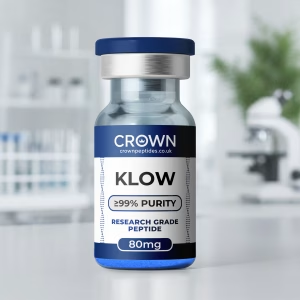
KLOW Research Peptide
HPLC and MS verified · batch certificate published · dispatched from the UK before 2pm
KPV: The Anti-Inflammatory Tail of a Hormone
KPV is the ingredient that makes KLOW different from GLOW. It is a tripeptide, lysine-proline-valine, that forms the last three amino acids of alpha-melanocyte-stimulating hormone (alpha-MSH), the hormone best known for stimulating skin pigmentation. Researchers found that alpha-MSH also has anti-inflammatory activity, and that much of it seemed to be concentrated in those final three amino acids, without the pigmentation effect.
How KPV gets into cells
A landmark 2008 study in Gastroenterology by Dalmasso, Merlin and colleagues showed that nanomolar concentrations of KPV inhibited NF-kappaB and MAP kinase inflammatory signalling in human intestinal and immune cells and reduced pro-inflammatory cytokine secretion (PMID: 18061177, PMC2431115). Crucially, they showed KPV enters cells through PepT1, a transporter for small peptides that becomes more active in the colon during inflammation, and that KPV in drinking water reduced inflammation in two mouse models of colitis.
Targeted delivery
The same research group later took KPV a step further. In a 2017 study in Molecular Therapy, Xiao, Merlin and colleagues loaded KPV into nanoparticles coated with hyaluronic acid, a molecule that targets the colon’s lining cells and immune cells (PMID: 28143741, PMC5498804). The nanoparticles delivered KPV into those target cells, and in a mouse model of colitis they both accelerated healing of the gut lining and reduced inflammation, including lowering the inflammatory signal TNF-alpha. It is a good example of how KPV’s research has moved from basic mechanism to sophisticated delivery science. Our KPV guide covers this work in depth.
Why Put These Four Together?
Looking at the four stories side by side, the logic of the blend becomes clear. Tissue repair happens in overlapping stages, and each KLOW ingredient has research concentrated in a different part of that sequence.
Inflammation first
After any injury, the immune system arrives first, clearing debris and releasing inflammatory signals. That phase is essential, but when it is excessive or slow to resolve, it can hold back the rebuilding that should follow. KPV’s research centres here, on dampening NF-kappaB-driven inflammatory signalling.
Then a blood supply
New tissue needs new blood vessels. BPC-157’s VEGFR2 research and thymosin beta-4’s angiogenesis data both sit at this stage, as does GHK’s association with blood vessel outgrowth.
Then cells moving in
Rebuilding requires cells to migrate into the damaged area. Thymosin beta-4’s actin regulation and BPC-157’s effects on tendon cell migration, described in other research, are both centred on this process.
Then matrix and remodelling
Finally, the new tissue must be built and strengthened. GHK-Cu’s wound chamber data, showing increased collagen and glycosaminoglycans, and its gene expression profile place it squarely at this stage.
KLOW, in other words, is designed to span the whole repair sequence, from calming inflammation through vessel growth and cell migration to matrix building. That makes it a practical tool for research on how those stages interact.
A Short History of Combining Peptides
Blending peptides is not a new idea, and it did not start with KLOW. Nature does it constantly. Most hormone signals arrive alongside others: growth hormone release, for instance, is shaped simultaneously by GHRH, ghrelin and somatostatin. In medicine, combination approaches are routine, from multi-drug regimens to combination hormone therapies.
In peptide research, the most influential example of combining compounds with different mechanisms is probably the pairing of GHRH analogues with ghrelin receptor agonists, where two different receptors on the same pituitary cell produce a larger growth hormone response together than either alone. The same thinking, that complementary mechanisms can cover more of a biological process than any single compound, underlies repair blends such as the Wolverine Stack, GLOW and KLOW.
What distinguishes KLOW is its breadth. Rather than doubling up on one mechanism, it deliberately spans several stages of a single process. That is both its appeal and the reason careful research design matters so much when working with it.
The Technical Breakdown: Counting Molecules, Not Milligrams
This section is for readers who want the chemistry and arithmetic behind the blend.
The molar picture
Milligrams measure weight, but biology responds to numbers of molecules. Because the four peptides differ enormously in size, converting the label amounts into moles gives a very different picture:
- GHK-Cu, roughly 400 g/mol: 50mg is about 125 micromoles.
- KPV, roughly 342 g/mol: 10mg is about 29 micromoles.
- BPC-157, roughly 1,419 g/mol: 10mg is about 7 micromoles.
- TB-500, based on thymosin beta-4 at roughly 4,960 g/mol: 10mg is about 2 micromoles.
So in molecule count, GHK-Cu dominates even more than its weight suggests, and KPV, just an eighth of the blend by weight, contributes around four times as many molecules as BPC-157 and more than ten times as many as TB-500. This reflects the very different concentrations at which each peptide is studied, and it matters for anyone designing an experiment or interpreting results.
Working out concentrations
When a blend is reconstituted, each component’s concentration must be calculated separately from its own labelled amount. For example, if a KLOW vial is reconstituted in 4ml of diluent:
- GHK-Cu: 50mg divided by 4ml gives 12.5mg per ml.
- BPC-157, TB-500 and KPV: 10mg divided by 4ml gives 2.5mg per ml each.
Our peptide calculator and guide to mg vs mcg make this arithmetic straightforward.
The copper chemistry
GHK binds copper(II) ions with high affinity, coordinating the metal through the histidine side chain, the free amino group of glycine and the peptide backbone. Copper(II) complexes absorb light in the orange-red part of the spectrum, which is why reconstituted KLOW, like GHK-Cu on its own, takes on a blue tint. That colour is a normal, expected sign that the copper complex is present.
Could the peptides interact with each other?
Mixing peptides in one vial raises a fair question about whether they affect one another. In the dry, lyophilised state, molecular movement is minimal, which is one reason blends are supplied freeze-dried. Once in solution, the main consideration is that copper is a reactive metal, so reconstituted blends are best refrigerated and used within a reasonable timeframe, as with any peptide solution.
Why the transport route matters for KPV
KPV’s entry into cells via the PepT1 transporter is unusual among the four. The other peptides act largely through receptors and signalling on or near the cell surface. KPV’s direct route into the cell is part of why such small amounts registered in cell-based studies.
Designing Research With a Four-Peptide Blend
A blend brings convenience, but it also brings a design challenge: with four active ingredients, how do you tell which one did what? A few principles help.
Build a ladder of comparisons
Because Crown Peptides supplies every KLOW component individually, as well as the Wolverine Stack and GLOW, it is possible to build a ladder of comparisons: BPC-157 and TB-500 alone, then the Wolverine Stack, then GLOW with GHK-Cu added, then KLOW with KPV added. Each step adds a single ingredient, so any change in outcome can be traced to it.
Match the measurements to the stages
Because each ingredient has research concentrated at a different stage of repair, it pays to measure across those stages: inflammatory markers early, blood vessel density and cell migration in the middle, and collagen and matrix measures later. A design that measures only one endpoint may miss the contribution of some components entirely.
Keep the batch constant
Using a single batch across a study, recording lot numbers and storing vials identically removes one of the most common hidden sources of variation in blend research. With four components, small differences between batches can compound.
Why Blends Are Harder to Make and Test
A single high-purity peptide is a precise piece of manufacturing. A four-peptide blend at specified ratios is considerably harder, for three reasons.
First, each of the four peptides must be made and purified to a high standard before they are combined. BPC-157 has 15 coupling steps in its synthesis, and thymosin beta-4-based material is much longer still, so deletion impurities are a real consideration. An impurity in any component becomes an impurity in the blend.
Second, the proportions must be accurate. A blend described as containing 10mg of KPV that actually contains 7mg, or 13mg, changes the experiment.
Third, the analysis itself is harder. A four-component blend produces four main peaks on an HPLC trace, each of which needs to be identified, and GHK-Cu brings the extra dimension of its copper ion. A single overall purity number is not enough; each component needs to be confirmed.
The Crown Peptides standard
Every batch of KLOW supplied by Crown Peptides comes with a batch-specific certificate of analysis. HPLC separates and measures the components, and mass spectrometry confirms each peptide’s identity by its molecular mass. Lot numbers on certificates match those on vial labels. Published certificates are on our Lab Reports page, and our guides to peptide testing and reading a certificate of analysis explain how to read a multi-component result.
Handling
KLOW is supplied as a lyophilised powder and should be stored cold, dry and away from light. Reconstitute slowly down the side of the vial and swirl gently rather than shaking. Our guides to peptide reconstitution and how long peptides last cover the practical side, and Bacteriostatic Water is available alongside.
Related Compounds and Neighbouring Blends
KLOW sits at the centre of a family of repair and signalling compounds.
The single ingredients
Each component is available on its own for researchers who want to isolate its contribution: GHK-Cu, BPC-157, TB-500 and KPV.
GLOW and the Wolverine Stack
GLOW is KLOW without KPV, and the Wolverine Stack (BPC-157 + TB-500 Blend) is the two-peptide repair core. Our GLOW guide and Wolverine Stack guide cover each.
Copper and immune relatives
AHK-Cu is a close copper peptide relative of GHK-Cu, and LL-37 is an antimicrobial peptide studied on the immune system’s defensive side, a natural counterpart to KPV’s calming role; see LL-37 vs KPV.
Research bundles
The Dermal & Cellular Research Bundle and Gastrointestinal Research Bundle bring together related compounds in separate vials. Browse the wider tissue biology research peptides category for more.
Read the certificate before you order
Every batch is published openly — identity by mass spectrometry, purity by HPLC, and the batch number printed on the vial you receive.
Open the COA libraryKLOW Questions, Answered
What is in the KLOW blend?
GHK-Cu 50mg, BPC-157 10mg, TB-500 10mg and KPV 10mg, for a total of 80mg per vial.
What is the difference between KLOW and GLOW?
KLOW contains everything in GLOW plus 10mg of KPV, a peptide studied for its anti-inflammatory signalling effects.
Why is reconstituted KLOW blue?
Because of the copper in GHK-Cu. The blue colour is expected and characteristic of copper peptide complexes.
What has research shown for each ingredient?
In animal and cell research, GHK-Cu increased collagen and matrix accumulation in rat wounds, BPC-157 promoted blood vessel growth through VEGFR2, thymosin beta-4 accelerated skin wound closure and cell migration, and KPV reduced inflammatory signalling and colitis in mouse models. Each finding is cited above.
Can I study the four ingredients separately?
Yes. GHK-Cu, BPC-157, TB-500 and KPV are each available individually, which makes it possible to compare the full blend against its parts and pin down each ingredient’s contribution.
Is KLOW legal in the UK?
None of KLOW’s four components is a controlled drug in the UK, and the blend is available as a research material. See are peptides legal in the UK for the full picture.
Four Stories, One Sequence
Behind the catchy name, KLOW is a thoughtful piece of design. A copper peptide found in young blood plasma that builds connective tissue. A stable gastric peptide that switches on the main receptor for new blood vessel growth. A protein fragment from the thymus that sets cells moving and closes wounds faster. And the anti-inflammatory tail of a pigmentation hormone that slips into cells and calms their inflammatory switches. Put together, they span the whole arc of tissue repair, from the first inflammatory response to the final remodelling of new tissue.
That makes KLOW one of the most versatile tools available for research on how the stages of repair fit together. Explore KLOW from Crown Peptides, every batch HPLC and mass spectrometry verified with each component confirmed, dispatched from the UK.
Working with KLOW Research Peptide
Batch-tested material, published certificates, and same-day dispatch on orders placed before 2pm.
See KLOW Research Peptide