

Research guide
KPV Peptide UK: Research, Mechanism and Study Data
Three amino acids is all KPV is, and it is the business end of alpha-MSH. Lys-Pro-Val, the inflammatory pathway it acts on, and what the intestinal research found.
Some of the most interesting molecules in biology are fragments: small pieces of larger hormones that turn out to carry one particular job on their own. KPV is a perfect example. It is just three amino acids long, the very tail end of a hormone best known for tanning skin. Yet researchers discovered that this tiny tail seems to carry much of its parent hormone’s ability to calm inflammation, without any of the pigmentation. Since then, KPV has been studied in the gut, the skin, the mouth and beyond, and in July 2026 it was one of six peptides a US FDA advisory committee recommended for wider pharmacy access.
This guide tells the KPV story from the beginning: the hormone it comes from, how scientists worked out that its tail carries the anti-inflammatory signal, how it gets inside cells, what the key studies found in different tissues, and the growing science of delivering it where it is needed. Crown Peptides supplies KPV for laboratory research use only.
What Is KPV?
KPV is a tripeptide made of three amino acids: lysine, proline and valine, written Lys-Pro-Val. Its molecular weight is about 342, making it one of the smallest biologically active peptides studied in the research field.
It is not an invented sequence. KPV occurs naturally as the last three amino acids, positions 11 to 13, of alpha-melanocyte-stimulating hormone, usually shortened to alpha-MSH. Scientists often write it as alpha-MSH(11-13) for that reason.
What does KPV do in research?
In published studies, research has indicated that KPV can reduce inflammatory signalling inside cells, particularly by inhibiting NF-kappaB, one of the master switches for inflammatory genes. It has been shown to reduce inflammation in mouse models of colitis, to protect skin cells from pollution-induced damage in the laboratory, and to inhibit the growth of certain microbes. Each of these findings is covered below with the study named.
The Parent Hormone: Alpha-MSH
To understand KPV, you have to start with the hormone it comes from.
A hormone with two jobs
Alpha-MSH is a 13-amino-acid peptide hormone made from a larger precursor protein called proopiomelanocortin, or POMC, which is also the source of ACTH and the body’s own endorphins. Alpha-MSH is best known for its effect on melanocytes, the pigment cells in skin, where it stimulates production of melanin. It is part of why skin tans.
But from the 1980s onwards, researchers, most notably James Lipton and Anna Catania, found that alpha-MSH had a second, very different role. It was a potent anti-inflammatory molecule. It reduced fever, calmed inflammation in many animal models and influenced how immune cells behaved. It is found in barrier organs such as the skin and gut, suggesting a role in the body’s first-line defences. That placement, at the very surfaces where the body meets the outside world and where inflammation most often begins, is a large part of why researchers came to see alpha-MSH as an ancient protective signal.
The pigmentation problem
For anyone hoping to study alpha-MSH as an anti-inflammatory, its pigmentation effect was a complication. A molecule that calms inflammation but also darkens skin is not a clean research tool. That raised an obvious question: could the anti-inflammatory part of the hormone be separated from the pigmentation part?
The answer was in the tail
Researchers began testing fragments of alpha-MSH. The pigmentation effect depends mainly on the central core of the hormone, a four-amino-acid sequence His-Phe-Arg-Trp that binds melanocortin receptors on pigment cells. The anti-inflammatory activity, however, was found to be substantially preserved in the final three amino acids, KPV.
A comprehensive 2008 review in Endocrine Reviews by Brzoska, Luger and colleagues at the University of Münster summarised the picture (PMID: 18612139). It described alpha-MSH’s anti-inflammatory effects across animal models of fever, contact dermatitis, vasculitis, fibrosis, eye, gut, brain and airway inflammation, arthritis and organ injury, and highlighted KPV as an alternative that preserves the anti-inflammatory effect but lacks the pigmentary action. The review also noted KPV’s simple structure and expected low production cost as practical advantages.
- Classification
- Tripeptide fragment of alpha-melanocyte-stimulating hormone
- Available strengths
- 10mg, 30mg and 50mg
- CAS Number
- 67727-97-3
- Molecular Weight
- 342.43 Da
- Molecular Formula
- C16H30N4O4
- Sequence
- Lys-Pro-Val (KPV)
How KPV Works: Not the Way You Might Expect
If KPV comes from a hormone that acts on melanocortin receptors, you might assume KPV acts on them too. The research suggests otherwise, and that is one of the most interesting parts of its story.
The Queen Mary study
In a 2003 study in the Journal of Pharmacology and Experimental Therapeutics, Getting, Schiöth and Perretti at Queen Mary University of London dissected how KPV works compared with other alpha-MSH fragments (PMID: 12750433). In mice with crystal-induced peritonitis, an inflammation of the abdominal lining, KPV significantly reduced the influx of inflammatory white blood cells, as did alpha-MSH itself and the core melanocortin peptide.
The surprise came when the team tried to block the effect. Blocking melanocortin receptors 3 and 4 did not stop KPV working. KPV did not raise cyclic AMP, the signal melanocortin receptors normally produce. And KPV still reduced inflammation in mice lacking a functional melanocortin receptor 1. The authors concluded that KPV’s anti-inflammatory effect is clearly different from that of the core MSH peptides, that it is unlikely to act through melanocortin receptors, and that it more likely works by inhibiting the functions of IL-1beta, a key inflammatory messenger.
The Emory study: in through PepT1
If KPV does not use the usual receptors, how does it act? A landmark 2008 study in Gastroenterology by Dalmasso, Merlin and colleagues at Emory University provided a crucial part of the answer (PMID: 18061177, PMC2431115).
The team studied KPV in human intestinal epithelial cells and human T cells stimulated with inflammatory cytokines. Nanomolar concentrations of KPV inhibited activation of NF-kappaB and MAP kinase inflammatory pathways and reduced pro-inflammatory cytokine secretion. Then they showed how it got in: KPV is carried into cells by PepT1, a transporter normally responsible for absorbing di- and tripeptides from digested food. PepT1 is found mainly in the small intestine, but it becomes much more active in the colon during inflammatory bowel disease, precisely where an anti-inflammatory would be most useful.
Finally, the team tested KPV in two mouse models of colitis. Given in drinking water, KPV reduced the incidence of colitis and lowered pro-inflammatory cytokine expression. The authors concluded that KPV is transported into cells by PepT1 and might be a new therapeutic agent for inflammatory bowel disease.
Putting the pieces together
The emerging picture is of a molecule that works from the inside. Rather than knocking on a receptor, KPV is carried into cells by a nutrient transporter and dampens inflammatory signalling within them, with NF-kappaB inhibition as a central effect. That route also means KPV may act most strongly where PepT1 is abundant, which helps explain why the gut has become its main research focus.
What KPV Research Has Shown Across Different Tissues
From that mechanistic foundation, KPV research has spread into several different tissues.
The gut: delivering KPV where it is needed
Much of the most recent KPV research is about delivery: getting the peptide to inflamed gut tissue efficiently. In 2017, the Emory group, led this time by Bo Xiao and Didier Merlin, published a study in Molecular Therapy in which KPV was loaded into nanoparticles coated with hyaluronic acid, a molecule that targets the cells lining the colon and the immune cells called macrophages (PMID: 28143741, PMC5498804). The nanoparticles delivered KPV into those target cells, appeared non-toxic to intestinal cells, and in a mouse model of colitis both accelerated healing of the gut lining and reduced inflammation, including lowering TNF-alpha, a major inflammatory signal.
A different approach came from Wenzhou Medical University in 2022. In a study in Acta Biomaterialia, Zhao and colleagues designed a hydrogel that sticks specifically to inflamed colon lining, because inflamed tissue carries more positively charged proteins than healthy tissue (PMID: 35245681). The gel captured KPV and kept it stable even at high temperatures. In rats with experimentally induced colitis, KPV delivered this way significantly improved outcomes, helped restore the colon’s protective epithelial barrier and increased the abundance of beneficial gut bacteria.
The skin: protection against pollution
Because alpha-MSH is active in skin, researchers have also studied KPV there. In a 2025 study in Tissue and Cell, a team at Pukyong National University in Korea exposed human skin cells, called keratinocytes, to fine airborne particulate matter, the kind of pollution found in city air (PMID: 40073467). Pollution exposure reduced cell survival and increased the inflammatory messenger IL-1beta. KPV restored cell viability, reduced IL-1beta, reduced reactive oxygen species and dampened the MAPK and NF-kappaB pathways. It also blocked a form of inflammatory cell death called pyroptosis, and it reduced inflammatory cell death in a three-dimensional skin model. The authors suggested KPV holds potential for protecting skin against pollutant-related damage.
KPV’s skin research also includes studies on how to get it across the skin barrier. A 2017 study in the Journal of Pharmaceutical Sciences explored delivering KPV through human skin using tiny micropores combined with a mild electrical current, a technique called iontophoresis. Our article on KPV and psoriasis research covers the skin inflammation side in more detail.
Microbes: an unexpected bonus
Alpha-MSH turns out to have antimicrobial activity as well, and so does KPV. In a 2000 study in the Journal of Leukocyte Biology, Cutuli, Lipton, Catania and colleagues found that alpha-MSH and KPV significantly inhibited colony formation by Staphylococcus aureus and reduced the viability of the yeast Candida albicans (PMID: 10670585). Interestingly, the peptides did not reduce the ability of human neutrophils, a type of white blood cell, to kill these pathogens; they enhanced it. The authors noted that peptides combining anti-inflammatory and antimicrobial effects could be valuable where infection and inflammation coexist, because many anti-inflammatory drugs weaken the body’s ability to fight microbes.
The mouth and beyond
KPV research continues to broaden. A 2021 study in Biomaterials Science explored a mucus-sticking hydrogel carrying KPV in a model of oral mucositis, the painful mouth inflammation that can follow chemotherapy, reporting anti-inflammatory, antibacterial and repair effects. Other recent work has explored KPV in nanodrug formulations for vascular research and its effects on fat accumulation in liver cells. The breadth of this work reflects how fundamental KPV’s anti-inflammatory mechanism appears to be.
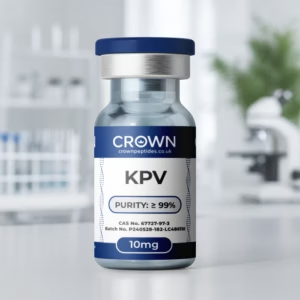
KPV Research Peptide
HPLC and MS verified · batch certificate published · dispatched from the UK before 2pm
A Timeline of KPV Research
KPV’s research history spans four decades, and seeing it in order shows how the field has matured from a hormone fragment to a delivery-science target.
The 1980s and 1990s: alpha-MSH as an anti-inflammatory
Work by James Lipton, Anna Catania and others established that alpha-MSH reduces fever and inflammation in animal models and influences immune cell behaviour. A 2000 review in the Annals of the New York Academy of Sciences described alpha-MSH as a neuroimmunomodulatory peptide acting on both the brain and the immune system (PMID: 11268347). Fragment studies began showing that the C-terminal tripeptide retained much of the activity.
The 2000s: mechanism
The antimicrobial findings in 2000, the Queen Mary receptor study in 2003 and the Emory PepT1 study in 2008 turned KPV from a fragment into a molecule with its own distinct mechanism. A 2006 study in Peptides even showed that the related sequence GKPV, immobilised on a surface, inhibited TNF-alpha-stimulated NF-kappaB activity, hinting at applications in coatings and materials (PMID: 16274845).
The 2010s and 2020s: delivery and new tissues
With the mechanism established, attention shifted to getting KPV where it is needed, through targeted nanoparticles, inflammation-seeking hydrogels and skin delivery techniques, and to new tissues such as the skin under pollution stress and the mouth. A 2023 review in Cells placed KPV within the wider melanocortin system’s role in inflammatory bowel research (PMID: 37508552, PMC10378568). The July 2026 FDA advisory committee vote brought KPV to a much wider audience.
KPV and the FDA Advisory Committee
KPV attracted fresh attention in July 2026, when the US FDA’s Pharmacy Compounding Advisory Committee voted 8 to 6, with one abstention, to recommend adding KPV to the list of substances US compounding pharmacies may use, reviewed for wound healing and inflammatory conditions. The recommendation is advisory, and the FDA must complete formal rulemaking before anything changes in the US. It has no bearing on KPV’s status in the UK, where it is available as a research material. Our article on the FDA advisory panel vote explains exactly what was decided.
The Technical Breakdown: Why Three Amino Acids Can Do So Much
This section goes deeper into the chemistry and biology for readers who want it.
The structure
KPV’s lysine carries a positively charged side chain. Proline, in the middle, is unusual among amino acids because its side chain loops back to bond with its own backbone, making it rigid and restricting how the chain can bend. Valine, at the end, has a small, water-repelling side chain. The result is a compact, charged molecule with a constrained shape.
Why PepT1 likes it
PepT1 evolved to absorb the enormous variety of di- and tripeptides produced when dietary protein is digested. It is not highly selective, which is why it can carry KPV. That also makes PepT1 attractive for drug delivery more broadly, and the Emory group’s work on KPV has fed into wider research on using PepT1 to deliver medicines to the inflamed colon.
NF-kappaB: the switch KPV turns down
NF-kappaB is a family of transcription factors held inactive in the cytoplasm by an inhibitor protein. When a cell detects an inflammatory signal, such as TNF-alpha or IL-1beta, a cascade of enzymes destroys the inhibitor, freeing NF-kappaB to enter the nucleus and switch on genes for inflammatory cytokines, adhesion molecules and enzymes. Because it sits at the hub of so many inflammatory pathways, NF-kappaB inhibition can dampen inflammation broadly. Research has indicated that KPV inhibits NF-kappaB activation in intestinal cells, immune cells and keratinocytes.
The IL-1beta connection
The Queen Mary study pointed to IL-1beta as a key target, and the 2008 Endocrine Reviews article noted an intriguing structural echo: a related tripeptide called KdPT corresponds to amino acids 193 to 195 of IL-1beta itself. That resemblance has led researchers to propose that KPV-like peptides may interfere with IL-1beta signalling at the receptor level, a hypothesis still being explored.
Stability
As a small, unmodified peptide, KPV can be broken down by peptidases in biological fluids. A 2015 study in Biomedical Chromatography developed a dedicated HPLC method specifically to measure KPV stability in solutions and skin tissue, reflecting how central stability is to KPV delivery research. That is also why so much recent work has focused on protective carriers such as nanoparticles and hydrogels.
Designing Research With KPV
KPV’s particular properties suggest a few practical principles for anyone planning experiments with it.
Think about the transporter
Because research indicates KPV enters cells largely through PepT1, the level of PepT1 in the cells being studied may shape the response. Intestinal epithelial cells and some immune cells express it; many other cell types express much less. Measuring or accounting for PepT1 expression can make results far easier to interpret.
Choose readouts that match the mechanism
NF-kappaB activation, MAP kinase signalling and inflammatory cytokines such as IL-1beta, IL-6 and TNF-alpha are the measures most closely tied to KPV’s published effects. Including them alongside tissue-level outcomes connects what happens inside the cell to what happens in the tissue.
Protect the peptide
As an unmodified tripeptide, KPV is vulnerable to peptidases in serum-containing media and biological fluids. Preparing fresh working solutions, keeping stock solutions cold and considering the time course of an experiment all help make sure the concentration you calculated is the concentration the cells actually see.
Use the right comparisons
Comparing KPV with alpha-MSH, or with other fragments of it, is a powerful way to separate its distinct mechanism from the melanocortin receptor effects of the parent hormone, exactly the approach the Queen Mary team used.
Why Purity Matters for a Three-Amino-Acid Peptide
It might seem that a peptide with only three building blocks is too simple to go wrong. In fact, short peptides have their own quality challenge. A synthesis error in a long peptide produces a near-identical molecule; in a tripeptide, a missing amino acid produces a completely different dipeptide, such as Lys-Pro or Pro-Val. The Queen Mary research showed that different alpha-MSH fragments behave in fundamentally different ways, so a sample contaminated with related short peptides would compromise precisely the kind of mechanism studies KPV is used for.
KPV is also typically studied at very low concentrations, nanomolar in the Emory cell work. At such low levels, the accuracy of the stated amount matters, which is why identity and purity need to be confirmed for every batch.
The Crown Peptides standard
Every batch of KPV supplied by Crown Peptides comes with a batch-specific certificate of analysis. HPLC confirms purity by separating KPV from related impurities, and mass spectrometry confirms its identity by molecular mass, around 342. Lot numbers on certificates match those on vial labels. Published certificates are on our Lab Reports page, and our guides to peptide testing and reading a certificate of analysis explain the methods.
Handling
KPV is supplied as a lyophilised powder and should be stored cold, dry and away from light. Because it is studied at low concentrations, careful dilution matters; our peptide calculator, reconstitution guide and mg vs mcg explainer help, and Bacteriostatic Water is available alongside.
Related Compounds and Where KPV Fits
KPV sits at the crossroads of inflammation, gut and skin research, and connects to several other compounds.
KLOW
KLOW combines KPV with GHK-Cu, BPC-157 and TB-500, adding an anti-inflammatory component to three peptides studied for tissue repair. Our KLOW blend guide and KLOW vs GLOW explain the logic.
BPC-157 and the gut
BPC-157, derived from a gastric protein, has an extensive gastrointestinal research literature, and VIP plays roles in gut motility and immunity. KPV, BPC-157 and VIP are brought together in the Gastrointestinal Research Bundle; see three peptides, one gut axis.
Immune research
LL-37 is an antimicrobial peptide the body makes itself, studied on the immune system’s defensive side, making it a natural counterpart to KPV; see LL-37 vs KPV. Thymosin Alpha-1 is studied for immune regulation, and KPV, Thymosin Alpha-1 and BPC-157 feature together in the Immune Pathway Research Bundle.
Melanocortin relatives
Because KPV comes from alpha-MSH, it has relatives among the melanocortin peptides: Melanotan-1, a stabilised analogue of the whole alpha-MSH hormone, and Melanotan-2. Unlike KPV, both act through melanocortin receptors. Our comparison Melanotan 1 vs 2 explains that side of the family.
Browse the full range in our immunology research peptides and gastrointestinal research peptides categories.
Read the certificate before you order
Every batch is published openly — identity by mass spectrometry, purity by HPLC, and the batch number printed on the vial you receive.
Open the COA libraryKPV Questions, Answered
What is KPV?
KPV is a tripeptide, lysine-proline-valine, that forms the last three amino acids of the hormone alpha-MSH. Research has indicated it carries much of alpha-MSH’s anti-inflammatory activity without its pigmentation effect.
How does KPV work?
Research indicates KPV enters cells through the PepT1 peptide transporter and inhibits inflammatory signalling inside them, particularly the NF-kappaB and MAP kinase pathways. Unlike alpha-MSH, it does not appear to act mainly through melanocortin receptors.
Does KPV cause tanning like alpha-MSH?
No. The pigmentation effect of alpha-MSH depends on its central core, not its tail. KPV was specifically highlighted by researchers because it preserves anti-inflammatory activity without the pigmentary action.
What has KPV been studied for?
Mainly inflammatory conditions of the gut in animal models, with further research on skin cell protection, antimicrobial activity and oral inflammation, as well as extensive work on delivery systems such as nanoparticles and hydrogels.
Why is KPV studied so much in the gut?
Because the transporter that carries it into cells, PepT1, is abundant in the intestine and becomes more active in the colon during inflammation. That makes the gut the tissue where KPV’s route into cells and its anti-inflammatory effect line up most naturally, which is why so much delivery research has focused there.
Is KPV the same as KdPT?
No. KdPT is a related tripeptide that corresponds to a short stretch of the inflammatory messenger IL-1beta. Both have been studied as small anti-inflammatory peptides, but they are different molecules.
Is KPV legal in the UK?
KPV is not a controlled drug in the UK and is available as a research material. See are peptides legal in the UK for the full picture.
A Tiny Tail With a Big Job
KPV’s story is a lesson in how much biology can be packed into a very small space. Three amino acids from the end of a tanning hormone turn out to carry an anti-inflammatory signal strong enough to calm inflamed guts in mice, protect skin cells from city pollution and slow the growth of common microbes, all while leaving pigmentation alone. They do it not by knocking on the hormone’s usual receptors, but by riding a nutrient transporter into the cell and turning down its inflammatory switches from the inside.
With delivery science advancing fast and regulators paying close attention, KPV is one of the most active small peptides in inflammation research today. Explore KPV from Crown Peptides, every batch HPLC and mass spectrometry verified and dispatched from the UK.
Working with KPV Research Peptide
Batch-tested material, published certificates, and same-day dispatch on orders placed before 2pm.
See KPV Research Peptide