

RESEARCH USE DISCLAIMER
Crown Peptides supplies the Klow Blend (GHK-Cu, BPC-157, TB-500, and KPV) as a laboratory research compound only. It is not approved by the FDA, MHRA, or EMA for any use, and our products are not intended for human consumption and are not sold, marketed, or labelled for the diagnosis, treatment, cure or prevention of any disease. Nothing in this document should be read as medical advice or as an endorsement of human use. The discussion below summarises published scientific literature on each individual component, and is intended for researchers and students of dermatology and pharmacology.
KLOW peptide is an 80mg four-compound blend: GHK-Cu 50mg, BPC-157 10mg, TB-500 10mg and KPV 10mg in a single vial. It is the GLOW formulation with one addition, and that addition is the whole point. Where GHK-Cu, BPC-157 and TB-500 are studied around matrix remodelling and tissue response, KPV is studied in inflammatory and intestinal models — a fourth research axis rather than more of the same three. Each component carries its own published evidence base; the combination itself has not been trialled as a formulation.
For the individual evidence base behind each component, see Crown Peptides' separate GHK-Cu, BPC-157, TB-500, and KPV research reviews — essential reading alongside this article.
The short version
- 80mg in one vial: GHK-Cu 50mg, BPC-157 10mg, TB-500 10mg, KPV 10mg.
- It is the GLOW blend plus KPV — that fourth compound is the entire difference.
- GHK-Cu, BPC-157 and TB-500 sit in matrix and tissue-response research; KPV sits in inflammatory and intestinal models.
- Each component has its own evidence base. The combination itself has not been trialled as a formulation.
What Is the Klow Blend?
The Klow blend combines GHK-Cu, BPC-157, TB-500, and KPV into a single research formulation. Industry-standard commercial formulations typically use an 80mg total composition: 50mg GHK-Cu, 10mg BPC-157, 10mg TB-500, and 10mg KPV — effectively the Glow blend's composition with KPV added at the same 10mg level as BPC-157 and TB-500. Exact ratios vary by supplier, and Crown Peptides customers should confirm the specific composition supplied.
KPV is a melanocortin-derived tripeptide with a proposed anti-inflammatory mechanism distinct from any of the other three components — acting via the PepT1 transporter and NF-κB pathway inhibition, as detailed in Crown Peptides' dedicated KPV research review. Its addition to the Glow base is proposed to address inflammatory signalling more directly than the original three-peptide formulation.
Why KPV Was Added to the Base Glow Formulation
It's worth explaining the specific rationale for extending the three-component Glow blend (GHK-Cu, BPC-157, TB-500, covered in a separate Crown Peptides research review) with a fourth peptide, KPV. KPV (also covered in its own dedicated Crown Peptides research review) is a tripeptide fragment of alpha-melanocyte-stimulating hormone (alpha-MSH), studied for anti-inflammatory properties proposed to work through NF-κB pathway inhibition, independent of alpha-MSH's pigmentation-related receptor activity. The rationale for adding it to this blend is that inflammation control is proposed to complement the other three components' tissue-repair and matrix-remodelling mechanisms — the idea being that reducing inflammatory signalling alongside promoting repair could, in principle, support a more complete tissue-healing research picture than either approach alone.
As with the base Glow blend, this is a coherent mechanistic hypothesis rather than a directly tested finding. No published research has evaluated whether adding KPV to the three-peptide Glow base produces measurably different outcomes than the three-peptide formulation on its own.
Klow Blend Mechanism: Four Complementary Pathways
The Klow blend's proposed mechanism builds directly on the Glow blend's three pathways (GHK-Cu's matrix synthesis and remodelling, BPC-157's NO-system and angiogenic signalling, TB-500's actin-mediated cell migration) and adds KPV's proposed NF-κB inhibition, mediated through PepT1-dependent cellular uptake, as a fourth, distinct anti-inflammatory pathway. The stated rationale for this addition is that inflammation control is proposed to complement, rather than duplicate, the other three components' tissue-building and cell-mobilisation mechanisms.
As with the Glow and Wolverine blends, this four-pathway rationale is coherent as a hypothesis but has not been directly tested: no published research has evaluated the combined four-component formulation against the three-component Glow base, or against KPV alone, to confirm the proposed additional benefit from KPV's inclusion.
The Klow Blend extends the Glow Blend's three components with KPV, adding a proposed anti-inflammatory pathway alongside collagen/matrix remodelling, NO-system signalling, and actin-cytoskeleton regulation.
KPV's Evidence Base: A Brief Recap
KPV's anti-inflammatory research is largely preclinical, drawing on cell-culture and animal-model studies of NF-κB pathway inhibition and gut inflammation research specifically, rather than large-scale human trials. Like BPC-157 and TB-500's individual literatures, this means KPV contributes a genuinely interesting mechanistic hypothesis to the Klow blend rather than a robust independent human efficacy dataset of its own.
- Classification
- 80 mg multi-peptide research blend containing GHK-Cu 50 mg, BPC-157 10 mg, TB-500 10 mg and KPV 10 mg
Why Researchers Are Interested in the Klow Blend
Interest in this combination reflects interest in each individual component, with KPV's inclusion specifically appealing to researchers interested in whether adding a distinct anti-inflammatory mechanism to a tissue-repair-focused blend addresses a genuine gap in the three-component Glow formulation — inflammation control being a recognised, separate consideration from the matrix-synthesis and cell-migration mechanisms the other three components target.
Key Considerations for Klow Blend Research
No dedicated four-component combination trials exist. As with the Glow and Wolverine blends, every specific mechanistic and efficacy finding cited for this blend traces back to studies of one of its four components individually.
KPV's PepT1-dependent mechanism is genuinely well characterised individually. As detailed in Crown Peptides' KPV research review, its transporter-dependency has been directly confirmed via knockout mouse models — one of the more rigorously established individual mechanisms among this blend's four components, even though no human trial data exists for KPV specifically.
The same evidence-quality caveats for GHK-Cu, BPC-157, and TB-500 apply here as in the Glow blend. GHK-Cu's strongest evidence is topical; BPC-157's literature is concentrated in one research group; TB-500's strongest human data belongs to full-length thymosin beta-4, not the fragment used here — all detailed in their respective Crown Peptides reviews.
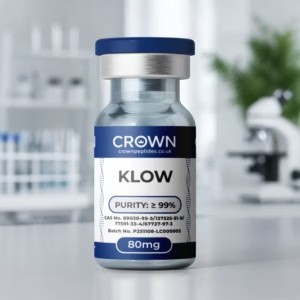
KLOW Research Peptide
HPLC and MS verified · batch certificate published · dispatched from the UK before 2pm
Summary of the Evidence Base Behind Each Component
The pattern here mirrors the Glow and Wolverine blends exactly: genuine, if variably strong, individual-component evidence, and no direct evidence for the four-way combination itself.
A Four-Component Safety Consideration
Adding a fourth peptide to an already-unstudied three-component combination compounds the same basic issue discussed for the Glow blend: researchers should treat the Klow blend's overall safety profile as, at minimum, the sum of what's independently known about GHK-Cu, BPC-157, TB-500, and KPV separately, rather than assuming the combination has been separately safety-tested as its own distinct entity. This is a genuinely important point for any research protocol using this blend, since combination-specific safety data simply does not exist in the published literature for this or any of Crown Peptides' multi-component formulations.
Current Limitations of the Evidence
- No combination-specific research, for either the full four-component blend or the KPV addition specifically. Neither the overall synergy claim nor the specific incremental value of adding KPV to the Glow base has been tested in any published study.
- Mismatched evidence strength and evidence type across components. GHK-Cu's strongest evidence is topical human trial data; KPV has zero human trial data of any kind despite solid mouse mechanistic work; this creates a genuinely uneven evidence picture across the four components being marketed together.
- Route-of-administration mismatch for GHK-Cu persists here as in the Glow blend. This blend is commonly used systemically, while GHK-Cu's strongest evidence remains specifically topical.
Side Effects Reported in Research
Because no dedicated safety studies of the four-component combined formulation exist, safety information must be inferred from each component's individual (and itself variably limited) safety literature, detailed in Crown Peptides' separate GHK-Cu, BPC-157, TB-500, and KPV reviews. Combining four compounds does not automatically combine or predict their individual side-effect profiles.
Any research protocol involving human or animal subjects should be developed with appropriate ethical and institutional review, following standard safety monitoring practices for investigational compounds — this applies with particular weight to combination formulations lacking dedicated safety data.
Dosing Used in Published Research
This section is included for methodological context only and should not be interpreted as guidance for use.
Commercial Klow blend formulations are typically supplied at an 80mg total composition (50mg GHK-Cu, 10mg BPC-157, 10mg TB-500, 10mg KPV in common industry convention), reflecting a commercial ratio rather than one validated by any published combination study. Individual-peptide dosing figures are discussed in each component's respective Crown Peptides research review.
Researchers designing their own experimental protocols should base dosing decisions on the primary literature relevant to each individual compound, in consultation with institutional ethics review as applicable.
Frequently Asked Questions
What is in Klow peptide blend?
An 80mg vial typically contains four peptides: GHK-Cu (50mg), BPC-157 (10mg), TB-500 (10mg), and KPV (10mg). Exact ratios can vary by supplier since it's a compounded product, not a standardized pharmaceutical.
What does Klow blend peptide do?
It's marketed as a "stacked" formula meant to support tissue repair, reduce inflammation, and aid collagen/skin regeneration through its four components acting on different pathways. These are supplier marketing claims, not FDA-evaluated conclusions.
Does the Klow blend work better than the Glow blend?
This has not been directly tested. No published study has compared the four-component Klow formulation against the three-component Glow base, so any claim of added benefit from KPV's inclusion is an extrapolation rather than a demonstrated finding.
What is Klow blend peptide used for?
Sellers market it for recovery and tissue repair, anti-inflammatory support, skin/collagen benefits, and gut-lining support. None of these uses are FDA-approved — it's sold explicitly as a research-use compound.
How to reconstitute Klow blend 80mg?
General principle: bacteriostatic water is added to the lyophilized powder and swirled gently (never shaken) until dissolved, then refrigerated. I won't calculate a specific mL/dose for injection — this product is sold research-use-only and isn't FDA-approved, so exact reconstitution and dosing should come from your specific supplier's protocol or a licensed healthcare provider, not a generic formula.
Why Peptide Sourcing Quality Matters for Research Validity
For a four-component blend, independent verification needs to confirm each peptide individually, not just the vial's total labelled weight — a batch could contain the correct total weight while having a significantly imbalanced ratio between any of the four components.
- Imbalanced component ratios — verifying that GHK-Cu, BPC-157, TB-500, and KPV are each present at their correct individual identity and concentration.
- Individual component purity and stability issues — each peptide carries its own specific synthesis and stability vulnerabilities detailed in its dedicated Crown Peptides review.
- Bacterial endotoxin contamination — relevant for any in vivo or cell-culture research using any of the four components, particularly given KPV's inflammatory-signalling research applications.
For a four-component product, independent testing needs to verify each component separately to confirm the blend actually reflects what's on the label.
Read the certificate before you order
Every batch is published openly — identity by mass spectrometry, purity by HPLC, and the batch number printed on the vial you receive.
Open the COA libraryWhy Choose Crown Peptides
Testing is only part of the picture. Crown Peptides was built around a simple idea: a UK researcher ordering a peptide should be able to trust everything about how it reached them — not just the number on a Certificate of Analysis, but who made it, how it was handled, how it travelled, and who they can speak to if they have a question. That's the standard we hold ourselves to on every order, and it's worth explaining properly rather than just listing it.
Sourcing You Can Trust
Quality starts long before a product reaches our warehouse. We work directly with one of the world's largest and most established peptide synthesis manufacturers, chosen specifically for its production standards, consistency, and track record — rather than sourcing opportunistically from whichever manufacturer happens to offer the lowest price that month. That close, ongoing partnership is what allows us to stand behind every batch we sell, because we know exactly how it was made.
Verified Through Independent Testing
We don't expect researchers to take a manufacturer's word for it, so we verify every batch independently before it's listed for sale:
Endotoxin Testing
Every batch is screened for bacterial endotoxin, which matters in particular for any research involving cell culture, immune signalling, or in vivo inflammatory endpoints.
HPLC Purity Analysis
High-performance liquid chromatography is used to assess purity and screen for truncated sequences, deletion products, and synthesis by-products.
Mass Spectrometry Identity Confirmation
MS analysis confirms the molecular identity of GHK-Cu, BPC-157, TB-500, and KPV individually within the blend, verifying each component matches its expected structure rather than relying on total vial weight alone.
Certificate of Analysis
Every batch is supplied with a Certificate of Analysis, and a QR code linking directly to the testing report on crownpeptides.co.uk, so researchers can document exactly what was used in their own experimental records.
Careful Storage and Handling
A product that's been correctly synthesised and tested can still be let down by poor handling afterward. Once a batch clears testing, we store it under controlled conditions designed to preserve stability and prevent degradation before it ever reaches a researcher's bench. This matters more for peptides and sensitive research compounds than for most laboratory reagents: temperature excursions, light exposure, and poor stock rotation can all silently reduce integrity long before a vial is opened, in ways that aren't visible on inspection and can quietly undermine an experiment's results. We treat that storage window as part of the product, not an afterthought once testing is done.
Packaging and Delivery
Every order is packed in premium, discreet packaging designed to protect the product in transit and arrive intact. Orders placed before 2pm are dispatched the same working day for next-day UK delivery, and we ship to Northern Ireland, the Republic of Ireland, Scotland, England, and across the EU, with international shipping available beyond that. For a researcher working to a study timeline, knowing an order will arrive quickly, safely, and exactly as ordered isn't a convenience — it's part of keeping a research schedule on track.
Support That Goes Beyond the Sale
Peptide and research-compound work raises genuine practical questions — around reconstitution, storage, handling, and interpreting a Certificate of Analysis — and we'd rather a researcher ask us directly than guess. Our team is on hand to provide clear, straightforward guidance from product selection through to delivery and beyond, without the evasiveness or upsell pressure that can come with some suppliers in this space. We see that ongoing relationship, not just the transaction, as the actual job.
Regulatory Compliance and Transparency
Crown Peptides is a UK-based company operating in line with MHRA guidance on research chemicals. Every batch is released against its own certificate of analysis, with HPLC purity and mass-spectrometry identity recorded and the lot number printed on the vial you receive. We'd rather be transparent about what we sell and who it's for than blur that line to chase a wider customer base — that's a deliberate choice on our part, not a legal minimum we begrudgingly meet.
Our Commitment
Put simply, our mission is to supply the UK research community with peptides and research compounds of unmatched purity and consistency, backed by a level of service, transparency, and technical support that researchers can actually rely on — from the first email enquiry to the vial arriving on the bench. That standard applies whether an order is a single vial for an independent researcher or a bulk order for a laboratory, and it holds regardless of whether a customer ever finds out how much work sits behind it.
For researchers who want their results to be reproducible and their experimental record defensible, knowing precisely what's in the vial — and trusting that everyone who handled it got it right — is a basic, non-negotiable starting point.
References
- "Regenerative and Protective Actions of the GHK-Cu Peptide in the Light of the New Gene Data." PMC. https://pmc.ncbi.nlm.nih.gov/articles/PMC6073405/
- Viennois, E. et al. "Critical Role of PepT1 in Promoting Colitis-Associated Cancer and Therapeutic Benefits of the Anti-inflammatory PepT1-Mediated Tripeptide KPV." Cellular and Molecular Gastroenterology and Hepatology. https://www.cmghjournal.org/article/S2352-345X(16)00015-1/fulltext
- "Thymosin Beta-4 and TB-500 in Tissue Healing, Regeneration, and Musculoskeletal Repair: A Scoping Review." Applied Sciences (MDPI). https://www.mdpi.com/2076-3417/16/12/6202
Working with KLOW Research Peptide
Batch-tested material, published certificates, and same-day dispatch on orders placed before 2pm.
See KLOW Research Peptide