Vilon Peptide UK: KE Research, Mechanism and Study Data
Two amino acids. That is the entire molecule. Lysine joined to glutamic acid, and nothing else — no ring, no tail, no scaffold. By any reasonable intuition about how biology works, a compound that small should do nothing at all.
On this page
- The Smallest Peptide in the Family
- How Can Something This Small Reach a Gene?
- What the Published Research Has Actually Found
- Where the Evidence Is Strong and Where It Thins Out
- Vilon Compared With Its Closest Relatives
- How Vilon Compares With the Better-Known Research Peptides
- The Technical Breakdown: Vilon Structure and Chemistry
- Why Purity Is Not a Box-Ticking Exercise Here
- Questions Researchers Ask Before Ordering It
- The Question Vilon Is Really Asking
Two amino acids. That is the entire molecule. Lysine joined to glutamic acid, and nothing else — no ring, no tail, no scaffold. By any reasonable intuition about how biology works, a compound that small should do nothing at all. It is barely bigger than the building blocks it is made from.
And yet Vilon has a published research record stretching back more than twenty-five years, spanning gene expression, chromatin structure, immune cell signalling and rodent lifespan — including work on lymphocytes taken from elderly human donors. It is the shortest member of the Khavinson bioregulator family, and arguably the one that forces the most interesting question: how little peptide do you actually need before something happens?
Vilon is available from Crown Peptides in 20mg vials, HPLC and mass-spectrometry verified with a certificate of analysis published for every batch. Like every compound in this category it is supplied strictly for laboratory research and is not approved for human use.
The Smallest Peptide in the Family
Vilon is a dipeptide with the sequence Lys-Glu, usually written KE in the literature. Put it alongside its relatives and the pattern is immediately obvious:
- Vilon — KE (Lys-Glu), two residues
- Vesugen — KED (Lys-Glu-Asp), three
- Livagen — KEDA (Lys-Glu-Asp-Ala), four
- Cartalax — AED (Ala-Glu-Asp), three
- Epitalon — AEDG (Ala-Glu-Asp-Gly), four
- Bronchogen — AEDL (Ala-Glu-Asp-Leu), four
Vilon sits at the root of two of them. Add aspartic acid and you have Vesugen. Add aspartic acid and alanine and you have Livagen. The same two-residue core, extended in different directions, with each extension associated in the Russian literature with a different tissue.
That design is not accidental, and understanding where it came from explains a great deal about what the research was actually trying to do.
From Glandular Extract to Two Amino Acids
The programme began in St Petersburg in the 1970s under Vladimir Khavinson, working on extracts prepared from animal tissue. The thymus extract was named Thymalin, and it is still studied today — Crown Peptides stocks Thymalin alongside Vilon, and there is a fuller account of the programme in the bioregulator peptides guide.
Extracts, though, are awkward things to study. They contain hundreds of components, they vary between batches, and when an effect shows up you cannot say which molecule produced it. So the obvious next move was to work out which fragment was doing the work and make that fragment synthetically.
Vilon was the answer the thymus work arrived at. It is the synthetic short-peptide successor to Thymalin — a defined, reproducible, two-residue molecule standing in for a complex biological extract. That is why so much of the Vilon literature concerns thymus tissue and immune cells: it inherited the research questions that Thymalin had been asked first.
How do you get from an extract to a dipeptide?
The reduction itself is worth understanding, because it explains why the family ended up looking the way it does.
The approach was fractionation followed by testing: separate the extract into components, assay each fraction, keep whatever retains activity, and repeat. Run that loop enough times and you converge on the shortest sequence that still produces the effect you were measuring. Do it across several different glandular extracts and you end up with a set of very short peptides, each one traced back to a different tissue — which is precisely the set that exists today.
Two things follow from that method, and both matter when reading the literature.
First, the sequences were not designed from theory. Nobody sat down and reasoned that Lys-Glu ought to influence immune gene expression. The peptide fell out of an empirical narrowing process, and the mechanistic explanation was constructed afterwards to account for a result that had already been observed. That is a perfectly respectable way to find a compound — a great deal of pharmacology works this way — but it does mean the mechanism is a hypothesis fitted to data rather than a prediction that data later confirmed.
Second, the tissue associations in this family are inherited from the extracts the peptides came out of, not demonstrated independently for each sequence. Vilon is called a thymus peptide because it came from thymus extract. That is a statement about its provenance, and only partly a statement about where it acts.
How Can Something This Small Reach a Gene?
This is where the bioregulator model gets genuinely interesting, and where it is worth being precise about what is established and what remains a proposed mechanism.
The proposal runs roughly like this. A dipeptide is small enough and carries the right charge distribution to cross the cell membrane without needing a dedicated receptor. Once inside, it is small enough again to enter the nucleus. There, rather than binding a protein target in the conventional drug sense, it is proposed to interact directly with DNA — specifically with the minor groove, where the charged side chains of lysine and glutamic acid can form contacts with exposed base pairs.
Lysine carries a positive charge at physiological pH; glutamic acid carries a negative one. A molecule with one of each, and almost nothing else, is an unusually clean probe for that kind of electrostatic interaction. Whether this is the full story is still debated, and nobody should present the DNA-binding model as settled. What can be said is that the model makes predictions, and some of those predictions have been tested.
The most direct test is also the most striking.
What the Published Research Has Actually Found
Chromatin in Cells From Elderly Donors
Work published in Biogerontology examined lymphocytes cultured from older human donors and reported that Vilon produced reactivation of chromatin — in plain terms, regions of DNA that had become tightly packed and transcriptionally quiet in the aged cells showed signs of loosening and becoming available again (PubMed 15105581).
This matters for two reasons. First, chromatin condensation is one of the better-characterised features of cellular ageing, so it is a sensible thing to be measuring. Second — and this is the part that distinguishes it from most of the family's literature — the cells came from people, not rodents. These are human cells in culture, which is a long way from a human trial, but a meaningful step above a mouse study.
A related report in Georgian Medical News described chromatin reactivation across several of the bioregulator peptides, placing Vilon within a broader pattern rather than treating it as an isolated result (PubMed 16705247).
The Interleukin-2 Finding
If Vilon really does make quiet DNA available again, you would expect to see specific genes switch on. Researchers looked at interleukin-2, a signalling protein central to how T cells coordinate an immune response, and reported that Lys-Glu affected IL-2 gene expression in lymphocytes (PubMed 11177276).
That is a tidy result in the context of a thymus-derived peptide. The thymus is where T cells mature; IL-2 is how mature T cells talk to one another. A molecule traced back to thymus extract turning up as an influence on a core T cell gene is the kind of coherence that makes a research programme worth continuing.
Thymus Cells in Culture
Later work extended this into direct cell-culture experiments, reporting immunomodulating effects of Vilon and a structural analogue in cultured human and animal thymus cells (PubMed 23486604). Separate work examined how short peptides affect thymocyte blast transformation and signalling along the sphingomyelin pathway (PubMed 12420072), which is one of the routes cells use to decide between proliferating and dying.
That decision point — proliferate or die — recurs throughout the Vilon literature.
Apoptosis and the Survival Question
A report in Bulletin of Experimental Biology and Medicine reported that peptide bioregulators inhibited apoptosis, the programmed cell death process (PubMed 11276315).
Worth pausing on, because this cuts both ways and the honest reading says so. Keeping cells alive that would otherwise have been cleared is beneficial in some contexts and distinctly unhelpful in others — apoptosis exists precisely because some cells need removing. A compound that influences that balance is interesting for exactly that reason, and it is one of the open questions the research has not closed.
Gene Expression Mapped Across a Whole Tissue
Rather than measuring one gene at a time, one group used DNA-microarray technology to look at expression across mouse heart tissue under Vilon and Epithalon (PubMed 12360356). This is the broad-brush version of the question: if these peptides act on gene expression, what does the whole pattern look like, and do two different peptides produce two different patterns?
It is also a useful comparison point for anyone weighing Vilon against Epitalon, since it puts them side by side in the same experiment rather than relying on separate studies with different methods. Anyone intending to build on it should go to the paper itself for the expression data, since a summary of this kind cannot do justice to a microarray result.
Vascular Permeability and Growth Factor Signalling
Work from 2005 examined the effect of Vilon on transforming growth factor-beta content and the permeability of microvessels in an experimental model (PubMed 16142267). TGF-beta sits at the centre of tissue remodelling and repair signalling, and microvessel permeability governs what crosses out of the bloodstream into tissue.
This is also the point where the family tree becomes relevant again. Add one aspartic acid residue to Vilon and you get Vesugen, the member of the family associated with vascular tissue in this literature. Finding vascular effects in the two-residue parent is consistent with that progression.
Lifespan and Biological Age in Mice
One of the earlier reports examined the effect of Vilon on biological age and lifespan in mice (PubMed 11140587). Rodent lifespan work is notoriously sensitive to strain, housing, diet and the definition of "biological age" used, so single studies of this kind carry real uncertainty. It is reported here as what it is — a mouse study, forming part of a pattern rather than settling anything.
The Oncology-Adjacent Work
Vilon also appears in experimental oncology literature. One report described an inhibitory effect of Vilon on the development of induced urinary bladder tumours in rats (PubMed 11586406), and a later paper examined Vilon combined with cyclophosphamide on tumour transplants and lymphoid tissue explants in rodents (PubMed 14743610).
These are induced-tumour models in rats and mice. They tell you something about how a compound behaves in a specific experimental system, and nothing whatsoever about outcomes in people. No clinical conclusions follow from them, and anyone citing this work as though they do has misread it. It is included here because leaving out an entire branch of the published record would give a less accurate picture than including it with its limits stated plainly.
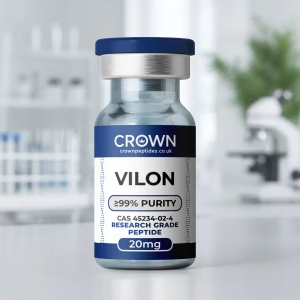
Vilon Research Peptide
Out of stock · every batch HPLC and MS tested
View Vilon Research Peptide ›Where the Evidence Is Strong and Where It Thins Out
An honest summary is more useful than an enthusiastic one, so here is the shape of it.
The strongest material is the cell and molecular work: chromatin structure in human donor lymphocytes, IL-2 gene expression, thymus cells in culture, gene expression mapped by microarray. These are measurable, mechanistically interesting, and several of them were designed to test specific predictions of the DNA-interaction model rather than just to look for an effect.
The thinner material is everything above the level of the cell. The rodent lifespan and tumour-model work is real published research, but it is older, much of it comes from a small number of connected groups, and a great deal of it was published in Russian-language journals with limited independent replication outside that network. The literature's centre of gravity sits in Bulletin of Experimental Biology and Medicine and Advances in Gerontology, and a research base concentrated in a handful of venues is a weaker base than one scattered across many.
What is genuinely absent is large, independent, Western-replicated human work. That gap is the single most important thing to understand about this compound family, and it is precisely why Vilon remains a research peptide rather than anything else.
None of this makes the molecular findings less interesting. It does mean the interesting part is still a question rather than an answer — which, for a laboratory compound, is the point.
Vilon Compared With Its Closest Relatives
Vilon and Epitalon
Epitalon (AEDG) is the best-known peptide in the family and the one with the largest literature, much of it centred on the pineal gland and telomerase. Vilon's record centres on the thymus and immune signalling. The microarray study is the one place they were examined side by side in a single experimental system, which makes it the obvious starting point for anyone asking whether the two sequences actually behave differently — the central claim of the whole programme being that they are not interchangeable and the specific residues matter. The Epitalon guide covers that side in detail.
Vilon and Thymalin
This is the extract-versus-defined-molecule comparison. Thymalin is the original thymus preparation; Vilon is the short synthetic peptide the work led to. Thymalin brings a longer clinical history in its country of origin; Vilon brings reproducibility, a known structure, and the ability to say exactly what is in the vial. For a laboratory, that second set of properties usually wins.
Vilon and Thymosin Alpha-1
Both trace to the thymus, and the contrast is instructive. Thymosin Alpha-1 is 28 amino acids with an extensively characterised mechanism and an approval history in several countries. Vilon is two amino acids with a proposed mechanism and a research-stage record. They represent two completely different bets about how short a peptide can be and still do something useful.
Vilon and Pinealon
Pinealon (EDR) is the family's neural member and the subject of some of the clearest work on short peptides entering the nucleus. Read alongside Vilon it gives a fuller picture of how the same structural idea was applied to a different tissue.
Vilon, Cartalax, Vesugen, Livagen and Bronchogen
These are the direct structural siblings. Cartalax (AED) carries the cartilage research; Vesugen (KED) the vascular work; Livagen (KEDA) the liver work; Bronchogen (AEDL) the bronchial work. Vilon is the two-residue core that Vesugen and Livagen are built outward from, which makes it the natural reference point for comparative work across the set.
How Vilon Compares With the Better-Known Research Peptides
Most people arriving at Vilon have already encountered the repair and signalling peptides, so the contrast is worth drawing.
BPC-157 is fifteen residues and its literature is dominated by tissue-repair models with visible, measurable outcomes. GHK-Cu is a copper-carrying tripeptide with a large body of skin and matrix work and well-mapped gene-expression effects. KPV is three residues studied mainly around inflammatory signalling.
Vilon belongs to a different category. It is not studied for a visible functional outcome but for what it appears to do at the level of chromatin and gene expression — the layer underneath the outcome. That makes it harder to demonstrate and harder to photograph, and it is why the bioregulators remain a niche within a niche. It also makes them the more conceptually ambitious line of work, because the claim is not "this helps tissue heal" but "this changes which genes a cell is reading".
The Technical Breakdown: Vilon Structure and Chemistry
Sequence and composition
Vilon is L-lysyl-L-glutamic acid: Lys-Glu, KE. Two residues, one peptide bond, molecular weight in the region of 275 Da — small enough that it sits close to the boundary between what is conventionally called a peptide and what is simply a modified amino acid pair.
Why the charges matter
Lysine's side chain carries a positive charge at physiological pH; glutamic acid's carries a negative one. The molecule is therefore a compact zwitterionic unit with both charge types exposed. Every proposed mechanism for the bioregulators — membrane transit, nuclear entry, minor-groove contact with DNA — depends on that charge arrangement, which is why a dipeptide with exactly one basic and one acidic residue is such a useful test case.
Stability and handling
Short peptides are generally more robust than long ones: there are fewer bonds to hydrolyse and no tertiary structure to lose. Lyophilised Vilon is stable when kept cold, dark and dry. Once reconstituted it should be treated as a limited-life solution, kept refrigerated, protected from light, and not subjected to repeated freeze-thaw cycles. Glutamic acid residues are susceptible to deamidation over time in solution, so freshly prepared material gives cleaner results than material that has been sitting.
Concentrations used in published work
The cell-culture literature generally works in the nanomolar to low-micromolar range, which is characteristic of this family and part of what makes it interesting — these are not compounds that need to be present in bulk to register an effect. Researchers designing experiments should take concentrations, vehicles and exposure times from the specific published paper they are building on rather than from any general figure, since the cell type and endpoint change what is appropriate.
Why Purity Is Not a Box-Ticking Exercise Here
For a two-residue peptide, purity verification is more consequential than it is for a longer sequence, and the reason is worth spelling out.
With a thirty-residue peptide, a synthesis error usually produces something obviously wrong — a truncated chain with a clearly different mass. With a dipeptide, the plausible impurities are free lysine, free glutamic acid, the reversed Glu-Lys sequence, or small amounts of salt and residual solvent. Several of those are close enough in mass and behaviour that a casual check will not separate them, and the reversed sequence in particular is a genuinely different molecule that would not be expected to behave the same way.
There is a second issue specific to this family. Because the proposed mechanism depends so heavily on the precise charge arrangement of the side chains, contamination that alters the effective charge balance of what is in the vial does not just dilute the result — it changes what is being tested. An experiment run on impure material is not a weaker version of the same experiment; it is an experiment on a different substance.
What Crown Peptides verifies on every batch
Every Vilon batch is checked by HPLC for purity and by mass spectrometry to confirm identity, and the certificate of analysis for that specific batch is published rather than summarised. Lot numbers are traceable, so the certificate you read corresponds to the vial you receive rather than to a representative sample from a different production run.
For a compound where the whole research question turns on two amino acids being in the right order with the right charges, knowing precisely what arrived is not administrative detail. It is the difference between a result you can publish and a result you cannot explain.
Handling on arrival
Store lyophilised material cold, dark and dry. Reconstitute with an appropriate sterile diluent for the work in hand, keep the solution refrigerated and protected from light, and avoid repeated freeze-thaw. Record the lot number against the experiment — with a family of structurally similar peptides in the same freezer, labelling discipline matters more than usual.
Questions Researchers Ask Before Ordering It
Is Vilon the same thing as Thymalin?
No. Thymalin is a preparation derived from thymus tissue and contains many components; Vilon is a single synthetic dipeptide with a defined sequence. The relationship is that the Vilon work grew out of the Thymalin work. For experimental purposes they are different materials and should not be substituted for one another — results obtained with one cannot be assumed to transfer to the other.
Why is it written as KE in some papers and Lys-Glu in others?
Both refer to the same molecule. KE is single-letter amino acid notation, Lys-Glu is three-letter. Older Russian-language papers sometimes use the trade name alone. Anyone searching the literature should try all three, because a search for one spelling will miss a substantial portion of the published record.
What makes a two-residue peptide worth studying at all?
Its size is the reason, not an obstacle to it. Most peptide research works with sequences long enough to fold into a shape that fits a receptor. Vilon is far too short for that, so if it produces reproducible effects, the explanation cannot be conventional receptor binding — which is what makes it a useful test of whether the proposed nuclear mechanism has anything to it. A larger molecule would introduce too many variables to isolate the question.
How does it differ from Epitalon in practical terms?
Different sequence, different associated tissue, and a very different weight of literature. Epitalon has the larger published record and the higher profile; Vilon has the shorter sequence and the closer link to immune and thymus work. The microarray study that examined both in the same experimental system is the most direct comparison available in the published literature, and it is where to look first.
Has any of this been replicated outside the original research network?
Only partially, and this is the honest weak point of the entire family. Most of the work originates from a connected group of researchers publishing in a small number of journals. Independent replication exists but is limited, and large-scale Western verification has not happened. Anyone building a research programme on these compounds should treat that as a known limitation rather than an oversight in the reading.
The Question Vilon Is Really Asking
Strip away the history and the family tree and one question remains: what is the minimum amount of molecular information needed to change what a cell does?
Conventional pharmacology answers with elaborate structures — specific shapes fitting specific pockets, affinity engineered across dozens of atoms. The bioregulator programme proposes something close to the opposite: that two amino acids in the right arrangement, carrying the right charges, can reach the nucleus and influence which parts of the genome are available to be read.
If that is wrong, twenty-five years of chromatin and gene-expression results need another explanation. If it is right, it points at a class of molecules so small they were largely skipped over while the field looked for bigger, more druggable targets.
Either way it is an open question with published data on both the molecular detail and its limits, and it is being actively worked on — short peptides continue to appear in the gerontology and neurodegeneration literature, including recent reviews of their potential in Alzheimer's research (PubMed 38944767). For a laboratory with an interest in chromatin, immune signalling or cellular ageing, Vilon is the cleanest possible probe of the underlying idea: the smallest version, with the longest record, and nothing extra to confound the result.
Vilon Research Peptide is available from Crown Peptides in 20mg vials, with batch-specific HPLC and mass spectrometry data published for every lot. The rest of the family — Vesugen, Livagen, Bronchogen, Cartalax, Thymalin and Epitalon — is stocked alongside it, for work that needs to compare across the set rather than study one sequence in isolation.