

RESEARCH USE DISCLAIMER
Crown Peptides supplies Pinealon as a laboratory research compound only. It is not approved by the FDA, MHRA or EMA for any use, and our products are not intended for human consumption and are not sold, marketed or labelled for the diagnosis, treatment, cure or prevention of any disease.
The short version
- Three amino acids: Glu-Asp-Arg, written EDR in single-letter code.
- Developed by Vladimir Khavinson’s group in St Petersburg, derived from the neuroprotective preparation Cortexin.
- Research centres on gene expression in neural tissue rather than receptor binding.
- The evidence is in vitro and rodent work plus small clinical observations. No completed controlled human efficacy trial.
What Pinealon Actually Is
Pinealon is three amino acids long — glutamic acid, aspartic acid, arginine, written EDR in single-letter code — and that brevity is the entire premise behind it. Where most research peptides work by binding a receptor on the cell surface, the claim made for Pinealon is that a peptide this short can enter the nucleus and interact with DNA directly. Whether that framework holds up is a fair question, and one this guide returns to. But the reason researchers keep coming back to EDR is that it sits at the centre of an unusually long-running research programme.
The compound was originally isolated from Cortexin, a polypeptide preparation derived from cortical tissue and used clinically in Russia as a neuroprotective agent. Pinealon is the synthetic version of one active fragment from that mixture: a single defined tripeptide rather than a complex extract.
The Khavinson Framework: Where Pinealon Comes From
Pinealon belongs to a family of compounds that Professor Vladimir Khavinson and colleagues at the St Petersburg Institute of Bioregulation and Gerontology call peptide bioregulators. The central proposal, set out across more than three decades of published work, is that very short peptides — two to seven residues — act as endogenous signalling molecules that regulate gene expression in a tissue-specific way.
Each bioregulator in the family is assigned a target tissue. Epitalon (AEDG) is directed at the pineal gland and telomerase. Bronchogen (AEDL) at lung tissue. Pancragen (KEDW) at pancreatic tissue. Pinealon’s assigned target is the central nervous system.
The mechanistic claim underpinning all of them is that these peptides bind DNA and histone proteins directly. Published work has reported selective binding of AEDG, EDR, AEDL and KEDW to histones H1, H2b, H3 and H4 — the proteins around which DNA is wound, and therefore a plausible route to influencing which genes are accessible for transcription.
- Classification
- Synthetic tripeptide bioregulator research compound
- Available strength
- 10mg
- CAS Number
- 175175-23-2
- Molecular Weight
- approximately 418.40 g/mol
- Molecular Formula
- C15H26N6O8
- Sequence
- Glu-Asp-Arg (3 amino acids)
How Pinealon Is Thought to Work
The proposed mechanism has two parts. The first is antioxidant: EDR has been reported to upregulate the synthesis of antioxidant enzymes, specifically superoxide dismutase 2 (SOD2) and glutathione peroxidase 1 (GPX1), which are the cell’s front-line defences against reactive oxygen species. The second is transcriptional, involving MAPK signalling and the PPARA and PPARG nuclear receptors.
That distinction matters more than it might appear. An antioxidant effect is a chemical property; a transcriptional effect implies the peptide is doing something inside the nucleus. The research group argues for the latter on the grounds that the two effects separate at different concentrations — a point covered below.
What the Published Research Shows
The most-cited primary experiment is a 2011 study in Rejuvenation Research, which exposed cerebellar granule cells, neutrophils and PC12 cells to both receptor-dependent and receptor-independent oxidative stress. Pinealon produced a dose-dependent restriction of reactive oxygen species accumulation, a reduction in necrotic cell death, and delayed activation of ERK 1/2 accompanied by cell-cycle modification.
The detail the authors built their argument on is that these effects saturated at different points. The antioxidant and cytoprotective effects plateaued at lower concentrations, while the cell-cycle effects continued rising at higher ones. If the peptide were acting purely as an antioxidant, both would be expected to track together. That they do not is the basis for the claim of a direct genomic interaction.
Subsequent work reported that EDR interferes with the elimination of dendritic spines in neuronal cultures taken from mouse models of Alzheimer’s and Huntington’s disease, and that it activates antioxidant enzyme synthesis in rat cerebellum neuron cultures. A 2020 review in Molecules by Khavinson, Linkova, Kozhevnikova and Trofimova pulls the gene-expression evidence together in the context of Alzheimer’s pathogenesis.
On the clinical side, the most substantial report describes oral Pinealon given alongside standard therapy to 72 patients with consequences of traumatic brain injury and cerebrasthenia, with improvements reported in memory, headache duration and intensity, emotional balance and performance. It is an observational addition to existing treatment rather than a controlled trial, and should be read as such.
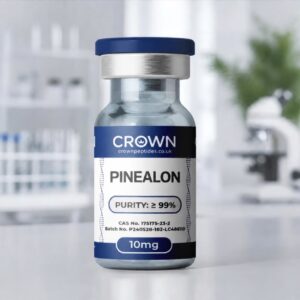
Pinealon Research Peptide
HPLC and MS verified · batch certificate published · dispatched from the UK before 2pm
Pinealon and Epitalon: Two Peptides, Two Targets
These two come from the same programme and are frequently discussed together, but they are directed at different systems. Epitalon is a tetrapeptide, Ala-Glu-Asp-Gly, associated with pineal regulation, melatonin synthesis and telomerase activity. Pinealon is a tripeptide aimed at neural tissue, with its reported effects concentrated on antioxidant enzyme expression and neuronal survival.
The names cause some of the confusion — Pinealon sounds pineal, but Epitalon is the pineal-directed compound of the two.
Current Limitations of the Evidence
The honest position is that the Pinealon literature has a structural weakness: most of it originates from a single research group. That is not in itself a criticism of the work, and the St Petersburg programme has been running for over thirty years with a substantial publication record. But independent replication by unaffiliated laboratories is what turns a body of work into an established finding, and for EDR specifically that replication is thin.
Two further gaps are worth naming. There is no completed controlled human efficacy trial for Pinealon. And while the group has published rodent distribution studies using radiolabelled EDR that are consistent with central nervous system penetration, verification by independent pharmacokinetic work would strengthen the case considerably.
For in vitro CNS work the delivery question largely falls away, which is one reason the cell-culture claims about nuclear localisation and gene expression are the more testable end of this literature.
Read the certificate before you order
Every batch is published openly — identity by mass spectrometry, purity by HPLC, and the batch number printed on the vial you receive.
Open the COA libraryFrequently Asked Questions
What does EDR stand for?
It is the single-letter code for the tripeptide sequence: E for glutamic acid, D for aspartic acid, R for arginine. EDR and Pinealon refer to the same compound.
How is Pinealon different from Epitalon?
Different length and different target. Epitalon is a four-residue peptide associated with pineal function and telomerase; Pinealon is a three-residue peptide directed at neural tissue and antioxidant enzyme expression.
Is Pinealon related to Cortexin?
Yes. Pinealon is the synthetic form of an active tripeptide fragment identified within Cortexin, a polypeptide preparation used clinically in Russia. Pinealon is a single defined peptide rather than a mixture.
How is Pinealon tested?
Every batch is analysed by HPLC for purity and mass spectrometry for identity, with the certificate of analysis published in full and the batch number printed on the vial.
References
- Khavinson V., Ribakova Y., Kulebiakin K. et al. Pinealon increases cell viability by suppression of free radical levels and activating proliferative processes. Rejuvenation Research, 2011.
- Khavinson V., Linkova N., Kozhevnikova E., Trofimova S. EDR Peptide: Possible Mechanism of Gene Expression and Protein Synthesis Regulation Involved in the Pathogenesis of Alzheimer’s Disease. Molecules, 2020. DOI 10.3390/molecules26010159.
- Khavinson V., Malinin V. Gerontological aspects of genome peptide regulation. Biogerontology, 2010.
Working with Pinealon Research Peptide
Batch-tested material, published certificates, and same-day dispatch on orders placed before 2pm.
See Pinealon Research Peptide