👻 Halloween Sale: 20% off singles, up to 30% off packs and bundles · Use code SPOOKYSALE👻 Up to 30% off · Use code SPOOKYSALE
Crown Peptides

Research Peptides

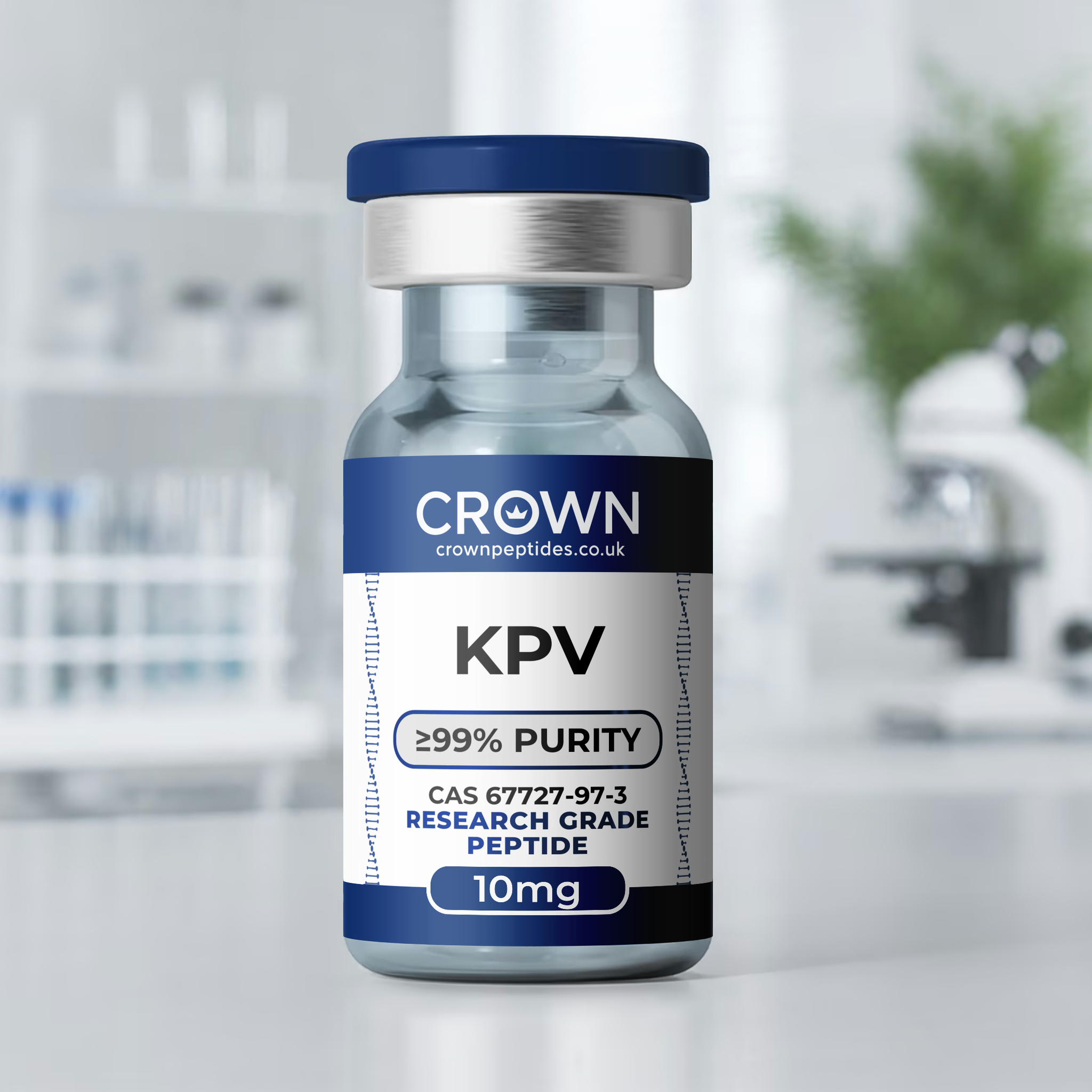
KPV Research Peptide

A high-purity research peptide studied in inflammation and gut research. Available in 10mg, 30mg and 50mg, with every batch independently tested and dispatched from the UK.

£33.99or from £25.49 per vial in packs of 10
Save up to 25%
From: £33.99
Your selection:
Order within
for same-day dispatch
13Hrs:23Min:09Sec
In stockEstimated deliveryEst. delivery Saturday 24 OctoberSaturday 24 Oct
All Batches TestedEvery batch, no exceptions
HPLC & MS VerifiedFull certificate published
Same Day PostageOrder before 2pm
UK Based CompanyDispatched from the UK
Product Overview

A high-purity research peptide studied in inflammation and gut research. Available in 10mg, 30mg and 50mg, with every batch independently tested and dispatched from the UK.

Full Product Specification
Overview

Product Overview

KPV peptide UK is Crown Peptides' tripeptide fragment of alpha-melanocyte-stimulating hormone, available in 10mg, 30mg and 50mg strengths for laboratory research.

10mg, 30mg & 50mgAvailable strengthsHPLC testedChromatographic purityMS verifiedIdentity confirmedBatch CoADocumentation supplied

Supplied for laboratory research purposes only — not for human consumption or for medical, veterinary or diagnostic use.

Key features

Key Features

  • Studied in research involving inflammatory mediator research
  • Studied in research involving intestinal epithelial models
  • Studied in research involving immune-signalling pathways
  • Studied in research involving skin and barrier-related research
  • Batch-specific quality documentation available
Background

About KPV Peptide UK

KPV is the tripeptide Lys-Pro-Val, corresponding to a short C-terminal fragment of alpha-melanocyte-stimulating hormone. Despite its very small size, it has attracted experimental interest because research suggests it can retain aspects of the parent peptide's anti-inflammatory signalling without requiring the full melanocortin sequence.

Also known as: KPV peptide, Lys-Pro-Val, alpha-MSH 11–13.

Research

KPV Research

KPV research includes inflammatory mediator pathways, intestinal epithelial models, immune signalling and skin or barrier-related systems, with published work examining its anti-inflammatory potential in murine models of inflammatory bowel disease (Learn more). Experimental work has also examined NF-kappaB-related signalling and cytokine responses. The tripeptide is therefore commonly used in mechanistic research on peptide-mediated inflammatory regulation, alongside related barrier-research peptides such as BPC-157.

  • Inflammatory mediator research
  • Intestinal epithelial models
  • Immune-signalling pathways
  • Skin and barrier-related research
From alpha-MSH to just three amino acids

Alpha-melanocyte-stimulating hormone is a 13-amino-acid peptide (SYSMEHFRWGKPV) cut from a larger precursor protein, pro-opiomelanocortin. It is best known for driving skin pigmentation, but by the early 1980s physiologist James Lipton and colleagues had found that it also lowers fever in animal models. That raised an obvious question: which part of the molecule carries the message?

Shorter fragments such as alpha-MSH 1–10 did nothing in their fever experiments, so attention turned to the far end of the chain. In 1984 Richards and Lipton showed that the final three residues alone, lysine-proline-valine, reduced fever in rabbits, although with lower potency than the full hormone. Five years later, Hiltz and Lipton reported in The FASEB Journal that the same tripeptide reduced chemically induced ear swelling in mice, in an experiment benchmarked against saline and corticosteroid groups. From that point KPV had a research identity of its own: the smallest piece of alpha-MSH still associated with its anti-inflammatory signalling, without the pigment-producing role of the parent hormone.

Colitis models and the PepT1 gateway

The gut is where KPV research has gone deepest. In 2008 a team at the University of Münster tested KPV in two well-established mouse models of colitis, one triggered by dextran sodium sulfate and one by transferring a subset of T cells. Mice given KPV recovered body weight sooner and showed fewer inflammatory cells in the colon wall. Strikingly, the effect held in mice with a non-functional melanocortin-1 receptor, suggesting KPV does not depend entirely on the receptor its parent hormone uses.

The same year, Emory University researchers offered an explanation in Gastroenterology. KPV is small enough to be carried into cells by PepT1, a transporter for di- and tripeptides that is normally found in the small intestine and becomes more abundant in the inflamed colon. Once inside intestinal epithelial cells and T cells, nanomolar concentrations of KPV damped down NF-κB and MAP kinase signalling and lowered pro-inflammatory cytokine output. Later work from the same group packaged KPV into hyaluronic acid-coated nanoparticles to steer it to colonic cells and macrophages in mouse colitis models.

Inside the cell: how KPV reaches NF-κB

NF-κB is a master switch for inflammatory genes. To do its job, its p65 subunit has to travel into the cell nucleus, carried by transport proteins called importins. A 2012 study from the University of Dundee, working with human bronchial airway cells, found that KPV itself moves into the nucleus and appears to interfere with the site on p65 that importin-α3 recognises. The result was less p65 reaching the nucleus and lower secretion of the chemokines IL-8 and eotaxin.

That intracellular route fits with earlier findings in skin cells. A University of Sheffield team studying human keratinocytes saw no rise in cyclic AMP, the classic messenger of melanocortin receptors, in response to alpha-MSH or KPV, though the peptides did trigger calcium signals under specific conditions. Together these studies make KPV an appealing tool for researchers who want to study NF-κB control by a peptide that does not simply act as a miniature hormone.

Barrier tissues: skin, cornea and microbes

Alpha-MSH occurs naturally in barrier organs such as the gut and skin, and that has steered KPV research towards the body’s front lines. In a 2000 study in the Journal of Leukocyte Biology, Cutuli and colleagues reported that both alpha-MSH and KPV inhibited colony formation by Staphylococcus aureus and reduced the viability of the yeast Candida albicans in laboratory tests, including at very low concentrations.

Repair of surface tissue is another strand. In a rabbit model of corneal epithelial wounding, topical KPV was associated with faster re-epithelialisation, an effect that was blocked when nitric oxide production was inhibited. More recently, a rat model of chemotherapy-induced oral mucositis used KPV loaded into a mucosa-adhering hydrogel, with lower IL-1β and TNF-α and higher IL-10 in the healing tissue. Those antimicrobial and barrier findings are why KPV is often considered alongside LL-37, the human cathelicidin peptide studied in innate defence.

Specifications

Specifications

Product
KPV
Classification
Tripeptide fragment of alpha-melanocyte-stimulating hormone
Available strengths
10mg, 30mg and 50mg
CAS number
67727-97-3
Molecular weight
342.43 Da
Molecular formula
C16H30N4O4
Sequence
Lys-Pro-Val (KPV)
Form
Research material supplied according to product label
Purity and assay
99% (HPLC), batch-specific — refer to Certificate of Analysis
Verification
HPLC and Mass Spectrometry where analytically appropriate

Compound-level reference data. Batch-specific results appear on the Certificate of Analysis.

Work out concentration with the peptide calculator
Testing

Purity and Testing

Crown Peptides KPV is supplied for controlled laboratory research with batch-specific analytical documentation. High-Performance Liquid Chromatography (HPLC) can assess chromatographic purity, while Mass Spectrometry provides molecular information used to support identity verification.

The batch-specific Certificate of Analysis is the definitive source for the exact purity result, identity data and analytical specification of the material supplied.

Storage

Storage Conditions

  • Store unreconstituted material at -20°C ± 5°C in a cool, dry environment
  • Prepared research solutions should use validated storage conditions appropriate to the compound and study design
  • Protect from unnecessary heat, direct light and repeated temperature fluctuations
Full storage guide
Related

Related Compounds

Researchers working with KPV may also be interested in BPC-157, KLOW, GHK-Cu, Melanotan-1 and LL-37 — other compounds studied in inflammatory, barrier and melanocortin-related research.

Compliance

Research Use Only

  • Laboratory research only
  • Not for human or clinical use
  • Not for human or veterinary consumption
  • Qualified personnel only
Questions

KPV Frequently Asked Questions

About KPV7 questions
What is KPV and where does it come from?

KPV is the tripeptide lysine-proline-valine. It matches the last three amino acids of alpha-melanocyte-stimulating hormone (alpha-MSH), the 13-residue peptide made from pro-opiomelanocortin. Crown Peptides supplies it in 10mg, 30mg and 50mg strengths.

Why is KPV also called alpha-MSH 11–13?

The name is a map reference. Alpha-MSH runs SYSMEHFRWGKPV, and K, P and V occupy positions 11, 12 and 13 at its C-terminal end. Papers use KPV, Lys-Pro-Val and alpha-MSH(11–13) interchangeably, which is worth knowing when searching the literature.

Is KPV still a melanocortin peptide?

By origin, yes; by behaviour, only partly. In mouse colitis work KPV remained active in animals lacking a working melanocortin-1 receptor, and in human keratinocytes it did not raise cyclic AMP the way a typical melanocortin agonist would. Much current research focuses on its entry into cells through the PepT1 transporter and its effects on NF-κB inside the cell.

Does KPV have alpha-MSH’s pigment effect?

That is the key difference. Review literature from the University of Münster highlights exactly this point: KPV keeps the anti-inflammatory signalling associated with alpha-MSH but lacks its pigmentary action. That separation is a large part of why the tripeptide is studied in its own right.

Why did KPV research begin with fever rather than the gut?

Because alpha-MSH was first noticed for lowering fever. James Lipton’s group went looking for the part of the hormone responsible, and in rabbit experiments the C-terminal Lys-Pro-Val reduced fever on its own. Its anti-inflammatory activity in mouse skin followed, and only later did intestinal epithelial cells and colitis models become the main arena for KPV work.

What is PepT1 and why does it matter for KPV?

PepT1 is a transporter that carries di- and tripeptides across cell membranes. It is found mainly in the small intestine and becomes more abundant in the inflamed colon. Researchers at Emory University showed that KPV uses PepT1 to enter intestinal epithelial cells and immune cells, which helps explain how such a small peptide acts at nanomolar concentrations in those models.

Is KPV part of the KLOW blend?

Yes. KLOW contains 10mg of KPV alongside GHK-Cu, BPC-157 and TB-500. Standalone KPV is the choice when you want to vary the KPV concentration independently or study it on its own.

Research context4 questions
How does KPV differ from Melanotan-1?

They sit at opposite ends of the alpha-MSH family. Melanotan-1 is a full-length, stabilised alpha-MSH analogue built to activate melanocortin receptors strongly, so it is studied in pigmentation research. KPV keeps just the final three residues and is studied for inflammatory signalling rather than pigment.

Why is KPV studied alongside LL-37?

Both are peptides of innate host defence. KPV and alpha-MSH have been reported to inhibit Staphylococcus aureus and Candida albicans in laboratory tests, while LL-37 is the human cathelicidin antimicrobial peptide. Researchers interested in where infection and inflammation meet often look at both.

What is KdPT and how is it related to KPV?

KdPT (Lys-D-Pro-Thr) is a close relative that corresponds to amino acids 193–195 of interleukin-1β. Like KPV it opens with lysine followed by proline, here in its D-form, and it has emerged as another small tripeptide studied for anti-inflammatory signalling. Comparing the two helps researchers pin down which structural features matter.

How does KPV fit with BPC-157 in gut research?

They address different parts of the same picture. KPV is studied for inflammatory signalling in intestinal epithelial and immune cells, while BPC-157 is studied in tissue-response and gastrointestinal repair models. Running both in one colitis or epithelial model lets researchers look at inflammation and repair side by side.

Strengths & identity2 questions
Why offer KPV in 10mg, 30mg and 50mg rather than one size?

KPV studies range from tiny to large. Epithelial and T-cell assays respond at nanomolar concentrations and barely dent a 10mg vial, while a multi-arm colitis model can get through far more material, which is where 30mg and 50mg earn their place. Whatever the strength, multi-vial bundles of five or ten let a project run from start to finish on a single batch.

Is KPV amidated, like the end of alpha-MSH?

Not this product. In alpha-MSH the final valine carries a C-terminal amide, but the formula listed here, C16H30N4O4 (342.43 Da on average, about 342.23 Da monoisotopic), matches the free-acid form of Lys-Pro-Val. In positive-mode electrospray that puts the singly protonated ion near m/z 343.2. An amidated version would sit roughly one mass unit lower, so the two are easy to tell apart, and each batch’s Certificate of Analysis records the confirmed result.

Read the batch certificate before you order

Every batch is published openly — identity, purity and batch number, with no account needed.

View lab reports

Supplied for laboratory research purposes only — not for human consumption or for medical, veterinary or diagnostic use.

All Batches TestedEvery batch, no exceptions

Each batch undergoes internal analytical verification using chromatographic and spectrometric methods prior to lyophilisation.

• HPLC Analysis
• Mass Spectrometry Confirmation
• Batch Traceability

For Research Use Only

By purchasing this product you confirm that you are a qualified researcher and that this compound will be used exclusively for laboratory research purposes.

Not for Human Consumption

This product is not intended for diagnostic or therapeutic use.

Any human or medical use is strictly prohibited.

Store Safely at All Times

Store in a cool, dry, secure and sterile environment away from any unauthorised persons or children.

Other Research Peptides

2 strengths5-Amino-1MQ 10mg research compound vial, Crown Peptides UKAgeing research

5-Amino-1MQ Research Compound


From£24.99Strength10mg
Add to basket
Adamax 10mg research peptide vial, Crown Peptides UKNeurocognitive research

Adamax Research Peptide


From£44.99Strength10mg
Add to basket
AHK-Cu 100mg copper peptide vial, Crown Peptides UKAgeing research

AHK-Cu Research Peptide


From£29.99Strength100mg
Add to basket
AICAR 50mg research compound vial, Crown Peptides UKAgeing research

AICAR Research Compound


From£34.99Strength50mg
Add to basket

Further reading

UK research peptides. Every batch HPLC and MS verified, certificate published in full.
SUPPORT Mon to Fri, 9am to 5pmDISPATCH Cut-off 2pmEMAIL Email usWHATSAPP +44 7301 802654

Disclaimer: All products are sold strictly for laboratory research purposes only. Not for human or veterinary use, consumption, therapeutic, or diagnostic application. None of our products are medicines, and none are presented as such. By purchasing, you confirm you are a qualified professional and legally permitted to handle these materials in compliance with all applicable laws and regulations. Misuse, resale for unauthorised purposes, or unlawful application is strictly prohibited. Crown Peptides UK disclaims all liability for improper use, handling, or regulatory non-compliance.

© 2026 Crown Peptides UK, a trading name of Crown Peptides Ltd (company no. 17068950), Suite Ra01, 195-197 Wood Street, London E17 3NU . All Rights Reserved.