ACE-031 (Ramatercept): The Myostatin Trap Behind Modern Muscle Research
What ACE-031 really is, how this ActRIIB decoy traps myostatin and its relatives, what mouse, monkey and human studies found, why its trial stopped, and the sharper muscle tools that followed.
On this page
- What Is ACE-031?
- The Brake Nobody Knew Muscle Had
- How Muscle Growth Signalling Works: One Accelerator, Several Brakes
- Why a Decoy Beat a Single Blocker
- What Animal Studies Found Beyond Healthy Muscle
- What Did ACE-031 Do in People?
- What Came Next: Sharper Tools Built on the Same Idea
- ACE-031 vs Follistatin: Natural Binding Protein or Engineered Decoy?
- The Open Questions Still Driving This Field
- The Technical Breakdown: Receptor Architecture, Ligand Binding and the Fc Tail
- Why Identity Testing Matters More as Molecules Get Bigger
- Related Compounds Worth Knowing About
- Common Questions About ACE-031
- Muscle's Brake Is Still the Most Interesting Lever in the Body
- References
Thirty-three days on the International Space Station should have cost a group of mice a good share of their muscle and bone, and the untreated ones duly lost both. The mice given a soluble decoy version of a single muscle receptor did something remarkable instead: they showed dramatic increases in muscle and bone mass, just like treated mice that never left the ground (PMID: 32900939). That decoy receptor, the activin receptor type IIB, is the idea behind ACE-031, one of the most talked-about molecules in muscle research and the compound that carried the "myostatin trap" idea from mouse cages into human trials.
Crown Peptides supplies the ACE-031 Research Peptide for laboratory work, alongside the growth-signalling compounds in our Musculoskeletal research peptides range. This guide explains what ACE-031 actually is (a large engineered protein rather than a short peptide, and why it is still searched for as an "ACE-031 peptide"), how it traps myostatin and its relatives, what animal and human studies found, what the trials reported on side effects, how it compares with follistatin, and where the field went next. ACE-031 and every other Crown Peptides compound linked here are sold strictly for laboratory research use only, and what follows is written for readers who want the science.
What Is ACE-031?
Think of ACE-031, or ramatercept, as two halves bolted together. One half is the catching end of a muscle receptor, ActRIIB (the activin receptor type IIB, sometimes written ACVR2B). The other is the Fc "tail" borrowed from a human IgG1 antibody. Two such chains pair up, so the finished molecule is a dimer (PMID: 40312924). It came out of Acceleron Pharma in Cambridge, Massachusetts, which partnered with Shire in September 2010 to develop it for Duchenne muscular dystrophy, Shire taking the rights outside North America.
A receptor with no cell attached
Normally ActRIIB sits in the membrane of muscle cells, waiting for myostatin and related signals to land on it. ACE-031 is the same docking site cut loose and set adrift in the blood. Any myostatin that binds it is caught before it ever reaches a real receptor. That is why it is called a "ligand trap" or decoy receptor: it does not block the receptor, it soaks up the messages meant for it.
Is ACE-031 a peptide or a protein?
Strictly, a protein. Each chain runs to several hundred amino acids, folded into a receptor domain and an antibody domain, compared with 15 for BPC-157. But every protein is built from amino acids joined by peptide bonds, as our guide What Is a Peptide Bond? explains, and the line between a long peptide and a protein is a convention rather than a law of nature (What Are Peptides? covers where it is usually drawn). Because it is discussed alongside peptide research tools, "ACE-031 peptide" has simply become its everyday name, and its size is part of the appeal: the Fc tail keeps it circulating for days rather than minutes.
ACE-031, ACE 031, ramatercept, ActRIIB-Fc: one molecule, many names
You will see it written as ACE-031, ACE 031, ramatercept, ActRIIB-IgG1 (the name on its Duchenne trial registration), ActRIIB-Fc or ACVR2B-Fc. The last two also describe the general design, including mouse versions used in animal studies, so check which molecule a paper tested.
The Brake Nobody Knew Muscle Had
ACE-031 only makes sense in the light of myostatin. In 1997, Alexandra McPherron and Se-Jin Lee at Johns Hopkins found that mice lacking a gene they called GDF-8 grew muscles two to three times heavier than normal (PMID: 9139826). Our guide to peptides being researched for muscle growth tells that part of the story; here are the chapters that followed.
Belgian Blue cattle and "bully" whippets
Within months, the same team had read the myostatin gene in nine other species and, alongside other groups, pinned down the cause of a famous farm curiosity. Belgian Blue cattle, with their bulging "double-muscled" build, carry an 11-letter deletion that wipes out almost all of the active part of the protein; Piedmontese cattle carry a single-letter change at a crucial spot (PMID: 9356471). A decade later, a two-letter deletion turned up in whippets. Dogs with two copies were the heavily muscled "bully" whippets, while dogs with one copy were more muscular than average and significantly faster in competitive races (PMID: 17530926).
A child, and a question
In 2004, doctors at Berlin's Charité described a child with a myostatin mutation and gross muscle hypertrophy (PMID: 15215484). The brake worked the same way in people. The obvious next question was whether it could be eased from the outside, in an adult animal, with a drug rather than a gene.
The first clue that a decoy would work
Lee and McPherron found the first clue in 2001. Purified myostatin bound ActRIIB (and, less strongly, ActRIIA), and that binding could be blocked by follistatin. Mice engineered to make follistatin, myostatin's own propeptide or a broken, "dominant-negative" ActRIIB in their muscles all grew dramatically, comparable to mice with no myostatin at all (PMID: 11459935). Blocking the receptor's signal worked as well as deleting the gene.
How Muscle Growth Signalling Works: One Accelerator, Several Brakes
Here is the simplest useful picture of muscle size.
The accelerator: IGF-1, Akt and mTOR
Growth factors such as IGF-1 switch on a chain of enzymes, Akt then mTOR, that tells muscle fibres to build protein. In a landmark study across several rodent models, this Akt/mTOR pathway rose during muscle growth and fell during wasting; blocking mTOR with rapamycin stopped growth in every model tested, and switching the pathway on genetically was enough to make fibres grow (PMID: 11715023). This is the side studied with IGF-1 LR3 and MGF.
The brake: myostatin, ActRIIB and Smad2/3
Myostatin lands on ActRIIB (and its sister receptor ActRIIA), which recruits a partner receptor and switches on two messenger proteins, Smad2 and Smad3. In muscle cells, myostatin needed both Smads to work, and it also turned down the Akt/mTOR accelerator itself (PMID: 19357233). In adult mouse muscle, Smad2 and Smad3 drove a wasting programme, while blocking them made fibres grow without needing satellite (stem) cells, partly through mTOR (PMID: 19357234).
Why the two sides talk to each other
The accelerator and the brake are wired together: Akt quietens the brake, and Smad signalling quietens the accelerator. The authors of the Smad study suggested that myostatin blockers would work best combined with IGF-1/Akt activators (PMID: 19357234).
Where ACE-031 sits
ACE-031 works on the brake, outside the cell. It does not add any growth signal; it removes the signals telling muscle to stop. And because it is a copy of the receptor rather than a myostatin-specific antibody, it catches the ligands that receptor would normally catch.
- Also known as
- Ramatercept; ACE 031; ActRIIB-IgG1; ActRIIB-Fc; ACVR2B-Fc
- Classification
- Recombinant fusion protein: the ligand-binding outer domain of human ActRIIB fused to a human IgG1 Fc tail, two chains paired as a dimer
- Developer
- Acceleron Pharma (partnered with Shire for Duchenne muscular dystrophy, 2010 to 2013)
- Ligands trapped
- Myostatin (GDF-8), GDF-11 and activin A with high affinity; also the blood-vessel signal BMP9
- Half-life in people
- About 10 to 15 days (phase 1 study)
- Research status
- Mouse and marmoset studies; phase 1 studies in healthy postmenopausal women; a phase 2 study and extension in boys with Duchenne muscular dystrophy, stopped in 2011
Why a Decoy Beat a Single Blocker
Here is the twist. ACE-031 was not interesting simply because it blocked myostatin. It was interesting because it blocked more than myostatin, and the extra targets turned out to matter.
Up to 60% more muscle in two weeks
In 2005, Se-Jin Lee's group tried a soluble form of ActRIIB in normal mice, and within a fortnight their muscle mass had climbed by as much as 60%. Then came the surprise. Mice with no myostatin gene at all still grew on it: less than normal mice, but clearly. At least one other ligand, the team concluded, normally holds muscle back as well, and these ligands signal through both ActRIIA and ActRIIB (PMID: 16330774).
Lee pushed the point further in 2007. Myostatin-null mice that also carried a follistatin gene, which mops up several of these ligands, ended up with about four times the muscle mass of normal mice (PMID: 17726519). Removing myostatin roughly doubles muscle; removing myostatin and its relatives can go much further.
Which ligands does ACE-031 catch?
Acceleron's scientists measured it directly. Myostatin (GDF-8) and its close cousin GDF-11 bound the ActRIIB-Fc trap about as tightly as activin A, a known high-affinity partner, while bone-building signals BMP-2 and BMP-7 bound at least 100 times more weakly (PMID: 20385559).
Bigger fibres of every type
Selective myostatin blockers had mainly enlarged fast, type II fibres. In Acceleron's 2010 mouse study, 28 days of ACE-031 left mice 16% heavier than controls, with individual leg muscles 26% to 46% heavier. Fibre cross-sectional area rose by 22% in slow type I fibres and 28% in type II fibres of the soleus, and by 57% in the fast-fibre plantaris, without shifting the muscles' fibre-type mix (PMID: 20466801).
The primate study published fifteen years later
One of the most interesting ACE-031 papers appeared only in February 2026, fifteen years after clinical work on the molecule stopped, written by Acceleron scientists with University of Pennsylvania and other collaborators. Common marmosets randomised to ACE-031 or a control solution for 14 weeks gained lean body mass over the study, which the controls did not. Their biceps showed larger type I and type II fibres, and a lower-leg muscle tested outside the body produced more absolute and specific force (PMID: 41686840). That last detail matters: more force per unit of muscle, not just more muscle.
What Animal Studies Found Beyond Healthy Muscle
Healthy mice were only the start. The real research interest lay in conditions where muscle, bone or fat go wrong.
Duchenne muscular dystrophy models
Mdx mice lack dystrophin, the protein missing in Duchenne muscular dystrophy. When a University of Pennsylvania team used a gene-delivery virus to make the liver release soluble ActRIIB, mdx mice gained muscle mass and force in a fast-twitch leg muscle, blood creatine kinase (a marker of muscle damage) fell, and heart size and function were unaffected (PMID: 20730876).
A fair picture includes a French and German study that ran the other way. Four months of ActRIIB-Fc made mouse muscle tire extremely quickly, with raised blood lactate, fewer capillaries and a severe metabolic myopathy in mdx mice. ActRIIB signalling, the authors showed, helps give muscle its high oxidative capacity (PMID: 24861054). Bigger muscle and better-fuelled muscle are separate questions, which is exactly why muscle metabolism research matters alongside size.
ALS models
Mice carrying a faulty human ALS gene, SOD1, are a standard model of amyotrophic lateral sclerosis. Given a mouse version of the soluble receptor, they became weak later than untreated mice and gained body weight, grip strength and muscle size, and it made no difference whether the treatment started before or after symptoms showed. They did not live longer. But the soluble receptor beat deleting the myostatin gene outright, on every measure taken (PMID: 19285073), another sign that trapping several ligands does more than removing one.
Cancer cachexia models
The most dramatic result came from Amgen. In several mouse models of cancer-related wasting, blocking the ActRIIB pathway with a soluble receptor not only stopped further muscle loss but completely reversed earlier muscle and heart wasting, switching off the wasting enzymes in muscle and growing muscle stem cells. The mice lived dramatically longer, even though their tumours kept growing (PMID: 20723755).
Bone and fat
ActRIIB ligands reach beyond muscle. In castrated mice, a model of androgen deprivation, Acceleron's ActRIIB-mFc raised lean mass by 26%, cut fat by 36% and prevented both fatty liver and bone loss (PMID: 20573726). The spaceflight study in the opening showed the same muscle-and-bone pattern in orbit.
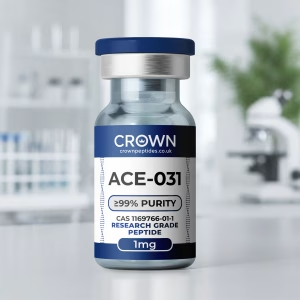
ACE-031 Research Peptide
Out of stock · every batch HPLC and MS tested
View ACE-031 Research Peptide ›What Did ACE-031 Do in People?
Two human studies of ACE-031 have been published, and together they tell the field's most important story.
The phase 1 study in healthy postmenopausal women
Acceleron's first-in-human study randomised 48 healthy postmenopausal women, three to one, to a single dose of ACE-031 at one of several levels or to placebo. It was generally well tolerated, and its half-life was 10 to 15 days. By day 29, the top dose group had gained a statistically significant 3.3% in whole-body lean mass, measured by DXA scanning, and 5.1% in thigh muscle volume, measured by MRI; blood markers also shifted in ways that hinted at effects on bone and fat (PMID: 23169607). It was the first clear sign that the brake could be eased in people.
The phase 2 study in boys with Duchenne muscular dystrophy
The Duchenne study began in April 2010 and enrolled 24 boys, according to its ClinicalTrials.gov record. It was randomised, double-blind and placebo-controlled, with dose levels rising in stages, and its main aim was safety. Published results came in 2017: no serious or severe adverse events were linked to ACE-031, but the trial was stopped after the second dose level over potential safety concerns about nosebleeds (epistaxis) and small dilated blood vessels (telangiectasias). Boys on ACE-031 tended to hold their six-minute walk distance while the placebo group declined, not statistically significant in so small and short a study, and showed trends towards more lean mass, higher bone mineral density and less fat (PMID: 27462804).
Clinical development was suspended in February 2011, and in May 2013 Acceleron and Shire announced that they would not restart it. ACE-031 itself never reached the market.
ACE-031 side effects: what the trials reported
The two published studies reported generally good tolerance, with local skin redness where it was given, in healthy women (PMID: 23169607), and nosebleeds and telangiectasias in boys with Duchenne, with no serious or severe adverse events (PMID: 27462804). The authors described these as effects outside muscle. Across the wider class, a 2022 review noted that while some drugs on this pathway stopped because of off-target effects, failures more often came from preserving muscle mass without improving function (PMID: 34520530).
Why blood vessels? The BMP9 clue
The receptor ACE-031 copies does not only catch muscle signals. Acceleron's own later work showed that ActRIIB-Fc also traps BMP9, a signal that regulates blood vessels, and its researchers suggested that trapping BMP9 might have been responsible for the nosebleeds and telangiectasias seen in people (PMID: 33586684).
That has not been proven, but the pieces fit. BMP9 and its close relative BMP10 are the natural partners of ALK1, a receptor on the cells lining blood vessels, where they keep those cells calm (PMID: 17068149). Faults in ALK1 or its partner endoglin cause hereditary haemorrhagic telangiectasia, an inherited condition named for exactly those small, fragile dilated vessels (PMID: 25620979). Nosebleeds and telangiectasias have also been reported more often with sotatercept, the related ActRIIA trap, than with placebo (PMID: 39466552). Either way, the idea pointed the field towards a clear goal: catch the muscle brakes, leave the vessel signals alone.
What Came Next: Sharper Tools Built on the Same Idea
ACE-031's early stop did not end myostatin research. It sharpened it, and the field has rarely moved faster.
ACE-083: keeping the effect in one muscle
Acceleron's next muscle compound, ACE-083, was built from follistatin rather than ActRIIB. It binds myostatin, activin A, activin B and GDF-11, but it also sticks to heparin and the scaffolding around cells, so it stays where it is placed: in mice it caused growth of the targeted muscle with no systemic muscle effects, and increased force in models of Charcot-Marie-Tooth disease (CMT) and Duchenne (PMID: 31388039).
In a phase 1 study of 58 healthy postmenopausal women, the targeted thigh and shin muscles grew by up to 14.5% and 8.9% in volume, with no serious adverse events, though strength did not change significantly (PMID: 29486514). Phase 2 studies followed. In facioscapulohumeral muscular dystrophy, muscle volume rose 16.4% in the biceps and 9.5% in the shin against placebo, with no consistent functional gain (PMID: 35428982); in CMT, volume rose 13.5% and ankle strength differed from placebo, while other functional measures did not (PMID: 35545446).
Antibodies that pick a single target
Drug makers also built antibodies aimed at myostatin alone. Eli Lilly's landogrozumab (LY2495655) was tested in 201 people aged 75 or over who had fallen in the past year; after 24 weeks, limb lean mass was 0.43 kg higher than with placebo, and some power-based tests such as stair climbing improved (PMID: 26516121).
The furthest along is apitegromab from Scholar Rock, which selectively blocks the activation of myostatin; in September 2026 the US FDA approved it as Isembyld for spinal muscular atrophy in people aged 2 and over already receiving SMN2-targeted treatment. In the phase 3 SAPPHIRE trial in 188 young people with non-walking type 2 or type 3 spinal muscular atrophy already receiving standard therapy, after 12 months the children aged 2 to 12 on apitegromab scored 1.8 points higher than placebo on a motor function scale (their scores edged up while the placebo group's fell), although the higher-dose group on its own did not reach significance (PMID: 40818473). In a 2026 phase 2 study of 102 adults with overweight or obesity taking tirzepatide, apitegromab led to 1.9 kg less lean mass loss than placebo, despite similar weight loss (PMID: 42260100).
Bimagrumab: blocking the receptor itself
Bimagrumab takes the opposite approach to ACE-031: instead of trapping ligands, it is an antibody that blocks the type II activin receptors themselves. In a 48-week phase 2 trial in 75 adults with type 2 diabetes and obesity, it reduced fat mass by 20.5% against 0.5% with placebo, while lean mass rose 3.6% against a 0.8% fall (PMID: 33439265). In the 507-person BELIEVE trial, published in 2026, the higher doses of bimagrumab and semaglutide together produced an average weight loss of 17.8 kg at 48 weeks, against 14.2 kg for semaglutide alone and 9.3 kg for bimagrumab alone at those doses, and 3.3 kg for placebo (PMID: 41772149). Our guide to peptides being researched for weight loss covers the other half of that story.
The ligand-trap family that became medicine
ACE-031's design lives on in two licensed medicines. Luspatercept (ACE-536) uses an ActRIIB extracellular domain modified to reduce activin binding; it traps GDF-11 and helps red blood cells mature (PMID: 24658078), and the US FDA approved it in November 2019 for anaemia in beta thalassaemia. Sotatercept, Acceleron's trap built on the sister receptor ActRIIA, became the first activin receptor IIA inhibitor approved by the US FDA for pulmonary arterial hypertension (PMID: 39466552) and was approved by the UK's MHRA in December 2024. And Acceleron's ActRIIB:ALK4-Fc, which pairs ActRIIB with a partner receptor, kept the muscle-limiting ligands in its grip but let BMP9 go, increasing muscle mass and function in mouse models of Duchenne, ALS and disuse (PMID: 33586684).
ACE-031 vs Follistatin: Natural Binding Protein or Engineered Decoy?
It is a natural comparison: both catch the same family of ligands, by completely different means.
Follistatin: the body's own sponge
Follistatin was first isolated in 1987, in part by a Salk Institute team that included Roger Guillemin (the same Guillemin whose hypothalamic hormone work features in our article What Is GnRH?). The team isolated a 35-kilodalton, cysteine-rich protein from pig ovarian fluid that held back release of follicle-stimulating hormone, and named it follistatin (PMID: 3120188). It is now known as an activin-binding protein and, as Lee and McPherron showed, it blocks myostatin binding to ActRIIB too (PMID: 11459935).
What is follistatin 344?
FS344 is one of follistatin's naturally spliced forms, chosen by gene-therapy researchers because it acts on skeletal muscle with only minimal effects on other cells. Delivered by a virus into the thigh muscles of macaque monkeys, it produced pronounced, durable gains in muscle size and strength, with no abnormal changes in key organs (PMID: 20368179). In a small phase 1/2a trial in six people with Becker muscular dystrophy, four improved their six-minute walk distance, by 29 to 125 metres, and no adverse effects were seen (PMID: 25322757).
How they differ
- Origin: follistatin is a natural binding protein; ACE-031 is an engineered copy of a receptor.
- Grip: both catch myostatin, activins and GDF-11; the ActRIIB trap also caught BMP9.
- Reach: ACE-031 was built to circulate through the whole body for days; follistatin-based tools such as FS344 gene delivery and ACE-083 were designed to act where they are placed.
The Open Questions Still Driving This Field
The questions ACE-031 raised are the ones the field is still chasing. Which ligand matters most in which disease: myostatin alone, or activin A and GDF-11 too? How do you turn extra muscle into extra function, the gap seen in so many trials? And can traps such as ActRIIB:ALK4-Fc be tuned to catch exactly the right ligands and nothing else?
The Technical Breakdown: Receptor Architecture, Ligand Binding and the Fc Tail
Here is the receptor chemistry in more detail, for anyone who wants it. Nothing above depends on this section.
Type II and type I receptors
TGF-beta family ligands signal through pairs of serine/threonine kinase receptors. A type II receptor (ActRIIA or ActRIIB) pairs with a type I receptor, an activin-like kinase, and the signal passes to Smad2 and Smad3; myostatin needs both Smads to act (PMID: 19357233). BMP9 and BMP10 signal instead through ALK1 and Smad1/5/8 in endothelial cells (PMID: 17068149), which is why a trap built from a type II receptor alone can reach both pathways.
Binding detail
Kinetic studies of ActRIIB-Fc showed GDF-8 and GDF-11 binding with affinities comparable to activin A, while BMP-2 and BMP-7 bound at least 100-fold more weakly. ActRIIB grips GDF-11 and activin A in different ways: changing leucine 79 abolished activin A binding but not GDF-11 binding (PMID: 20385559). Engineering of this kind produced luspatercept's reduced activin binding (PMID: 24658078), and pairing ActRIIB with the ALK4 extracellular domain left BMP9 untrapped (PMID: 33586684).
The Fc tail and the long half-life
The IgG1 Fc region joins two receptor chains into one dimer and gives the molecule antibody-like persistence in blood, measured in days rather than the minutes typical of a short peptide (PMID: 23169607). Our article Peptide Half-Life Explained covers why size and structure change clearance so much.
Why Identity Testing Matters More as Molecules Get Bigger
A purity figure answers one question: how much of what is in the vial is the main component. For a short peptide that is usually enough. A large engineered protein asks more, because two halves have to be joined, the chains have to pair up and the whole thing has to fold, so a preparation can be chemically clean and still not be the molecule on the label. Hence identity testing. HPLC measures how much of a batch is the intended material; mass spectrometry then checks the molecule itself, weighed against the expected mass for a protein that size rather than to the single dalton.
Every product Crown Peptides sells, the ACE-031 Research Peptide included, comes with a batch certificate published on our Lab Reports page, matched to the batch number on the vial. Our guides Peptide Testing UK and How to Read a Peptide Certificate of Analysis explain each line on one. Vials ship freeze-dried and are kept cold until they leave us (see storage information); weekday orders placed before 2pm go out the same day, UK delivery is free over £100, and batch questions reach a real person, usually within 24 hours on business days or sooner on WhatsApp, via our contact page.
Related Compounds Worth Knowing About
ACE-031 eases the brake. The compounds below are studied on the other side of the same story, or where it meets repair and metabolism.
The growth-factor accelerator
IGF-1 LR3 delivers a strong IGF-1 signal that largely escapes the binding proteins holding natural IGF-1 in check; in rat muscle cells it was more potent than IGF-1 at stimulating protein synthesis and slowing breakdown (PMID: 1378742). MGF is based on a splice variant of IGF-1 that appears rapidly after muscle damage in rats, apparently helping to wake satellite cells (PMID: 12692175), and PEG-MGF is its pegylated, longer-lasting form. Our IGF-1 LR3 guide, MGF guide and PEG-MGF guide tell their stories in full.
Repair after injury
BPC-157 consistently improved healing of a completely cut quadriceps muscle in rats over 72 days (PMID: 16609979). TB-500 is based on thymosin beta-4, which, given to exercised mdx mice for six months, increased the number of regenerating fibres, the same Duchenne model used in ACE-031 research (PMID: 20126456). The BPC-157 + TB-500 Blend (Wolverine Stack) combines both, and BPC-157 vs TB-500 compares them.
Muscle metabolism and the myostatin link
MOTS-c is the compound in our range most directly tied to myostatin. People with more MOTS-c in their blood tended to have less myostatin, and giving MOTS-c to obese mice brought their myostatin down, acting through the Akt pathway (PMID: 33554779); see our MOTS-c guide. Because ActRIIB blockade reduced muscle's oxidative capacity in mice (PMID: 24861054), compounds that act on muscle fuel are a natural companion topic. SLU-PP-332 increased oxidative type IIa fibres and endurance in mice (PMID: 36988910), while AICAR activates AMPK, and in rats it cut muscle protein synthesis to 45% of control values alongside reduced mTOR signalling (PMID: 11997383). 5-Amino-1MQ boosted muscle stem cell repair in aged mice, with peak muscle torque about 70% higher than controls (PMID: 30753815). Our AICAR and SLU-PP-332 guides go further.
The growth hormone axis
Growth hormone peptides work further upstream, raising the body's own growth hormone and IGF-1. GHRH analogues include Sermorelin, Tesamorelin and CJC-1295 (With DAC); Ipamorelin mimics ghrelin at its receptor. Growth Hormone Peptides Explained maps the family, and Peptides vs Steroids explains how all of these differ from anabolic steroids.
Most of the compounds above, the ACE-031 Research Peptide included, sit together in our Musculoskeletal research peptides category, while AICAR, SLU-PP-332 and 5-Amino-1MQ sit in our Metabolic research peptides range.
Common Questions About ACE-031
What did studies find about ACE-031 and muscle?
In mice, a soluble ActRIIB added as much as 60% to muscle mass inside a fortnight, and ACE-031 enlarged both slow and fast fibres; in marmosets it raised lean mass and muscle force. In healthy postmenopausal women, a single dose raised lean mass by 3.3% and thigh muscle volume by 5.1% within 29 days in the highest-dose group.
What side effects were reported in ACE-031 trials?
In healthy women it was generally well tolerated, with local skin redness reported. In boys with Duchenne muscular dystrophy there were no serious or severe adverse events, but nosebleeds and telangiectasias led to the trial being stopped. Later research suggests that ActRIIB-Fc trapping BMP9, a blood-vessel signal, may explain them.
ACE-031 vs follistatin 344: what is the difference?
Follistatin is a natural binding protein; FS344 is one of its spliced forms, studied mainly through gene delivery into individual muscles. ACE-031 is an engineered receptor decoy that circulates throughout the body. They catch an overlapping set of ligands, but the ActRIIB trap also catches BMP9.
What is ACE-083?
ACE-083 is Acceleron's follistatin-based, locally acting successor, designed to grow only the muscle it is placed in. It increased targeted muscle volume in healthy women and in two phase 2 studies, though functional gains were not consistent.
Why was the ACE-031 Duchenne trial stopped?
The trial was stopped after its second dose level because of potential safety concerns over nosebleeds and small dilated blood vessels, which the authors described as effects outside muscle. Acceleron's later work suggested trapping the blood-vessel signal BMP9 might have been behind them.
What is the difference between ACE-031 and bimagrumab?
ACE-031 is a decoy receptor floating in the blood, soaking up myostatin and related signals. Bimagrumab is an antibody that sits on the type II activin receptors themselves and blocks them. Both ease the same brake from opposite ends.
Muscle's Brake Is Still the Most Interesting Lever in the Body
ACE-031 proved the point: catch myostatin and its relatives in the blood, and muscle grows, in mice, in monkeys and in people. Its early stop taught the field just as much: every extra ligand a trap catches can be a gift or a problem. From that lesson came local follistatin traps, single-target antibodies, one of them now a US-approved medicine, receptor antibodies tested alongside weight-loss medicines, and two ligand traps that are licensed medicines in their own right.
The next step may come from pairing an eased brake with a pressed accelerator, or from protecting muscle while fat is lost. If that is where your work is heading, the ACE-031 Research Peptide and the rest of our Musculoskeletal research peptides range are ready for it.
References
- Lee SJ, Lehar A, Meir JU, et al. Targeting myostatin/activin A protects against skeletal muscle and bone loss during spaceflight. Proc Natl Acad Sci U S A. 2020;117:23942-23951. PMID: 32900939
- Reichel C, Filip T, Gmeiner G, et al. Gel Electrophoretic Detection of Black Market ACE-031. Drug Test Anal. 2025;17:1934-1946. PMID: 40312924
- McPherron AC, Lawler AM, Lee SJ. Regulation of skeletal muscle mass in mice by a new TGF-beta superfamily member. Nature. 1997;387:83-90. PMID: 9139826
- McPherron AC, Lee SJ. Double muscling in cattle due to mutations in the myostatin gene. Proc Natl Acad Sci U S A. 1997;94:12457-61. PMID: 9356471
- Mosher DS, Quignon P, Bustamante CD, et al. A mutation in the myostatin gene increases muscle mass and enhances racing performance in heterozygote dogs. PLoS Genet. 2007;3:e79. PMID: 17530926
- Schuelke M, Wagner KR, Stolz LE, et al. Myostatin mutation associated with gross muscle hypertrophy in a child. N Engl J Med. 2004;350:2682-8. PMID: 15215484
- Lee SJ, McPherron AC. Regulation of myostatin activity and muscle growth. Proc Natl Acad Sci U S A. 2001;98:9306-11. PMID: 11459935
- Bodine SC, Stitt TN, Gonzalez M, et al. Akt/mTOR pathway is a crucial regulator of skeletal muscle hypertrophy and can prevent muscle atrophy in vivo. Nat Cell Biol. 2001;3:1014-9. PMID: 11715023
- Trendelenburg AU, Meyer A, Rohner D, et al. Myostatin reduces Akt/TORC1/p70S6K signaling, inhibiting myoblast differentiation and myotube size. Am J Physiol Cell Physiol. 2009;296:C1258-70. PMID: 19357233
- Sartori R, Milan G, Patron M, et al. Smad2 and 3 transcription factors control muscle mass in adulthood. Am J Physiol Cell Physiol. 2009;296:C1248-57. PMID: 19357234
- Lee SJ, Reed LA, Davies MV, et al. Regulation of muscle growth by multiple ligands signaling through activin type II receptors. Proc Natl Acad Sci U S A. 2005;102:18117-22. PMID: 16330774
- Lee SJ. Quadrupling muscle mass in mice by targeting TGF-beta signaling pathways. PLoS One. 2007;2:e789. PMID: 17726519
- Sako D, Grinberg AV, Liu J, et al. Characterization of the ligand binding functionality of the extracellular domain of activin receptor type IIb. J Biol Chem. 2010;285:21037-48. PMID: 20385559
- Cadena SM, Tomkinson KN, Monnell TE, et al. Administration of a soluble activin type IIB receptor promotes skeletal muscle growth independent of fiber type. J Appl Physiol (1985). 2010;109:635-42. PMID: 20466801
- Cadena SM, Bogdanovich S, Khurana TS, et al. ACE-031, a soluble activin type IIB receptor, increases muscle mass and strength in the common marmoset (Callithrix jacchus). PLoS One. 2026;21:e0342666. PMID: 41686840
- Morine KJ, Bish LT, Selsby JT, et al. Activin IIB receptor blockade attenuates dystrophic pathology in a mouse model of Duchenne muscular dystrophy. Muscle Nerve. 2010;42:722-30. PMID: 20730876
- Relizani K, Mouisel E, Giannesini B, et al. Blockade of ActRIIB signaling triggers muscle fatigability and metabolic myopathy. Mol Ther. 2014;22:1423-1433. PMID: 24861054
- Morrison BM, Lachey JL, Warsing LC, et al. A soluble activin type IIB receptor improves function in a mouse model of amyotrophic lateral sclerosis. Exp Neurol. 2009;217:258-68. PMID: 19285073
- Zhou X, Wang JL, Lu J, et al. Reversal of cancer cachexia and muscle wasting by ActRIIB antagonism leads to prolonged survival. Cell. 2010;142:531-43. PMID: 20723755
- Koncarevic A, Cornwall-Brady M, Pullen A, et al. A soluble activin receptor type IIb prevents the effects of androgen deprivation on body composition and bone health. Endocrinology. 2010;151:4289-300. PMID: 20573726
- Attie KM, Borgstein NG, Yang Y, et al. A single ascending-dose study of muscle regulator ACE-031 in healthy volunteers. Muscle Nerve. 2013;47:416-23. PMID: 23169607
- Campbell C, McMillan HJ, Mah JK, et al. Myostatin inhibitor ACE-031 treatment of ambulatory boys with Duchenne muscular dystrophy: Results of a randomized, placebo-controlled clinical trial. Muscle Nerve. 2017;55:458-464. PMID: 27462804
- Rodgers BD, Ward CW. Myostatin/Activin Receptor Ligands in Muscle and the Development Status of Attenuating Drugs. Endocr Rev. 2022;43:329-365. PMID: 34520530
- Li J, Fredericks M, Cannell M, et al. ActRIIB:ALK4-Fc alleviates muscle dysfunction and comorbidities in murine models of neuromuscular disorders. J Clin Invest. 2021;131. PMID: 33586684
- David L, Mallet C, Mazerbourg S, et al. Identification of BMP9 and BMP10 as functional activators of the orphan activin receptor-like kinase 1 (ALK1) in endothelial cells. Blood. 2007;109:1953-61. PMID: 17068149
- Tillet E, Bailly S. Emerging roles of BMP9 and BMP10 in hereditary hemorrhagic telangiectasia. Front Genet. 2014;5:456. PMID: 25620979
- Pearsall RS, Davies MV, Cannell M, et al. Follistatin-based ligand trap ACE-083 induces localized hypertrophy of skeletal muscle with functional improvement in models of neuromuscular disease. Sci Rep. 2019;9:11392. PMID: 31388039
- Glasser CE, Gartner MR, Wilson D, et al. Locally acting ACE-083 increases muscle volume in healthy volunteers. Muscle Nerve. 2018;57:921-926. PMID: 29486514
- Statland JM, Campbell C, Desai U, et al. Randomized phase 2 study of ACE-083, a muscle-promoting agent, in facioscapulohumeral muscular dystrophy. Muscle Nerve. 2022;66:50-62. PMID: 35428982
- Thomas FP, Brannagan TH 3rd, Butterfield RJ, et al. Randomized Phase 2 Study of ACE-083 in Patients With Charcot-Marie-Tooth Disease. Neurology. 2022;98:e2356-e2367. PMID: 35545446
- Becker C, Lord SR, Studenski SA, et al. Myostatin antibody (LY2495655) in older weak fallers: a proof-of-concept, randomised, phase 2 trial. Lancet Diabetes Endocrinol. 2015;3:948-57. PMID: 26516121
- Crawford TO, Servais L, Mercuri E, et al. Safety and efficacy of apitegromab in nonambulatory type 2 or type 3 spinal muscular atrophy (SAPPHIRE): a phase 3, double-blind, randomised, placebo-controlled trial. Lancet Neurol. 2025;24:727-739. PMID: 40818473
- Pratley RE, Denham DS, Trivedi R, et al. Apitegromab for lean mass preservation during tirzepatide-induced weight loss: a randomized, double-blind, placebo-controlled phase 2 trial. Nat Med. 2026;32:2673-2678. PMID: 42260100
- Heymsfield SB, Coleman LA, Miller R, et al. Effect of Bimagrumab vs Placebo on Body Fat Mass Among Adults With Type 2 Diabetes and Obesity: A Phase 2 Randomized Clinical Trial. JAMA Netw Open. 2021;4:e2033457. PMID: 33439265
- Heymsfield SB, Aronne LJ, Montgomery P, et al. Bimagrumab plus semaglutide alone or in combination for the treatment of obesity: a randomized phase 2 trial. Nat Med. 2026;32:869-882. PMID: 41772149
- Suragani RN, Cadena SM, Cawley SM, et al. Transforming growth factor-β superfamily ligand trap ACE-536 corrects anemia by promoting late-stage erythropoiesis. Nat Med. 2014;20:408-14. PMID: 24658078
- Villanueva J, Wade J, Torres A, et al. Sotatercept: The First FDA-Approved Activin A Receptor IIA Inhibitor Used in the Management of Pulmonary Arterial Hypertension. Am J Cardiovasc Drugs. 2025;25:17-24. PMID: 39466552
- Ueno N, Ling N, Ying SY, et al. Isolation and partial characterization of follistatin: a single-chain Mr 35,000 monomeric protein that inhibits the release of follicle-stimulating hormone. Proc Natl Acad Sci U S A. 1987;84:8282-6. PMID: 3120188
- Kota J, Handy CR, Haidet AM, et al. Follistatin gene delivery enhances muscle growth and strength in nonhuman primates. Sci Transl Med. 2009;1:6ra15. PMID: 20368179
- Mendell JR, Sahenk Z, Malik V, et al. A phase 1/2a follistatin gene therapy trial for becker muscular dystrophy. Mol Ther. 2015;23:192-201. PMID: 25322757
- Francis GL, Ross M, Ballard FJ, et al. Novel recombinant fusion protein analogues of insulin-like growth factor (IGF)-I indicate the relative importance of IGF-binding protein and receptor binding for enhanced biological potency. J Mol Endocrinol. 1992;8:213-23. PMID: 1378742
- Hill M, Goldspink G. Expression and splicing of the insulin-like growth factor gene in rodent muscle is associated with muscle satellite (stem) cell activation following local tissue damage. J Physiol. 2003;549:409-18. PMID: 12692175
- Staresinic M, Petrovic I, Novinscak T, et al. Effective therapy of transected quadriceps muscle in rat: Gastric pentadecapeptide BPC 157. J Orthop Res. 2006;24:1109-17. PMID: 16609979
- Spurney CF, Cha HJ, Sali A, et al. Evaluation of skeletal and cardiac muscle function after chronic administration of thymosin beta-4 in the dystrophin deficient mouse. PLoS One. 2010;5:e8976. PMID: 20126456
- Kumagai H, Coelho AR, Wan J, et al. MOTS-c reduces myostatin and muscle atrophy signaling. Am J Physiol Endocrinol Metab. 2021;320:E680-E690. PMID: 33554779
- Billon C, Sitaula S, Banerjee S, et al. Synthetic ERRα/β/γ Agonist Induces an ERRα-Dependent Acute Aerobic Exercise Response and Enhances Exercise Capacity. ACS Chem Biol. 2023;18:756-771. PMID: 36988910
- Bolster DR, Crozier SJ, Kimball SR, et al. AMP-activated protein kinase suppresses protein synthesis in rat skeletal muscle through down-regulated mammalian target of rapamycin (mTOR) signaling. J Biol Chem. 2002;277:23977-80. PMID: 11997383
- Neelakantan H, Brightwell CR, Graber TG, et al. Small molecule nicotinamide N-methyltransferase inhibitor activates senescent muscle stem cells and improves regenerative capacity of aged skeletal muscle. Biochem Pharmacol. 2019;163:481-492. PMID: 30753815