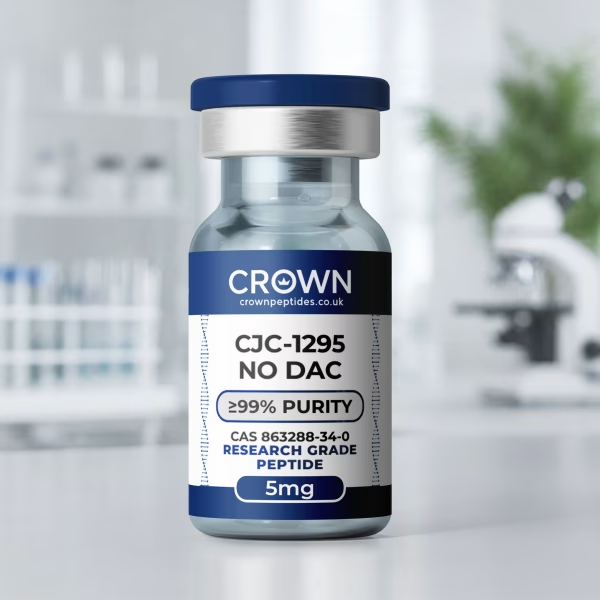
CJC-1295 (No DAC) Research Peptide
A high-purity research peptide studied in growth-hormone research.
Out of stock
Supplied for laboratory research purposes only — not for human consumption or for medical, veterinary or diagnostic use.
Product Overview
CJC-1295 No DAC UK is Crown Peptides' short-acting synthetic growth-hormone-releasing hormone analogue, available in 5mg strength for laboratory research.
- Studied in research involving GHRH receptor signalling
- Studied in research involving pulsatile growth-hormone release
- Studied in research involving peptide stability and enzymatic breakdown
- Studied in research involving the GRF(1-29) active fragment
- Batch-specific quality documentation available
About CJC-1295 No DAC UK
CJC-1295 No DAC is a 29-residue synthetic analogue of growth-hormone-releasing hormone, built on the GRF(1-29) fragment with four amino-acid substitutions and no albumin-binding attachment.
Also known as: Mod GRF (1-29), Modified GRF 1-29, CJC-1295 without DAC, CJC 1295 no DAC, tetrasubstituted GRF(1-29).
Because nothing tethers it to a carrier protein, it clears quickly, which is why it is studied where short, well-defined GHRH signals are wanted rather than the sustained exposure produced by CJC-1295 with DAC.
CJC-1295 No DAC Research
CJC-1295 No DAC appears in endocrine work on how the GHRH receptor is switched on at the pituitary, on the enzymatic breakdown that limits the life of natural GHRH in plasma, and the difference between pulsed and continuous stimulation of growth-hormone release (Learn more). Its short duration makes it a useful comparator against longer-acting analogues and against ghrelin-receptor peptides such as Ipamorelin in controlled models.
- GHRH receptor signalling
- Pulsatile growth-hormone release
- Dipeptidyl peptidase-IV resistance and peptide half-life
- Structure-activity work on the GRF(1-29) fragment
Why the first 29 residues are the part that matters
Human growth-hormone-releasing hormone was first isolated as a 44-residue peptide from pancreatic tumours that were causing acromegaly. Once chemists began cutting it back, something useful emerged: almost everything the hormone needs in order to switch on its receptor sits in the first 29 amino acids. Shorten the chain to GRF(1-29) and cap the end as an amide, and the fragment keeps the biological activity of the full-length hormone while being roughly a third shorter to make.
Work comparing the authentic full-length peptide against the 1-29 amide confirmed the point directly, finding the shortened analogue behaved like the real thing in the assays used. (Learn more) The C-terminal tail, in other words, is largely ballast as far as receptor activation goes. That finding is the reason every GHRH-derived research peptide in common use — Sermorelin, Mod GRF (1-29) and the CJC-1295 family alike — is built on the 1-29 core rather than the whole 44-residue sequence.
The enzyme problem: why natural GHRH disappears in minutes
Natural GHRH is extremely short-lived in blood. Clearance studies in people put its plasma disappearance in the order of minutes, fast enough that any experiment needing a sustained signal has to use a continuous infusion rather than a single injection. (Learn more)
The reason is enzymatic rather than mechanical. Work at the end of the 1980s identified dipeptidyl peptidase IV as the main culprit, with trypsin-like activity as a secondary route. DPP-IV snips off the first two residues of the chain, and that single cut is enough: the truncated GRF(3-44) product is effectively inert at the receptor. Later studies on the brush-border enzymes of the intestine found the same enzyme doing the same job to GRF(1-29)NH2, which tells you how general the vulnerability is. Every design decision in Mod GRF (1-29) follows from this one weakness.
Four substitutions, four different problems solved
What separates CJC-1295 No DAC from plain GRF(1-29) is four changed amino acids, and each one answers a specific failure found in the laboratory.
Position 2 carries D-alanine in place of the natural L-alanine. DPP-IV reads the shape of the residue it is about to cut, and swapping to the mirror-image D form makes the bond far harder to cleave. Medicinal-chemistry work on position-2-substituted GRF analogues showed exactly this pattern, with the modified peptides surviving DPP-IV exposure that destroyed the unmodified chain, and parallel studies using the purified enzyme confirmed which analogues it could and could not attack.
Position 8 carries glutamine instead of asparagine. Asparagine residues deamidate slowly in neutral aqueous solution, a reaction that quietly converts part of a stored batch into a different molecule. Studies on GRF analogues traced degradation in neutral solution specifically to deamidation at Asn8 (Learn more), and follow-up work showed the rate depended on the peptide's local secondary structure. Replacing the residue removes the reaction entirely.
Position 15 carries alanine, a change made for potency rather than stability. Analogues combining a position-2 substitution with Ala15 were reported to have enhanced activity over either change alone. (Learn more) Position 27 carries leucine in place of methionine, because methionine side chains oxidise on exposure to air, giving another slow route by which a vial of peptide can drift away from its stated identity.
Pulses versus a flat signal
Growth hormone is not released evenly. The pituitary puts it out in bursts, and the pattern of those bursts carries information that a flat concentration does not. This is the main reason a short-acting GHRH analogue remains interesting after longer-acting versions were developed: it produces a discrete, time-limited stimulus that researchers can place deliberately.
The point was established early. When human pancreatic GRF was given to volunteers as a constant infusion rather than a bolus, growth-hormone responses did not simply stay high for as long as the infusion ran. Studying how the shape of a stimulus feeds through to the hormone output needs a tool whose own duration is short and predictable, and that is the niche a non-albumin-binding GRF(1-29) analogue occupies.
What the albumin-conjugate experiments revealed about the plain backbone
The research that eventually produced the DAC version is also, read the other way round, a good source of information about the unmodified peptide. In that work, GRF analogues carrying a maleimide group were first joined to serum albumin and then put in front of cultured rat pituitary cells. The joined-up molecules still released growth hormone, and they no longer fell to DPP-IV.
Two things follow for the plain peptide. First, the receptor-activating machinery lives at the N-terminal end of the 29-residue chain, far enough from the C-terminus that even a 66 kDa protein hung off the far end does not block it. Second, the DPP-IV resistance conferred by the carrier was an addition to, not a replacement for, the resistance already built into the tetrasubstituted backbone. Separate work on how GRF(1-29)NH2 interacts with plasma proteins when released from a polymer matrix looked at the same question from the formulation side. (Learn more)
Specifications
- Product
- CJC-1295 No DAC
- Classification
- Short-acting synthetic growth-hormone-releasing hormone analogue
- Available strength
- 5mg
- Form
- Research material supplied according to product label
- Purity / assay
- 99% (HPLC), batch-specific; refer to Certificate of Analysis
- Verification
- HPLC and Mass Spectrometry where analytically appropriate
- CAS Number
- 863288-34-0
- Molecular formula
- C152H252N44O42
- Molecular weight
- 3367.9 Da
- Sequence
- Tyr-D-Ala-Asp-Ala-Ile-Phe-Thr-Gln-Ser-Tyr-Arg-Lys-Val-Leu-Ala-Gln-Leu-Ser-Ala-Arg-Lys-Leu-Leu-Gln-Asp-Ile-Leu-Ser-Arg-NH2
- Also known as
- Mod GRF (1-29), Modified GRF 1-29, CJC-1295 without DAC, CJC 1295 no DAC
- Product Name
- CJC-1295 No DAC
- Commonly referenced CAS Number
- 863288-34-0
Purity and Testing
Crown Peptides CJC-1295 No DAC is supplied for controlled laboratory research with batch-specific analytical documentation. High-Performance Liquid Chromatography (HPLC) can assess chromatographic purity, while Mass Spectrometry provides molecular information used to support identity verification.
The batch-specific Certificate of Analysis is the definitive source for the exact purity result, identity data and analytical specification of the material supplied.
Storage Conditions
- Store unreconstituted material at -20°C ± 5°C in a cool, dry environment
- Prepared research solutions should use validated storage conditions appropriate to the compound and study design
- Protect from unnecessary heat, direct light and repeated temperature fluctuations
Related Compounds
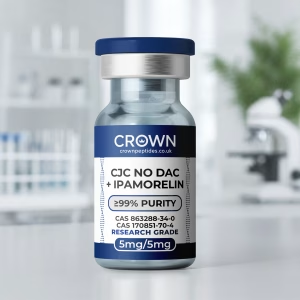
Researchers working with CJC-1295 No DAC may also be interested in CJC-1295 No DAC + Ipamorelin, CJC-1295 with DAC, Sermorelin, Ipamorelin and Tesamorelin — other growth-hormone-releasing peptides studied in the same endocrine research pathway.
CJC-1295 No DAC Frequently Asked Questions
About CJC-1295 No DAC5 questions
What is CJC-1295 No DAC?
It is a 29-amino-acid synthetic analogue of growth-hormone-releasing hormone, supplied by Crown Peptides as 5mg of research material per vial. The chain is the GRF(1-29) fragment of the natural hormone with four amino acids changed to make it more stable, and with no albumin-binding attachment on the end — which is what the "No DAC" in the name refers to.
What is the difference between CJC-1295 with and without DAC?
One piece of chemistry. The DAC version adds a thirtieth amino acid carrying a chemical hook that fastens the peptide to albumin in the bloodstream, so it persists for days. Take that hook away and you have this compound, which is cleared quickly instead. Both act at the same receptor; they differ in how long they stay in play. Our CJC-1295 with DAC page covers the albumin side in detail.
How long does CJC-1295 No DAC stay active?
Far less time than the DAC version, which is the entire point of it. Published clearance work on natural GHRH in people put plasma disappearance in the order of minutes, and the four substitutions in this analogue are aimed at slowing enzymatic breakdown rather than at extending it into the multi-day range. Researchers choose it precisely when a short, well-bounded signal is wanted.
What is CJC-1295 No DAC studied for?
Published work using GHRH analogues of this type covers receptor signalling at the pituitary, the way growth hormone is released in bursts rather than at a steady level, and the enzyme chemistry that determines how long a peptide survives in plasma. It is also widely used as the short-acting comparator in studies that set pulsed signalling against sustained signalling.
How do I check the vial contains what it should?
Match three things against the Certificate of Analysis for that batch: the CAS number, the molecular weight and the HPLC purity figure. For this compound the mass should come out near 3367.9 Da, which is around 280 Da lighter than the DAC version — the difference being the extra lysine and its attachment. Mass spectrometry separates the two without ambiguity, which matters because the names are similar enough to be confused.
Chemistry and identity4 questions
Which amino acids are changed, and why?
Four, each fixing a separate problem. D-alanine at position 2 blocks the enzyme that otherwise cuts the first two residues off and inactivates the peptide. Glutamine at position 8 removes an asparagine that slowly deamidates in solution. Alanine at position 15 was introduced for potency. Leucine at position 27 replaces a methionine that oxidises on exposure to air.
What CAS number does CJC-1295 No DAC have?
863288-34-0, which is the number printed on our label and listed against the molecular formula C152H252N44O42. It is worth knowing that CAS numbers in this family are frequently reported inconsistently by suppliers and databases alike, because the DAC and non-DAC forms share so much of their chemistry. The molecular weight on the Certificate of Analysis is the more reliable discriminator of the two.
What does the 5mg on the label refer to?
The mass of lyophilised peptide in the vial before any solvent is added. It is not a concentration — the concentration depends entirely on how much solvent is used, which is why our peptide calculator asks for both numbers.
Why does the sequence contain a D-amino acid?
Because enzymes are shape-selective. Dipeptidyl peptidase IV recognises the natural L-form at position 2 and cleaves next to it; present it with the mirror-image D-form and the bond becomes much harder to attack. It is a small change that buys a large amount of stability, and the same trick appears across many peptide drugs for the same reason.
Ordering and handling4 questions
Is CJC-1295 No DAC legal to buy in the UK?
It is supplied legally in the UK as a research chemical for laboratory use. It is not a licensed medicine, it has no marketing authorisation, and it must not be used for human or veterinary purposes. Orders are placed on the understanding that the material is for controlled laboratory research only.
How should the vial be stored?
Keep the unopened, freeze-dried vial at -20°C ± 5°C, somewhere cool, dry and out of direct light. Once a solution has been prepared, storage conditions should follow whatever the study design has validated. Repeated warming and cooling is the thing most likely to degrade a peptide in practice.
What should the Certificate of Analysis show?
The batch number, the HPLC chromatogram and the purity figure derived from it, and mass-spectrometry data supporting identity. Every batch has its own certificate rather than a generic one, and it is that document — not the product page — that states the exact specification of the material you receive.
Does the price per vial drop if I order more than one?
Yes. The 3, 5 and 10-vial packs carry progressively larger savings against the single-vial price, shown on the pack selector above. The vials themselves are identical; only the price per vial changes.
Read the batch certificate before you order
Every batch is published openly — identity, purity and batch number, with no account needed.
View lab reports- Laboratory research only
- Not for human or clinical use
- Not for human or veterinary consumption
Supplied for laboratory research purposes only — not for human consumption or for medical, veterinary or diagnostic use.
Other Research Peptides
 Endocrine researchCJC-1295 + IpamorelinBlend