Vesugen Research Peptide
Vesugen, the vascular peptide bioregulator Lys-Glu-Asp (KED), studied in research on vascular endothelial cells and gene expression.
Out of stock
Supplied for laboratory research purposes only — not for human consumption or for medical, veterinary or diagnostic use.
Product Overview
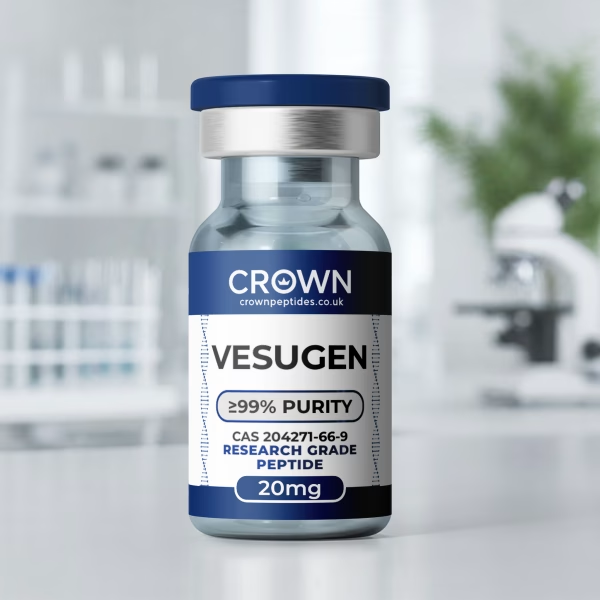
Vesugen UK is Crown Peptides’ vascular peptide bioregulator, the tripeptide Lys-Glu-Asp, supplied in 20mg for laboratory research.
- Studied in research involving vascular endothelial cells and endothelin-1 expression
- Studied in research involving cell proliferation markers in endothelial tissue from young and aged animals
- Studied in research involving gene expression, including IGF1 and FOXO1
- Studied in research involving the peptide bioregulator family and tissue-specific activity
- CAS number and sequence confirmed on every batch certificate
About Vesugen UK
Vesugen is a short synthetic peptide made of three amino acids: lysine, glutamic acid and aspartic acid, written in shorthand as KED. It belongs to a family of peptide bioregulators developed at the St Petersburg Institute of Bioregulation and Gerontology under Vladimir Khavinson, each one associated with a particular tissue.
Also known as: Vezugen, KED, Lys-Glu-Asp, L-lysyl-L-glutamyl-L-aspartic acid, H-Lys-Glu-Asp-OH, vascular peptide bioregulator
Vesugen is the one studied in connection with blood vessels and the cells that line them.
The family came out of a specific line of work. Researchers had been studying polypeptide complexes extracted from animal organs, and then set about identifying the shortest active fragments within them. Vesugen is the synthetic tripeptide identified from the vascular tissue complex. This is worth being clear about, because the two get mixed up. The organ extract and the tripeptide are different things: the extract is a mixture of many polypeptides, and Vesugen is one defined three-amino-acid sequence of known formula, mass and CAS number. Research on the extract is not research on Vesugen, and we do not present it as such on this page.
Vesugen sits in the bioregulator research peptides category alongside the other members of the family we supply: Epitalon (AEDG, studied in connection with the pineal gland), Pinealon (EDR, brain tissue), Cartalax (AED, cartilage) and Thymalin (thymus). They are studied as a group as often as individually, and several papers compare them side by side.
What sets this family apart from most research peptides is their size. At 390 daltons Vesugen is smaller than almost anything else in the range. For comparison, BPC-157 is about three and a half times its mass. That small size is central to how the family is thought to work, and it is also why the published research concentrates on gene expression rather than on receptors.
Vesugen Research
We want to be straightforward about the state of this literature, because it is unusual. Nothing on Vesugen has been retracted or questioned, but most of the published work comes from the same research group in St Petersburg, and there is little independent replication of findings specific to this tripeptide. What follows is drawn from the strongest of it, and mostly from papers published in open-access international journals so that anyone can read them in full. We have left out the weaker material rather than pad the list.
- Endothelin-1, connexin and sirtuin expression in vascular endothelium
- Proliferation markers in endothelial cells from young and aged animals
- Gene expression in stem cell and neuron cultures
- Tissue-specific activity across the bioregulator family
The most directly relevant study
A 2016 paper examined KED in cultured endothelium from normal arteries and from patients with atherosclerosis and restenosis. In the diseased endothelium, expression of endothelin-1 (a signalling molecule that constricts blood vessels) was raised; KED brought it back towards normal levels. The study also reported restored cell-to-cell communication through connexin expression, and increased expression of sirtuin-1, a protein widely studied in connection with cellular ageing. Of everything published on this compound, this is the study that speaks most directly to why it is of interest in vascular research. (Learn more)
Proliferation, and a specific gene
A 2014 study looked at vascular endothelial cell cultures taken from both young and old animals and found Vesugen increased Ki-67, a standard marker of cells actively dividing. The same paper used molecular modelling to identify where in the genome the peptide might be acting, placing it in the core promoter region of the MKI67 gene, the gene that produces Ki-67, spanning the fourteen bases before and twelve bases after the point where the gene starts being read. That is an unusually specific claim for a compound of this kind, and it is the paper most often cited for the mechanism. (Learn more)
Measurable changes in gene expression
A 2020 study worked with human bone-marrow mesenchymal stem cells in two different ageing models, using peptides at nanomolar concentrations. Expression of IGF1, a growth factor, rose between three and a half and five and a half times. KED specifically reduced FOXO1 expression by between 1.6 and 2.3 times. Being honest about the detail: KED’s effect on one other gene reversed direction between the two ageing models, which the authors reported openly. This study is the best source of actual figures. (Learn more)
Evidence for tissue specificity
The claim that each peptide in this family acts on its own tissue was tested directly in a 2012 study. Three peptides were applied to three different human cell types. Each acted on its own: Vesugen stimulated particular differentiation factors in one cell type while the others acted on pancreatic and bronchial cells respectively. The effect was stronger in older, late-passage cultures than in fresh ones, which is a pattern that recurs throughout this literature. (Learn more)
Work in cells from elderly donors
Two recent studies in mainstream open-access journals used neurons grown from the skin cells of elderly donors. A 2024 study found KED, along with two related peptides, increased the branching of those neurons, measured as both the number of primary branches and total branch length. The authors also reported plainly what did not change, including markers of cell ageing and mitochondrial activity. A 2025 study using a similar approach found KED reduced expression of p21, a cell-ageing marker, by around 15%, and reduced beta-galactosidase activity, another ageing marker, by between 1.5 and 2.4 times. (Learn more) (Learn more)
Ageing signals in cardiovascular cells
A 2022 review in the journal Cells mapped the signalling molecules involved in cellular ageing and low-grade inflammation in cardiovascular tissue, covering a long list including the interleukins, TNF-alpha, NF-kappa-B and the sirtuins. It identifies the KED tripeptide as one of two short peptides studied as regulators of those molecules. As a review it is secondary evidence, but it is open access, in English, and sets out the research context clearly. (Learn more)
Early human work
Vesugen has been through small clinical studies, and it is important to be accurate about their size and design. A 2014 study treated 41 patients with reduced blood flow associated with atherosclerosis and reported significant improvement in arterial blood flow on both clinical and instrumental measures. The study compared patients before and after treatment rather than against a control group, and a second publication from the same centre with the same number of patients appears to report a different set of measurements from what is likely the same group. So this is early, open-label work from a single centre, not a controlled trial. We would rather say that than overstate it. (Learn more)
How the family is thought to work
The proposed mechanism for this whole group is that peptides this short pass into cells and into the nucleus, where they bind to specific sequences of DNA and to the histone proteins DNA is wound around, and in doing so change which genes are read. A 2021 systematic review sets this out in full, and a 2022 paper proposes that the peptides get into cells through transporters that normally carry two and three amino acid fragments. (Learn more) (Learn more) One caveat we think is worth stating: the original cell-penetration and DNA-binding experiments were done on closely related peptides from the same family rather than on Lys-Glu-Asp itself, so for Vesugen this remains the proposed mechanism rather than a directly demonstrated one.
Taken together, Vesugen is a precisely defined molecule with a clear identity, one strong mechanistic study in the tissue it is associated with, specific measured changes in gene expression, and early human work from a single centre. Related compounds in the same family include Epitalon and Pinealon.
Specifications
- Product
- Vesugen
- Classification
- Short peptide bioregulator, synthetic tripeptide
- Sequence
- Lys-Glu-Asp (KED)
- Available strength
- 20mg
- Form
- Lyophilised research material supplied according to product label
- Purity / assay
- batch-specific; refer to Certificate of Analysis
- Verification
- HPLC and Mass Spectrometry
- CAS Number
- 204271-66-9
- Also known as
- Vezugen, KED, Lys-Glu-Asp
- Product Name
- Vesugen
- Molecular Formula
- C15H26N4O8
- Molecular Weight
- approximately 390.39 g/mol; refer to the batch Certificate of Analysis for the confirmed mass
Purity and Testing
A tripeptide is one of the more straightforward things to verify, which makes the certificate worth reading. At 390 daltons, mass spectrometry can confirm the molecule’s identity very precisely, and HPLC shows how clean the preparation is.
Crown Peptides Vesugen is supplied with batch-specific quality documentation, published on our lab reports page before the batch goes on sale, stating the sequence and the CAS number alongside the assay result. It is worth noting that several suppliers list this compound with no CAS number at all, or with the field marked as not applicable. There is one: 204271-66-9. The Certificate of Analysis should be used as the definitive source for identity, assay, purity and relevant impurity information.
Storage Conditions
- Store unreconstituted material at -20°C ± 5°C in a cool, dry environment
- Prepared research solutions should use validated storage conditions appropriate to the compound and study design
- Protect from unnecessary heat, direct light and repeated temperature fluctuations
Related Compounds
Compounds studied alongside Vesugen in the peptide bioregulator family include Epitalon, Pinealon, Cartalax and Thymalin. The full range is in our bioregulator research peptides category.
Vesugen Frequently Asked Questions
About Vesugen6 questions
What is Vesugen?
Vesugen is a synthetic peptide of three amino acids, lysine, glutamic acid and aspartic acid, known in shorthand as KED. It is one of a family of short peptide bioregulators developed in St Petersburg, each associated with a particular tissue, and Vesugen is the one studied in connection with blood vessels and the cells lining them.
Why is it also spelled Vezugen?
Both spellings refer to the same compound. The name comes from Russian, and the two spellings are different ways of writing the same word in the Latin alphabet. The clinical papers tend to use Vezugen; most suppliers use Vesugen.
What does KED mean?
It is the sequence written in single-letter code: K for lysine, E for glutamic acid, D for aspartic acid. Chemists and researchers often refer to these peptides by those letters, which is why you will see Vesugen written as KED and Epitalon as AEDG.
Is Vesugen the same as a vascular tissue extract?
No, and this is the most common confusion around it. Extracts made from vascular tissue are mixtures containing many different polypeptides. Vesugen is one specific three-amino-acid sequence that was identified within that mixture and is now made synthetically. It has a defined formula, mass and CAS number; an extract does not. Research done on the extract is not research on Vesugen.
How is it thought to work?
The proposal for this whole family is that peptides this short can enter cells and reach the nucleus, bind to particular stretches of DNA and to the proteins packaging it, and so change which genes get read. One study placed Vesugen specifically at the control region of the MKI67 gene. Worth saying plainly: the cell-entry and DNA-binding experiments behind this were carried out on related peptides in the family rather than on Vesugen itself.
How does Vesugen differ from Epitalon, Pinealon and Cartalax?
They are different sequences studied in connection with different tissues. Epitalon is a four-amino-acid sequence associated with the pineal gland, Pinealon a three-amino-acid sequence associated with brain tissue, and Cartalax one associated with cartilage. Vesugen is the vascular one. Several published studies test them side by side, which is part of the evidence for each acting on its own tissue.
Findings in research models4 questions
What did the 2016 endothelium study find?
In cultured endothelium from patients with atherosclerosis and restenosis, endothelin-1 expression was raised compared with normal tissue, and KED brought it back towards normal. The study also reported restored cell-to-cell communication through connexin expression and increased sirtuin-1 expression.
What changes in gene expression have been measured?
In human bone-marrow stem cells at nanomolar concentrations, IGF1 expression rose between three and a half and five and a half times, and KED reduced FOXO1 expression by between 1.6 and 2.3 times. In neurons grown from elderly donors, KED reduced the cell-ageing marker p21 by around 15% and beta-galactosidase activity by between 1.5 and 2.4 times.
Has Vesugen been studied in people?
Yes, but only in small early studies. A 2014 study of 41 patients with reduced arterial blood flow reported significant improvement after treatment on both clinical and instrumental measures. These studies compared patients before and after treatment rather than against a control group, and came from a single centre, so they are early work rather than controlled trials.
How strong is the evidence overall?
Honestly, it is narrower than for many compounds we supply. Nothing has been retracted or questioned, and some of the work is published in well-regarded open-access journals, but most of it comes from one research group and there is little independent replication of findings specific to this tripeptide. We would rather say that than imply a deeper literature than exists.
Buying, testing & storage4 questions
Is Vesugen legal to buy in the UK?
Vesugen is supplied in the UK as a laboratory research material. It is not a licensed medicine and is not sold for human or veterinary use. It is supplied strictly for laboratory research purposes by qualified personnel.
Where can I buy Vesugen in the UK?
Crown Peptides supplies Vesugen in 20mg vials from the UK, with HPLC and mass spectrometry verification and a batch-specific Certificate of Analysis published for every batch, stating the sequence and CAS number. Orders placed before 2pm are dispatched the same working day.
Does Vesugen have a CAS number?
Yes: 204271-66-9. This is worth knowing because several suppliers list the compound without one, or record it as not applicable. A registry number exists for the tripeptide and we state it on the certificate.
How should Vesugen be stored and handled?
Unreconstituted material should be kept at -20°C ± 5°C in a cool, dry place, away from direct light and repeated temperature swings. Prepared solutions should follow storage conditions validated for the study in question. Our storage information page covers handling in more detail.
Read the batch certificate before you order
Every batch is published openly — identity, purity and batch number, with no account needed.
View lab reports- Laboratory research only
- Not for human or clinical use
- Not for human or veterinary consumption
Supplied for laboratory research purposes only — not for human consumption or for medical, veterinary or diagnostic use.
Other Research Peptides
 Endocrine researchCJC-1295 + IpamorelinBlend