Follistatin-344 Research Compound
A high-purity research compound studied in myostatin and activin research.
Out of stock
Supplied for laboratory research purposes only — not for human consumption or for medical, veterinary or diagnostic use.
Product Overview
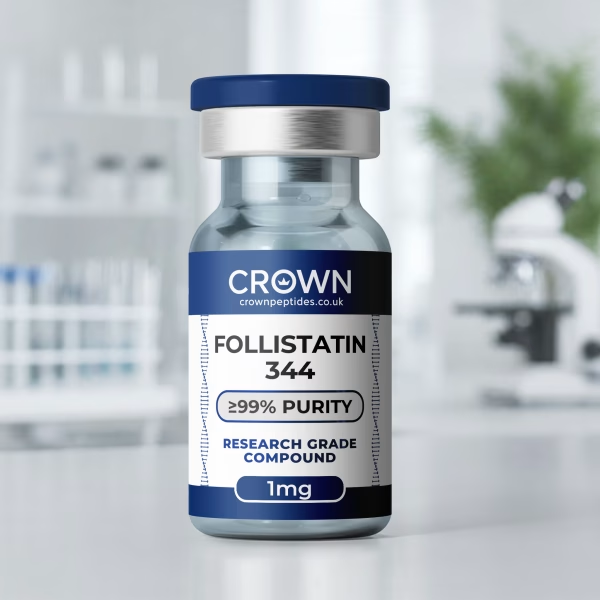
Follistatin-344 UK is Crown Peptides’ recombinant follistatin research compound, supplied in 1mg for laboratory research.
- Studied in research involving myostatin and activin signalling
- Studied in research involving skeletal muscle mass and fibre size in animal models
- Studied in research involving the activin-follistatin system in reproduction
- Studied in research involving tissue repair and inflammatory signalling
- Batch-specific quality documentation published for every batch
About Follistatin-344 UK
Follistatin is a binding protein. Its job in the body is to find certain growth signals, lock onto them and hold them out of reach of the receptors they would otherwise activate. The two it is best known for are activin and myostatin.
Also known as: follistatin, FST, FS, FS-344, FST-344, activin-binding protein, FSH-suppressing protein
Myostatin is the signal that puts a ceiling on how much muscle an animal builds, which is why follistatin has been studied so heavily in muscle research: take the brake off, and the research models respond.
It is worth being precise about the name, because a great deal of what is written about this compound online is wrong. Follistatin is made from a single gene that can be read in two ways, producing precursors of 344 and 317 building blocks. A precursor is the unfinished version that exists inside the cell. Before the cell releases it, a short lead section is cut off, so the 344 precursor becomes the 315 form that actually circulates, and the 317 precursor becomes the 288 form. Follistatin-344 is therefore the name of the precursor, not of a separate circulating protein. Research that uses “FS-344” is almost always using it as genetic instructions delivered into muscle, which the cell then reads and turns into the 315 form.
The other thing to be clear about: this is a protein, not a peptide. Follistatin has three repeating domains held together by a defined pattern of sulphur bridges, and at roughly 38 kilodaltons it is more than twenty times the size of a short research peptide such as BPC-157. It cannot be built on a peptide synthesiser the way those are. It has to be grown in living cells and then purified, which is why it is supplied and priced differently from the rest of the range.
In research terms it sits alongside ACE-031 in the musculoskeletal research area. Both work on the myostatin side of the equation, by holding growth-limiting signals away from their receptors, rather than on the growth-promoting side where MGF and IGF-1 LR3 sit. A wider overview of the compounds studied in this field is in our guide to peptides researched for muscle growth.
Follistatin Research
Follistatin has one of the longest and best-documented research records of any compound in this category. It was first identified in the 1980s in reproductive biology, moved into muscle research in the early 2000s, and has since been through animal models, primates and two small human studies. The published work divides cleanly into three strands.
- How follistatin binds and neutralises myostatin and activin
- What happens to muscle mass when it is present in excess in animal models
- The reproductive and inflammatory biology it was originally discovered for
Where the story starts: a gene read two ways
In 1988 a group screening human testis cDNA found that the follistatin gene produced two different precursors, of 344 and 317 building blocks, from the same starting material. That single finding is the origin of every number attached to this compound, and it is the reason the naming is as confusing as it is. (Learn more)
The link to myostatin
In 2001 Se-Jin Lee and Alexandra McPherron at Johns Hopkins showed that myostatin signals through the activin type IIB receptor, and that follistatin blocks that interaction. They then made mice carrying extra follistatin in their skeletal muscle. Those mice gained muscle mass comparable to mice born with no myostatin at all. This is the paper the entire muscle research field is built on. (Learn more)
It does more than block myostatin
In 2007 Lee crossed the follistatin mice onto a background where myostatin had been removed entirely. If follistatin only worked by blocking myostatin, removing myostatin should have left nothing more to gain. Instead the double animals reached roughly four times the muscle mass of normal mice, which showed follistatin also holds back other growth-limiting signals in the same family. (Learn more)
Measuring the grip directly
A 2004 study measured the binding between follistatin and myostatin directly and found it extremely tight, with a dissociation constant of 5.84 x 10⁻¹⁰ M. Individual domains of follistatin on their own could not do it; the whole protein was needed. In chick limb bud tissue, follistatin reversed the loss of muscle-forming markers that myostatin caused, and did so in proportion to the dose. (Learn more)
Seeing how it works
Two structural studies showed the mechanism in physical detail. In 2005 a crystal structure of follistatin bound to activin showed two follistatin molecules wrapping around a single activin molecule, burying about a third of its surface and covering both receptor contact points at once. In 2009 a structure of follistatin bound to myostatin showed that the pair together form a strongly positively charged surface that sticks to the outside of cells, which appears to speed up the removal of myostatin altogether. (Learn more) (Learn more)
Why the different forms behave differently
A 1993 study purified six naturally occurring follistatin forms from ovarian tissue and tested them side by side. All six gripped activin with much the same strength, but they behaved completely differently at the cell surface: the 288 form binds to sugar chains on the outside of cells, while the 315 form has no such affinity and stays in circulation. That difference in stickiness, not in binding strength, is what separates the forms. (Learn more)
Gene delivery in animals and primates
From 2008 onwards a group at Nationwide Children’s Hospital in Ohio took a different approach, delivering the follistatin gene into muscle using a viral carrier so the muscle itself produced the protein. A single administration increased muscle mass and strength in both normal and dystrophic mice, and the effect was still present more than two years later, including in animals treated at an advanced age. (Learn more) The same approach was then tested in macaques, where increases in muscle size and in individual fibre diameter were recorded in the treated leg, with reproductive hormone levels and organ structure unaffected. (Learn more)
Two small human studies
The same group carried the gene delivery approach into people. In 2015 six men with Becker muscular dystrophy received injections into both thighs; four of the six improved their six-minute walking distance, by between 29 and 125 metres, with two showing no change, and muscle biopsies showed less scarring and a more normal spread of fibre sizes. (Learn more) In 2017 six people with inclusion body myositis were treated alongside a prescribed exercise programme and gained an average of 56 metres per year on the same walking test, against a decline of about 26 metres per year in an untreated comparison group. Both studies were small, neither used a placebo, and in the second the exercise programme cannot be separated from the treatment, so they are best read as early signals rather than settled results. (Learn more)
What happens without it
Mice born unable to make follistatin at all are growth-retarded, have noticeably reduced diaphragm and rib muscle, and do not survive. It is a blunt demonstration of how central this protein is to normal development, and of how much of its biology sits outside muscle. (Learn more)
Taken together, follistatin is one of the most thoroughly mapped regulators in muscle biology: a defined protein with solved structures, a measured binding affinity, consistent results across mouse models, primate data, and two early human studies. An important note on how to read all of it: the muscle work above delivers follistatin as genetic instructions, not as protein from a vial, and the two are not interchangeable. Related compounds studied on the same pathway include ACE-031 and PEG-MGF.
Specifications
- Product
- Follistatin-344
- Classification
- Recombinant follistatin research compound (binding protein, not a synthetic peptide)
- Available strength
- 1mg
- Form
- Lyophilised research material supplied according to product label
- Purity / assay
- batch-specific; refer to Certificate of Analysis
- Verification
- HPLC and Mass Spectrometry where analytically appropriate
- UniProt reference
- P19883 (gene FST)
- Also known as
- follistatin, FST, FS-344, activin-binding protein
- Product Name
- Follistatin-344
- Structure
- three follistatin domains, each with a defined pattern of sulphur bridges, plus an N-terminal domain
- Precursor length
- 344 amino acids, of which the first 29 form the signal sequence removed on secretion
- Mature secreted form
- 315 amino acids
- Molecular Weight
- approximately 38 kDa for the 344 precursor and approximately 34.8 kDa for the mature 315 form; refer to the batch Certificate of Analysis for the confirmed mass
- UniProt
- P19883 (FST)
Purity and Testing
This is the compound where batch documentation matters most, and we would say that even if it cost us a sale.
Follistatin is a large protein grown in cells rather than a short chain built on a machine, so two vials carrying the same label can be genuinely different material. Published analytical work on products sold under this name has found wide variation in what they actually contain. That is a problem no customer can detect by looking at a vial.
Crown Peptides Follistatin-344 is supplied with batch-specific quality documentation, and the certificate for every batch is published on our lab reports page before the batch goes on sale. A protein of this size is assessed differently from a short peptide: HPLC shows how clean the preparation is, while mass spectrometry confirms identity against the expected mass for the intact protein rather than to the single dalton as it would for a 16-building-block peptide. The Certificate of Analysis should be used as the definitive source for identity, assay, purity and relevant impurity information.
Storage Conditions
- Store unreconstituted material at -20°C ± 5°C in a cool, dry environment
- Proteins of this size are more sensitive to handling than short peptides; avoid repeated freezing and thawing of prepared solutions
- Prepared research solutions should use validated storage conditions appropriate to the compound and study design
- Protect from unnecessary heat, direct light and repeated temperature fluctuations
Follistatin-344 Frequently Asked Questions
About Follistatin-3446 questions
What is Follistatin-344?
Follistatin-344 is a recombinant research compound based on follistatin, a natural binding protein that locks onto growth signals including activin and myostatin and keeps them away from their receptors. It is used in research on muscle regulation, reproduction and tissue repair.
Is Follistatin-344 a peptide?
No, and this is worth getting right. Peptides are short chains, typically under fifty building blocks, that can be assembled chemically. Follistatin is a folded protein of over three hundred building blocks with a specific internal architecture, and it has to be produced in living cells. We describe it as a research compound rather than a research peptide for that reason.
What does the 344 refer to?
The number of building blocks in the precursor, which is the unfinished version inside the cell. The first 29 of those form a lead sequence that is cut off when the cell releases the protein, leaving the 315-building-block form that circulates. So 344 describes a stage, not a separate protein.
What is the difference between Follistatin-344, 315 and 288?
344 and 317 are the two precursors. 315 and 288 are the finished forms they become. The practical difference between the two finished forms is where they end up: 288 sticks to the outside of cells, while 315 stays in circulation. Both grip activin with much the same strength.
What is myostatin?
Myostatin is a signalling protein that limits how much skeletal muscle an animal builds. Animals born without it develop far more muscle than normal. Because follistatin binds myostatin and holds it away from its receptor, it has been used throughout muscle research as a way of studying what happens when that limit is lifted.
How is Follistatin-344 different from ACE-031?
ACE-031 is a manufactured decoy receptor: it is built from the part of the receptor that catches myostatin, so myostatin binds it instead of the real thing. Follistatin is a naturally occurring binding protein that grabs the signal directly. Both end at the same point, with myostatin unable to reach its receptor, but they get there by different routes and have separate research records.
Findings in research models4 questions
What did the 2001 Johns Hopkins study show?
That follistatin blocks myostatin from binding its receptor, and that mice engineered to carry extra follistatin in their muscle gained muscle mass comparable to mice born without myostatin at all. It established follistatin as a tool for studying the myostatin pathway.
Why did the 2007 study matter?
Because it tested whether follistatin does anything beyond blocking myostatin. With myostatin removed entirely, extra follistatin still produced a large further gain in muscle mass, reaching roughly four times normal. That showed it acts on several growth-limiting signals, not just one.
Has follistatin been studied in humans?
Yes, in two small studies, both delivering the follistatin gene into muscle rather than giving protein from a vial. Six men with Becker muscular dystrophy were treated in 2015 and six people with inclusion body myositis in 2017, with improvements in walking distance in most participants. Both were small and neither used a placebo group.
Is follistatin only studied in muscle?
No. It was discovered in reproductive biology as a protein that suppresses follicle-stimulating hormone release, and that remains an active area. More recent work has looked at the activin-follistatin system in kidney tissue repair and in inflammatory signalling.
Buying, testing & storage4 questions
Is Follistatin-344 legal to buy in the UK?
Follistatin-344 is supplied in the UK as a laboratory research material. It is not a licensed medicine and is not sold for human or veterinary use. It is supplied strictly for laboratory research purposes by qualified personnel.
Where can I buy Follistatin-344 in the UK?
Crown Peptides supplies Follistatin-344 in 1mg vials from the UK, with HPLC and mass spectrometry verification and a batch-specific Certificate of Analysis published for every batch before it goes on sale. Orders placed before 2pm are dispatched the same working day.
Why is Follistatin-344 more expensive than most research peptides?
Because of how it is made. Short peptides are assembled chemically in a predictable, scalable process. A protein of this size has to be expressed in living cells, then folded correctly and purified, which is slower, lower-yielding and harder to verify. The price reflects the production route rather than the quantity in the vial.
How should Follistatin-344 be stored and handled?
Unreconstituted material should be kept at -20°C ± 5°C in a cool, dry place, away from direct light and repeated temperature swings. Large proteins are less forgiving than short peptides once in solution, so repeated freezing and thawing should be avoided. Our storage information page covers handling in more detail.
Read the batch certificate before you order
Every batch is published openly — identity, purity and batch number, with no account needed.
View lab reports- Laboratory research only
- Not for human or clinical use
- Not for human or veterinary consumption
Supplied for laboratory research purposes only — not for human consumption or for medical, veterinary or diagnostic use.
Other Research Peptides
 Endocrine researchCJC-1295 + IpamorelinBlend