
Research guide
Thymalin Peptide UK: Thymus Research, Mechanism and Study Data
Thymalin is a calf thymus peptide complex from the Soviet bioregulator programme. Here is what is actually in the vial, how it differs from Thymogen and Thymosin Alpha-1, and what the studies show.
One organ in the human body is designed to disappear. The thymus, a small gland sitting just behind the breastbone, does its most important work before you are old enough to remember it, and then begins shrinking. By middle age much of its working tissue has been replaced by fat. Nothing else in human anatomy follows that schedule, and immunologists have spent decades arguing about what it costs us.
Thymalin comes from one of the earliest serious attempts to do something about it. In Soviet-era Leningrad, two military medical researchers extracted a mixture of small peptides from calf thymus glands on the theory that the organ speaks to the rest of the body in a chemical language, and that you could supply that language from outside. This guide covers what is actually in a Thymalin vial, where it came from, how the proposed mechanism works, what each study found and in what kind of model, how it differs from Thymosin Alpha-1 and from the synthetic dipeptide Thymogen, and what would move the field forward. Thymalin is sold by Crown Peptides strictly for laboratory research use only, and everything below is written for readers interested in the science. You can find it on our Thymalin Research Peptide page. One thing to keep in mind throughout: a large share of the thymalin literature was published in Russian-language journals with English abstracts only, often by the groups that developed the compound, and much of it has not been independently replicated. That does not make it worthless, but it does change how firmly any single finding should be held.
What Is Thymalin, and What Is Actually in the Vial?
Thymalin is not one peptide. It is a complex of low-molecular-weight polypeptides obtained from calf thymus by mild acid extraction, a technique chosen to pull out small peptides while leaving larger proteins behind. The result is a mixture, and that single fact explains most of what is unusual about researching it (PMID: 9637345).
Later work has identified specific dipeptides inside that mixture as carrying much of the activity. Two are named repeatedly: KE, lysine-glutamate, and EW, glutamate-tryptophan. A 2023 paper describes both as active substances of Thymalin, with KE associated with stimulating cellular immunity and acting on macrophages, lymphocytes, thymocytes and neutrophils, and EW with vascular effects including reduced angiotensin-induced vasoconstriction (PMID: 37686182).
Thymalin, Timalin or something else?
You will find it spelled Thymalin, Timalin and Thymalinum. All refer to the same thymus extract: Russian-language papers usually use Timalin, English-language papers from the same authors usually use Thymalin. Searching PubMed for one and not the other will miss a large chunk of the literature.
Thymalin and Thymogen are not the same thing
This is the most common confusion in this corner of peptide research, and worth getting straight before going further. Thymalin is the natural extract: a mixture of peptides from calf thymus. Thymogen is a synthetic single molecule. The connection is direct and documented: researchers took Thymalin, separated it by reverse-phase high performance liquid chromatography, isolated the dipeptide L-Glu-L-Trp as one of its immunomodulatory components, synthesised it, and built a separate product around it named Thymogen (PMID: 9637345, PMID: 11707921).
So Thymogen is one ingredient of Thymalin, made synthetically. Studies on one are not studies on the other, and the published comparisons found real differences: both activated T-cell differentiation and T-cell recognition of peptide-MHC complexes, and both altered cyclic nucleotides and interleukin-2 and interferon output from blood lymphocytes, but the synthetic dipeptides activated neutrophil chemotaxis and phagocytosis while showing no effect on the antioxidant response in thymocytes, unlike the natural peptides (PMID: 9637345). Mixtures and single molecules behave differently, and the authors said so themselves.
The Shrinking Organ Behind the Whole Idea
None of this makes sense without the thymus, so here is the short version.
What the thymus actually does
The thymus is where T lymphocytes grow up. Immature cells arrive from the bone marrow and go through a brutal training programme across the organ’s cortex and medulla: checkpoints that select for cells able to recognise a genuine threat and eliminate cells that would attack the body’s own tissues. The ones that pass are exported as naive T cells, each carrying a different receptor, collectively able to recognise pathogens the body has never met (PMID: 30927993).
Why it fades, and what that costs
Thymic involution is one of the most consistent changes in the ageing immune system. As the organ regresses, the output of naive T cells falls and the diversity of the T-cell repertoire narrows, which the literature links to reduced responses to new infections and to vaccines. The underlying mechanisms are still only partly understood, with both the thymic microenvironment and the developing cells themselves implicated (PMID: 24109481).
How much of immune ageing this explains is genuinely contested. But the direction of travel in modern work is striking. A 2025 study in PLoS Biology engineered mice so that thymic epithelial cells could be pushed to express Myc, which both prevented and partially reversed age-related thymic involution. Those mice had more peripheral naive CD4 and CD8 T cells, preserved antibody responses and significantly reduced mortality after infection with Toxoplasma gondii (PMID: 40720380). That is a genetically engineered mouse model, not a compound, but it is the clearest demonstration yet that restoring thymic output changes outcomes rather than just numbers on a chart.
On the human side, the most discussed attempt is the TRIIM study, a small open-label trial in which growth hormone, DHEA and metformin were given with the intention of regenerating the thymus. It reported immunological changes and a mean epigenetic age roughly 1.5 years below baseline after a year (PMID: 31496122). It was small, it had no placebo arm and its authors had a commercial interest, all of which belongs in any description of it. It is here because it shows thymic regeneration being pursued seriously in humans, by routes with nothing to do with thymic peptides.
- Classification
- Thymus bioregulator peptide research compound
- Available strength
- 10mg (coming soon)
The Military Medical Programme That Produced It
Thymalin’s origin story is unusual, and it explains both the strengths and the gaps in its evidence base.
The work was done by Vladimir Morozov and Vladimir Khavinson at the Military Medical Academy in Leningrad, within a Soviet programme concerned with protecting and restoring the immune function of military personnel, including after radiation exposure. Their starting idea was that organs communicate through short peptides, and that extracting those peptides from an animal organ would give you a tool for influencing the same organ in a recipient. They called the resulting class cytomedins, and produced extracts from the thymus, the pineal gland, the prostate, the cerebral cortex and the retina. Thymalin was the first to go into practical use as an immunocorrector (PMID: 9637345).
That programme ran for decades and eventually produced the short synthetic peptides the field is better known for today, including Epitalon from the pineal work. Our article on bioregulator peptides explained tells the wider story of the Khavinson peptides, so this guide stays on the thymus branch. Khavinson’s own long review sets out the logic: tissue extracts first, then identification of the active short peptides within them, then synthesis of those peptides as defined molecules, with Thymalin’s immune-stimulating effects described as its most prominent property (PMID: 12374906).
How Thymalin Is Thought to Work
There are three proposed mechanisms in the literature, and they operate at different levels.
Pushing immature cells towards mature T cells
The most concrete evidence comes from a study on human haematopoietic stem cells in culture. Thymalin reduced expression of CD44, a stem cell marker, and CD117, a marker of the intermediate stage of differentiation, by two to three times, while increasing expression of CD28, a marker of mature T lymphocytes, by 6.8 times. The authors read that as indirect evidence that thymalin pushes CD117-positive cells towards mature CD28-positive T cells (PMID: 33237528). This was a cell culture experiment, and the differentiation claim is an interpretation of marker changes rather than direct observation of cells maturing.
Turning down inflammatory signalling
The second mechanism is about volume rather than numbers. In a laboratory model of inflammation using human peripheral blood mononuclear cells stimulated with bacterial lipopolysaccharide, Thymalin and its EW and KE dipeptides reduced production of interleukin-1 beta, interleukin-6 and tumour necrosis factor alpha by between 1.4 and 6.0 times. Blood came from four donors, with each measurement repeated several times (PMID: 37686182).
An Italian-led group, working in collaboration with Khavinson’s institute, found something similar in a different system. Testing five of the Khavinson peptides, including Thymalin, on the human THP-1 monocyte line differentiated into macrophages, all five inhibited lipopolysaccharide-stimulated expression of tumour necrosis factor and interleukin-6, and reduced adhesion of the treated monocytes to activated endothelial cells, one of the first steps in an inflammatory response (PMID: 35408963). That paper matters out of proportion to its size: it is one of the few studies of these compounds led from outside Russia, although the originating institute was a co-author.
The short-peptide idea: signals that reach DNA
The third and most speculative mechanism is the theoretical backbone of the whole bioregulator concept: that dipeptides and tetrapeptides are small enough to enter the nucleus and interact directly with DNA, influencing which genes are read. The 2023 paper used molecular modelling and docking to look at how EW and KE might bind double-stranded DNA, and database analysis to identify candidate target genes including AKT1, AKT2, ACE2 and CHUK (PMID: 37686182). That is computational prediction plus bioinformatics, not demonstrated gene regulation, and reads as a hypothesis the authors then tested indirectly with their cytokine experiments.
- Also known as
- Timalin, Thymalinum, thymus polypeptide extract, thymic peptide complex
- Classification
- Low-molecular-weight polypeptide complex extracted from calf thymus; immunomodulatory peptide bioregulator
- Sequence
- No single sequence: a peptide mixture. KE (lysine-glutamate) and EW (glutamate-tryptophan) are described in the literature as active components
- Research status
- Developed in the Soviet Union and used as a registered medicine in Russia and some neighbouring states; most studies published in Russian-language journals, largely by the originating groups
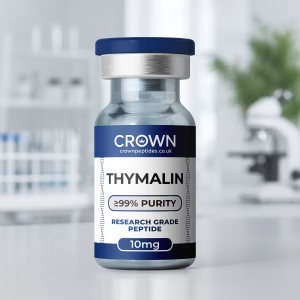
Thymalin Research Peptide
HPLC and MS verified · certificate with every batch · pricing announced when stock arrives
What the Research Has Actually Found
The thymalin literature runs to hundreds of entries, most of them Russian-language clinical reports on a very wide range of conditions. Rather than list them, here are the studies with English abstracts clear enough to describe accurately, with what kind of study each one was.
Human stem cells in culture
The CD44, CD117 and CD28 marker study described above is the most mechanistically useful piece of recent work, published in a peer-reviewed English-language journal with specific numbers attached (PMID: 33237528). The authors also noted that severe COVID-19 was associated with falls in CD28-positive, CD4-positive and CD8-positive T cells, which is what led them to propose thymalin as worth investigating in that setting.
Rats with transplanted tumours
A group in Rostov tested Thymalin in albino outbred male rats carrying transplanted sarcoma 45, as part of work on what they call activation therapy. They reported tumour growth arrest or regression in more than half of the animals, with growth suppressed by 78% in the rest, alongside increased lymphoproliferative activity in the thymus lobules, and attributed the effect partly to using amounts lower than the standard ones (PMID: 29797130). This was a rat study in a transplanted tumour model, a long way from any statement about disease in people, and it has not been replicated elsewhere.
Where thymalin is found in the body
An immunomorphological study looked for thymalin-reactive material in human tissue and found it in the epidermis and in fetal reticuloepithelium, two structures that develop from the same embryonic origin. It was present only in young epidermal cells, and by the age of 70 that layer appeared thinned and discontinuous, with the overall content declining with age (PMID: 12447484). It is a staining study rather than a quantitative measurement, but the hook is interesting: the material the compound is based on appears to decline in human tissue on roughly the same schedule as the thymus itself.
The long observation study in older adults
The study most often cited for thymalin is a joint project between institutes in St Petersburg and Kiev, which followed 266 elderly and older people for six to eight years, giving the peptide preparations during the first two to three years. The published report describes improvements across cardiovascular, endocrine, immune and nervous system indices, a 2.0 to 2.4-fold reduction in the incidence of acute respiratory disease compared with controls, and reduced incidence of several age-related conditions. It reports mortality during the observation period falling 2.0 to 2.1-fold in the Thymalin group, 1.6 to 1.8-fold in the Epithalamin group and 2.5-fold with both, and 4.1-fold in a separate group given both annually for six years (PMID: 14523363).
Those are large numbers, and they need to be read with the design in mind. The published abstract describes a clinical assessment with a control group, but gives no information about randomisation, blinding or how the control group was assembled, and the work was conducted and reported by the institutes that developed the compounds. Essentially the same report appeared in both Russian and English (PMID: 12577695). A mortality difference of that scale in an unblinded, non-randomised study is exactly the sort of result that needs replication before it can carry weight, and in the two decades since, no independent group has published anything of comparable size on thymalin.
The respiratory infection report
A more recent paper describes adding thymalin to standard therapy for patients with COVID-19. The authors report that standard treatment alone brought down interleukin-6, C-reactive protein and D-dimer, and that adding thymalin accelerated the decline in those markers and in T-cell indices (PMID: 33575961). The abstract describes no randomisation or blinding and gives no patient numbers. It is a clinical report from the originating group rather than a controlled trial.
The rat lifespan study that is often misattributed
You will frequently see thymalin credited with a rat lifespan study. The study exists and it is a good one, but it tested Thymogen, the synthetic L-Glu-L-Trp dipeptide isolated from Thymalin, not the extract. Seventy-six five-month-old outbred female rats were split into a saline control group of 32 and a treated group of 44 receiving 5 micrograms of the dipeptide five times a week for twelve months, then followed to natural death with all tumours examined microscopically.
Mean lifespan was similar between groups. But among the longest-lived 10%, controls reached 949 plus or minus 16.1 days against 1048 plus or minus 21.1 days in the treated animals, and six of the 44 treated rats outlived the maximum lifespan of any control. The ageing rate expressed as alpha in the Gompertz equation was 0.0071 per day in controls and 0.0041 in treated rats. Total tumour incidence was 1.5 times lower, malignant tumours 1.7 times lower and blood cancers 3.4 times lower (PMID: 11707921).
That is a well-described, controlled rodent study with a clear negative result alongside its positive ones: mean lifespan did not change. It is evidence about a single synthetic dipeptide in rats, and attributing it to the thymus extract would be exactly the kind of upgrade this field does not need.
How to read the rest of the literature
Beyond these, the picture gets harder to assess rather than less interesting. There are Russian-language reports of thymalin in tuberculosis, burns, spinal osteomyelitis, glomerulonephritis and oncology, many with English abstracts too brief to evaluate, plus a Russian-language review summarising the originating group’s clinical work across the whole bioregulator range (PMID: 24003726). Some of that work may well be sound. The point is that from an English abstract alone you usually cannot tell how many patients were involved or how they were allocated, which is why this guide has stuck to what can be stated precisely.
Thymalin vs Thymosin Alpha-1
Anyone researching thymic peptides runs into both of these, and they are frequently treated as interchangeable. They are not.
Thymosin Alpha-1 is a single, fully defined 28-amino-acid peptide. It came out of American work on thymosin fraction 5, a different thymus extract, and once the active peptide was identified it was synthesised as a defined molecule and taken through conventional drug development. It has been studied in immunocompromised states, as a vaccine response enhancer and in infection, and it is reviewed extensively in the English-language literature (PMID: 33362999). It is approved as a medicine in a number of countries, which is covered in our Thymosin Alpha-1 guide.
Thymalin took the other fork in the road. It remained an extract: a mixture standardised by manufacturing process rather than by a single defined structure, with its active components identified later and spun off as separate products.
The practical consequences follow from that. For a defined peptide, identity is a yes or no question that mass spectrometry answers; for an extract, identity is a question about the whole profile, harder to pin down and harder to reproduce between batches. It is also why the research records differ so sharply, with Thymosin Alpha-1 carrying an international, independently replicated literature while thymalin’s is concentrated in one tradition. If your interest is a clean, reproducible immune research tool, Thymosin Alpha-1 is the better-characterised option. If your interest is the Soviet bioregulator tradition and what it proposed about organ signalling, thymalin is where that story starts. For how the thymic peptides relate to each other more broadly, see Thymosin Alpha-1 vs TB-500.
What Would Move This Field Forward
The questions here are unusually clear, which is itself a kind of opportunity.
Full characterisation of the mixture. Modern peptidomics could map what is actually in a thymus extract far more completely than the methods available when thymalin was developed. That one piece of work would turn an extract into a defined composition and make everything else easier to study.
Independent replication. The Italian-led monocyte study shows what this looks like in practice: take the compound, put it in a standard cell system, publish what happens. The same kind of work from groups with no connection to the original programme would settle a lot of arguments quickly.
Separating the components. Since KE and EW are described as the active parts, the obvious experiment is a direct comparison of the extract against each dipeptide and against both together in the same system. The published differences between natural and synthetic preparations suggest the answer will not be trivial.
Connecting to modern thymic biology. Thymic epithelial cells are now the main focus of regeneration research. Whether a thymus-derived peptide mixture does anything to those cells is a question nobody appears to have asked with current tools.
The Technical Breakdown: Extraction, Composition and Chemistry
This section is for readers who want the chemistry. Everything above makes sense without it.
How the extract is made
The original method is mild acid extraction of calf thymus tissue. Acid conditions keep small peptides in solution while precipitating larger proteins, so the fraction that comes through is enriched in low-molecular-weight material. Because the product is defined by the process rather than a formula, the manufacturing route is effectively part of the compound’s identity, which is why the literature consistently specifies the method (PMID: 9637345).
The components that were pulled out of it
Reverse-phase HPLC separation of Thymalin yielded L-Glu-L-Trp, which became Thymogen. A second immunomodulatory dipeptide was synthesised and named Vilon, which corresponds to the KE pairing (PMID: 9637345). Both are among the shortest biologically active peptides ever marketed, which is precisely what made the originating group propose that such molecules could act at the level of DNA rather than through surface receptors.
Quantities used in the published work
Figures in the literature span a wide range, from micromolar concentrations in cell culture to microgram quantities per animal in the rodent work, such as the 5 micrograms per rat in the dipeptide lifespan study. These are pharmacology context for reading the papers, not guidance for laboratory work, where concentrations follow the experimental design. Our understanding quantities page explains how a milligram figure on a vial relates to a working solution.
Why Testing Matters Differently for a Peptide Complex
For a single synthetic peptide, analytical testing answers a simple question: is this the right molecule, and how much of the vial is something else. For a peptide complex there is a second question underneath that one, which is whether this batch resembles the last batch. If the profile shifts between production runs, two experiments months apart are not comparing the same material, and a result that fails to replicate may be telling you about manufacturing rather than biology. That is why, for compounds of this type, a certificate tied to the specific batch number in your hand is worth more than a generic specification sheet.
What every Crown Peptides batch comes with
Every batch we sell is analysed before it is listed. HPLC separates what is in the vial and gives a purity figure, and for a complex it also gives a profile you can compare between batches. Mass spectrometry confirms molecular identity. The results are published as a batch-specific certificate on our Lab Reports page, with the batch number printed on the vial so you can match the two. Our guide to how to read a peptide certificate of analysis walks through what each section means, and peptide testing UK explains what the two methods can and cannot show.
Stored, packed and dispatched properly
Compounds are supplied as lyophilised powder, the most stable form for storage and transport, kept cold, sealed and away from light and moisture as set out on our storage information page. Orders placed before 2pm on a weekday are dispatched the same day from the UK, with free UK delivery on orders over £100.
A UK company you can talk to
Crown Peptides is a UK company. Our team answers enquiries within 24 hours on business days, with WhatsApp for quicker questions, and you can get in touch about a certificate, a batch or a compound in our range.
Related Compounds Worth Knowing About
Thymalin sits at the junction of two research areas: thymic immunology and the Russian bioregulator tradition. These compounds cover the ground on either side, and most of them sit in our immunology research peptides category.
Thymosin Alpha-1
Thymosin Alpha-1 is the defined 28-amino-acid thymic peptide described above, and the natural comparison for any thymalin work. If you want the same biological territory with a single molecule and an international research record, this is it.
Epitalon
Epitalon is the other half of the original cytomedin programme: a four-amino-acid peptide derived from the pineal extract Epithalamin, studied for telomerase activity, melatonin rhythms and lifespan in animal models. Thymalin and Epithalamin were given together in the long observation study above. Our Epitalon guide covers that research.
Pinealon
Pinealon is a three-amino-acid peptide from the same programme, studied in neuronal models for exactly the mechanism thymalin’s developers proposed: short peptides interacting directly with DNA. Our Pinealon guide explains that work, which is the best test case for the whole idea.
KPV
KPV is a three-amino-acid fragment of alpha-MSH studied for damping inflammatory signalling, including inside cells. Since one of thymalin’s proposed mechanisms is lowering interleukin-6 and tumour necrosis factor output, KPV is the obvious reference compound for that half of the story. Our KPV guide has the detail.
LL-37
LL-37 is the human body’s own cathelicidin peptide, studied in antimicrobial defence and immune signalling. Where thymalin research is about the adaptive side of immunity and T-cell maturation, LL-37 belongs to the fast, innate side. Our comparison of LL-37 vs KPV sets out how the two halves of the immune response differ.
TB-500
TB-500 is the synthetic form of a fragment of thymosin beta-4, another molecule first found in thymus extracts but which turned out to be about cell movement and tissue repair rather than immunity. It is a good illustration of how much biology was sitting in those early extracts.
For a wider view of this area, see our roundup of the best peptides for immune research, or browse the full range of immunology research peptides.
Common Questions About Thymalin
What is thymalin?
Thymalin is a complex of low-molecular-weight polypeptides extracted from calf thymus by mild acid extraction, developed by Morozov and Khavinson in the Soviet Union and studied as an immunomodulator. It is a mixture rather than a single defined peptide.
Is thymalin the same as Timalin?
Yes. Timalin is the usual transliteration in Russian-language publications and Thymalin the usual English spelling. Searching for only one will miss much of the literature.
How is thymalin different from Thymogen?
Thymogen is a single synthetic dipeptide, L-Glu-L-Trp, that was isolated from Thymalin by HPLC and then made synthetically as its own product. Thymalin is the whole extract. Studies of one are not studies of the other, and the published comparisons found genuine differences in what each one does.
How is thymalin different from Thymosin Alpha-1?
Thymosin Alpha-1 is a single, fully defined 28-amino-acid peptide from a different line of research, with an international, independently replicated literature and medicine status in a number of countries. Thymalin is an extract with its research concentrated in one tradition and largely published in Russian.
What has research on thymalin actually found?
The clearest findings are in cell culture: shifts in stem cell and T-cell markers in human haematopoietic stem cells, and reduced interleukin-1 beta, interleukin-6 and tumour necrosis factor alpha output from human immune cells stimulated with bacterial lipopolysaccharide, reported by two separate groups. There is also a rat tumour study, a long human observation study from the originating institutes, and a large body of older Russian-language clinical reports that are hard to assess from their abstracts.
Has thymalin been through modern controlled clinical trials?
Not in the sense most readers would mean. The most-cited human work is the six-to-eight-year observation of 266 older adults published by the institutes that developed the compounds, with no information in the abstract about randomisation or blinding, and no independent study of comparable size has followed. Thymalin has been registered and used as a medicine in Russia and some neighbouring states since the Soviet era; it has never been assessed by the MHRA or the European Medicines Agency.
Is thymalin legal in the UK?
Thymalin is not a controlled drug under the Misuse of Drugs Act, and compounds that are not licensed medicines in the UK can be supplied here for laboratory research. Our article are peptides legal in the UK explains how UK law applies to research compounds.
Can I buy thymalin in the UK?
Yes. Crown Peptides supplies Thymalin in 10mg vials, in our immunology research peptides category with a published certificate for every batch. For a peptide complex in particular, ask for a batch-specific certificate rather than a generic specification: batch-to-batch consistency is the thing most worth checking.
Read the certificate before you order
Every batch is published openly — identity by mass spectrometry, purity by HPLC, and the batch number printed on the vial you receive.
Open the COA libraryAn Old Question the Field Is Only Now Equipped to Answer
The idea behind thymalin was ambitious and, in its way, ahead of its evidence: that an organ which fades on a fixed schedule leaves a gap in the body’s signalling, and that the gap could be filled from outside. The researchers who proposed it had acid extraction, animal models and clinical observation. They did not have peptidomics, single-cell sequencing, epigenetic clocks or the ability to switch a gene on in thymic epithelial cells and watch an aged thymus partially rebuild itself.
Those tools exist now, and the thymus is back at the centre of ageing research for reasons that have nothing to do with peptide extracts. What has not happened is anyone turning those tools on thymalin itself. Its mechanistic claims are testable, its active components are named, and the cell studies that do exist found something. That is an unusually open question for a compound that has been around this long, and open questions are where interesting research starts. Thymalin itself is on our Thymalin Research Peptide page, and the thymic and bioregulator compounds from the same tradition are available to work with today: explore our immunology research peptides, every batch HPLC and mass spectrometry verified, with the full certificate published and dispatched from the UK.
References
- Morozov VG, Khavinson VK. Natural and synthetic thymic peptides as therapeutics for immune dysfunction. Int J Immunopharmacol. 1997;19:501-5. PMID: 9637345
- Anisimov VN, Khavinson VK, Morozov VG. Immunomodulatory synthetic dipeptide L-Glu-L-Trp slows down aging and inhibits spontaneous carcinogenesis in rats. Biogerontology. 2000;1:55-9. PMID: 11707921
- Khavinson VKh, Morozov VG. Peptides of pineal gland and thymus prolong human life. Neuro Endocrinol Lett. 2003;24:233-40. PMID: 14523363
- Khavinson VKh, Morozov VG. [Geroprotective effect of thymalin and epithalamin]. Adv Gerontol. 2002;10:74-84. PMID: 12577695
- Khavinson VK, Linkova NS, Kvetnoy IM, et al. Thymalin: Activation of Differentiation of Human Hematopoietic Stem Cells. Bull Exp Biol Med. 2020;170:118-122. PMID: 33237528
- Khavinson VK, Kuznik BI, Trofimova SV, et al. Results and Prospects of Using Activator of Hematopoietic Stem Cell Differentiation in Complex Therapy for Patients with COVID-19. Stem Cell Rev Rep. 2021;17:285-290. PMID: 33575961
- Linkova N, Khavinson V, Diatlova A, et al. The Influence of KE and EW Dipeptides in the Composition of the Thymalin Drug on Gene Expression and Protein Synthesis Involved in the Pathogenesis of COVID-19. Int J Mol Sci. 2023;24. PMID: 37686182
- Avolio F, Martinotti S, Khavinson VK, et al. Peptides Regulating Proliferative Activity and Inflammatory Pathways in the Monocyte/Macrophage THP-1 Cell Line. Int J Mol Sci. 2022;23. PMID: 35408963
- Zhukova GV, Schikhlyarova AI, Barteneva TA, et al. Effect of Thymalin on the Tumor and Thymus under Conditions of Activation Therapy In Vivo. Bull Exp Biol Med. 2018;165:80-83. PMID: 29797130
- Khlystova ZS, Kalinina II, Shmeleva SP, et al. Age-related changes of thymalin content in human epidermis. Bull Exp Biol Med. 2002;133:620-2. PMID: 12447484
- Khavinson VKh. Peptides and Ageing. Neuro Endocrinol Lett. 2002;23 Suppl 3:11-144. PMID: 12374906
- Khavinson VKh, Kuznik BI, Ryzhak GA. [Peptide bioregulators: the new class of geroprotectors. Message 2. Clinical studies results]. Adv Gerontol. 2013;26:20-37. PMID: 24003726
- Palmer DB. The effect of age on thymic function. Front Immunol. 2013;4:316. PMID: 24109481
- Thapa P, Farber DL. The Role of the Thymus in the Immune Response. Thorac Surg Clin. 2019;29:123-131. PMID: 30927993
- Morales-Sánchez A, Lavaert M, Vacchio MS, et al. Enhancing thymic function improves T-cell reconstitution and immune responses in aged mice. PLoS Biol. 2025;23:e3003283. PMID: 40720380
- Fahy GM, Brooke RT, Watson JP, et al. Reversal of epigenetic aging and immunosenescent trends in humans. Aging Cell. 2019;18:e13028. PMID: 31496122
- Dominari A, Hathaway Iii D, Pandav K, et al. Thymosin alpha 1: A comprehensive review of the literature. World J Virol. 2020;9:67-78. PMID: 33362999
Working with Thymalin Research Peptide
Coming soon to Crown Peptides. Every batch will be HPLC and MS tested, with its certificate published before it goes on sale.
See Thymalin Research Peptide