👻 Halloween Sale: 20% off singles, up to 30% off packs and bundles · Use code SPOOKYSALE👻 Up to 30% off · Use code SPOOKYSALE
Crown Peptides

Lab Supplies

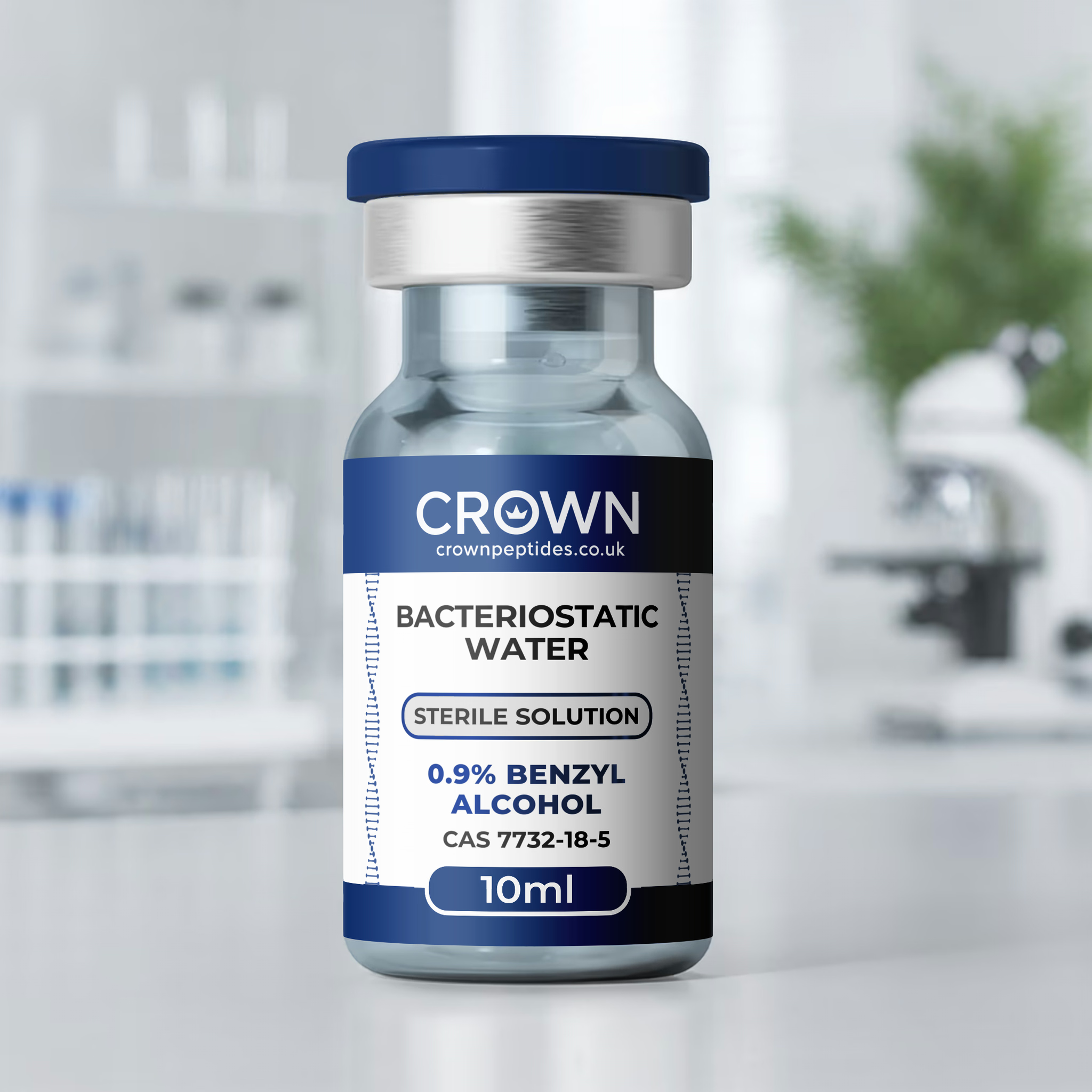
Bacteriostatic Water

A sterile, preserved diluent for reconstituting research peptides, manufactured to USP standards. Supplied in 10ml vials and dispatched from the UK.

£9.99or from £7.49 per vial in packs of 10
Save up to 25%
From: £9.99
Your selection:
Order within
for same-day dispatch
03Hrs:46Min:31Sec
In stockEstimated deliveryEst. delivery Saturday 24 OctoberSaturday 24 Oct
All Batches TestedEvery batch, no exceptions
HPLC & MS VerifiedFull certificate published
Same Day PostageOrder before 2pm
UK Based CompanyDispatched from the UK
Product Overview

A sterile, preserved diluent for reconstituting research peptides, manufactured to USP standards. Supplied in 10ml vials and dispatched from the UK.

Full Product Specification
Overview

Product Overview

Bacteriostatic water UK is Crown Peptides' sterile, preserved aqueous diluent, supplied in 10ml vials for laboratory dilution and reconstitution work.

10mlVial sizeSterilePreserved aqueous diluentBenzyl alcoholPreservativeBatch CoADocumentation supplied

Supplied for laboratory research purposes only — not for human consumption or for medical, veterinary or diagnostic use.

Key features

Key Features

  • Studied in research involving laboratory dilution and solution preparation
  • Studied in research involving aseptic handling workflows
  • Studied in research involving preserved aqueous research systems
  • Studied in research involving sample-preparation consistency
  • Batch-specific quality documentation available
Background

About Bacteriostatic Water UK

Bacteriostatic water is a sterile water preparation containing a bacteriostatic preservative, commonly benzyl alcohol. In laboratory workflows it is used where a preserved aqueous diluent is required for controlled preparation of compatible research materials.

Also known as: BAC water, bac water, bacteriostatic water 0.9% benzyl alcohol.

Research

Bacteriostatic Water Research

Unlike the peptide products in this range, bacteriostatic water is not itself an experimental peptide or bioactive research compound. Its role is functional: it provides a preserved, benzyl alcohol-containing aqueous vehicle formulated to USP standards (Learn more) for laboratory preparation and dilution. Researchers should always confirm compatibility with the specific material being prepared — for example when reconstituting peptides such as BPC-157 or TB-500 — because solvent choice, pH, concentration and storage can affect stability.

  • Laboratory dilution and solution preparation
  • Aseptic handling workflows
  • Preserved aqueous research systems
  • Sample-preparation consistency
Benzyl alcohol: the small molecule behind the name

The word “bacteriostatic” describes exactly what the preservative is there to do. Benzyl alcohol, a simple aromatic alcohol with the formula C6H5CH2OH, holds back the multiplication of bacteria that might get into a vial during use. It is not a sterilising agent and is not expected to kill a heavy contamination; its job is to stop a few stray organisms from turning into a thriving population between one withdrawal and the next. Benzyl alcohol also occurs naturally in many plant oils, and it has a long record as a preservative in pharmaceutical and laboratory liquids.

Crown Peptides bacteriostatic water is described as 0.9% benzyl alcohol, the most widely used strength, which works out at 9mg of benzyl alcohol in every millilitre and around 90mg in a full 10ml vial. Comparable pharmacopoeial products are typically slightly acidic, with a pH in the region of 4.5 to 7.0, and contain no salt, so the liquid is hypotonic. As the Specifications section notes, the label and batch documentation remain the definitive record for the exact formulation.

Bacteriostatic, sterile or saline: three different waters

These three liquids look identical in a vial, yet they are not interchangeable. Plain sterile water, the unpreserved pharmacopoeial grade, is pure water with nothing added. Because it contains no preservative, it is intended for single use: once the stopper has been pierced, any leftover liquid is normally discarded, since nothing in it can hold back contaminating bacteria.

Sodium chloride 0.9%, often called normal saline, is different again. It carries dissolved salt at roughly the same concentration as body fluids, making it isotonic, and it comes both preserved and unpreserved; the preserved version, bacteriostatic sodium chloride, pairs the same 0.9% benzyl alcohol with 0.9% salt. Bacteriostatic water sits between them: preserved like bacteriostatic saline, salt-free like sterile water. For a laboratory the choice depends on the material, because salt can reduce the solubility of some compounds and a few are sensitive to preservatives.

Freeze-dried peptides and the reason for a preserved diluent

Most research peptides, including the BPC-157, TB-500 and other vials sold alongside this product, ship as lyophilised powder. Freeze-drying removes water so the peptide stays stable during transport and storage, but it means every vial must be dissolved before it can be used in an experiment. A study rarely uses that solution all at once. More often a lab prepares a stock and draws from it over several days, which is exactly where a preserved, salt-free water earns its place: the benzyl alcohol helps keep the stock free of bacterial growth between uses.

Compatibility still needs checking. Benzyl alcohol is known to unsettle some larger proteins: in a 1997 study of recombinant interferon-gamma, 0.9% benzyl alcohol altered the protein’s folded structure and drove the formation of high-molecular-weight aggregates. Short peptides are generally less vulnerable than large folded proteins, but compound-specific data should always guide the choice of solvent.

Multi-use vials and the 28-day convention

A bacteriostatic water vial is built to be opened more than once. Its rubber stopper can be pierced repeatedly, and the preservative protects what remains between each use. That makes a single 10ml vial practical for preparing several freeze-dried samples over the course of a project, rather than opening a fresh container each time.

There is still a limit. A widely followed rule of thumb in US healthcare guidance, from bodies including the Joint Commission, is that an opened multi-use vial should be dated and discarded within 28 days unless the manufacturer specifies a different period. Many laboratories borrow the same convention as typical guidance: write the date of first opening on the vial, keep handling aseptic, and retire it at 28 days or sooner if anything looks wrong. The preservative supports good technique; it does not replace it.

The 1982 neonatal cases: a preservative with a history

Benzyl alcohol’s regulatory story is worth knowing. In June 1982 the US Centers for Disease Control reported 16 deaths among premature babies in two hospitals, linked to benzyl alcohol in bacteriostatic saline and water used to flush catheter lines. The infants developed severe metabolic acidosis, laboured “gasping” breathing and circulatory collapse, a pattern that became known as gasping syndrome.

The explanation lay in metabolism. Adults convert benzyl alcohol to benzoic acid and then attach glycine to form hippuric acid, which is cleared easily, but that pathway is immature in very premature babies, so benzoic acid built up. The FDA advised against benzyl alcohol-preserved flush solutions and diluents for newborns, and current labels for preserved waters carry a neonatal warning. It is a clear example of why the exact composition of any diluent matters.

Specifications

Specifications

Product
Bacteriostatic Water
Classification
Bacteriostatic water laboratory diluent
Available strength
10ml
Form
Sterile preserved aqueous laboratory diluent

Compound-level reference data. Batch-specific results appear on the Certificate of Analysis.

Work out concentration with the peptide calculator
Testing

Purity and Testing

Quality assessment for bacteriostatic water is formulation-specific and should focus on the labelled composition, preservative content, sterility-related specification and container integrity. The product label and batch documentation are the definitive sources for the supplied formulation.

Storage

Storage Conditions

  • Store according to the vial label and batch documentation
  • Maintain aseptic handling during laboratory use
  • Do not use if container integrity is compromised or unexpected particulate matter or discolouration is present
Full storage guide
Related

Related Compounds

Bacteriostatic water is commonly purchased alongside BPC-157, TB-500, MOTS-c, Epitalon and KLOW for reconstitution — see each product page for compound-specific preparation guidance.

Compliance

Research Use Only

  • Laboratory research only
  • Not for human or clinical use
  • Not for human or veterinary consumption
  • Qualified personnel only
Questions

Bacteriostatic Water Frequently Asked Questions

About Bacteriostatic Water6 questions
What is bacteriostatic water?

It is sterile, salt-free water containing benzyl alcohol as a preservative, listed at 0.9%, supplied by Crown Peptides in 10ml multi-use vials for laboratory dilution and for dissolving freeze-dried research materials. Researchers often shorten the name to BAC water.

What does “bacteriostatic” actually mean?

It means “stopping bacteria from multiplying”, as opposed to bactericidal, which means killing them outright. Benzyl alcohol at this strength keeps any bacteria introduced during use from growing into a significant population, rather than sterilising a contaminated liquid.

How much benzyl alcohol does a 10ml vial hold?

At 0.9%, every millilitre carries 9mg of benzyl alcohol, so a full 10ml vial contains about 90mg. That concentration is the most common commercial strength; some pharmacopoeial products use 1.1%, which is one more reason to read the label of whatever brand a lab has on the shelf.

Why isn’t it simply called sterile water?

Because sterile water, in pharmaceutical terms, means water with nothing added and is intended to be used once. Bacteriostatic water starts sterile too, but the added preservative lets it be accessed repeatedly, so the two names describe genuinely different products.

Is bacteriostatic water isotonic?

No, it contains no salt, so it is hypotonic compared with body fluids or cell-culture media. That rarely matters for dissolving a small amount of lyophilised peptide, but in cell-based work the final solution should be diluted into suitable buffer or medium so osmotic strength does not skew results.

Why do benzyl alcohol products carry a warning about newborns?

Following the 1982 cluster of deaths among premature babies exposed to benzyl alcohol-preserved flush fluids, the FDA advised against benzyl alcohol-preserved flush solutions and diluents for newborns, and labels for preserved waters now warn against neonatal use. Very premature infants cannot clear benzoic acid efficiently, and the resulting acidosis became known as gasping syndrome.

Choosing a diluent4 questions
When would a lab use plain sterile water instead?

Sterile water is the better pick when a material is sensitive to preservatives, when the whole solution will be used straight away, or when an assay must be free of any extra chemical. Its drawback is that, lacking a preservative, an opened container is normally treated as single use.

How does bacteriostatic sodium chloride differ?

Bacteriostatic sodium chloride carries the same benzyl alcohol preservative but adds 0.9% salt, making it isotonic. Some protocols call for it specifically; for others the salt is unwelcome because it can lower the solubility of certain compounds or interfere with downstream analysis.

Can benzyl alcohol interact with the material being dissolved?

With some substances, yes. Published formulation research has shown benzyl alcohol encouraging aggregation of certain proteins, interferon-gamma being a well-studied example. Small peptides are usually more tolerant, but compound-specific stability data, where available, should take priority over habit.

Why is BAC water so often bought with freeze-dried peptides?

Lyophilised peptides such as BPC-157, Epitalon and MOTS-c arrive as dry powder and have to be dissolved before use. A preserved, salt-free water lets a lab make up a stock and come back to it over several days, which matches how most peptide experiments actually run.

Vials & handling3 questions
How long can an opened vial be kept in use?

Typical guidance, drawn from US healthcare practice for multi-use containers, is 28 days from first opening unless the manufacturer states otherwise. Dating the vial when it is first pierced makes that easy to track, and any vial that becomes cloudy, discoloured or damaged should be retired early.

Does bacteriostatic water need to go in the fridge?

Commercial bacteriostatic water is generally labelled for room-temperature storage, unlike the freeze-dried peptides it is used with. Our Storage Conditions section asks for the vial label and batch documentation to be followed, so check those first; a prepared peptide solution, by contrast, follows the storage rules for that peptide.

Is a box of five 10ml vials better value than buying singly?

For a lab that reconstitutes regularly, usually. The five-vial box costs less per vial than individual vials, and because each opened vial is best retired after about four weeks, having fresh sealed stock on hand avoids stretching one vial past its useful life.

Read the batch certificate before you order

Every batch is published openly — identity, purity and batch number, with no account needed.

View lab reports

Supplied for laboratory research purposes only — not for human consumption or for medical, veterinary or diagnostic use.

All Batches TestedEvery batch, no exceptions

Each batch undergoes internal analytical verification using chromatographic and spectrometric methods prior to lyophilisation.

• HPLC Analysis
• Mass Spectrometry Confirmation
• Batch Traceability

For Research Use Only

By purchasing this product you confirm that you are a qualified researcher and that this compound will be used exclusively for laboratory research purposes.

Not for Human Consumption

This product is not intended for diagnostic or therapeutic use.

Any human or medical use is strictly prohibited.

Store Safely at All Times

Store in a cool, dry, secure and sterile environment away from any unauthorised persons or children.

Other Research Peptides

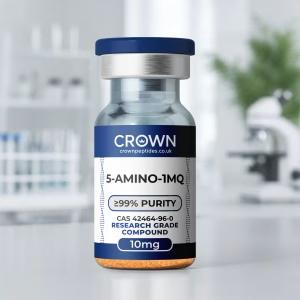
2 strengths5-Amino-1MQ 10mg research compound vial, Crown Peptides UKAgeing research

5-Amino-1MQ Research Compound


From£24.99Strength10mg
Add to basket
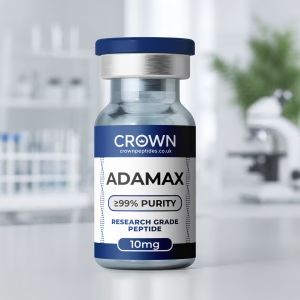
Adamax 10mg research peptide vial, Crown Peptides UKNeurocognitive research

Adamax Research Peptide


From£44.99Strength10mg
Add to basket
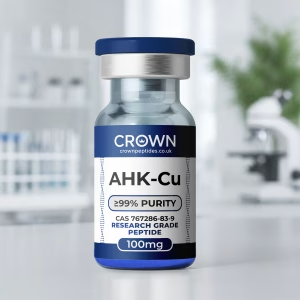
AHK-Cu 100mg copper peptide vial, Crown Peptides UKAgeing research

AHK-Cu Research Peptide


From£29.99Strength100mg
Add to basket
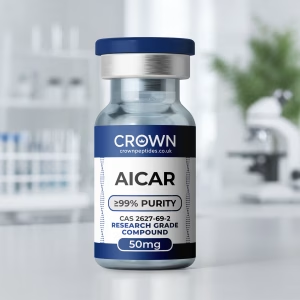
AICAR 50mg research compound vial, Crown Peptides UKAgeing research

AICAR Research Compound


From£34.99Strength50mg
Add to basket

Further reading

UK research peptides. Every batch HPLC and MS verified, certificate published in full.
SUPPORT Mon to Fri, 9am to 5pmDISPATCH Cut-off 2pmEMAIL Email usWHATSAPP +44 7301 802654

Disclaimer: All products are sold strictly for laboratory research purposes only. Not for human or veterinary use, consumption, therapeutic, or diagnostic application. None of our products are medicines, and none are presented as such. By purchasing, you confirm you are a qualified professional and legally permitted to handle these materials in compliance with all applicable laws and regulations. Misuse, resale for unauthorised purposes, or unlawful application is strictly prohibited. Crown Peptides UK disclaims all liability for improper use, handling, or regulatory non-compliance.

© 2026 Crown Peptides UK, a trading name of Crown Peptides Ltd (company no. 17068950), Suite Ra01, 195-197 Wood Street, London E17 3NU . All Rights Reserved.