

Research guide
Bacteriostatic Water UK Guide
Bacteriostatic water is sterile water plus 0.9% benzyl alcohol, and that small difference is what lets a reconstituted vial last weeks instead of hours.
RESEARCH USE DISCLAIMER
Crown Peptides supplies bacteriostatic water strictly for laboratory research use as a peptide reconstitution solvent. Our products are not intended for human consumption and are not sold, marketed, or labelled for the diagnosis, treatment, cure or prevention of any disease. Nothing in this document should be read as medical advice or as an endorsement of human use.
Bacteriostatic water is different from every other product covered in this article series: it isn’t a bioactive research compound with a mechanism of action or a body of clinical studies behind it. It’s a reconstitution solvent — the sterile liquid used to dissolve lyophilised (freeze-dried) peptides before they can be used in laboratory research. Because it plays a supporting rather than an experimental role, this article is structured differently from the rest of this series: shorter, more practical, and focused on what the solvent is, why its specific formulation matters, and how sourcing quality affects the peptides reconstituted with it.
What Is Bacteriostatic Water?
Bacteriostatic water is sterile water for injection preserved with a small concentration of benzyl alcohol (commonly 0.9%, in line with United States Pharmacopeia specifications for multi-dose parenteral preparations). The benzyl alcohol acts as a bacteriostatic agent — it inhibits bacterial reproduction within the sealed vial, which is what allows a single vial to be safely accessed multiple times over an extended period, unlike plain sterile water, which is intended for single use only once punctured.
This distinction is the entire point of the product. Standard sterile water for injection contains no preservative, so once a vial is opened, any remaining contents are expected to be discarded promptly to avoid contamination risk. Bacteriostatic water’s benzyl alcohol preservative is specifically what makes repeated withdrawal from the same vial — as is typical when reconstituting a peptide for a research protocol spanning several days or weeks — practical without introducing a new contamination variable each time the vial is accessed.
Why Bacteriostatic Water Matters for Peptide Reconstitution
Lyophilised peptides are supplied as dry powders specifically to maximise chemical stability during shipping and storage — a peptide in solution degrades considerably faster than the same peptide freeze-dried. Reconstitution with an appropriate solvent is a required step before a lyophilised peptide can be used in any research protocol, and the quality and formulation of that solvent is not a trivial detail: impurities, incorrect pH, or an unsuitable preservative can all affect peptide solubility, stability, and downstream experimental accuracy.
Benzyl alcohol, the active preservative in bacteriostatic water, is generally compatible with the majority of research peptides and does not react with or hydrolyse peptide bonds under standard refrigerated storage conditions. That said, a small number of specific peptides are documented as incompatible with benzyl alcohol, in which case preservative-free sterile water is the appropriate alternative — with the understanding that a preservative-free solution cannot be safely stored for repeated withdrawal in the same way.
Bacteriostatic water’s benzyl alcohol preservative is what distinguishes it from plain sterile water, allowing safe repeated withdrawal from the same vial over an extended research protocol.
Why Benzyl Alcohol Specifically Was Chosen as the Preservative
It’s worth understanding why benzyl alcohol, rather than another antimicrobial preservative, became the pharmacopeial standard for this application. Benzyl alcohol has a long history of use in parenteral (injectable) pharmaceutical formulations specifically because it combines effective bacteriostatic activity against a broad range of common contaminant organisms with a well-characterised safety and compatibility profile at the low concentrations used in multi-dose vials. It works by disrupting bacterial cell membrane integrity, which inhibits reproduction (a bacteriostatic effect) without necessarily killing all organisms outright (which would be a bactericidal effect) — but for the purposes of a sealed, repeatedly-accessed vial, preventing bacterial proliferation between uses is the functionally important property.
The specific concentration used in pharmacopeial bacteriostatic water — typically 0.9% — reflects a balance identified through pharmaceutical formulation research: high enough to reliably inhibit bacterial growth across the intended multi-dose usage window, while remaining low enough to avoid the local tissue irritation and other concentration-dependent effects that can occur with benzyl alcohol at higher levels. This is precisely why using an arbitrary or non-pharmaceutical-grade solvent, rather than one manufactured to this specific USP concentration standard, introduces a genuine and avoidable risk.
- Classification
- Bacteriostatic water laboratory diluent
Key Considerations for Research Use
- Multi-dose usability. Properly preserved bacteriostatic water maintains sterility for approximately 28 days after first puncture when refrigerated, in line with USP guidance — a considerably longer usable window than unpreserved sterile water allows.
- Compatibility is peptide-specific, not universal. While benzyl alcohol is broadly compatible with most research peptides, researchers should check compatibility for any specific compound before assuming bacteriostatic water is the correct choice, since a small number of peptides are documented as sensitive to this preservative.
- Sterility and endotoxin control. Because reconstitution solvent comes into direct contact with the research peptide, its own sterility and endotoxin status matters as much as the peptide’s — a compromised solvent can introduce exactly the kind of contamination-driven confound discussed throughout this article series for the peptides themselves.
- Storage after reconstitution. Once a peptide has been reconstituted using bacteriostatic water, the resulting solution should generally be refrigerated and used within the timeframe indicated for that specific peptide, since reconstitution itself begins the clock on chemical stability regardless of the solvent’s own preservative properties.
Which Peptides Are Documented as Benzyl-Alcohol-Sensitive
While benzyl alcohol is broadly compatible with the majority of research peptides, it’s worth being specific about the kind of compound where this compatibility question arises most often. Peptides with particular structural features — certain proline-rich sequences, or peptides prone to specific degradation pathways that benzyl alcohol can theoretically accelerate — are the ones most commonly flagged in formulation literature as requiring preservative-free water instead. Bacteriostatic water manufacturers and pharmacopeial references typically don’t publish a single definitive list covering every research peptide, which is precisely why checking compatibility for a specific compound, rather than assuming universal suitability, is the responsible approach for any new peptide a researcher hasn’t previously reconstituted with this solvent.
In cases where preservative-free sterile water for injection is used instead specifically because of a documented incompatibility, the trade-off is straightforward: the reconstituted solution loses the extended multi-dose stability window that benzyl alcohol provides, and should generally be treated as intended for more prompt use, with any remaining solution handled according to single-use protocols rather than stored for repeated access over multiple weeks.
Frequently Asked Questions
Does Bacteriostatic Water Need to be Refrigerated?
Bacteriostatic water does not strictly require refrigeration before use, but storing it in the fridge can help preserve its integrity and prevent bacterial growth once opened. Unopened vials should generally be kept at controlled room temperature, away from direct light and extreme heat.
How to Store Bacteriostatic Water?
Unopened vials should be stored in a cool, dark place at controlled room temperature (around 68°F to 77°F). Once punctured with a needle, it is highly recommended to store the vial in the refrigerator to maximize safety and efficacy.
How Long Does Bacteriostatic Water Last in Fridge?
Once the vial has been punctured, bacteriostatic water is generally considered safe to use for up to 28 days when stored in the refrigerator. After this 28-day period, the benzyl alcohol preservative begins to degrade, and the vial should be discarded to avoid any risk of contamination.
Preparing Peptides for Laboratory Work
Preparing Peptides for laboratory work follows standard practice for lyophilised peptides: work on a clean surface, use a sterile research diluent selected under your own protocol, and let the powder dissolve fully with gentle swirling before use. Once prepared, the solution should be stored as described in the storage section of this guide.
Does Bacteriostatic Water Expire if Unopened?
Yes, unopened bacteriostatic water does expire, and you should always adhere to the expiration date printed on the vial’s label. It typically has a shelf life of about one to two years from the manufacturing date when stored properly at room temperature.
Common Reconstitution Errors Worth Avoiding
Beyond solvent selection itself, several practical reconstitution errors recur often enough in peptide research handling to be worth flagging generally, without providing specific step-by-step protocol instructions (which should always come from the primary literature relevant to a researcher’s specific peptide and study design). Directing a needle stream forcefully against lyophilised powder, rather than allowing solvent to run gently down the interior vial wall, can create excessive foaming or agitation that some peptides are sensitive to during the dissolution process. Vigorous shaking to encourage dissolution, rather than gentle swirling, carries a similar risk for shear-sensitive peptide structures. And introducing air into a sealed multi-dose vial repeatedly, without appropriate technique, can gradually compromise the internal environment that helps preserve solution stability across a vial’s usable window.
None of these represent dangerous errors in the way a genuine contamination or incorrect-solvent issue would, but they are the kind of small technique details that can measurably affect experimental consistency, particularly across a research protocol involving repeated reconstitution over an extended study.
Temperature and Light Sensitivity After Reconstitution
Once a peptide has been reconstituted, its stability profile changes meaningfully compared to the lyophilised powder form, and this applies regardless of which solvent was used. Reconstituted peptide solutions should generally be protected from both elevated temperature and direct light exposure, since both accelerate degradation processes (including oxidation and hydrolysis) that proceed far more slowly in the dry, freeze-dried state. This is why refrigeration (rather than room-temperature storage) is the standard recommendation for reconstituted solutions across the peptide research literature, and why researchers working with light-sensitive compounds specifically should also consider amber vials or foil wrapping as an additional precaution during the solution’s usable window.
Why is benzyl alcohol used instead of another preservative?
Benzyl alcohol has a long history of use in parenteral pharmaceutical formulations because it combines effective bacteriostatic activity against common contaminant organisms with a well-characterised safety profile at the low concentrations used in multi-dose vials, which is why it became the pharmacopeial standard for this specific application rather than an alternative preservative.
Should reconstituted peptide solutions be refrigerated?
Yes, generally. Reconstituted peptide solutions should be protected from elevated temperature and light exposure, both of which accelerate degradation processes that proceed far more slowly in the dry, lyophilised state. Refrigeration is the standard recommendation across the peptide research literature once reconstitution has occurred.
What happens if a peptide is incompatible with benzyl alcohol?
In that case, preservative-free sterile water for injection is the appropriate alternative solvent, though researchers should be aware that this trade-off means losing the extended multi-dose stability window that benzyl alcohol provides, and any reconstituted solution should be handled with more prompt single-use protocols instead.
Is bacteriostatic water the same as saline?
No. Saline is a sodium chloride solution formulated to be isotonic with body fluids, while bacteriostatic water is preserved sterile water without added electrolytes. The two serve different formulation purposes, and substituting one for the other without confirming compatibility with a specific peptide’s reconstitution requirements is not advisable.
A Brief History: Why Multi-Dose Vials Became Standard Practice
It’s worth understanding the broader pharmaceutical context that made multi-dose, preserved vials like bacteriostatic water a standard research and clinical tool in the first place. Before benzyl-alcohol-preserved formulations became widely available, repeated access to the same injectable solution vial carried a considerably higher documented contamination risk, which is why regulatory and pharmacopeial standards developed specifically to address this — establishing both the preservative concentration required and the maximum usable window (commonly cited as around 28 days under refrigeration) within which a properly preserved multi-dose vial can be considered acceptably safe from a microbiological standpoint. This standard didn’t emerge arbitrarily; it reflects accumulated pharmaceutical formulation and microbiology research into how quickly bacterial contamination can establish itself in an improperly preserved solution versus one meeting USP specification.
Understanding this history helps explain why deviating from pharmacopeial-grade bacteriostatic water — whether by using an incorrectly formulated substitute, or by exceeding the documented usable window — isn’t simply a matter of convenience or cost-saving, but a genuine departure from a standard developed specifically to manage a real, previously well-documented contamination risk.
Does bacteriostatic water expire?
Yes, in two distinct senses. The sealed, unopened vial has its own shelf life as indicated on its packaging and Certificate of Analysis. Once punctured, a separate and shorter usable window applies — commonly cited as approximately 28 days under refrigeration — after which the vial should be discarded regardless of how much solution remains.
Can bacteriostatic water be used for more than one peptide?
From a sterility standpoint, a vial of bacteriostatic water is simply a solvent and isn’t inherently tied to a single specific peptide, but in practice, researchers should still consider cross-contamination risk and clean technique when accessing a shared solvent vial across multiple reconstitution procedures, and many research protocols specify a dedicated solvent vial per compound as good laboratory practice.
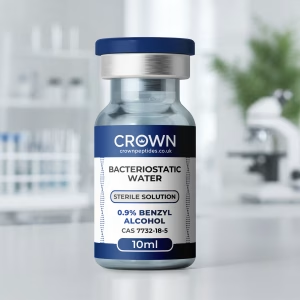
Bacteriostatic Water
HPLC and MS verified · batch certificate published · dispatched from the UK before 2pm
Why Sourcing Quality Matters for Reconstitution Solvent
Because bacteriostatic water is used specifically to dissolve peptides before they’re studied, its purity standards need to match — not fall below — the standards applied to the peptides themselves. A contaminated or incorrectly formulated solvent can introduce exactly the kind of confounding variable that undermines confidence in an experimental result, even when the peptide itself was correctly sourced and tested.
Common failure modes relevant to reconstitution solvent specifically include:
- Incorrect benzyl alcohol concentration — a solvent with too little preservative won’t reliably prevent bacterial growth across the intended multi-dose usage window, while an incorrect concentration in either direction represents a deviation from USP specification.
- Bacterial or endotoxin contamination — solvent that isn’t manufactured and packaged under proper sterile, endotoxin-controlled conditions can introduce contamination directly into every peptide it’s used to reconstitute.
- pH inconsistency — solvent pH outside the expected range can affect peptide solubility and stability during reconstitution, in some cases visibly (cloudiness or precipitation) but in other cases without any obvious sign.
- Non-pharmaceutical-grade manufacturing — solvent produced outside properly controlled, sterile manufacturing conditions carries a materially higher risk of the contamination issues described above.
Given that reconstitution solvent touches every single peptide used in a research protocol, its quality standard isn’t a minor supporting detail — it’s a basic precondition for trusting any downstream experimental result involving a reconstituted peptide.
Read the certificate before you order
Every batch is published openly — identity by mass spectrometry, purity by HPLC, and the batch number printed on the vial you receive.
Open the COA libraryWhy Choose Crown Peptides
Testing is only part of the picture. Crown Peptides was built around a simple idea: a UK researcher ordering a peptide should be able to trust everything about how it reached them — not just the number on a Certificate of Analysis, but who made it, how it was handled, how it travelled, and who they can speak to if they have a question. That’s the standard we hold ourselves to on every order, and it’s worth explaining properly rather than just listing it.
Sourcing You Can Trust
Quality starts long before a product reaches our warehouse. We work directly with one of the world’s largest and most established peptide synthesis manufacturers, chosen specifically for its production standards, consistency, and track record — rather than sourcing opportunistically from whichever manufacturer happens to offer the lowest price that month. That close, ongoing partnership is what allows us to stand behind every batch we sell, because we know exactly how it was made.
Verified Through Independent Testing
We don’t expect researchers to take a manufacturer’s word for it, so we verify every batch independently before it’s listed for sale:
Endotoxin Testing
Every batch is screened for bacterial endotoxin, which matters in particular for any research involving cell culture, immune signalling, or in vivo inflammatory endpoints.
HPLC Purity Analysis
High-performance liquid chromatography is used to assess purity and screen for truncated sequences, deletion products, and synthesis by-products.
Mass Spectrometry / Analytical Confirmation
Analytical testing confirms both the sterility and correct benzyl alcohol concentration of the supplied bacteriostatic water, providing an independent quality check that matches the standard applied to the peptides it is used to reconstitute.
Certificate of Analysis
Every batch is supplied with a Certificate of Analysis, and a QR code linking directly to the testing report on crownpeptides.co.uk, so researchers can document exactly what was used in their own experimental records.
Careful Storage and Handling
A product that’s been correctly synthesised and tested can still be let down by poor handling afterward. Once a batch clears testing, we store it under controlled conditions designed to preserve stability and prevent degradation before it ever reaches a researcher’s bench. This matters more for peptides and sensitive research compounds than for most laboratory reagents: temperature excursions, light exposure, and poor stock rotation can all silently reduce integrity long before a vial is opened, in ways that aren’t visible on inspection and can quietly undermine an experiment’s results. We treat that storage window as part of the product, not an afterthought once testing is done.
Packaging and Delivery
Every order is packed in premium, discreet packaging designed to protect the product in transit and arrive intact. Orders placed before 2pm are dispatched the same working day for next-day UK delivery, and we ship to Northern Ireland, the Republic of Ireland, Scotland, England, and across the EU, with international shipping available beyond that. For a researcher working to a study timeline, knowing an order will arrive quickly, safely, and exactly as ordered isn’t a convenience — it’s part of keeping a research schedule on track.
Support That Goes Beyond the Sale
Peptide and research-compound work raises genuine practical questions — around reconstitution, storage, handling, and interpreting a Certificate of Analysis — and we’d rather a researcher ask us directly than guess. Our team is on hand to provide clear, straightforward guidance from product selection through to delivery and beyond, without the evasiveness or upsell pressure that can come with some suppliers in this space. We see that ongoing relationship, not just the transaction, as the actual job.
Regulatory Compliance and Transparency
Crown Peptides is a UK-based company operating in line with MHRA guidance on research chemicals. Every product is clearly labelled for laboratory research use only, sold on the basis that the purchaser is a qualified professional legally able to handle these materials, and never marketed, described, or sold as suitable for human consumption, therapeutic use, or diagnostic application. We’d rather be transparent about what we sell and who it’s for than blur that line to chase a wider customer base — that’s a deliberate choice on our part, not a legal minimum we begrudgingly meet.
Our Commitment
Put simply, our mission is to supply the UK research community with peptides and research compounds of unmatched purity and consistency, backed by a level of service, transparency, and technical support that researchers can actually rely on — from the first email enquiry to the vial arriving on the bench. That standard applies whether an order is a single vial for an independent researcher or a bulk order for a laboratory, and it holds regardless of whether a customer ever finds out how much work sits behind it.
Crown Peptides’ products are supplied strictly for laboratory research and are not sold, labelled, or intended for human consumption, diagnosis, treatment, or prevention of disease. For researchers who want their results to be reproducible and their experimental record defensible, knowing precisely what’s in the vial — and trusting that everyone who handled it got it right — is a basic, non-negotiable starting point.
Ready to order? View batch testing and pricing on crownpeptides.co.uk
References
- “Bacteriostatic Water for Injection, USP.” DailyMed, U.S. National Library of Medicine. https://dailymed.nlm.nih.gov/dailymed/
- United States Pharmacopeia. “Water for Injection” monograph standards. https://www.usp.org/
Working with Bacteriostatic Water
Batch-tested material, published certificates, and same-day dispatch on orders placed before 2pm.
See Bacteriostatic Water