

Research guide
Hexarelin UK: GHRP and Cardiac Research, Mechanism and Study Data
Hexarelin is a potent growth hormone-releasing hexapeptide that also binds the cardiac receptor CD36. This guide covers its design, human growth hormone and heart studies, desensitisation data and how it compares with GHRP-6, GHRP-2 an…
In a small study in Turin, researchers gave seven healthy men either growth hormone or a six-amino-acid peptide called hexarelin. Both raised blood growth hormone to the same level. Only one made the heart pump harder. Within 15 minutes of hexarelin, the share of blood the left ventricle pushed out with each beat had started to climb, and growth hormone on its own did nothing of the kind.
That result turned hexarelin from “another growth hormone peptide” into one of the most interesting compounds in its family. It is a powerful releaser of growth hormone, one of the strongest studied in people, but it also binds a second receptor in the heart and blood vessels called CD36, and it appears to act on the heart in ways growth hormone cannot explain. This guide covers what hexarelin is, how it was designed, how its two receptor systems work, what the human and animal studies found, including the honest picture on desensitisation, and how it compares with GHRP-6, GHRP-2 and Ipamorelin. Hexarelin acetate is sold by Crown Peptides strictly for laboratory research use only, and everything below is written for readers interested in the science. You can find it on our Hexarelin Acetate Research Peptide page, part of our Endocrine & Hormonal research peptides range.
What Is Hexarelin, and Why Does It Stand Out From Its Family?
Hexarelin is a synthetic hexapeptide, a chain of six amino acids, belonging to the growth hormone-releasing peptide (GHRP) family. Like its relatives, it prompts the pituitary gland to release growth hormone by acting on the ghrelin receptor. What sets it apart is a second job. Hexarelin also binds CD36, a receptor found on heart muscle cells, blood vessel linings and immune cells, and that link has made it a favourite tool for cardiovascular researchers as well as endocrinologists.
Is hexarelin the same as examorelin?
Yes. Examorelin is hexarelin’s official non-proprietary name, and the two are used interchangeably. In development it also carried the codes EP 23905 and MF 6003 (AdisInsight). Searches for “hexarelin peptide”, “hexarelin acetate” and “examorelin” all refer to the same compound.
What is hexarelin acetate?
Like most research peptides, hexarelin is supplied as a salt. Hexarelin acetate is the peptide paired with acetate, which makes it easier to purify, weigh and keep stable as a freeze-dried powder. The active peptide chain is the same; the acetate simply adds a little to the weight of the powder.
Where does it sit among growth hormone peptides?
There are two main ways to ask the pituitary for growth hormone. One is through the GHRH receptor, used by compounds like Sermorelin and Tesamorelin. The other is through the ghrelin receptor, also called GHS-R1a, used by the GHRPs such as GHRP-6, GHRP-2, Ipamorelin and hexarelin. Hexarelin belongs to the second group, and it is generally counted among the most potent members, with the important twist of that extra cardiac receptor.
Designing a Better GHRP: Where Hexarelin Came From
The story starts before anyone knew the receptor existed. In the late 1970s and early 1980s, Cyril Bowers and colleagues were building small synthetic peptides in search of something that would release growth hormone. In 1984 they described a hexapeptide, His-D-Trp-Ala-Trp-D-Phe-Lys-NH2, that released growth hormone in a dose-related way in rats, monkeys, lambs and calves, without releasing LH, FSH, TSH or prolactin (PMID: 6714155). That peptide became known as GHRP-6.
Here is the remarkable part: nobody yet knew what GHRP-6 was binding to.
One methyl group makes hexarelin
In the early 1990s, Romano Deghenghi and colleagues at the University of Milan made a small but clever change to GHRP-6. They replaced the D-tryptophan at position 2 with D-2-methyl-tryptophan, a chemically more stable version of the same amino acid. The result was hexarelin, His-D-2-Me-Trp-Ala-Trp-D-Phe-Lys-NH2. In a 1994 rat study, hexarelin was very active in 10-day-old rats. Given intravenously to adult rats, hexarelin and GHRP-6 produced similar growth hormone release, peaking within 10 minutes. Given under the skin, hexarelin produced a long-lasting release and was slightly more effective than GHRP-6 (PMID: 7910650).
The receptor, and then the hormone, are found
In 1996, a Merck team cloned the receptor that GHRPs and similar compounds act on, a G protein-coupled receptor in the pituitary and hypothalamus, and suggested these synthetic compounds were mimicking a hormone nobody had yet discovered (PMID: 8688086). In 1999, a Japanese team found it: a 28-amino-acid peptide from the stomach with an unusual fatty acid attached, which they named ghrelin (PMID: 10604470). Synthetic peptides like GHRP-6 and hexarelin had, in effect, found the lock before anyone found the natural key.
Through the 1990s, hexarelin was studied in people, largely in Italy and the UK, as a growth hormone test and a possible therapy for growth hormone deficiency. Its development for that use was later discontinued, according to AdisInsight (AdisInsight). By then, however, researchers had stumbled on something more surprising: its effects on the heart.
- Classification
- Synthetic growth hormone-releasing hexapeptide research compound, acetate salt
- Available strength
- 5mg (coming soon)
- CAS Number
- 208251-52-9 (hexarelin acetate); 140703-51-1 (hexarelin)
- Molecular Weight
- approximately 887.0 g/mol (peptide); approximately 947.1 g/mol (monoacetate)
- Molecular Formula
- C47H58N12O6 (peptide); C49H62N12O8 (monoacetate)
- Sequence
- His-D-2-methyl-Trp-Ala-Trp-D-Phe-Lys-NH2 (6 amino acids)
How Hexarelin Works: Two Receptors, Two Stories
Most GHRPs are thought of as one-receptor compounds. Hexarelin is better understood as a two-receptor compound.
The ghrelin receptor: releasing growth hormone
In the pituitary and hypothalamus, hexarelin acts on GHS-R1a, the ghrelin receptor. Switching it on prompts somatotroph cells to release growth hormone. GHRPs also appear to work partly by counteracting somatostatin, the brain’s main growth hormone brake, and partly through the hypothalamus. A detailed 1997 review described their effect as marked, dose-related and synergistic with GHRH, and noted that it is reduced, but still strong, in older people (PMID: 9186261).
Synergy with GHRH
Hexarelin and GHRH work through different receptors, and together they produce more than the sum of their parts. In a 1996 London study in six healthy men, giving hexarelin with GHRH produced peak growth hormone secretion rates significantly greater than the two added together (PMID: 8762732). A dose-response study from the same group found that a low dose of hexarelin combined with GHRH produced a large growth hormone release with only a moderate rise in prolactin and no rise in cortisol (PMID: 8954038).
CD36: the cardiac receptor
Here is where hexarelin’s story splits off from its family. In 2002, researchers in Montreal attached a light-activated tag to hexarelin and used it to find what the peptide binds in rat heart tissue. The protein they pulled out was CD36, a multi-purpose receptor found on heart muscle cells and the cells lining small blood vessels. In isolated perfused hearts, hexarelin increased coronary perfusion pressure in a dose-dependent way, and this effect was missing in hearts from CD36-knockout mice and from a strain of rats that naturally lacks CD36 (PMID: 11988484).
That is worth pausing on, because it is not all good news. An increase in coronary perfusion pressure means the coronary vessels narrowed, and the authors suggested CD36 might play a part in coronary spasm in conditions such as high cholesterol. CD36 activation by hexarelin, in other words, can have more than one kind of effect on blood vessels, and that is part of why the receptor is so intensely studied.
A follow-up study pinned down where hexarelin binds on CD36: a stretch of the receptor between residues 132 and 177, overlapping the site that CD36 uses to pick up oxidised LDL cholesterol (PMID: 15176951). That overlap suggested a reason why GHRPs might influence how immune cells handle cholesterol, a line of research we come back to below.
Evidence for a heart action independent of growth hormone
How do you prove a peptide acts on the heart directly, rather than through the growth hormone it releases? Remove the pituitary. In a 1999 study, hypophysectomised rats, with no pituitary and so no growth hormone response, were given hexarelin for seven days. Hexarelin still protected their hearts against ischaemia-reperfusion damage in an isolated heart model, improving recovery of contractility and limiting rises in pressure and enzyme release. Another GHRP, EP 51389, which releases growth hormone but does not bind heart tissue, had no protective effect (PMID: 10465272).
Binding studies in human tissue support the same idea. A 2000 study using a radio-labelled hexarelin found binding sites mainly in the heart muscle, as well as in the adrenal glands, gonads, arteries and other tissues. In non-endocrine tissues such as the heart, neither ghrelin nor the non-peptide secretagogue MK-0677 could displace hexarelin, whereas hexarelin itself could, suggesting a receptor that recognises peptide GHRPs specifically (PMID: 11061542).
- Also known as
- Examorelin; EP 23905; MF 6003; hexarelin acetate (salt form)
- Classification
- Synthetic growth hormone-releasing hexapeptide (GHRP); GHS-R1a agonist and CD36 ligand
- Sequence
- His-D-2-Me-Trp-Ala-Trp-D-Phe-Lys-NH2
- Molecular weight
- 887.0 g/mol (peptide, C47H58N12O6; PubChem)
- CAS number
- 140703-51-1 (PubChem)
- Research status
- Research peptide; studied in people in the 1990s and early 2000s; development as a medicine discontinued
What the Research Has Actually Found
Hexarelin has a richer human dataset than many research peptides, because it was studied clinically in the 1990s. Alongside that sits a large body of animal and cell work, much of it on the heart.
Growth hormone release in people
The landmark human study came from Turin in 1994. Twelve healthy young volunteers received hexarelin intravenously, under the skin, by nasal spray and by mouth. Given into a vein, hexarelin released about twice as much growth hormone as the same amount of GHRH, and a larger amount increased the response further. The response was highly reproducible on repeat testing. Measured bioavailability was 77% under the skin, 4.8% by nasal spray and 0.3% by mouth, although the oral form still produced a clear, dose-related rise when much larger amounts were used (PMID: 8126144).
A 1996 dose-response study in healthy men found that the growth hormone response reached a plateau at the top of the range of amounts tested. Hexarelin also raised prolactin and cortisol in a dose-dependent way (PMID: 8954038). That is an important point of accuracy: hexarelin is not a pure growth hormone releaser.
Hexarelin as a test of pituitary reserve
Because the response is strong and reproducible, hexarelin was tested as a diagnostic probe. At St Bartholomew’s Hospital in London, 19 patients with possible pituitary disease had both a hexarelin test and the standard insulin tolerance test. Peak growth hormone was higher after hexarelin, and the two tests correlated well. Every patient with a low growth hormone response to hexarelin was also growth hormone deficient on the insulin test. Hexarelin was not useful for testing the cortisol axis, however (PMID: 10469018). The authors proposed it as a first screening test for adult growth hormone deficiency.
Desensitisation: what happens with repeated exposure?
This is the question everyone asks about GHRPs, and hexarelin has some of the clearest human data. The honest answer is: partial, depends on the pattern, and reversible.
Within hours
In the 1996 London study, a second intravenous dose of hexarelin still released growth hormone, but when it came 120 minutes after the first, the peak was lower. The synergy with GHRH was lost on the second round (PMID: 8762732).
Over weeks
A Manchester team gave hexarelin twice daily under the skin for 16 weeks. In 12 healthy older volunteers, the growth hormone response to a test dose fell from an area under the curve of 19.1 at the start to 13.1 at week 1, 12.3 at week 4 and 10.5 at week 16 (the fall was statistically significant from week 4). Four weeks after stopping, it was back to 19.4, no different from baseline (PMID: 10990150). The full paper added a fair counterpoint: over 16 weeks, IGF-1, IGFBP-3, body fat, lean mass and bone density did not change significantly, and the authors described the biological impact of that schedule on the growth hormone axis as minimal (PMID: 9589671). The same study found that the cortisol response to hexarelin had actually fallen by week 16, and prolactin was unchanged, so repeated exposure did not over-stimulate those hormones (PMID: 10341859).
A different pattern, a different result
Pattern seems to matter. In a Turin study of elderly volunteers, eight days of intranasal hexarelin or 15 days of oral hexarelin, three times a day, did not reduce the growth hormone response. Oral treatment slightly but significantly raised IGF-1 and IGFBP-3, and neither route changed prolactin or cortisol (PMID: 8921821). Those were short studies in small groups, using different routes and schedules, so they do not cancel out the 16-week finding. Together, they suggest that how often and how strongly the receptor is stimulated shapes how much it adapts, which matches the broader GHRP literature describing more desensitisation with continuous exposure than with intermittent exposure (PMID: 9186261).
Acute heart effects in people
Now back to the opening study. In seven healthy men, intravenous hexarelin and growth hormone raised blood growth hormone to the same extent. Hexarelin increased left ventricular ejection fraction from 64.0% to 70.7%, with no significant change in blood pressure or heart rate, while growth hormone left it unchanged. The effect began at 15 minutes, peaked at 30 and lasted up to 60 minutes (PMID: 10342360).
The same team then studied seven men with severe growth hormone deficiency, whose pituitaries released almost no growth hormone in response to hexarelin. Hexarelin still raised ejection fraction, from 50% to a peak of 57%, pointing again to a direct cardiac action (PMID: 10528131).
The most striking human data came from a study of 24 men with coronary artery disease undergoing bypass surgery under general anaesthesia, split between hexarelin, GHRH, growth hormone and placebo. Hexarelin rapidly increased ejection fraction, cardiac index and cardiac output, lasting up to 90 minutes, while GHRH, growth hormone and placebo had no haemodynamic effect. Hexarelin raised growth hormone only slightly, far less than administered growth hormone did (PMID: 12144941).
A fair counterpoint from the heart studies
The picture is not uniform. In a study of patients with severe heart muscle weakness, hexarelin raised ejection fraction in five patients whose weakness came from coronary artery disease, from about 22.6% to a peak of 26.2%, but not in eight patients with dilated cardiomyopathy, despite a similar growth hormone response (PMID: 11959048). All of these human heart studies were small and measured single-dose effects over an hour or two. None tested longer-term outcomes.
Heart studies in animals
Longer-term work has been done in animals, with consistent results.
In a 2000 Swedish study, rats with heart damage from a tied-off coronary artery were given hexarelin, growth hormone or saline for two weeks, starting four weeks after the injury. The higher hexarelin dose increased stroke volume and cardiac output and lowered peripheral resistance to a similar extent as growth hormone, but without the extra body weight gain that growth hormone produced (PMID: 10614623).
In a 2013 Japanese study in ghrelin-knockout mice after heart attack, two-week mortality was 6.7% with hexarelin and 14.3% with ghrelin, against 50% with vehicle. Hexarelin improved ejection fraction and pressure measures more than ghrelin did (PMID: 23861368).
A 2018 Australian mouse study used MRI to follow heart function after induced heart attack. After 14 days, hexarelin-treated mice had significantly better left ventricular function than vehicle-treated mice. After 21 days, they had less collagen build-up in the heart muscle, lower TGF-beta-1, lower troponin-I, IL-1-beta and TNF-alpha, and a shift in nervous system balance towards the calming, parasympathetic side (PMID: 29756411).
And in spontaneously hypertensive rats, five weeks of hexarelin reduced collagen build-up in the heart, increased the activity of collagen-degrading enzymes MMP-2 and MMP-9, and eased left ventricular thickening, diastolic dysfunction and high blood pressure. A GHS-R blocker abolished those effects, which points to a ghrelin-receptor role in that model (PMID: 22842067). So the cardiac story is not purely CD36: different models implicate different receptors, and untangling them is a live research question.
Fat cells and cholesterol handling
CD36 is also a major fatty acid and cholesterol receptor, which opens a metabolic line of research. In a 2007 study, hexarelin reduced the fat content of cultured mouse fat cells and switched on genes for fat burning and mitochondrial activity, including PGC-1-alpha and UCP-1, markers usually associated with brown fat. Mice given hexarelin showed a similar pattern in white fat, and it disappeared in CD36-knockout mice (PMID: 17138655).
A related compound makes the CD36 link clearer still. EP 80317 is a GHRP-family peptide that binds CD36 but does not release growth hormone. In mice prone to atherosclerosis, it reduced lesion area by up to 51% and lowered total cholesterol by 30%, and those effects were absent in mice lacking CD36 (PMID: 16123174). That separates the CD36 effects from growth hormone entirely, and it shows why hexarelin’s second receptor has become a research field of its own.
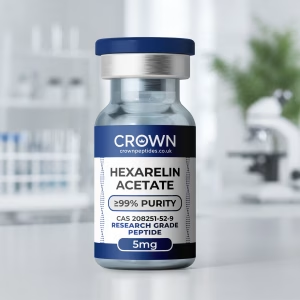
Hexarelin Acetate Research Peptide
HPLC and MS verified · certificate with every batch · pricing announced when stock arrives
Hexarelin vs GHRP-6, GHRP-2 and Ipamorelin
Hexarelin is most often compared with three relatives. The differences come down to potency, selectivity and that second receptor.
Hexarelin vs GHRP-6
GHRP-6 is hexarelin’s parent. The only difference in sequence is the methyl group on the tryptophan at position 2. In rats, the two produced similar growth hormone release intravenously, with hexarelin slightly more effective under the skin and producing a long-lasting release (PMID: 7910650). GHRP-6 is also widely studied for its effect on appetite. Our GHRP-6 guide covers it in depth.
Hexarelin vs GHRP-2
Both are often called the most potent GHRPs, and the head-to-head data say they are in the same league. In a 1997 Turin study in six healthy young adults, intravenous GHRP-2 and hexarelin at matched amounts produced similar, strong growth hormone responses, both higher than GHRH. Both also produced similar rises in prolactin, ACTH and cortisol (PMID: 9285939). So the main difference is not raw potency but hexarelin’s CD36 binding and its larger body of cardiac research. Our GHRP-2 vs GHRP-6 comparison shows how those two relatives differ from each other.
Hexarelin vs Ipamorelin
Ipamorelin went the other way: it was designed for selectivity rather than power. In its 1998 profile from Novo Nordisk, tested in rat pituitary cells, rats and pigs, Ipamorelin released growth hormone with potency similar to GHRP-6, but in pigs, unlike GHRP-6 and GHRP-2, it did not raise ACTH or cortisol, even at doses more than 200 times higher than needed for growth hormone release (PMID: 9849822). Hexarelin, by contrast, does raise cortisol and prolactin after a single dose (PMID: 8954038). If a study needs a clean growth hormone signal, Ipamorelin is usually the better fit. If it needs maximum release or is interested in the heart and CD36, hexarelin is the more interesting tool. Our Ipamorelin guide and Ipamorelin vs GHRP-2 article explore that contrast.
Where Hexarelin Research Is Heading
Hexarelin’s clinical development stopped, but its research story did not.
Separating the two receptors. Some cardiac effects need CD36; others are blocked by a ghrelin-receptor antagonist. Working out which receptor does what, in which tissue, is a central question, helped by CD36-only ligands like EP 80317.
Heart remodelling and fibrosis. Mouse and rat studies consistently show less scarring and better function after injury. The obvious next step is longer, carefully controlled studies that look at outcomes beyond the first few weeks.
Inflammation and cholesterol. CD36 sits at the crossroads of fat handling and immune activity. Hexarelin and related peptides are being used to probe how that receptor shapes cholesterol movement, fat cell behaviour and inflammatory signalling.
Understanding desensitisation. The human data show that response falls with frequent twice-daily exposure and recovers after a pause, while short intermittent use did not reduce it. Mapping exactly which patterns preserve responsiveness remains a useful question for the whole GHRP family.
The Technical Breakdown: Sequence, Receptors and Chemistry
This section is for readers who want the molecular detail. Everything above makes sense without it.
The sequence
Hexarelin is His-D-2-Me-Trp-Ala-Trp-D-Phe-Lys-NH2 (PMID: 9285939). Two residues are D-amino acids, the mirror-image forms that protect the chain from many enzymes. The C-terminal lysine is amidated, removing the free acid group at the end. The defining change from GHRP-6 is the 2-methyl group on the D-tryptophan at position 2, which the developers chose because it is chemically more stable (PMID: 7910650).
GHS-R1a signalling
GHS-R1a is a G protein-coupled receptor on the growth hormone-producing cells of the pituitary and on cells in the hypothalamus. GHRPs act at both sites, partly by counteracting somatostatin, the brain’s growth hormone brake. Their effect is only blunted, not abolished, by inhibitory signals that almost abolish the effect of GHRH (PMID: 9186261).
The CD36 binding site
CD36 is a heavily glycosylated membrane protein, identified in rat heart at about 84 kDa (PMID: 11988484), that acts as a scavenger receptor for oxidised LDL. Photo-crosslinking placed hexarelin’s binding site in the CD36 segment from asparagine 132 to glutamate 177, with methionine 169 as a likely contact point (PMID: 15176951).
Why the route changed the results
One technical thread runs through the hexarelin literature: how it was given changed how much reached the bloodstream. Bioavailability was 77% under the skin but only 4.8% by nasal spray and 0.3% by mouth (PMID: 8126144), which is why studies using different routes are not directly comparable. In the laboratory, working concentrations depend entirely on the experiment, and our understanding quantities page explains how milligram figures relate to research solutions.
Anti-doping status
Hexarelin is listed by the World Anti-Doping Agency under section S2 among growth hormone-releasing peptides, as examorelin (hexarelin) (Finnish Center for Integrity in Sports, 2026 list).
Why Verified Testing Matters for Hexarelin
Hexarelin is only six residues long, but its structure is unusually demanding. It contains two D-amino acids, a non-standard 2-methyl-tryptophan, two tryptophan-type residues that can oxidise, and an amidated C-terminus. A batch that contains the plain D-tryptophan of GHRP-6 instead of the methylated version, the wrong mirror-image form at either D position, or an oxidised tryptophan could still look like a white powder in a vial, but it would not be hexarelin. Mass spectrometry is what distinguishes hexarelin at 887 g/mol from GHRP-6, which differs by a single methyl group. HPLC is what shows how much of the vial is the right compound.
What every Crown Peptides batch comes with
Every batch is tested before sale. HPLC (high-performance liquid chromatography) measures purity by separating hexarelin from related impurities, and mass spectrometry confirms identity by weighing the molecule. The results are published as a batch-specific certificate of analysis on our Lab Reports page, and the batch number printed on each vial links it to that certificate. For a walk-through, see how to read a peptide certificate of analysis.
Stored, packed and dispatched properly
Hexarelin acetate is supplied as lyophilised (freeze-dried) powder in 5mg vials, the most stable form for storage and transport. Vials are kept cold, sealed and protected from light and moisture, which matters for a peptide with oxidation-sensitive tryptophan residues. Our storage information page has the details. Weekday orders placed before 2pm are dispatched the same day from the UK, and UK delivery is free on orders over £100.
A UK company you can talk to
Crown Peptides is a UK company. We reply to enquiries within 24 hours on business days, with WhatsApp available for quicker answers. For questions about a batch, a certificate or a compound, get in touch.
Related Compounds Worth Knowing About
Hexarelin sits within a family of growth hormone peptides that reach the pituitary by two different routes. These are the closest relatives in our range.
GHRP-6
GHRP-6 is hexarelin’s parent compound, differing by a single methyl group. It is the original GHRP and still a standard reference in ghrelin-receptor research.
GHRP-2
GHRP-2 matches hexarelin for growth hormone release in head-to-head human data. Our GHRP-2 guide covers its research history in full.
Ipamorelin
Ipamorelin is the selective member of the family, releasing growth hormone without the cortisol rise seen with hexarelin, GHRP-2 and GHRP-6.
Sermorelin
Sermorelin works through the GHRH receptor instead. Because GHRH and GHRPs are synergistic, it is a natural comparison compound in growth hormone studies.
CJC-1295 (With DAC)
CJC-1295 (With DAC) is a long-acting GHRH analogue. It contrasts with hexarelin’s short, sharp pulses and adds a useful time dimension to growth hormone research.
Tesamorelin
Tesamorelin is a stabilised GHRH analogue with the deepest clinical record of the GHRH-route compounds, a helpful benchmark for the ghrelin-route peptides.
Browse the full family in our Endocrine & Hormonal research peptides category, or see how these compounds fit together in our roundup of the best peptides for muscle research.
Common Questions About Hexarelin
What is hexarelin?
Hexarelin is a synthetic six-amino-acid growth hormone-releasing peptide (GHRP). It releases growth hormone through the ghrelin receptor, GHS-R1a, and also binds CD36, a receptor in the heart and blood vessels.
Is hexarelin the same as examorelin?
Yes. Examorelin is its official non-proprietary name. Hexarelin acetate is the acetate salt form of the same peptide.
Is hexarelin stronger than GHRP-6 and GHRP-2?
In rats it was similar to GHRP-6 intravenously and slightly more effective under the skin. In a head-to-head human study, hexarelin and GHRP-2 produced similar, strong growth hormone responses. It belongs among the most potent GHRPs rather than clearly above them.
Does the response to hexarelin fade with repeated use?
Partly. In a 16-week human study with twice-daily dosing, the growth hormone response fell by roughly 30 to 45% and returned to baseline four weeks after stopping. Short, intermittent nasal and oral use in older volunteers did not reduce the response.
What has research found about hexarelin and the heart?
Small human studies found single doses raised ejection fraction within an hour in healthy men, growth hormone-deficient men and bypass surgery patients, but not in dilated cardiomyopathy. Animal studies found better heart function and less scarring after injury. No long-term human heart studies have been published.
Is hexarelin legal in the UK?
Hexarelin is not a controlled drug under the Misuse of Drugs Act, and it can be bought legally in the UK for laboratory research. Our guide are peptides legal in the UK explains the rules.
Can I buy hexarelin in the UK?
Yes. Crown Peptides supplies hexarelin acetate in 5mg lyophilised vials, within our endocrine and hormonal research peptides category, each batch with a published certificate showing HPLC purity and mass spectrometry identity.
How should hexarelin be stored?
As a freeze-dried powder, kept cold, sealed, dry and away from light, which protects its tryptophan residues from oxidation.
Read the certificate before you order
Every batch is published openly — identity by mass spectrometry, purity by HPLC, and the batch number printed on the vial you receive.
Open the COA libraryThe Growth Hormone Peptide That Kept Surprising Its Discoverers
Hexarelin was built to do one thing: release growth hormone more reliably than the peptide it came from. It did that, and it did it powerfully. Then it turned out to bind a cholesterol and fatty acid receptor in the heart, to change how the heart pumps in ways growth hormone cannot, and to reshape fat cells through a receptor that has nothing to do with the pituitary.
That is why hexarelin remains so valuable decades after its clinical path ended: one well-characterised molecule touching two of the most interesting receptor systems in physiology, with a human dataset many newer peptides lack. The big questions, which receptor does what in the heart, and how CD36 can be steered, are exactly the kind that a well-defined tool compound is built to answer.
If your research sits where growth hormone biology meets the cardiovascular system, hexarelin is the place to start. Explore hexarelin acetate and its relatives in our Endocrine & Hormonal research peptides range, each batch HPLC and mass spectrometry verified, with its certificate published in full.
References
- Bowers CY, Momany FA, Reynolds GA, et al. On the in vitro and in vivo activity of a new synthetic hexapeptide that acts on the pituitary to specifically release growth hormone. Endocrinology. 1984;114:1537-45. PMID: 6714155
- Deghenghi R, Cananzi MM, Torsello A, et al. GH-releasing activity of Hexarelin, a new growth hormone releasing peptide, in infant and adult rats. Life Sci. 1994;54:1321-8. PMID: 7910650
- Howard AD, Feighner SD, Cully DF, et al. A receptor in pituitary and hypothalamus that functions in growth hormone release. Science. 1996;273:974-7. PMID: 8688086
- Kojima M, Hosoda H, Date Y, et al. Ghrelin is a growth-hormone-releasing acylated peptide from stomach. Nature. 1999;402:656-60. PMID: 10604470
- Ghigo E, Arvat E, Muccioli G, et al. Growth hormone-releasing peptides. Eur J Endocrinol. 1997;136:445-60. PMID: 9186261
- Massoud AF, Hindmarsh PC, Matthews DR, et al. The effect of repeated administration of hexarelin, a growth hormone releasing peptide, and growth hormone releasing hormone on growth hormone responsivity. Clin Endocrinol (Oxf). 1996;44:555-62. PMID: 8762732
- Massoud AF, Hindmarsh PC, Brook CG. Hexarelin-induced growth hormone, cortisol, and prolactin release: a dose-response study. J Clin Endocrinol Metab. 1996;81:4338-41. PMID: 8954038
- Bodart V, Febbraio M, Demers A, et al. CD36 mediates the cardiovascular action of growth hormone-releasing peptides in the heart. Circ Res. 2002;90:844-9. PMID: 11988484
- Demers A, McNicoll N, Febbraio M, et al. Identification of the growth hormone-releasing peptide binding site in CD36: a photoaffinity cross-linking study. Biochem J. 2004;382:417-24. PMID: 15176951
- Locatelli V, Rossoni G, Schweiger F, et al. Growth hormone-independent cardioprotective effects of hexarelin in the rat. Endocrinology. 1999;140:4024-31. PMID: 10465272
- Papotti M, Ghè C, Cassoni P, et al. Growth hormone secretagogue binding sites in peripheral human tissues. J Clin Endocrinol Metab. 2000;85:3803-7. PMID: 11061542
- Ghigo E, Arvat E, Gianotti L, et al. Growth hormone-releasing activity of hexarelin, a new synthetic hexapeptide, after intravenous, subcutaneous, intranasal, and oral administration in man. J Clin Endocrinol Metab. 1994;78:693-8. PMID: 8126144
- Korbonits M, Kaltsas G, Perry LA, et al. Hexarelin as a test of pituitary reserve in patients with pituitary disease. Clin Endocrinol (Oxf). 1999;51:369-75. PMID: 10469018
- Rahim A, Shalet SM. Does desensitization to hexarelin occur?. Growth Horm IGF Res. 1998;8 Suppl B:141-3. PMID: 10990150
- Rahim A, O’Neill PA, Shalet SM. Growth hormone status during long-term hexarelin therapy. J Clin Endocrinol Metab. 1998;83:1644-9. PMID: 9589671
- Rahim A, O’Neill PA, Shalet SM. The effect of chronic hexarelin administration on the pituitary-adrenal axis and prolactin. Clin Endocrinol (Oxf). 1999;50:77-84. PMID: 10341859
- Ghigo E, Arvat E, Gianotti L, et al. Short-term administration of intranasal or oral Hexarelin, a synthetic hexapeptide, does not desensitize the growth hormone responsiveness in human aging. Eur J Endocrinol. 1996;135:407-12. PMID: 8921821
- Bisi G, Podio V, Valetto MR, et al. Acute cardiovascular and hormonal effects of GH and hexarelin, a synthetic GH-releasing peptide, in humans. J Endocrinol Invest. 1999;22:266-72. PMID: 10342360
- Bisi G, Podio V, Valetto MR, et al. Cardiac effects of hexarelin in hypopituitary adults. Eur J Pharmacol. 1999;381:31-8. PMID: 10528131
- Broglio F, Guarracino F, Benso A, et al. Effects of acute hexarelin administration on cardiac performance in patients with coronary artery disease during by-pass surgery. Eur J Pharmacol. 2002;448:193-200. PMID: 12144941
- Imazio M, Bobbio M, Broglio F, et al. GH-independent cardiotropic activities of hexarelin in patients with severe left ventricular dysfunction due to dilated and ischemic cardiomyopathy. Eur J Heart Fail. 2002;4:185-91. PMID: 11959048
- Tivesten A, Bollano E, Caidahl K, et al. The growth hormone secretagogue hexarelin improves cardiac function in rats after experimental myocardial infarction. Endocrinology. 2000;141:60-6. PMID: 10614623
- Mao Y, Tokudome T, Kishimoto I, et al. Hexarelin treatment in male ghrelin knockout mice after myocardial infarction. Endocrinology. 2013;154:3847-54. PMID: 23861368
- McDonald H, Peart J, Kurniawan N, et al. Hexarelin treatment preserves myocardial function and reduces cardiac fibrosis in a mouse model of acute myocardial infarction. Physiol Rep. 2018;6:e13699. PMID: 29756411
- Xu X, Ding F, Pang J, et al. Chronic administration of hexarelin attenuates cardiac fibrosis in the spontaneously hypertensive rat. Am J Physiol Heart Circ Physiol. 2012;303:H703-11. PMID: 22842067
- Rodrigue-Way A, Demers A, Ong H, et al. A growth hormone-releasing peptide promotes mitochondrial biogenesis and a fat burning-like phenotype through scavenger receptor CD36 in white adipocytes. Endocrinology. 2007;148:1009-18. PMID: 17138655
- Marleau S, Harb D, Bujold K, et al. EP 80317, a ligand of the CD36 scavenger receptor, protects apolipoprotein E-deficient mice from developing atherosclerotic lesions. FASEB J. 2005;19:1869-71. PMID: 16123174
- Arvat E, di Vito L, Maccagno B, et al. Effects of GHRP-2 and hexarelin, two synthetic GH-releasing peptides, on GH, prolactin, ACTH and cortisol levels in man. Comparison with the effects of GHRH, TRH and hCRH. Peptides. 1997;18:885-91. PMID: 9285939
- Raun K, Hansen BS, Johansen NL, et al. Ipamorelin, the first selective growth hormone secretagogue. Eur J Endocrinol. 1998;139:552-61. PMID: 9849822
- AdisInsight. Examorelin (hexarelin): drug profile. Profile
- Finnish Center for Integrity in Sports (SUEK). Doping agent classes and substances 2026 (WADA Prohibited List). List
Working with Hexarelin Acetate Research Peptide
Coming soon to Crown Peptides. Every batch will be HPLC and MS tested, with its certificate published before it goes on sale.
See Hexarelin Acetate Research Peptide