Register today and get 10% off your first orderRegister for 10% off your first orderRegister now
Crown Peptides

Research Peptides

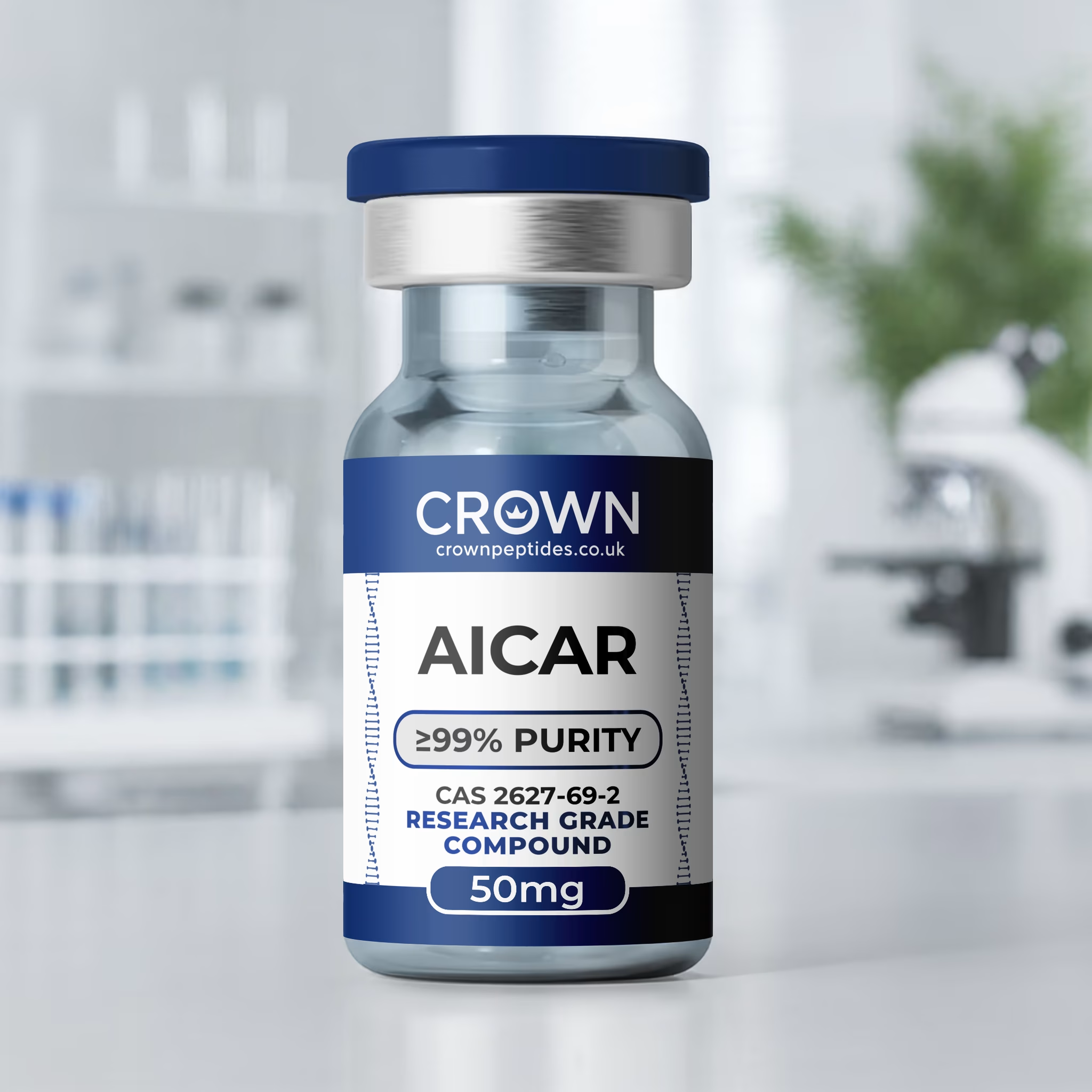
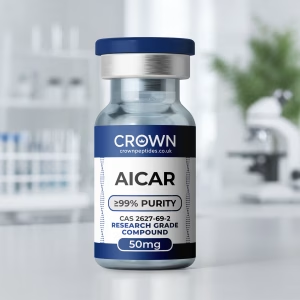
AICAR Research Compound

A high-purity research compound studied in AMPK activation and cellular energy metabolism research. Coming soon in 50mg, with every batch independently tested and dispatched from the UK.

£34.99or from £26.24 per vial in packs of 10
Save up to 25%
From: £34.99
Your selection:
All Batches TestedEvery batch, no exceptions
HPLC & MS VerifiedFull certificate published
Same Day PostageOrder before 2pm
UK Based CompanyDispatched from the UK
Product Overview

A high-purity research compound studied in AMPK activation and cellular energy metabolism research. Coming soon in 50mg, with every batch independently tested and dispatched from the UK.

Full Product Specification
Overview

Product Overview

AICAR UK is Crown Peptides’ synthetic nucleoside AMPK activator research compound, coming soon in 50mg for laboratory research.

50mg (coming soon)Available strengthHPLC testedChromatographic purityMS verifiedIdentity confirmedBatch CoADocumentation supplied

Supplied for laboratory research purposes only — not for human consumption or for medical, veterinary or diagnostic use.

Key features

Key Features

  • Studied in research involving AMP-activated protein kinase (AMPK) activation
  • Studied in research involving skeletal muscle fatty acid oxidation and glucose uptake
  • Studied in research involving purine nucleotide synthesis
  • Studied in research involving AMPK-independent cell-death pathways in lymphocytes
  • Batch-specific quality documentation available
Background

About AICAR UK

AICAR, short for 5-aminoimidazole-4-carboxamide ribonucleoside, is a small nucleoside rather than a peptide: an imidazole ring carrying an amino group and a carboxamide group, joined to the sugar ribose. It has the international name acadesine. Inside cells it is converted to ZMP, a natural intermediate in the pathway that builds purines, and ZMP closely resembles AMP, the signal that switches on the cell’s energy sensor, AMPK. That makes AICAR one of the longest-used laboratory tools in AMPK research. It sits alongside MOTS-c and 5-Amino-1MQ in the metabolic research area.

AICAR’s research history runs in three phases. In the early 1980s it was studied as a purine precursor in heart and skeletal muscle. In 1995 it was shown to activate AMPK in intact cells without disturbing the cell’s own ATP, ADP and AMP, and it became the standard way to switch the kinase on in the laboratory. Alongside that, acadesine went through clinical trials in heart surgery and was later studied in leukaemia cells. More recently, researchers have catalogued how many of its effects run through other nucleotide pathways, and newer compounds, including the nuclear-receptor agonist SLU-PP-332, are studied through quite different targets. Work on cellular energy metabolism often also involves NAD+.

Also known as: acadesine, AICA riboside, AICA ribonucleoside, AICAr, Z-riboside, 5-aminoimidazole-4-carboxamide ribonucleoside, 5-amino-1-β-D-ribofuranosylimidazole-4-carboxamide

Research

AICAR Research

AICAR became a mainstream research tool in 1995, when a study in rat liver cells showed that it activates AMPK through its phosphorylated form, ZMP, without changing the cell’s adenine nucleotide levels. (Learn more) It is now one of the most widely cited compounds in research on cellular energy sensing and mitochondrial metabolism, a field that also includes SS-31 and L-Carnitine.

  • AMP-activated protein kinase (AMPK) activation
  • Skeletal muscle fatty acid oxidation and glucose uptake
  • Purine nucleotide synthesis
  • AMPK-independent cell-death pathways in lymphocytes
Where the story starts: a purine precursor

Cells build purines from scratch in a ten-step pathway ending in IMP, the parent of ATP and GTP, and ZMP, the phosphorylated form of AICAR, is one of the last intermediates on that route. Researchers in the early 1980s used this to their advantage. In a 1982 study in dogs, heart muscle that had been deprived of blood flow normally took hours to days to rebuild its ATP and GTP; supplying AICAR as a purine precursor selectively speeded up that rebuilding. (Learn more)

A specific way to switch on AMPK

AMPK is activated when AMP rises, but earlier methods of raising AMP, such as heat shock or loading cells with fructose, also disturbed the cell’s energy balance. In 1995 Hardie’s group in Dundee incubated rat hepatocytes with AICAR and found that it built up inside the cells as ZMP, which mimicked both of AMP’s activating effects on AMPK: direct activation and promotion of its phosphorylation by an upstream kinase. ATP, ADP and AMP levels did not change. The treated cells inactivated HMG-CoA reductase, a known AMPK target, and almost completely stopped making fatty acids and sterols, while in fat cells AICAR blocked isoprenaline-induced fat breakdown. (Learn more)

Fuel use in skeletal muscle

In 1997 the same approach was taken into perfused rat hindlimb muscle. AICAR activated AMPK, inactivated acetyl-CoA carboxylase and lowered malonyl-CoA, the molecule that normally limits the entry of fatty acids into mitochondria. Over 45 minutes at 2 millimolar, fatty acid oxidation rose 2.8-fold and glucose uptake increased significantly, while oxygen uptake did not change. (Learn more)

The 2008 exercise mimetic study

Researchers at the Salk Institute tested whether drugs aimed at specific pathways could reproduce the gene changes that training brings about in mouse muscle. In sedentary mice, four weeks of AICAR alone switched on metabolic genes in muscle and increased treadmill running endurance by 44%. The paper helped popularise the term “exercise mimetic” for compounds acting through the AMPK and PPAR-delta pathway in this way. (Learn more)

Getting into the cell, and beyond AMPK

AICAR has to be carried into cells by nucleoside transporters and phosphorylated by adenosine kinase before it acts. In a 2003 study of B-cell chronic lymphocytic leukaemia cells, blocking either step prevented both AMPK activation and acadesine-induced apoptosis, and T cells, which built up less ZMP, were largely unaffected. (Learn more) A follow-up in 2010 found that other AMPK activators did not reproduce the effect and that AICAR still killed B cells from mice lacking AMPK-alpha-1, acting instead through the proteins BIM and NOXA. (Learn more) A 2021 systematic review collects many such AMPK-independent effects across metabolism, hypoxia, nucleotide synthesis and cancer models, and recommends caution when AICAR alone is used to draw conclusions about AMPK. (Learn more)

A link with MOTS-c

The pathway that makes ZMP also connects AICAR to a mitochondrial peptide. In the 2015 paper describing MOTS-c, cells producing the peptide blocked de novo purine synthesis and built up their own AICAR nucleotide to more than 20 times control levels, which led to AMPK activation. (Learn more)

Clinical history as acadesine

Acadesine was tested in people undergoing coronary artery bypass surgery. An earlier meta-analysis of five trials had suggested fewer early cardiac events, so a large confirmatory trial, RED-CABG, was run in 300 centres. It was stopped early for futility after 3,080 participants, with the main outcome occurring in 5.1% of the acadesine group and 5.0% of the placebo group. (Learn more)

Taken together, AICAR is a well-characterised laboratory compound with a forty-year research record: a defined nucleoside, a clear route into the cell, a known active form in ZMP, and a large body of work on AMPK, muscle metabolism and nucleotide signalling, along with an equally well-documented set of effects that do not depend on AMPK.

Specifications

Specifications

Product
AICAR
Classification
Synthetic nucleoside AMPK activator research compound
Available strength
50mg (coming soon)
CAS number
2627-69-2
Molecular weight
≈ 258.2 g/mol
Molecular formula
C9H14N4O5
Form
Research material supplied according to product label
Purity and assay
≥99% (HPLC), batch-specific — refer to Certificate of Analysis
Verification
HPLC and Mass Spectrometry where analytically appropriate

Compound-level reference data. Batch-specific results appear on the Certificate of Analysis.

Work out concentration with the peptide calculator
Testing

Purity and Testing

Crown Peptides AICAR will be supplied with batch-specific quality documentation appropriate to the material. Because AICAR is easily confused with its phosphorylated form, ZMP, which is about 80 mass units heavier, and with the free base AICA, which lacks the ribose sugar, identity matters as much as purity: HPLC shows how clean a batch is, while mass spectrometry confirms the riboside itself at about 258 daltons. The Certificate of Analysis should be used as the definitive source for identity, assay, purity and relevant impurity information.

Storage

Storage Conditions

  • Store unreconstituted material at -20°C ± 5°C in a cool, dry environment
  • Prepared research solutions should use validated storage conditions appropriate to the compound and study design
  • Protect from unnecessary heat, direct light and repeated temperature fluctuations
Full storage guide
Related

Related Compounds

Researchers working with AICAR may also be interested in MOTS-c, the mitochondrial peptide reported to raise cellular AICAR nucleotide levels, as well as 5-Amino-1MQ, NAD+, SS-31, L-Carnitine and AOD-9604 — other compounds studied in cellular energy, mitochondrial and metabolic research.

Compliance

Research Use Only

  • Laboratory research only
  • Not for human or clinical use
  • Not for human or veterinary consumption
  • Qualified personnel only
Questions

AICAR Frequently Asked Questions

About AICAR7 questions
What is AICAR?

AICAR is 5-aminoimidazole-4-carboxamide ribonucleoside, also called acadesine. It is a small nucleoside made of an imidazole ring joined to ribose, not a peptide. Inside cells it is phosphorylated to ZMP, which mimics AMP and activates the energy-sensing enzyme AMPK, and it has been used in laboratory research on AMPK, muscle metabolism and purine synthesis since the 1990s.

What does the name AICAR stand for?

The letters come from the chemical name: 5-AminoImidazole-4-CArboxamide Ribonucleoside. Papers also write it as AICA riboside or AICAr, with a small “r” to mark the riboside. Acadesine is its international non-proprietary name, used mainly in the clinical literature, and older papers sometimes call it Z-riboside, from its link to ZMP.

Is AICAR the same as ZMP?

No. AICAR is the riboside, the form researchers add to cells, with a molecular weight of about 258. ZMP, also called AICA ribotide, carries an extra phosphate group and weighs about 338. Cells make ZMP from AICAR, and ZMP is the form that acts on AMPK. Some databases and papers use “AICAR” loosely for both, so checking the CAS number, 2627-69-2 for the riboside, avoids confusion.

How does AICAR switch on AMPK?

AICAR is carried into the cell by nucleoside transporters and then phosphorylated by adenosine kinase to ZMP. ZMP binds AMPK in the same way as AMP, activating it directly and making it easier for upstream kinases to phosphorylate. Blocking nucleoside transport or adenosine kinase prevents the effect, which is why both steps are often checked in cell studies.

What is AMPK and why is it studied?

AMP-activated protein kinase is an enzyme that senses the cell’s energy level. When ATP falls and AMP rises, AMPK switches off energy-using processes such as fat and cholesterol synthesis and switches on energy-producing ones such as fatty acid oxidation. It is studied in metabolism, muscle biology, ageing and cancer research, and AICAR was one of the first ways to activate it in intact cells.

Why does AICAR matter in purine biochemistry?

Its phosphorylated form, ZMP, is a natural intermediate in the de novo pathway that cells use to build the purines adenine and guanine. That is why AICAR was first studied in the 1980s as a precursor for rebuilding ATP and GTP in muscle, and why changes in purine synthesis, such as those reported for MOTS-c, can raise the cell’s own AICAR nucleotide levels.

Is AICAR on the WADA Prohibited List?

Yes. AICAR is named as an AMPK activator under the metabolic modulators section of the World Anti-Doping Agency Prohibited List; Crown Peptides supplies it solely for laboratory research.

Findings in research models4 questions
What did AICAR do in perfused rat muscle?

In a 1997 study, rat hindlimb muscle was perfused with AICAR at 2 millimolar for 45 minutes. AMPK was activated, its target acetyl-CoA carboxylase was switched off and malonyl-CoA fell. Fatty acid oxidation rose 2.8-fold and glucose uptake increased, while oxygen uptake stayed the same, which linked AMPK directly to fuel choice in muscle.

What did the 2008 Salk Institute study find?

The researchers gave sedentary mice AICAR for four weeks and found that it switched on metabolic genes in skeletal muscle and increased treadmill running endurance by 44%, without any training. They also showed that a PPAR-delta agonist combined with training increased oxidative muscle fibres. The paper, titled “AMPK and PPARdelta agonists are exercise mimetics”, popularised the term.

Are all of AICAR’s effects caused by AMPK?

No. In leukaemia cell studies, AICAR still triggered cell death in B cells from mice lacking AMPK-alpha-1, and other AMPK activators did not reproduce the effect. Because ZMP is also a purine intermediate, AICAR can alter nucleotide pools directly. A 2021 systematic review lists many such AMPK-independent effects and recommends confirming results with genetic models or a second activator.

Has acadesine been tested in clinical studies?

Yes. It was studied as an intravenous infusion in people undergoing coronary artery bypass surgery. The large RED-CABG trial, reported in 2012, was stopped early for futility after 3,080 participants, with no difference from placebo in its main outcome. Acadesine has also been studied in leukaemia cells and in an early-phase leukaemia trial.

Buying, testing & storage4 questions
Is AICAR legal to buy in the UK?

AICAR is not a controlled drug under the Misuse of Drugs Act 1971, including the Class C group covering anabolic steroids and growth hormones, and it is not a licensed medicine in the UK; acadesine was investigated in clinical trials but has not been authorised. It is sold in the UK as a research compound for laboratory use only, which is how Crown Peptides supplies it. This is general information, not legal advice.

Where can I buy AICAR in the UK?

AICAR is coming soon to Crown Peptides in 50mg vials, available singly or in packs of 3, 5 or 10 with a saving on every vial. Orders ship from the UK, and every batch is independently tested, with its Certificate of Analysis published on this page once stock arrives.

How far does a 50mg vial go?

Fifty milligrams of a 258-dalton nucleoside is roughly 194 micromoles. AICAR is used at much higher concentrations than most research compounds, typically 0.5 to 2 millimolar in the published cell and muscle work, so a vial makes roughly 390 millilitres of medium at 0.5 millimolar. The 5 and 10-vial packs keep a longer project on a single batch.

How should AICAR be stored once it arrives?

Keep the unreconstituted powder at -20°C ± 5°C, dry and away from light. As a nucleoside with a free amino group and several hydroxyl groups, it is best kept sealed to limit moisture uptake. Prepared solutions should follow storage conditions validated for your study design, and each batch’s Certificate of Analysis documents the material as dispatched.

Read the batch certificate before you order

Every batch is published openly — identity, purity and batch number, with no account needed.

View lab reports

Supplied for laboratory research purposes only — not for human consumption or for medical, veterinary or diagnostic use.

All Batches TestedEvery batch, no exceptions

Each batch undergoes internal analytical verification using chromatographic and spectrometric methods prior to lyophilisation.

• HPLC Analysis
• Mass Spectrometry Confirmation
• Batch Traceability

For Research Use Only

By purchasing this product you confirm that you are a qualified researcher and that this compound will be used exclusively for laboratory research purposes.

Not for Human Consumption

This product is not intended for diagnostic or therapeutic use.

Any human or medical use is strictly prohibited.

Store Safely at All Times

Store in a cool, dry, secure and sterile environment away from any unauthorised persons or children.

Other Research Peptides

2 strengths5-Amino-1MQ 10mg research compound vial, Crown Peptides UKAgeing research

5-Amino-1MQ Research Compound


From£24.99Strength10mg
Add to basket
Adamax 10mg research peptide vial, Crown Peptides UKNeurocognitive research

Adamax Research Peptide


From£44.99Strength10mg
Add to basket
AHK-Cu 100mg copper peptide vial, Crown Peptides UKAgeing research

AHK-Cu Research Peptide


From£29.99Strength100mg
Add to basket
AICAR 50mg research compound vial, Crown Peptides UKAgeing research

AICAR Research Compound


From£34.99Strength50mg
Add to basket

Further reading

UK research peptides. Every batch HPLC and MS verified, certificate published in full.
SUPPORT Mon to Fri, 9am to 5pmDISPATCH Cut-off 2pmEMAIL Email usWHATSAPP +44 7301 802654

Disclaimer: All products are sold strictly for laboratory research purposes only. Not for human or veterinary use, consumption, therapeutic, or diagnostic application. None of our products are medicines, and none are presented as such. By purchasing, you confirm you are a qualified professional and legally permitted to handle these materials in compliance with all applicable laws and regulations. Misuse, resale for unauthorised purposes, or unlawful application is strictly prohibited. Crown Peptides UK disclaims all liability for improper use, handling, or regulatory non-compliance.

© 2026 Crown Peptides UK, a trading name of Crown Peptides Ltd (company no. 17068950), Suite Ra01, 195-197 Wood Street, London E17 3NU . All Rights Reserved.