Research Peptides
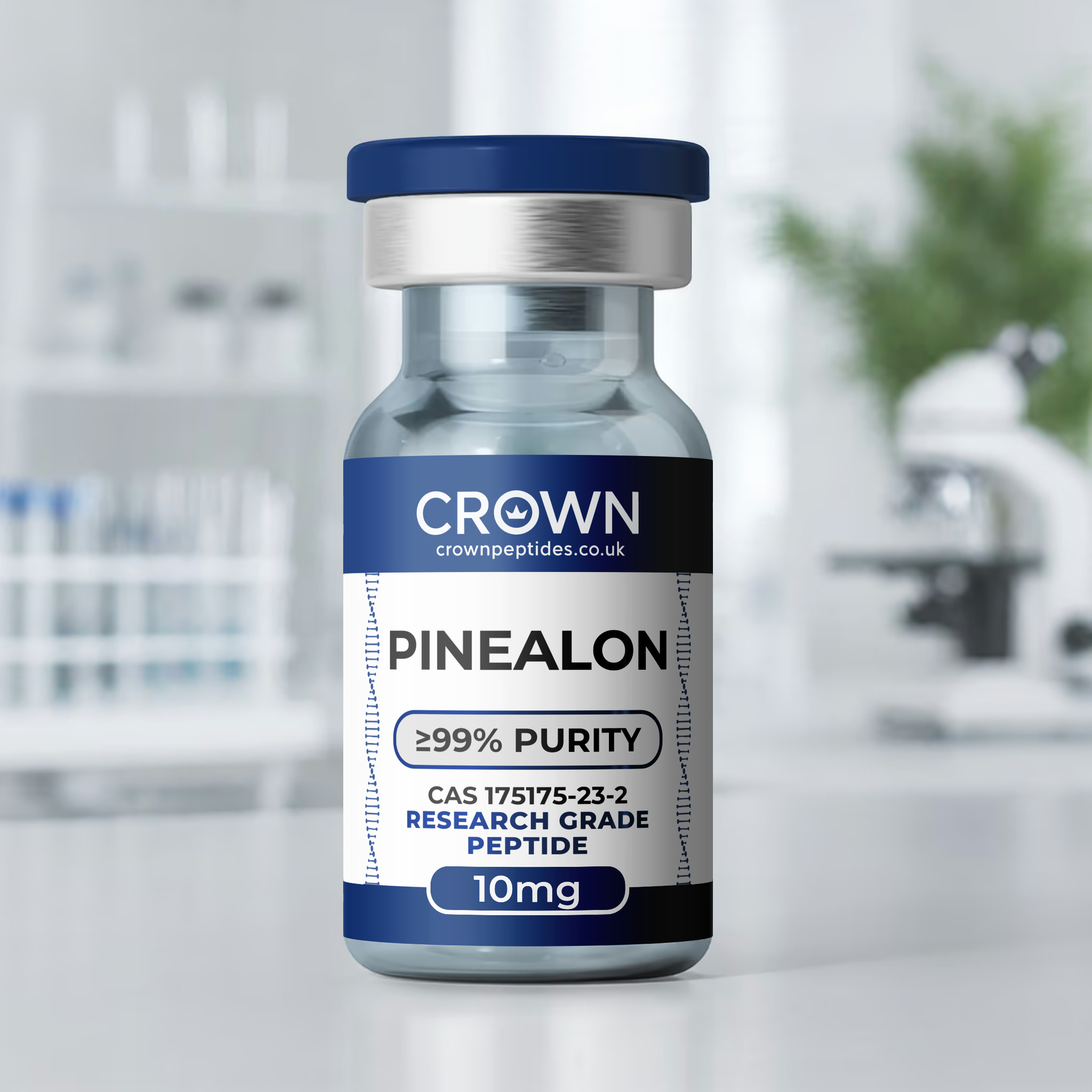
A high-purity research peptide studied in brain and neuroprotection research. Available in 10mg, with every batch independently tested and dispatched from the UK.
Pinealon peptide UK is Crown Peptides' synthetic tripeptide bioregulator research compound, available in 10mg for laboratory research.
Supplied for laboratory research purposes only — not for human consumption or for medical, veterinary or diagnostic use.
Pinealon is a synthetic tripeptide bioregulator composed of glutamic acid, aspartic acid and arginine (Glu-Asp-Arg). It belongs to the same short-peptide bioregulator research tradition as Epitalon, developed to study tissue-specific gene-expression regulation, and is used in CNS and neuroprotective research.
Also known as: Pinealon peptide, EDR peptide, Glu-Asp-Arg.
Research uses Pinealon to study behavioural and neurochemical processes under stress conditions, including one study examining its effects alongside Cortexin on behaviour and neurochemistry in aged animal models under hypoxia and hypothermia (Learn more). This work sits within a broader body of research into pineal and brain-ageing biology, gene-expression regulation and stress resistance, alongside related bioregulator and CNS-research compounds such as Epitalon.
Pinealon is about as small as a signalling peptide gets. Its three residues read glutamic acid, aspartic acid and arginine, which is why it is often written in one-letter code as EDR. Two of those side chains end in carboxylic acid groups, while arginine carries a guanidinium group that stays positively charged across almost the entire pH range found in biology. At neutral pH the molecule therefore holds a small overall negative charge and is strongly water-loving.
With the formula C15H26N6O8 and a mass of roughly 418, Pinealon is less than half the size of the seven-residue neuropeptides it is often discussed beside, such as Semax and Selank. A chain this short has no folded shape to speak of, so everything about how it behaves comes down to the order and charge of three building blocks. That simplicity makes cell and animal results easier to attribute to one defined sequence.
The foundation paper for Pinealon cell biology appeared in Rejuvenation Research and tested the tripeptide in three quite different cell types: cerebellar granule neurons, neutrophils and PC12 pheochromocytoma cells. In each, oxidative stress was triggered either through receptor-linked routes or by mechanisms that bypass receptors, and Pinealon limited the build-up of reactive oxygen species in a dose-dependent way (Learn more). Necrotic cell death, measured with propidium iodide staining, fell as well.
Two further details make the paper more interesting than a straightforward antioxidant result. Activation of the ERK 1/2 signalling enzymes followed a delayed time course, and the cell cycle was modified. Crucially, the protection against free radicals and cell death levelled off at low concentrations, while the cell-cycle effects kept changing as the concentration rose. The authors read that mismatch as evidence that Pinealon does more than mop up radicals and may act on the genome directly, an idea later explored in cortex cultures, where EDR was reported to stimulate serotonin expression.
Animal work on Pinealon spans both ends of life. In one model, pregnant rats received a methionine-rich diet that pushes up blood homocysteine, a recognised way of stressing the developing brain, and some of the mothers were also given Pinealon. Their offspring showed better spatial orientation and learning, and cerebellar neurons taken from those young animals accumulated fewer reactive oxygen species and contained fewer necrotic cells when tested in culture (Learn more). The authors noted that this lined up with their earlier dish-based findings.
At the other end of the lifespan, 18-month-old rats were exposed to two stress models, acute low-pressure hypoxia and mild cooling, and Pinealon was compared with the brain-derived polypeptide preparation Cortexin. Behaviour and brain chemistry were both tracked, including free-radical markers, caspase-3 activity and monoamine transmitters. Together these studies make Pinealon a useful tool for asking how a single short peptide performs across developmental, ageing and environmental stress models.
The most recent strand of Pinealon research looks at synapses. In primary cultures of mouse hippocampal neurons exposed to amyloid-beta, a standard laboratory model of the synaptic damage seen in Alzheimer's disease, EDR increased the number of mature "mushroom" spines by 71%, bringing them back to the level of unexposed cultures (Learn more). A related tripeptide, KED (Lys-Glu-Asp), raised the count by only 20% under the same conditions.
Work in the 5xFAD transgenic mouse model followed, with both EDR and KED reported to prevent dendritic spine loss. Molecular docking in the same paper mapped possible EDR binding sites in the promoter regions of genes including CASP3, GAP43, APOE, SOD2, PPARA and PPARG, whose protein products are involved in neuronal survival, growth and antioxidant defence. Those predictions remain computational for now.
Compound-level reference data. Batch-specific results appear on the Certificate of Analysis.
Work out concentration with the peptide calculatorCrown Peptides Pinealon is supplied with batch-specific quality documentation appropriate to the material. Analytical methods vary by compound and formulation, so the Certificate of Analysis should be used as the definitive source for identity, assay, purity and relevant impurity information.
Pinealon is a synthetic tripeptide with the sequence Glu-Asp-Arg, a molecular weight of about 418 and the CAS number 175175-23-2. It comes from Vladimir Khavinson's short-peptide research programme and has been studied mainly in neuronal cell cultures and in rat models of oxidative stress, hypoxia and amyloid damage. Crown Peptides supplies it at 10mg per vial; it is also listed as EDR peptide or Pinealon peptide.
It is simply the sequence spelled in single-letter amino acid code: E for glutamic acid, D for aspartic acid and R for arginine. Many journal titles use the short form rather than the trade-style name, so searching for both "Pinealon" and "EDR peptide" gives a much fuller view of the literature. The same shorthand explains KED, the Lys-Glu-Asp tripeptide that often appears as a comparison in the same studies.
Cerebellar granule cells are a long-established preparation for studying oxidative injury in neurons. They can be grown in large, fairly uniform populations and respond in a measurable way when stressed. Several of the same authors used them in the original Pinealon cell paper and again in the rat offspring study, where neurons were isolated from young animals' cerebellum and challenged in culture, so the two sets of results can be read side by side.
Cortexin is not one molecule but a mixture of polypeptides extracted from animal brain cortex, whereas Pinealon is a single defined tripeptide. When the two were compared in aged rats under hypoxia and mild cooling, Cortexin had the more pronounced effect on free-radical processes and caspase-3 activity in the brain. Both raised adrenergic transmitter levels in the hypoxia model and cortical serotonin in the cooling model. For a research team, a known three-residue sequence is far easier to characterise and reproduce than an extract.
A Russian review of neuroprotective peptides placed them in the same group of short peptides, but structurally they have little in common. Semax is seven residues long, built from a fragment of the pituitary hormone ACTH plus a Pro-Gly-Pro tail, and its research centres on BDNF signalling and stroke models. Pinealon has no hormone parent at all and is studied for oxidative stress, synapse density and possible interactions with gene promoters.
Dendritic spines are tiny protrusions on a neuron where most excitatory synapses form. The mushroom type, with a broad head on a thin neck, is regarded as the stable, mature form associated with lasting connections. Amyloid-beta strips these spines from cultured hippocampal neurons, so counting them has become a standard readout in Alzheimer's models, and it is the measure on which EDR produced its clearest result.
The evidence says it can. When Pinealon was tagged with a fluorescent label and added to HeLa cells, signal appeared in the cytoplasm, the nucleus and the nucleolus. The same paper reported that unlabelled Pinealon changed the fluorescence of labelled DNA fragments in a sequence-dependent way, even distinguishing methylated from unmethylated cytosine. Later computer modelling placed EDR among short peptides predicted to fit the binding sites of membrane carriers such as LAT1, LAT2 and PEPT1.
Homocysteine is formed when the body processes the amino acid methionine, and raised levels are linked with oxidative stress and with harm to developing nervous tissue. Feeding pregnant rats extra methionine is a practical way to raise it in a controlled fashion, so researchers can then ask whether a compound given to the mother changes how the offspring's brain cells cope. Pinealon was tested in exactly that design.
In hippocampal neurons exposed to amyloid, the gap was wide: EDR lifted mushroom-spine numbers by 71%, KED by 20%. In the later 5xFAD mouse work both tripeptides were reported to protect spines, and docking suggested each recognises similar DNA sequences. KED is not part of the Crown Peptides range, but its results make a helpful benchmark when reading EDR papers.
There is. In ageing cultures of brain cortex cells, both Glu-Asp-Arg and Lys-Glu-Asp were reported to stimulate serotonin expression. Docking pointed to a CCTGCC nucleotide stretch in the gene for tryptophan hydroxylase, the enzyme that makes serotonin, as a sequence complementary to these peptides. The aged-rat cooling study, which recorded higher cortical serotonin, adds an animal data point to the same theme.
Not quite, and that is what caught researchers' attention. Its protective effect on radical levels and cell survival reached a ceiling at low concentrations, yet changes in the cell cycle carried on as concentrations increased. A pure radical scavenger would not be expected to show that split, which is why the authors proposed an additional route of action involving the genome.
Pinealon begins with glutamic acid, and a glutamic acid at the start of a peptide chain can slowly close into a five-membered ring called pyroglutamate, losing one molecule of water, about 18 mass units. The reaction is favoured by warmth and by mildly acidic or alkaline solutions, and it can even happen inside a mass spectrometer's ion source. A small companion peak just below the main protonated ion near 419 is therefore worth recognising when reviewing data on stored solutions; each batch’s Certificate of Analysis documents the powder as dispatched.
Every vial contains 10mg. Order it singly, or in five- and ten-vial packs that cost less per vial. Ten milligrams of a 418-dalton peptide is close to 24 micromoles, a generous quantity for cell-culture work, so one vial often covers a pilot series, while the larger packs suit animal studies or longer projects where you want plenty of material on hand from the outset.
Every batch is published openly — identity, purity and batch number, with no account needed.
Supplied for laboratory research purposes only — not for human consumption or for medical, veterinary or diagnostic use.
Each batch undergoes internal analytical verification using chromatographic and spectrometric methods prior to lyophilisation.
• HPLC Analysis
• Mass Spectrometry Confirmation
• Batch Traceability
By purchasing this product you confirm that you are a qualified researcher and that this compound will be used exclusively for laboratory research purposes.
This product is not intended for diagnostic or therapeutic use.
Any human or medical use is strictly prohibited.
Store in a cool, dry, secure and sterile environment away from any unauthorised persons or children.
Disclaimer: All products are sold strictly for laboratory research purposes only. Not for human or veterinary use, consumption, therapeutic, or diagnostic application. None of our products are medicines, and none are presented as such. By purchasing, you confirm you are a qualified professional and legally permitted to handle these materials in compliance with all applicable laws and regulations. Misuse, resale for unauthorised purposes, or unlawful application is strictly prohibited. Crown Peptides UK disclaims all liability for improper use, handling, or regulatory non-compliance.