

Research guide
Gonadorelin UK: GnRH Pulse Research, Mechanism and Study Data
Gonadorelin is the synthetic copy of natural GnRH, the brain hormone that controls LH and FSH. This guide covers its Nobel-winning discovery, why the rhythm of its signal matters, and what fifty years of studies have found.
Give the pituitary gland a pulse of this hormone once an hour and it springs into action. Give it exactly the same hormone non-stop and it goes quiet. Same molecule, same receptor, opposite result. That slightly baffling discovery changed how biologists think about hormones, and it all comes back to a ten-amino-acid peptide called gonadorelin.
Gonadorelin is the synthetic version of gonadotropin-releasing hormone (GnRH), the brain signal at the very top of the reproductive hormone system. It was the prize in one of the fiercest races in twentieth-century endocrinology, it is tied to a Nobel Prize, and it is still used as a reference tool in laboratories, clinics and farms. This guide covers what gonadorelin is, where it came from, why the rhythm of its signal matters more than the amount, what the published studies have found, and how it relates to Kisspeptin-10 and the long-acting GnRH analogues. Gonadorelin acetate is sold by Crown Peptides strictly for laboratory research use only, and everything below is written for readers interested in the science. You can find it on our Gonadorelin Acetate Research Peptide page, part of our Endocrine & Hormonal research peptides range.
What Is Gonadorelin, and Why Does One Small Peptide Matter So Much?
Gonadorelin is a decapeptide, a chain of ten amino acids, with exactly the same sequence as the GnRH made naturally in the human brain. It is not a modified version or an analogue. It is a laboratory-made copy of the native hormone, built residue for residue.
That matters because GnRH is the first domino in the reproductive chain. A small group of nerve cells in the hypothalamus releases it in bursts. It travels a very short distance to the pituitary gland, where it tells cells called gonadotropes to release luteinising hormone (LH) and follicle-stimulating hormone (FSH). Those two hormones then act on the ovaries or testes. Change the GnRH signal and everything downstream changes with it, which makes gonadorelin one of the most useful tools there is for studying how the system is wired.
Is gonadorelin the same as GnRH and LHRH?
Yes, in sequence. GnRH, LHRH (luteinising hormone-releasing hormone), LH-RH and LRF are all names for the same natural hormone, coined by different laboratories. Older papers also use gonadoliberin and luliberin. “Gonadorelin” is the official non-proprietary name for the synthetic peptide.
What is gonadorelin acetate?
Peptides are usually supplied as a salt, which is easier to purify, weigh and keep stable as a dry powder. Gonadorelin acetate is gonadorelin paired with acetate. Gonadorelin hydrochloride, found in some veterinary products, is the same peptide paired with chloride. The peptide chain is identical; only the counter-ion, and so the weight per milligram of powder, differs.
Brand names you will meet in the literature
Researchers often search for “gonadorelin peptide”, “GnRH peptide” or “LHRH peptide”, but papers also use brand names. Factrel was the gonadorelin hydrochloride product used in human medicine in the United States to test pituitary function; that human product has since been discontinued there, though the same brand name is still used for a veterinary product for cattle. Lutrepulse is a gonadorelin acetate product from Ferring that was approved for sale in Canada for inducing ovulation in women with primary hypothalamic amenorrhoea, delivered in pulses by a small pump (Lutrepulse product monograph). Veterinary names include Ovarelin and Fertagyl, which we come back to below.
The Race to Decode the Brain’s Reproductive Signal
By the 1950s, scientists were fairly sure the brain controlled the pituitary through chemical messengers. Proving it was another matter. The messengers were present in such tiny amounts that isolating one meant processing the hypothalami of hundreds of thousands of animals.
Two rival teams took on the challenge. Andrew Schally’s group in New Orleans worked with pig hypothalami. Roger Guillemin’s group worked with sheep. The rivalry was famously intense, and it drove both teams forward at remarkable speed.
In 1971, Schally’s team reported that a single polypeptide from pig hypothalami released both LH and FSH from the pituitaries of several species. They identified its structure as pGlu-His-Trp-Ser-Tyr-Gly-Leu-Arg-Pro-Gly-NH2, synthesised it, and showed that the natural and synthetic versions shared the same activity (PMID: 4938639). Many had expected two separate releasing hormones, one for each pituitary hormone. One peptide doing both jobs hinted that something more subtle was going on.
Months later, Guillemin’s group published the sheep structure. It was identical to the pig sequence, and their fully synthetic decapeptide matched the activity of the natural hormone (PMID: 4550508). Two species, two rival teams, one answer. In 1977, Schally and Guillemin shared half of the Nobel Prize in Physiology or Medicine for their discoveries about peptide hormone production in the brain, with the other half going to Rosalyn Yalow for radioimmunoassay, the technique that made such tiny hormone quantities measurable.
The neurons that start life in the nose
Here is one of the strangest twists. In 1989, a study in fetal mice showed that GnRH neurons are not born in the brain at all. They originate in the developing nose, in the medial olfactory placode, then migrate across the nasal septum into the forebrain before settling in the hypothalamus (PMID: 2645530). The authors pointed out that this route could explain Kallmann syndrome, in which people have both an absent sense of smell and low reproductive hormones. If the neurons never finish their journey, both systems are affected.
- Classification
- Synthetic gonadotropin-releasing hormone (GnRH) decapeptide research compound, acetate salt
- Available strength
- 2mg (coming soon)
- CAS Number
- 34973-08-5 (gonadorelin acetate); 33515-09-2 (gonadorelin)
- Molecular Weight
- approximately 1182.3 g/mol (peptide); approximately 1242.3 g/mol (monoacetate)
- Molecular Formula
- C55H75N17O13 (peptide); C57H79N17O15 (monoacetate)
- Sequence
- pGlu-His-Trp-Ser-Tyr-Gly-Leu-Arg-Pro-Gly-NH2 (10 amino acids)
How Gonadorelin Works: Why the Rhythm Matters More Than the Amount
This is the part that makes gonadorelin so fascinating. The pituitary does not just read how much GnRH it receives. It reads the pattern.
One signal, two hormones
Gonadorelin binds the GnRH receptor on gonadotrope cells. Switching that receptor on prompts the cells to release stored LH and FSH and, over longer periods, to make more of both. In males, LH drives testosterone production and FSH supports sperm production. In females, the two together drive follicle growth, oestrogen production and ovulation.
The experiment that changed endocrinology
In 1978, Ernst Knobil’s laboratory studied rhesus monkeys whose own GnRH release had been abolished by a lesion in the hypothalamus. A continuous infusion of GnRH failed to restore gonadotropin secretion. The same synthetic decapeptide given once an hour, the monkeys’ natural rhythm, brought LH and FSH back. Then came the striking part: switching responding animals from hourly pulses back to a continuous infusion caused “desensitisation” or “down-regulation” (PMID: 100883). The pattern of delivery, not the amount, decided the outcome: pulses switch the axis on, constant exposure switches it off.
Fast pulses and slow pulses send different messages
The Knobil team then changed the tempo. In a 1981 study in the same monkey model, raising the pulse rate from one an hour to two, three or five an hour made gonadotropin levels fall, most sharply at the fastest rates. Slowing pulses to one every three hours gave variable effects on LH, but FSH rose every time (PMID: 6788538).
A 1989 rat study traced this to the genes. Fast pulses every eight minutes raised messenger RNA for the shared alpha subunit about three-fold and LH-beta by 50%, but left FSH-beta unchanged. Slow pulses every two to eight hours increased FSH-beta messenger RNA two- to 2.5-fold without changing LH-beta. Giving the same total amount of GnRH over 24 hours at different rhythms confirmed it was timing, not dose, doing the work (PMID: 2502379). One peptide sends two distinct instructions simply by changing its tempo.
A receptor built differently from its neighbours
Most receptors of its family have a “tail” that the cell uses to tag and quickly silence the receptor once it has been switched on. The mammalian GnRH receptor has no such tail. A 1999 cell study showed that, as a result, it is not tagged by phosphorylation after activation and resists the rapid desensitisation, within five to ten minutes, seen in receptors that have a tail (PMID: 10514504). That might seem to contradict the Knobil finding. The answer is that the shutdown seen with continuous exposure develops over hours to days through other mechanisms further down the signalling chain, and exactly how those add up is still being worked out.
A signal that is gone in minutes
Natural GnRH is built to be brief. In a 1977 human study, infused GnRH was cleared with a first-phase half-life of 5.5 to 8 minutes in healthy volunteers, and kidney failure roughly doubled that (PMID: 320223). A 1982 study measured 7.8 minutes for native LHRH against 18.7 minutes for the analogue D-Trp6-LHRH, better known as triptorelin (PMID: 6210706). A short life is exactly what a pulse-based signal needs, because each burst has to fade before the next arrives. It is why native gonadorelin is the natural choice when a study needs to mimic the body’s own pulses.
- Also known as
- GnRH, LHRH, LH-RH, gonadoliberin, luliberin; gonadorelin acetate (salt form)
- Classification
- Hypothalamic decapeptide hormone; synthetic native-sequence GnRH
- Sequence
- pGlu-His-Trp-Ser-Tyr-Gly-Leu-Arg-Pro-Gly-NH2
- Molecular weight
- 1182.3 g/mol (peptide, C55H75N17O13; PubChem); the acetate salt weighs slightly more
- CAS number
- 33515-09-2 (gonadorelin; PubChem)
- Research status
- Widely studied research peptide; used as a diagnostic agent in people and as a veterinary medicine in cattle in some countries
What the Research Has Actually Found
Because gonadorelin is identical to the natural hormone, it has been studied in people, primates, rodents and farm animals for more than fifty years. Here are the areas where the findings are clearest.
What clinical studies of pulsatile GnRH found
Some people are born with little or no GnRH secretion, a condition called congenital or idiopathic hypogonadotropic hypogonadism. Their pituitary is usually healthy; it simply is not receiving the signal.
The first long-term pulse study in men
In a 1982 New England Journal of Medicine study, six men with idiopathic hypogonadotropic hypogonadism received low-dose GnRH in pulses from a portable pump. Gonadotropins reached the normal adult range within a week. Average testosterone rose from 77 to 520 ng per decilitre after one month. Testis size increased in four men, and sperm production was achieved in three by 43 weeks (PMID: 6813732). A small study, but an important early result.
Ovulation studies in women
A 1993 analysis from Massachusetts General Hospital looked back at women with hypogonadotropic amenorrhoea who had ovulation induced with either pulsatile GnRH (41 women, 118 treatment cycles) or gonadotropins (30 women, 111 treatment cycles). Ovulation and conception rates per attempt were not significantly different. The big difference was follicle numbers: more than two dominant follicles appeared in 47.6% of gonadotropin cycles but only 18.9% of pulsatile GnRH cycles, and all triplet or higher multiple pregnancies were in the gonadotropin group. The estimated cumulative chance of conception after six attempts was 96% with pulsatile GnRH and 72% with gonadotropins (PMID: 8325934). This was a retrospective comparison, not a randomised trial, but it fits the physiology: a pulse lets the body’s own feedback loops select one follicle rather than overriding them.
A more recent comparison in men
A 2019 non-randomised study from China compared a pulsatile gonadorelin pump (10 men) with cyclical hCG/hMG gonadotropin therapy (18 men) in azoospermic men with congenital hypogonadotropic hypogonadism. Sperm appeared earlier with the gonadorelin pump, at a median of 6 months against 14 months, while the share who eventually produced sperm was similar, 90% against 83.3%. Skin reactions at the pump site were common in the gonadorelin group (PMID: 30569789). The numbers are small and the groups were not randomised, so this is an encouraging signal rather than a settled answer.
Gonadorelin as a diagnostic tool
Because gonadorelin is the native signal, it makes an ideal test probe. Give a standard amount, measure the LH and FSH released, and you learn whether the pituitary is working and how mature the axis is. In the United States, gonadorelin hydrochloride (Factrel) was used for this kind of test before the human product was discontinued (Drugs.com). Gonadorelin stimulation tests are still reported in clinical studies elsewhere, notably in China.
A retrospective study of 865 girls with idiopathic central precocious puberty at a children’s hospital in Hangzhou, all of whom had a gonadorelin stimulation test, found that peak LH was highest in normal-weight girls (median 9.1 mIU/ml), compared with 8.5 in overweight girls and 6.2 in girls with obesity (PMID: 25645648). The authors recommended taking body mass index into account when reading the test.
Gonadorelin in animal reproduction
Some of the biggest real-world uses of gonadorelin are on farms. In dairy herds, knowing exactly when a cow will ovulate makes artificial insemination far more efficient, and GnRH is central to that timing.
The best-known example is the protocol now called Ovsynch, first described in 1995: GnRH, then prostaglandin seven days later, then a second GnRH dose. In the first experiments, the first GnRH dose caused ovulation in 18 of 20 cows, and all cows ovulated a newly formed dominant follicle 24 to 32 hours after the second dose. Ten of 20 cows conceived to a single timed insemination, with no need to watch for signs of heat (PMID: 16727787).
Regulatory status here is specific to each product and country. In the UK, Ovarelin, a 50 microgram per ml gonadorelin solution for cattle from Ceva, is listed on the Veterinary Medicines Directorate database with an authorisation dated April 2006 (VMD product information). In the United States, Fertagyl (gonadorelin) is FDA-approved for cattle under ANADA 200-134, labelled for ovarian follicular cysts in dairy cattle and for use with cloprostenol in fixed-time insemination programmes (Fertagyl label).
A fair counterpoint: native GnRH is not the strongest option
A 2015 crossover study in 12 Holstein cows compared gonadorelin with two longer-lasting analogues, lecirelin and buserelin. Peak LH after gonadorelin was about 2.5 times lower than after either analogue, and arrived about an hour earlier. Even so, the dominant follicle disappeared in 73% of cows after gonadorelin against 82% to 100% for the analogues, differences that were not statistically significant in a study this size (PMID: 25890780). For researchers, the contrast is useful: gonadorelin gives a shorter, more natural-shaped LH surge, while analogues give a bigger, longer one.
Bigger studies, finer tuning
Farm research now runs at a scale few laboratory studies reach. A study published in 2026 across four commercial dairies in California and Wisconsin compared a standard and a doubled amount of gonadorelin hydrochloride at the first GnRH step of a breeding programme in 6,621 cows. The higher amount produced a bigger LH release, a higher ovulation rate (83.0% against 70.8% in a scanned subset of 505 cows) and slightly more pregnancies at first insemination (51.8% against 48.6%), with most of the gain in cows that had calved more than once (PMID: 41698585). Several authors were from a gonadorelin manufacturer, which is worth knowing when reading the results.
How stable is gonadorelin in solution?
A 1990 study by Ferring’s analytical division used stability-indicating HPLC to test how pH, temperature and buffer affect gonadorelin in water. It was most stable at around pH 5.0. Acetate buffer was the most favourable, while phosphate caused more breakdown. In acetate buffer at pH 5.0 with 3% mannitol, the predicted time for gonadorelin to lose 10% of its content at 20 degrees C was 9.0 years (PMID: 2151342). That is an optimised pharmaceutical formulation rather than a typical laboratory solution, but it shows why buffer choice matters in experimental design.
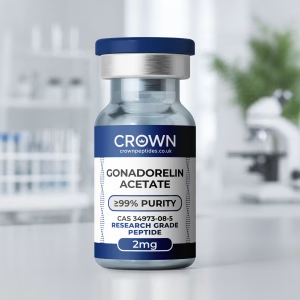
Gonadorelin Acetate Research Peptide
HPLC and MS verified · certificate with every batch · pricing announced when stock arrives
Gonadorelin vs Kisspeptin-10 and the Long-Acting Analogues
Gonadorelin is easiest to understand alongside its relatives: the signal above it, and the engineered versions built from it.
Kisspeptin-10: the switch upstream
For thirty years after GnRH was decoded, nobody knew what told GnRH neurons when to fire. The answer arrived in 2003 from two groups studying families in which puberty never began. A French team found a deletion in a receptor gene called GPR54 in five affected siblings (PMID: 12944565). A US and UK team found other GPR54 mutations in people, and showed that mice lacking the receptor had the same problem but still responded to GnRH itself (PMID: 14573733). The fault was above GnRH, not below it.
The receptor’s partner is kisspeptin. In 2005, researchers showed that GPR54 sits on GnRH neurons in mice, and that kisspeptin given into the brain of sheep produced a dramatic release of GnRH into the cerebrospinal fluid, with a matching rise in LH (PMID: 15665093). Kisspeptin-10, the shortest fully active fragment, was tested in healthy men in Edinburgh in 2011: an intravenous bolus raised LH from 4.1 to 12.4 IU per litre within 30 minutes at the most effective dose, and a lower-rate infusion increased LH pulse frequency from 0.7 to 1.0 pulses an hour (PMID: 21632807).
So the chain runs kisspeptin, then GnRH, then LH and FSH. That gives researchers a neat pairing. Kisspeptin-10 tests whether the GnRH neurons are responsive. Gonadorelin bypasses them and tests the pituitary directly. Used side by side, they show at which level a signal is failing. Our article on Kisspeptin-10 as the master switch for puberty tells that part of the story in full.
The long-acting analogues: same receptor, opposite effect
Chemists found that swapping the glycine at position 6 of the GnRH sequence for a D-amino acid made the peptide resist breakdown and bind the receptor more strongly. The results include triptorelin, leuprorelin, buserelin and goserelin. Given continuously or as depots, these analogues cause an initial surge of LH and FSH followed by exactly the shutdown Knobil saw with a continuous infusion, and they are used in medicine precisely because they switch the axis off. Native gonadorelin, given in pulses, does the reverse. Same receptor, similar sequence, opposite outcome, and the main difference is time. Our guide to peptide half-life explains why some peptides linger and others vanish.
Where Gonadorelin Research Is Heading
How one receptor decodes a rhythm. The pituitary can read the tempo of GnRH pulses and respond with different gene programmes. Exactly how a single receptor turns timing into a choice between LH and FSH is still being mapped, and short-lived native gonadorelin is the cleanest tool for testing it.
Mapping the kisspeptin to GnRH relay. Pairing Kisspeptin-10 with gonadorelin to locate where in the chain a signal is weak is becoming a standard approach, in animal models and in isolated cell systems.
Sharper tests and smarter farming. Refining diagnostic reference ranges for different groups, and fine-tuning gonadorelin dose and timing in large dairy studies, are both active, practical fields with real results still arriving.
The Technical Breakdown: Sequence, Receptor and Chemistry
This section is for readers who want the molecular detail. Everything above makes sense without it.
The sequence and its protected ends
Gonadorelin’s sequence is pGlu-His-Trp-Ser-Tyr-Gly-Leu-Arg-Pro-Gly-NH2 (PMID: 4938639). Both ends are capped. The first residue is pyroglutamic acid, a ring-closed form that removes the free amino group at the start; the last is glycinamide, which replaces the free acid at the end. These caps protect against enzymes that trim peptides from either end, but enzymes still cut inside the chain, notably around glycine 6 and proline 9, which is why the native hormone lasts only minutes.
Why position 6 is the famous one
In its active shape, GnRH is thought to fold into a turn around glycine 6, bringing its two ends together so both can contact the receptor. Glycine is the most flexible amino acid, which allows that turn but also leaves the site exposed to enzymes. Replacing it with a bulky D-amino acid, as in triptorelin (D-Trp6) or leuprorelin (D-Leu6), is thought to stabilise that turn and block the cut. In a study of eight people, triptorelin was cleared more slowly than native GnRH, probably because it is broken down more slowly (PMID: 6210706).
The receptor and its signalling chain
The GnRH receptor is a G protein-coupled receptor that signals mainly through the Gq/11 pathway. Activation switches on phospholipase C, producing two internal messengers. One releases calcium inside the cell, triggering release of stored LH and FSH. The other activates protein kinase C and, further downstream, MAP kinase pathways that control the alpha, LH-beta and FSH-beta genes. The missing C-terminal tail lets the receptor escape rapid phosphorylation-driven switch-off (PMID: 10514504).
Salt form and weighing
The gonadorelin peptide weighs 1182.3 g/mol; PubChem lists the monoacetate at 1242.3 g/mol. Real batches also carry some water and variable counter-ion, which is why peptide content and purity are reported separately on a good certificate. Our understanding quantities guide explains how milligram figures relate to research solutions.
Why timing matters as much as amount
The defining feature of gonadorelin research is that timing matters as much as amount: the same molecule given in pulses or continuously produces opposite effects on the pituitary. That is why published studies describe their pulse frequency so carefully. In the laboratory, concentrations and timing depend entirely on the experimental design, and our understanding quantities page explains how milligram figures relate to research solutions.
Anti-doping status
Gonadorelin appears on the World Anti-Doping Agency Prohibited List under section S2, among testosterone-stimulating peptides prohibited in males (Finnish Center for Integrity in Sports, 2026 list).
Why Verified Testing Matters for a Ten-Residue Hormone
Gonadorelin is short, but that does not make it simple to get right. It contains tryptophan and tyrosine, which can oxidise, a pyroglutamate ring that must form correctly at one end and an amidated glycine at the other. A missing residue, an incomplete end or a D-isomer in the wrong place can change how it behaves at the receptor. In a system this sensitive to timing and amount, a vial that is only partly the right molecule is a different experiment. Mass spectrometry confirms the molecule has the right weight; HPLC confirms how much of the vial is that molecule.
What every Crown Peptides batch comes with
Each batch is tested before it goes on sale. HPLC (high-performance liquid chromatography) separates gonadorelin from related impurities and measures purity, and mass spectrometry confirms identity. Results are published as a batch-specific certificate of analysis on our Lab Reports page, and the batch number on each vial lets you match it to its certificate. Our guides on how to read a peptide certificate of analysis and peptide testing in the UK explain what to look for.
Stored, packed and dispatched properly
Gonadorelin acetate is supplied as lyophilised (freeze-dried) powder in 2mg vials, the most stable form for storage and transport. Vials are kept cold, sealed and away from light and moisture, which matters for a peptide with light- and oxygen-sensitive residues like tryptophan. See our storage information page and how long do peptides last for detail. Weekday orders placed before 2pm leave the same day from the UK, with free UK delivery over £100.
A UK company you can talk to
Crown Peptides is a UK company. We reply within 24 hours on business days, and WhatsApp is there for quicker answers. If you have a question about a certificate, a batch or a compound, contact us directly.
Related Compounds Worth Knowing About
Gonadorelin shares its world with other signalling peptides. Some act upstream or alongside it; others follow the same releasing-hormone logic in a different system.
Kisspeptin-10
Kisspeptin-10 is the signal that tells GnRH neurons to fire, one step above gonadorelin. Pairing the two lets researchers test the hypothalamus and pituitary separately. Our comparison of Kisspeptin-10 and oxytocin places it among the brain’s other signal peptides.
Oxytocin Acetate
Oxytocin Acetate is another small hypothalamic peptide central to reproduction, from labour to milk let-down and social bonding. Like gonadorelin, it is a short, end-modified peptide decoded in the mid-twentieth century.
PT-141
PT-141 acts on melanocortin receptors in the brain rather than the GnRH system, but is studied in the same broad area of reproductive and sexual function, making it a useful brain-level contrast.
Sermorelin
Sermorelin is to growth hormone what gonadorelin is to LH and FSH: a version of a hypothalamic releasing hormone, here the first 29 amino acids of GHRH. Its signal is also naturally pulsatile.
Tesamorelin
Tesamorelin is a stabilised GHRH analogue. Its relationship to native GHRH mirrors the one between triptorelin and gonadorelin: a modified releasing hormone built to outlast the original.
Ipamorelin
Ipamorelin stimulates growth hormone through the ghrelin receptor rather than the GHRH receptor, and is valued for its selectivity, a theme that runs through gonadorelin research too.
Explore the full family in our Endocrine & Hormonal research peptides category, or read our Sermorelin guide to see the releasing-hormone idea play out in the growth hormone system.
Common Questions About Gonadorelin
What is gonadorelin?
Gonadorelin is a synthetic peptide with the same ten-amino-acid sequence as natural gonadotropin-releasing hormone (GnRH). It acts on the pituitary gland to release LH and FSH, the hormones that drive the ovaries and testes.
Is gonadorelin the same as GnRH or LHRH?
Yes. GnRH and LHRH are names for the natural hormone, and gonadorelin is the official name for the synthetic version with the identical sequence. Gonadorelin acetate and gonadorelin hydrochloride are the same peptide in two salt forms.
How is gonadorelin different from Kisspeptin-10?
Kisspeptin-10 acts one level higher, on GnRH neurons, prompting them to release GnRH. Gonadorelin skips that step and acts directly on the pituitary.
How is gonadorelin different from triptorelin or leuprorelin?
Those are engineered analogues with a D-amino acid at position 6 that makes them last far longer. Given continuously, they switch the reproductive axis off after an initial surge. Native gonadorelin is cleared in minutes, which suits it to mimicking natural pulses.
Is gonadorelin an approved medicine anywhere?
It depends on the country and use. Gonadorelin hydrochloride (Factrel) was used in US human medicine as a diagnostic test of pituitary function and that product has since been discontinued. Gonadorelin acetate (Lutrepulse) was approved in Canada for inducing ovulation in primary hypothalamic amenorrhoea. In animals, gonadorelin products are authorised for cattle, including Ovarelin in the UK and Fertagyl in the United States.
Is gonadorelin legal in the UK?
Gonadorelin is not a controlled drug under the Misuse of Drugs Act, and research compounds like it can be bought legally in the UK for laboratory research. Our guide are peptides legal in the UK explains the rules in more detail.
Can I buy gonadorelin acetate in the UK?
Yes. Crown Peptides supplies gonadorelin acetate in 2mg lyophilised vials, within our endocrine and hormonal research peptides category, with a batch-specific certificate showing HPLC purity and mass spectrometry identity.
How should gonadorelin be stored?
As a freeze-dried powder, kept cold, sealed, dry and away from light. Published stability work shows gonadorelin is most stable around pH 5 in acetate buffer and less stable in phosphate.
Read the certificate before you order
Every batch is published openly — identity by mass spectrometry, purity by HPLC, and the batch number printed on the vial you receive.
Open the COA libraryThe Hormone That Taught Biology to Count Time
Most hormones are judged by how much of them there is. Gonadorelin forced scientists to ask a different question: when? It showed that the brain controls reproduction with a rhythm, that a pulse can mean “go” while a constant signal means “stop”, and that changing the tempo can choose between two hormones.
The story is still unfolding. Kisspeptin has given gonadorelin a partner one step upstream, frequency decoding is being traced down to individual genes, and dairy scientists are still learning how GnRH timing shapes fertility across thousands of animals. Every one of those questions needs a clean, reliable, native-sequence GnRH to answer it.
If your research touches the reproductive axis, gonadorelin is where the signal starts. Explore gonadorelin acetate alongside Kisspeptin-10 and the wider family in our Endocrine & Hormonal research peptides range, each batch HPLC and mass spectrometry verified, with its certificate published in full.
References
- Schally AV, Arimura A, Kastin AJ, et al. Gonadotropin-releasing hormone: one polypeptide regulates secretion of luteinizing and follicle-stimulating hormones. Science. 1971;173:1036-8. PMID: 4938639
- Burgus R, Butcher M, Amoss M, et al. Primary structure of the ovine hypothalamic luteinizing hormone-releasing factor (LRF) (LH-hypothalamus-LRF-gas chromatography-mass spectrometry-decapeptide-Edman degradation). Proc Natl Acad Sci U S A. 1972;69:278-82. PMID: 4550508
- Schwanzel-Fukuda M, Pfaff DW. Origin of luteinizing hormone-releasing hormone neurons. Nature. 1989;338:161-4. PMID: 2645530
- Belchetz PE, Plant TM, Nakai Y, et al. Hypophysial responses to continuous and intermittent delivery of hypopthalamic gonadotropin-releasing hormone. Science. 1978;202:631-3. PMID: 100883
- Wildt L, Häusler A, Marshall G, et al. Frequency and amplitude of gonadotropin-releasing hormone stimulation and gonadotropin secretion in the rhesus monkey. Endocrinology. 1981;109:376-85. PMID: 6788538
- Dalkin AC, Haisenleder DJ, Ortolano GA, et al. The frequency of gonadotropin-releasing-hormone stimulation differentially regulates gonadotropin subunit messenger ribonucleic acid expression. Endocrinology. 1989;125:917-24. PMID: 2502379
- Willars GB, Heding A, Vrecl M, et al. Lack of a C-terminal tail in the mammalian gonadotropin-releasing hormone receptor confers resistance to agonist-dependent phosphorylation and rapid desensitization. J Biol Chem. 1999;274:30146-53. PMID: 10514504
- Pimstone B, Epstein S, Hamilton SM, et al. Metabolic clearance and plasma half disappearance time of exogenous gonadotropin releasing hormone in normal subjects and in patients with liver disease and chronic renal failure. J Clin Endocrinol Metab. 1977;44:356-60. PMID: 320223
- Barron JL, Millar RP, Searle D. Metabolic clearance and plasma half-disappearance time of D-TRP6 and exogenous luteinizing hormone-releasing hormone. J Clin Endocrinol Metab. 1982;54:1169-73. PMID: 6210706
- Hoffman AR, Crowley WF Jr. Induction of puberty in men by long-term pulsatile administration of low-dose gonadotropin-releasing hormone. N Engl J Med. 1982;307:1237-41. PMID: 6813732
- Martin KA, Hall JE, Adams JM, et al. Comparison of exogenous gonadotropins and pulsatile gonadotropin-releasing hormone for induction of ovulation in hypogonadotropic amenorrhea. J Clin Endocrinol Metab. 1993;77:125-9. PMID: 8325934
- Zhang L, Cai K, Wang Y, et al. The Pulsatile Gonadorelin Pump Induces Earlier Spermatogenesis Than Cyclical Gonadotropin Therapy in Congenital Hypogonadotropic Hypogonadism Men. Am J Mens Health. 2019;13:1557988318818280. PMID: 30569789
- Fu JF, Liang JF, Zhou XL, et al. Impact of BMI on gonadorelin-stimulated LH peak in premenarcheal girls with idiopathic central precocious puberty. Obesity (Silver Spring). 2015;23:637-43. PMID: 25645648
- Pursley JR, Mee MO, Wiltbank MC. Synchronization of ovulation in dairy cows using PGF2alpha and GnRH. Theriogenology. 1995;44:915-23. PMID: 16727787
- Picard-Hagen N, Lhermie G, Florentin S, et al. Effect of gonadorelin, lecirelin, and buserelin on LH surge, ovulation, and progesterone in cattle. Theriogenology. 2015;84:177-83. PMID: 25890780
- Lima FS, Bruno RGS, Cleale RM, et al. Increasing gonadorelin hydrochloride dose at the first GnRH of breeding Ovsynch enhances luteinizing hormone release, ovulatory response, and pregnancy in first-service lactating dairy cows. J Dairy Sci. 2026;109:7523-7535. PMID: 41698585
- Helm VJ, Müller BW. Stability of gonadorelin and triptorelin in aqueous solution. Pharm Res. 1990;7:1253-6. PMID: 2151342
- de Roux N, Genin E, Carel JC, et al. Hypogonadotropic hypogonadism due to loss of function of the KiSS1-derived peptide receptor GPR54. Proc Natl Acad Sci U S A. 2003;100:10972-6. PMID: 12944565
- Seminara SB, Messager S, Chatzidaki EE, et al. The GPR54 gene as a regulator of puberty. N Engl J Med. 2003;349:1614-27. PMID: 14573733
- Messager S, Chatzidaki EE, Ma D, et al. Kisspeptin directly stimulates gonadotropin-releasing hormone release via G protein-coupled receptor 54. Proc Natl Acad Sci U S A. 2005;102:1761-6. PMID: 15665093
- George JT, Veldhuis JD, Roseweir AK, et al. Kisspeptin-10 is a potent stimulator of LH and increases pulse frequency in men. J Clin Endocrinol Metab. 2011;96:E1228-36. PMID: 21632807
- Ferring Inc. Lutrepulse (gonadorelin acetate for injection) product monograph. Monograph
- Drugs.com. Gonadorelin (intravenous, injection). Drug information
- Veterinary Medicines Directorate. Ovarelin 50 µg/ml solution for injection for cattle. Product information database
- Drugs.com Veterinary. Fertagyl (gonadorelin) label, ANADA 200-134. Label
- Finnish Center for Integrity in Sports (SUEK). Doping agent classes and substances 2026 (WADA Prohibited List). List
Working with Gonadorelin Acetate Research Peptide
Coming soon to Crown Peptides. Every batch will be HPLC and MS tested, with its certificate published before it goes on sale.
See Gonadorelin Acetate Research Peptide