Register today and get 10% off your first orderRegister for 10% off your first orderRegister now
Crown Peptides

Research Peptides

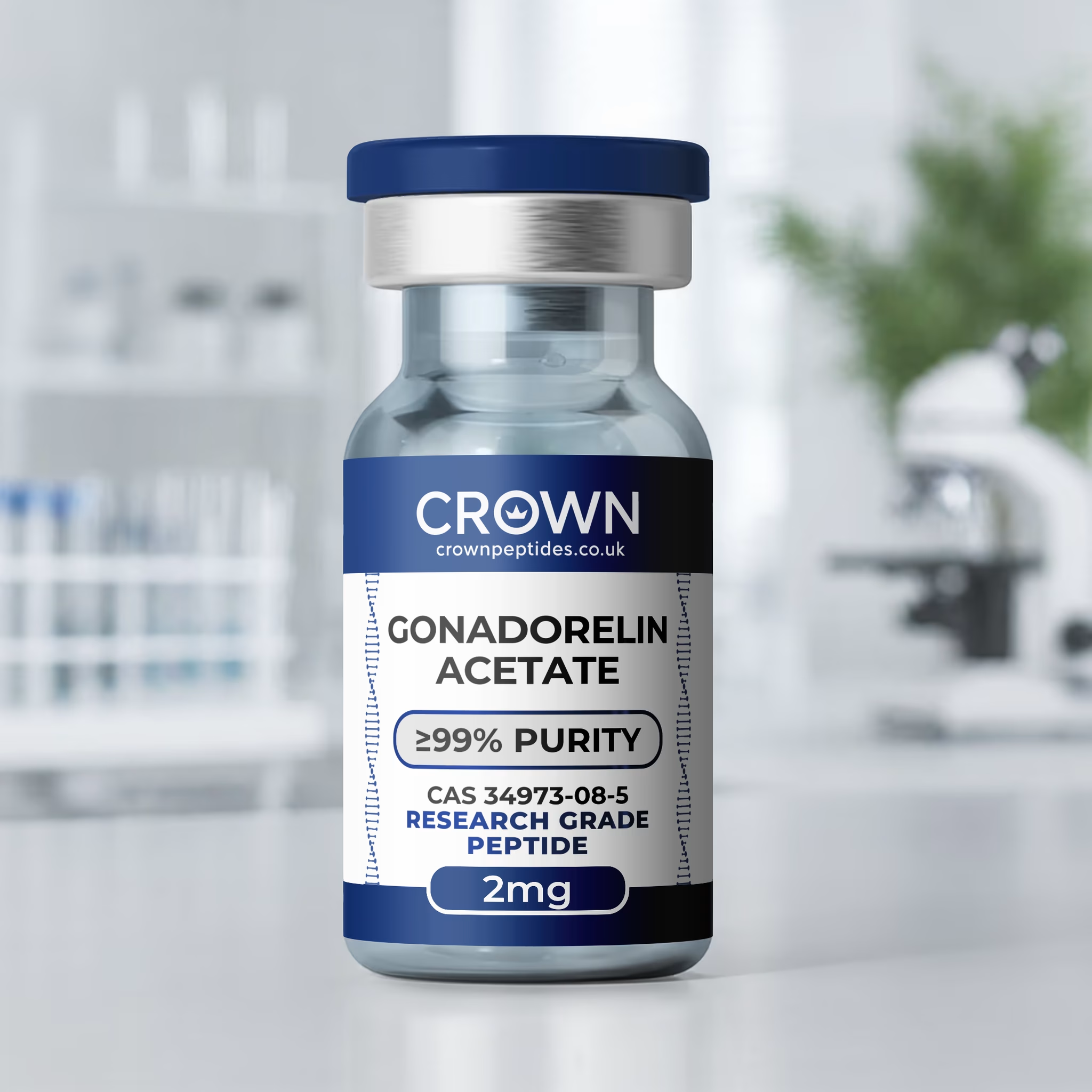
Gonadorelin Acetate Research Peptide

A high-purity research peptide studied in GnRH receptor, pituitary and reproductive neuroendocrine research. Coming soon in 2mg, with every batch independently tested and dispatched from the UK.

£39.99or from £29.99 per vial in packs of 10
Save up to 25%
From: £39.99
Your selection:
All Batches TestedEvery batch, no exceptions
HPLC & MS VerifiedFull certificate published
Same Day PostageOrder before 2pm
UK Based CompanyDispatched from the UK
Product Overview

A high-purity research peptide studied in GnRH receptor, pituitary and reproductive neuroendocrine research. Coming soon in 2mg, with every batch independently tested and dispatched from the UK.

Full Product Specification
Overview

Product Overview

Gonadorelin peptide UK is Crown Peptides’ synthetic gonadotropin-releasing hormone (GnRH) decapeptide research compound, supplied as the acetate salt and coming soon in 2mg for laboratory research.

2mg (coming soon)Available strengthHPLC testedChromatographic purityMS verifiedIdentity confirmedBatch CoADocumentation supplied

Supplied for laboratory research purposes only — not for human consumption or for medical, veterinary or diagnostic use.

Key features

Key Features

  • Studied in research involving the hypothalamic-pituitary-gonadal axis
  • Studied in research involving GnRH receptor signalling in pituitary gonadotropes
  • Studied in research involving pulsatile versus continuous hormone delivery
  • Studied in research involving kisspeptin control of GnRH release
  • Batch-specific quality documentation available
Background

About Gonadorelin Peptide UK

Gonadorelin is the synthetic form of gonadotropin-releasing hormone, the ten-amino-acid peptide pGlu-His-Trp-Ser-Tyr-Gly-Leu-Arg-Pro-Gly-NH2. It has exactly the same sequence as the hormone made by a small group of neurons in the hypothalamus, which release it into the blood vessels that run down to the pituitary gland. There it acts on cells called gonadotropes, which respond by releasing luteinising hormone (LH) and follicle-stimulating hormone (FSH). It sits in the endocrine and hormonal research area alongside Kisspeptin-10, which acts one step higher up the same pathway, and Oxytocin, another hypothalamic peptide hormone.

As the native hormone rather than a modified analogue, gonadorelin is the reference compound for GnRH receptor work. The long-acting analogues developed later, such as leuprorelin and triptorelin, change the sixth residue and the end of the chain so that they resist breakdown and bind more tightly. Gonadorelin keeps the natural sequence, with its blocked pyroglutamate start and amidated glycine end, so researchers can study the receptor exactly as the body’s own hormone engages it.

Also known as: gonadorelin acetate, GnRH, GnRH-I, LHRH, LH-RH, luteinising hormone-releasing hormone, gonadoliberin, LHRH acetate

Research

Gonadorelin Research

The structure of the hormone was proposed in 1971 by Andrew Schally’s group, working with material purified from pig hypothalami, and the synthetic decapeptide followed soon after. (Learn more) It has since become one of the best characterised peptide hormones in neuroendocrine research. Its main study areas sit upstream and downstream of compounds such as Kisspeptin-10, and it is often compared with other hypothalamic releasing hormones such as the GHRH analogue Sermorelin.

  • Hypothalamic-pituitary-gonadal axis
  • GnRH receptor structure and signalling
  • Pulse frequency and receptor desensitisation
  • Kisspeptin regulation of GnRH neurons
Where the story starts: a ten-residue sequence

In 1971 Matsuo, Baba, Nair, Arimura and Schally published the proposed amino acid sequence of the porcine LH- and FSH-releasing hormone, the first structure of the releasing hormone that controls both gonadotropins. A companion paper confirmed it by conventional sequencing, and solid-phase synthesis of the same decapeptide followed in the same year. That synthetic peptide is what is now called gonadorelin. Schally shared the 1977 Nobel Prize in Physiology or Medicine for this work on hypothalamic peptide hormones. (Learn more)

Where GnRH neurons come from

GnRH-producing neurons are unusual because they are not born in the brain. Using tracer labelling in fetal mice, a 1989 study showed that they originate in the medial olfactory placode of the developing nose, migrate across the nasal septum and enter the forebrain along the nervus terminalis before settling in the septal-preoptic area and hypothalamus. The authors noted that this route could explain why Kallmann syndrome combines low gonadotropins with a loss of the sense of smell. (Learn more)

Rhythm matters more than amount

The most influential gonadorelin study is a 1978 experiment in rhesus monkeys whose own GnRH release had been stopped by a hypothalamic lesion. A constant infusion of synthetic GnRH failed to restore sustained LH and FSH release, while the same peptide given once an hour, the animals’ natural pulse rate, re-established it. Switching animals from hourly pulses to continuous delivery then shut the response down again, an effect the authors described as desensitisation or down-regulation. (Learn more) It underpins most later GnRH study designs.

An unusual receptor

The GnRH receptor was cloned from mouse cells in 1992. Its sequence encodes a 327-amino-acid protein with the seven membrane-spanning segments typical of G protein-coupled receptors, but without the intracellular tail found on almost all others in the family. The authors suggested that this missing tail could explain unusual features of how the receptor signals and is regulated. (Learn more)

How pulse speed chooses between LH and FSH

In GnRH-deficient male rats given GnRH pulses either every 30 minutes or every 240 minutes, fast pulses raised transcription of the LH-beta gene six- to nine-fold, while the sustained rise in FSH-beta transcription needed slow pulses. The FSH response tracked levels of follistatin, a local pituitary protein that rose with fast pulses and fell with slow ones. (Learn more)

Pulsatile delivery in a clinical study

In a 1982 clinical study of six men with idiopathic hypogonadotropic hypogonadism, a condition in which the hypothalamus fails to produce normal GnRH pulses, GnRH delivered in pulses under the skin by a portable pump brought LH and FSH into the normal adult range within a week. (Learn more)

The kisspeptin connection

In 2005 a Cambridge-led team showed that the kisspeptin receptor GPR54 is found on GnRH neurons in the mouse hypothalamus, that GnRH neurons migrate normally in mice lacking the receptor, and that kisspeptin given into the brain of sheep produced a sharp release of GnRH into the cerebrospinal fluid, followed by a rise in LH. (Learn more) This places kisspeptin directly above gonadorelin in the chain of signals.

Taken together, gonadorelin is a foundational tool in reproductive neuroendocrinology: a native sequence with a known receptor, a well-documented dependence on pulse timing, and a defined place in the kisspeptin-GnRH-gonadotropin cascade.

Specifications

Specifications

Product
Gonadorelin Acetate
Classification
Synthetic gonadotropin-releasing hormone (GnRH) decapeptide research compound, acetate salt
Available strength
2mg (coming soon)
CAS number
34973-08-5 (gonadorelin acetate); 33515-09-2 (gonadorelin)
Molecular weight
≈ 1182.3 g/mol (peptide); approximately 1242.3 g/mol (monoacetate)
Molecular formula
C55H75N17O13 (peptide); C57H79N17O15 (monoacetate)
Sequence
pGlu-His-Trp-Ser-Tyr-Gly-Leu-Arg-Pro-Gly-NH2 (10 amino acids)
Form
Research material supplied according to product label
Purity and assay
≥99% (HPLC), batch-specific — refer to Certificate of Analysis
Verification
HPLC and Mass Spectrometry where analytically appropriate

Compound-level reference data. Batch-specific results appear on the Certificate of Analysis.

Work out concentration with the peptide calculator
Testing

Purity and Testing

Crown Peptides Gonadorelin will be supplied with batch-specific quality documentation appropriate to the material. Because gonadorelin is the native hormone, its value as a reference compound depends on the sequence being exactly right: a substitution at the sixth residue or a change at the amidated end would turn it into a different GnRH analogue. HPLC shows how clean a batch is, while mass spectrometry confirms the full ten-residue chain at about 1,182 daltons. The Certificate of Analysis should be used as the definitive source for identity, assay, purity and relevant impurity information.

Storage

Storage Conditions

  • Store unreconstituted material at -20°C ± 5°C in a cool, dry environment
  • Prepared research solutions should use validated storage conditions appropriate to the compound and study design
  • Protect from unnecessary heat, direct light and repeated temperature fluctuations
Full storage guide
Related

Related Compounds

Researchers working with gonadorelin may also be interested in Kisspeptin-10, which acts directly upstream of GnRH, as well as Oxytocin, Sermorelin, Tesamorelin, PT-141 and VIP — other compounds studied in hypothalamic, pituitary and reproductive neuroendocrine research.

Compliance

Research Use Only

  • Laboratory research only
  • Not for human or clinical use
  • Not for human or veterinary consumption
  • Qualified personnel only
Questions

Gonadorelin Frequently Asked Questions

About Gonadorelin7 questions
What is gonadorelin?

Gonadorelin is the synthetic version of gonadotropin-releasing hormone, a ten-amino-acid peptide made in the hypothalamus. Its sequence is identical to the natural hormone, pGlu-His-Trp-Ser-Tyr-Gly-Leu-Arg-Pro-Gly-NH2. In laboratory research it is used to study the GnRH receptor, pituitary gonadotrope cells and the release of LH and FSH in cell and animal models.

Are gonadorelin, GnRH and LHRH the same thing?

Yes, for practical purposes. GnRH and LHRH are two names for the same natural hormone; LHRH reflects the early focus on luteinising hormone, while GnRH acknowledges that it releases FSH as well. Gonadorelin is the official non-proprietary name for the synthetic peptide with that sequence. GnRH-I is used to separate it from GnRH-II, a related form that differs at three positions.

How is gonadorelin different from leuprorelin and triptorelin?

Leuprorelin and triptorelin are synthetic analogues built on the gonadorelin sequence. Both replace the glycine at position six with a D-amino acid, and leuprorelin also swaps the final glycinamide for an ethylamide group. These changes slow breakdown and increase binding, so the analogues act for much longer. Gonadorelin keeps the native sequence, which is why it is used as the natural reference ligand.

What do “pGlu” and “-NH2” mean in the sequence?

Both ends of gonadorelin are chemically capped. “pGlu” is pyroglutamic acid, a glutamine or glutamate that has closed into a ring, so the chain has no free amino group at the start. “-NH2” shows that the final glycine is an amide rather than an acid. Both features help the hormone bind its receptor and resist some enzymes that trim peptide ends.

Why does the GnRH receptor lack a tail?

Most G protein-coupled receptors have an intracellular tail that the cell uses to switch them off and pull them inside. The mammalian GnRH receptor, cloned in 1992, has no such tail. Researchers study this because it changes how the receptor responds to repeated stimulation, and it makes the receptor a useful model for comparing desensitisation mechanisms across the receptor family.

How does gonadorelin relate to Kisspeptin-10?

They act at neighbouring steps of the same pathway. Kisspeptin is released onto GnRH neurons in the hypothalamus and makes them release GnRH; GnRH then acts on the pituitary. Kisspeptin-10 is therefore studied at the level of the brain, while gonadorelin is used to stimulate the pituitary directly, bypassing the neurons above it.

Has gonadorelin been used as a medicine?

Yes. Gonadorelin has been licensed as a prescription medicine in a number of countries, most often as a diagnostic test of how well the pituitary can release gonadotropins. It has also been authorised as a veterinary medicine for cattle. The material sold by Crown Peptides is a research compound and is not a medicinal product.

Findings in research models4 questions
Why does pulsed gonadorelin work when continuous delivery does not?

In the 1978 rhesus monkey study, hourly pulses of synthetic GnRH restored LH and FSH release in animals whose own GnRH had been switched off, while a constant infusion did not. Moving animals from pulses to continuous delivery shut the response down again. The pituitary appears to need gaps between signals, and steady exposure leads to desensitisation.

How can one hormone control both LH and FSH?

Through the speed of its pulses. In GnRH-deficient rats, pulses every 30 minutes mainly increased transcription of the LH-beta gene, while pulses every four hours gave a sustained rise in FSH-beta transcription. The FSH response tracked follistatin, a pituitary protein that rose with fast pulses and fell with slow ones, so pulse frequency acts as a code the gonadotrope reads.

Where do GnRH neurons originate?

In the developing nose. Tracer work in fetal mice showed that GnRH neurons arise in the medial olfactory placode and travel into the forebrain along the nervus terminalis, a small cranial nerve, before reaching the hypothalamus. This migration is studied in models of Kallmann syndrome, where it fails and both gonadotropin release and the sense of smell are affected.

What did the 2005 kisspeptin study show about GnRH release?

It linked kisspeptin directly to GnRH neurons. The kisspeptin receptor was found on GnRH neurons in mice, kisspeptin did not raise LH or FSH in mice lacking that receptor, and in sheep kisspeptin given into the brain released GnRH into the cerebrospinal fluid, followed by a rise in LH. Gonadorelin is the hormone measured at that step.

Buying, testing & storage4 questions
Is gonadorelin legal to buy in the UK?

Gonadorelin is not a controlled drug under the Misuse of Drugs Act 1971, and it does not appear on the Class C list of anabolic steroids and related hormones. It is, however, the active ingredient in a UK-licensed prescription-only medicine, Gonadorelin 100 micrograms powder for solution for injection, used as a pituitary function test, and in veterinary medicines authorised for cattle. Crown Peptides supplies gonadorelin acetate only as a research compound for laboratory use, not as a medicine. This is general information, not legal advice.

Where can I buy gonadorelin in the UK?

Gonadorelin Acetate is coming soon to Crown Peptides in 2mg vials, available singly or in packs of 3, 5 or 10 with a saving on every vial. Orders ship from the UK, and every batch is independently tested, with its Certificate of Analysis published on this page once stock arrives.

How far does a 2mg vial go?

Two milligrams of a 1,182-dalton peptide is roughly 1.7 micromoles, or about 1.6 micromoles if calculated on the monoacetate salt; the exact peptide content is given on the batch’s Certificate of Analysis. Pituitary cell studies typically use GnRH at nanomolar concentrations, so one vial covers a good deal of in vitro work, and the multi-vial packs keep a longer pulse study on a single batch.

How should gonadorelin be stored once it arrives?

Keep the unreconstituted powder at -20°C ± 5°C, dry and away from light. The sequence contains tryptophan and tyrosine, both of which are sensitive to light and oxidation, so vials are best kept sealed and dark until use. Prepared solutions should follow storage conditions validated for your study design, and each batch’s Certificate of Analysis documents the material as dispatched.

Read the batch certificate before you order

Every batch is published openly — identity, purity and batch number, with no account needed.

View lab reports

Supplied for laboratory research purposes only — not for human consumption or for medical, veterinary or diagnostic use.

All Batches TestedEvery batch, no exceptions

Each batch undergoes internal analytical verification using chromatographic and spectrometric methods prior to lyophilisation.

• HPLC Analysis
• Mass Spectrometry Confirmation
• Batch Traceability

For Research Use Only

By purchasing this product you confirm that you are a qualified researcher and that this compound will be used exclusively for laboratory research purposes.

Not for Human Consumption

This product is not intended for diagnostic or therapeutic use.

Any human or medical use is strictly prohibited.

Store Safely at All Times

Store in a cool, dry, secure and sterile environment away from any unauthorised persons or children.

Other Research Peptides

2 strengths5-Amino-1MQ 10mg research compound vial, Crown Peptides UKAgeing research

5-Amino-1MQ Research Compound


From£24.99Strength10mg
Add to basket
Adamax 10mg research peptide vial, Crown Peptides UKNeurocognitive research

Adamax Research Peptide


From£44.99Strength10mg
Add to basket
AHK-Cu 100mg copper peptide vial, Crown Peptides UKAgeing research

AHK-Cu Research Peptide


From£29.99Strength100mg
Add to basket
AICAR 50mg research compound vial, Crown Peptides UKAgeing research

AICAR Research Compound


From£34.99Strength50mg
Add to basket

Further reading

UK research peptides. Every batch HPLC and MS verified, certificate published in full.
SUPPORT Mon to Fri, 9am to 5pmDISPATCH Cut-off 2pmEMAIL Email usWHATSAPP +44 7301 802654

Disclaimer: All products are sold strictly for laboratory research purposes only. Not for human or veterinary use, consumption, therapeutic, or diagnostic application. None of our products are medicines, and none are presented as such. By purchasing, you confirm you are a qualified professional and legally permitted to handle these materials in compliance with all applicable laws and regulations. Misuse, resale for unauthorised purposes, or unlawful application is strictly prohibited. Crown Peptides UK disclaims all liability for improper use, handling, or regulatory non-compliance.

© 2026 Crown Peptides UK, a trading name of Crown Peptides Ltd (company no. 17068950), Suite Ra01, 195-197 Wood Street, London E17 3NU . All Rights Reserved.