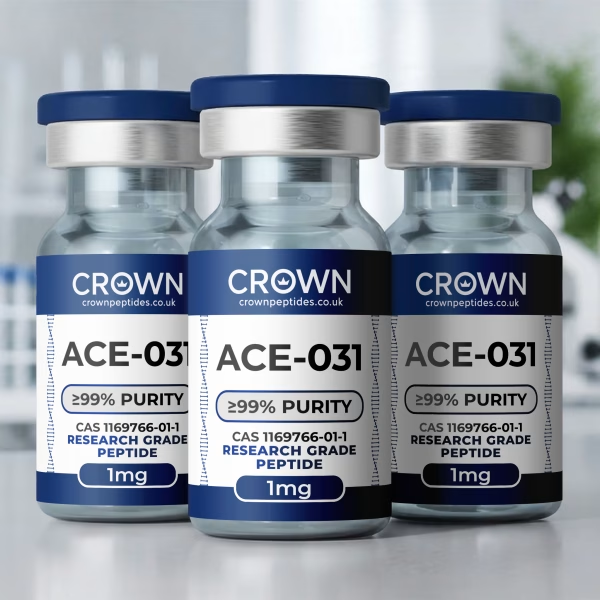
ACE-031 Research Peptide
A high-purity research compound studied in myostatin, skeletal muscle and bone research. Supplied in 1mg, with every batch independently tested and dispatched from the UK.
Out of stock
Supplied for laboratory research purposes only — not for human consumption or for medical, veterinary or diagnostic use.
Product Overview
ACE-031 UK is Crown Peptides’ soluble activin receptor type IIB fusion protein, supplied in 1mg for laboratory research.
- Studied in research involving myostatin and activin signalling through the activin type IIB receptor
- Studied in research involving skeletal muscle mass and fibre size in animal models
- Studied in research involving muscle function in models of muscular dystrophy and ALS
- Studied in research involving bone mass and body composition in animal models
- Batch-specific quality documentation available
About ACE-031 UK
ACE-031, also known by its international name ramatercept, is a research compound built from two parts: the outer, ligand-binding portion of the human activin receptor type IIB (ActRIIB) joined to the Fc region of human immunoglobulin G1. On a cell, ActRIIB sits in the membrane and passes on signals from myostatin and several related members of the TGF-beta family. ACE-031 is the free-floating version of that receptor. Because it binds the same ligands but carries no signalling machinery, it acts as a decoy, often called a ligand trap, that holds these growth-limiting signals away from the receptors on muscle and other cells.
Also known as: ramatercept, ACE031, ACE 031, ActRIIB-Fc, ActRIIB-IgG1, soluble activin receptor type IIB, sActRIIB, ACVR2B-Fc
That makes ACE-031 a different kind of tool from the smaller muscle-research peptides. MGF and IGF-1 LR3 come from the IGF-1 growth pathway, which pushes growth forward; ACE-031 works on the myostatin side, which normally holds growth back. It sits in the musculoskeletal research area alongside TB-500 and BPC-157.
ACE-031 was developed by Acceleron Pharma in Cambridge, Massachusetts, which also created the related ligand traps sotatercept (ACE-011), built on activin receptor type IIA, and luspatercept (ACE-536). The two halves of the molecule pair up through the Fc region, so ACE-031 is a dimer: two receptor arms held on one Fc stem, with a molecular weight of roughly 77 kilodaltons. For comparison, BPC-157 is about 1.4 kilodaltons.
ACE-031 Research
Research on soluble ActRIIB began at Johns Hopkins and Acceleron in the mid-2000s and moved from mouse studies into human volunteer and clinical studies within a few years. It is one of the most studied approaches to the myostatin pathway, and the published work covers muscle growth, muscle function in disease models, bone and body composition. A wider overview of compounds studied in this field is in our guide to peptides researched for muscle growth.
- Myostatin and activin signalling through the activin type IIB receptor
- Skeletal muscle mass and fibre size in animal models
- Muscle function in models of muscular dystrophy and ALS
- Bone mass and body composition in animal models
Where the story starts: a receptor decoy for myostatin
In 2005 Se-Jin Lee’s group at Johns Hopkins and their collaborators described a soluble form of the activin type IIB receptor as a potent myostatin inhibitor. Injected into normal mice, it increased muscle mass by up to 60% in two weeks. The effect was smaller, but still present, in mice that had no myostatin at all, which showed that at least one other ligand also limits muscle growth through the same receptors. (Learn more)
Growth in every fibre type
Acceleron’s 2010 study gave ACE-031 to eight-week-old mice for 28 days. Body weight ended 16% higher than in controls, and the soleus, plantaris, gastrocnemius and extensor digitorum longus muscles were 33%, 44%, 46% and 26% heavier. Fibre cross-sectional area rose in both slow type I and fast type II fibres without any change in fibre-type make-up. This set it apart from selective myostatin blockade, which acts mainly on type II fibres. (Learn more)
Muscle function in a muscular dystrophy model
In 2011 a University of Pennsylvania group treated mdx mice, the standard model of Duchenne muscular dystrophy, with soluble ActRIIB for 12 weeks. At the higher dose, body weight rose by 27% and lean muscle mass by 33%. Force produced by the extensor digitorum longus muscle was higher at both doses, and circulating creatine kinase, a marker of muscle damage, was lower than in untreated mice. (Learn more)
Strength in an ALS model
A 2009 Johns Hopkins study used SOD1(G93A) mice, a model of amyotrophic lateral sclerosis. Soluble ActRIIB delayed the onset of weakness and increased body weight, grip strength and muscle size, whether treatment began before or after symptoms appeared. It outperformed genetic removal of myostatin on every measure the authors took. (Learn more)
Muscle, fat and bone together
In a 2010 mouse model of androgen deprivation, soluble ActRIIB raised lean tissue mass by 23% in intact mice and 26% in castrated mice, cut fat mass, prevented fatty liver and prevented the loss of bone mass seen in untreated castrated mice. (Learn more) In 2015 a Johns Hopkins and Kennedy Krieger team gave a soluble ACVR2B to oim mice, a model of the brittle bone condition osteogenesis imperfecta, for four weeks and recorded significant increases in both bone and muscle, close to the levels of healthy littermates. (Learn more)
Human volunteer and clinical studies
ACE-031 is one of the few compounds in this class to have been studied in people. In a 2013 placebo-controlled study, 48 healthy postmenopausal women received a single dose. Within 29 days the highest-dose group showed statistically significant increases in total lean body mass of 3.3%, measured by DXA, and in thigh muscle volume of 5.1%, measured by MRI. Serum markers pointed to changes in bone and fat metabolism too, and the half-life was 10 to 15 days. (Learn more) A 2017 placebo-controlled study in boys with Duchenne muscular dystrophy reported trends towards maintained six-minute walk distance, increased lean mass and bone mineral density, and reduced fat mass, and its authors described myostatin inhibition as a promising approach. (Learn more)
Taken together, ACE-031 is a well-characterised research tool: a defined receptor fusion protein with a clear mechanism, consistent increases in muscle mass across animal models, published data on bone and body composition, and human study data that few compounds in the myostatin field can match. Related growth-axis compounds include Tesamorelin and CJC-1295 with DAC.
Specifications
- Product
- ACE-031
- Classification
- Soluble activin receptor type IIB Fc fusion protein research compound
- Available strength
- 1mg
- Form
- Research material supplied according to product label
- Purity / assay
- batch-specific; refer to Certificate of Analysis
- Verification
- HPLC and Mass Spectrometry where analytically appropriate
- Also known as
- ramatercept, ActRIIB-Fc, ActRIIB-IgG1, soluble activin receptor type IIB
- Product Name
- ACE-031
- Structure
- extracellular domain of human activin receptor type IIB fused to the Fc region of human IgG1, forming a dimer
- Molecular Weight
- approximately 77 kDa; refer to the batch Certificate of Analysis for the confirmed mass
- CAS Number
- 1169766-01-1
Purity and Testing
Crown Peptides ACE-031 will be supplied with batch-specific quality documentation appropriate to the material. A protein of this size is checked differently from a short peptide. HPLC shows how clean a batch is, while mass spectrometry confirms the molecule’s identity; for a glycosylated dimer of around 77 kilodaltons, the measured mass is read against the expected value for the intact protein rather than to the single dalton, as it would be for a small peptide. The Certificate of Analysis should be used as the definitive source for identity, assay, purity and relevant impurity information.
Storage Conditions
- Store unreconstituted material at -20°C ± 5°C in a cool, dry environment
- Prepared research solutions should use validated storage conditions appropriate to the compound and study design
- Protect from unnecessary heat, direct light and repeated temperature fluctuations
Related Compounds
Researchers working with ACE-031 may also be interested in MGF, PEG-MGF, IGF-1 LR3, TB-500, BPC-157, MOTS-c, SS-31, Sermorelin and Ipamorelin — other compounds studied in muscle biology, tissue research and growth-axis research.
ACE-031 Frequently Asked Questions
About ACE-0318 questions
What is ACE-031?
ACE-031 is a research compound made from the ligand-binding part of the activin receptor type IIB joined to the Fc region of a human antibody. It binds myostatin and related growth-limiting signals before they reach their receptors, and it is used in research on muscle, bone and body composition.
Is ACE-031 a peptide?
Strictly, it is a fusion protein. Like a peptide it is made of amino acids, but it is far larger: two chains of several hundred amino acids each, joined together, with sugar groups attached. It is grouped with research peptides because it is studied in the same fields and handled in a similar way.
What is myostatin?
Myostatin, also called GDF-8, is a growth factor made mainly in skeletal muscle that limits how large muscle grows. Animals born without working myostatin, including certain cattle breeds and the knockout mice described in 1997, carry far more muscle than normal. That finding is what led researchers to look for ways to block the myostatin pathway, and ACE-031 was one of the first approaches tested.
How does ACE-031 work?
It works as a decoy receptor, or ligand trap. Myostatin, activins and GDF-11 normally bind activin type II receptors on muscle cells and send signals that limit growth. ACE-031 binds these ligands in the fluid around cells, so fewer of them reach the real receptors, and that braking signal is reduced.
What does ACE-031 mean, and what is ramatercept?
ACE-031 was Acceleron Pharma’s development code, with ACE standing for Acceleron. Ramatercept is its international non-proprietary name. The “-cept” ending is used for receptor fusion proteins, as in sotatercept and luspatercept. People also search for it as ACE031 or ACE 031.
How is ACE-031 different from MGF and IGF-1 LR3?
They work on opposite sides of muscle growth. IGF-1 LR3 and MGF come from the IGF-1 pathway, which drives growth. ACE-031 reduces signals from the myostatin pathway, which limits growth. They are also very different in size: ACE-031 is roughly eight times larger than IGF-1 LR3.
How is ACE-031 different from sotatercept (ACE-011)?
Both are Acceleron ligand traps with the same Fc design. Sotatercept is built on activin receptor type IIA and has mainly been studied in blood and lung research. ACE-031 is built on type IIB, which binds myostatin more strongly, and has mainly been studied in muscle research.
Is ACE-031 on the WADA Prohibited List?
Yes. The World Anti-Doping Agency’s 2026 Prohibited List names “decoy activin receptors (e.g., ACE-031)” under section S4.3, agents preventing activin receptor IIB activation, as prohibited at all times.
Findings in research models3 questions
What did the 2005 Johns Hopkins study show?
A soluble activin type IIB receptor increased muscle mass by up to 60% in two weeks in normal mice. It still increased muscle in mice lacking myostatin, which showed that other ligands besides myostatin also limit muscle growth through these receptors.
What did the 2013 healthy volunteer study measure?
It measured safety, blood levels and body composition after a single dose in 48 postmenopausal women. At day 29 the highest-dose group showed a 3.3% increase in total lean body mass and a 5.1% increase in thigh muscle volume, both statistically significant.
Has ACE-031 been studied in bone research?
Yes. Soluble ActRIIB prevented bone loss in a mouse model of androgen deprivation and increased bone and muscle mass in a mouse model of osteogenesis imperfecta. Serum markers in the 2013 volunteer study also pointed to changes in bone metabolism.
Buying, testing & storage4 questions
Is ACE-031 legal to buy in the UK?
ACE-031 is not a controlled drug under the Misuse of Drugs Act 1971, and there is no licensed medicine containing it in the UK. It is sold as a research compound for laboratory use only, which is how Crown Peptides supplies it. This is general information, not legal advice.
Where can I buy ACE-031 in the UK?
ACE-031 is supplied by Crown Peptides in 1mg vials, singly or in packs of 3, 5 or 10 with a saving on every vial. Orders ship from the UK, and every batch is independently tested, with its Certificate of Analysis published on this page.
How much material is in a 1mg vial?
One milligram of a protein of about 77 kilodaltons is roughly 13 nanomoles, so the same weight holds far fewer molecules than a short peptide. The 5 and 10-vial packs keep a longer project on a single batch.
How should ACE-031 be stored and handled?
Keep the unreconstituted powder at -20°C ± 5°C, dry and away from light. As a large protein it is more sensitive than a short peptide: dissolve it gently by swirling rather than shaking, which can cause foaming and clumping, and avoid repeated freeze-thaw cycles. Our storage information page covers general handling.
Read the batch certificate before you order
Every batch is published openly — identity, purity and batch number, with no account needed.
View lab reports- Laboratory research only
- Not for human or clinical use
- Not for human or veterinary consumption
Supplied for laboratory research purposes only — not for human consumption or for medical, veterinary or diagnostic use.
Other Research Peptides
 Musculoskeletal researchBPC-157 + TB-500 Blend (Wolverine Stack)5mg / 5mg · 2 strengths ›