Cerebrolysin UK: Brain-Derived Peptide Mixture Research, Mechanism and Study Data
Cerebrolysin is a mixture of hundreds of short peptides from digested pig-brain protein. Here is how it is thought to work, what cell, animal and clinical studies found, and how a peptide mixture is analysed.
On this page
- What Is Cerebrolysin, and Why Is It Unlike Almost Every Other Peptide?
- From Pig Brain to Research Bench: Where Cerebrolysin Came From
- How Cerebrolysin Is Thought to Work: Many Peptides, Several Pathways
- What the Research Has Actually Found
- Cerebrolysin vs Semax, Cortexin and Pinealon
- Where Cerebrolysin Research Is Heading
- The Technical Breakdown: Composition, Fractions and Analysis
- Why Verified Testing Matters for a Peptide Mixture
- Related Compounds Worth Knowing About
- Common Questions About Cerebrolysin
- A Brain in a Vial, and the Peptides Still Waiting to Be Named
- References
In 2015, a team of pharmaceutical scientists in Ghent bought a sample of Cerebrolysin online and asked a question that had hung over it for decades: what, exactly, is in it? Their mass spectrometers picked out 638 different peptides. Most were fragments of ordinary structural brain proteins. Not one was a piece of the famous growth factors, such as BDNF or NGF, that the preparation is so often linked with. And yet this same mixture has been studied in cell cultures, in rats after stroke and brain injury, and in randomised trials involving thousands of patients.
That puzzle is what makes Cerebrolysin one of the most fascinating materials in neuroscience research. It is not one peptide but hundreds, made by digesting pig-brain proteins with enzymes, and it has a research record that most single peptides can only envy. This guide explains what Cerebrolysin is, where it came from, the pathways it is thought to act on, what the cell, animal and human studies actually found (including the trials that came out neutral), how it compares with Semax, Cortexin and Pinealon, and how a mixture like this is analysed and tested. Cerebrolysin is sold by Crown Peptides strictly for laboratory research use only, and everything below is written for readers interested in the science. You can find it on our Cerebrolysin Research Peptide page.
What Is Cerebrolysin, and Why Is It Unlike Almost Every Other Peptide?
Most research peptides are a single molecule with a single sequence. Every molecule of Semax in a vial, for example, is the same seven amino acids in the same order. Cerebrolysin is different in kind. It is made by breaking down purified proteins from pig brain with enzymes under controlled conditions, which leaves a mixture of short peptides and free amino acids. There is no single sequence, mass or structure to point to. The material is defined by how it is made and by its overall analytical profile.
A digest rather than a design
A synthetic peptide is built residue by residue to a blueprint. Cerebrolysin is closer to a standardised extract: large brain proteins are cut into many small pieces, and the pieces are kept. One early description from the Austrian researchers who studied it put the make-up at about 75% free amino acids and 25% low-molecular-weight peptides, all under 10 kilodaltons (PMID: 11459078). That small size matters, because the big natural growth factors are proteins far larger than anything in the mix.
Is the Crown Peptides material the medicine itself?
No. Cerebrolysin is an approved medicine in some countries, but it is not a licensed medicine in the UK. Crown Peptides supplies a freeze-dried research material, produced by controlled enzymatic digestion of porcine brain protein, in 60mg vials; it is not the branded medicinal product.
Other names people search for
You will see it written as "Cerebrolysin peptide", "porcine brain peptide preparation", "brain-derived peptide mixture" and FPF-1070. Cortexin, which comes up in the same searches, is a separate preparation; we compare the two below.
From Pig Brain to Research Bench: Where Cerebrolysin Came From
Cerebrolysin was developed in Austria. Papers from the early 2000s name its maker as EBEWE Arzneimittel (PMID: 11459078), and the producer today is EVER Neuro Pharma, based in Unterach, Austria, according to recent clinical trial papers (PMID: 26564102). Much of the early cell work came from research groups in Graz.
The problem it was meant to solve
The brain makes its own growth-supporting proteins, called neurotrophic factors, which help neurons survive, grow connections and recover from injury; NGF and BDNF are the best known. They are attractive research targets, but they are large proteins and hard to get into the brain. Cerebrolysin is described in the literature as a neuropeptide preparation that mimics the action of the brain's own neurotrophic factors on protection and repair (PMID: 22514792): a mixture of small peptides that might reproduce some of what the big growth factors do.
From the lab to clinics across Eurasia
A 2023 Cochrane review notes that Cerebrolysin is widely used for acute ischaemic stroke in Russia, Eastern Europe, China, and other Asian and post-Soviet countries (PMID: 37818733). That long history is one reason the literature is so large, and why independent reviewers have looked so closely at trial quality.
How Cerebrolysin Is Thought to Work: Many Peptides, Several Pathways
With a single peptide, "how it works" usually means one receptor. With Cerebrolysin, it means overlapping effects across many models, and here is where it gets interesting: several have been tied to specific, testable pathways.
Neurotrophic-like support for neurons
In cell culture, Cerebrolysin behaves in some ways like a growth factor. A 2001 Graz study grew neurons from chick embryo forebrain under low-serum stress. Both Cerebrolysin and an artificial amino acid solution promoted the outgrowth of nerve fibres at day 4. By day 8, the networks given only amino acids had degenerated, while the Cerebrolysin cultures still showed a well-differentiated neuronal network. Neither added BDNF nor extra serum protected the network at that stage. The authors concluded that the peptide fraction, not the amino acids, was responsible (PMID: 11459078).
Protecting neurons in cell models
Cerebrolysin has also been studied in lab models that imitate the damage of a stroke. In one, chick cortical neurons were exposed to glutamate, iodoacetate or ionomycin, three different ways of stressing a cell. Cerebrolysin gave dose-dependent protection in all three, and in the glutamate model it almost doubled neuronal survival compared with damaged controls (PMID: 12826494). Reviews of the animal literature describe other protective threads, including inhibition of calpain, an enzyme that breaks down the cell's internal scaffolding after injury (PMID: 22514792).
New brain cells in rat studies
The adult brain keeps small pools of neural progenitor cells that can divide and become new neurons or support cells. In rat studies, Cerebrolysin increased their division and helped them mature and migrate. Two signalling pathways have been tied to these effects: PI3K/Akt, a classic growth-factor pathway, for cell division (PMID: 20857512), and Sonic hedgehog, a developmental signalling system, for division and maturation (PMID: 23696546). Both studies are covered below.
Kinases linked to amyloid and tau
In Alzheimer-model mice, Cerebrolysin was associated with lower activity of two enzymes, CDK5 and GSK-3 beta, which add phosphate groups to proteins involved in amyloid production and in tau tangles (PMID: 16511867), a concrete mechanism rather than a vague "neurotrophic" label.
- Also known as
- Cerebrolysin peptide; FPF-1070; porcine brain peptide preparation; brain-derived peptide mixture
- Classification
- Brain-derived peptide preparation: a mixture of short peptides and free amino acids from enzymatically digested porcine brain protein
- Composition
- Mixture; no single sequence, molecular formula or CAS number applies
- Research status
- Cell and animal studies, plus clinical trials in stroke, traumatic brain injury and dementia in countries where it is a licensed medicine; not licensed in the UK
What the Research Has Actually Found
Two points help in reading this literature. First, many studies, including several of the trials and some of the rat work, involved scientists from the manufacturer or were supported by it, which the Cochrane reviewers took into account (PMID: 37818733). Second, the results are genuinely mixed in places, and the most useful picture includes both the encouraging and the neutral findings.
A wide window in cell models of ischaemia
One striking cell finding concerns timing. In two culture models of ischaemia, Cerebrolysin rescued neurons in a dose-dependent way even when added late: up to 96 hours after glutamate damage, and with a small but significant effect 72 hours after oxygen-glucose deprivation (PMID: 16362636). Not every result pointed the same way: after iodoacetate damage, Cerebrolysin improved overall survival but increased the number of neurons dying by apoptosis, which the authors read as a shift from one type of cell death to another (PMID: 12826494).
Stroke in rats: new brain cells and recovery
Michael Chopp, Zheng Gang Zhang and colleagues in Detroit produced some of the most detailed animal work, using a rat model in which a small clot blocks the middle cerebral artery.
More progenitor cells, better function, same-size injury
In a 2010 rat study, Cerebrolysin started 24 hours after stroke increased the number of dividing progenitor cells in the subventricular zone and the number of migrating young neurons at the edge of the damaged area 28 days later. It reduced dying cells in that border zone by about 50%. Interestingly, it did not significantly shrink the infarct itself, yet it substantially improved scores on a range of behavioural tests at 21 and 28 days. In progenitor cells grown from these rats, Cerebrolysin increased cell division in a dose-dependent way, and blocking the PI3K/Akt pathway abolished that increase (PMID: 20857512).
The Sonic hedgehog link
A 2013 study from the same group went a step further. In progenitor cells from adult rats, Cerebrolysin increased cell division and maturation into neurons and myelin-forming oligodendrocytes, and it raised levels of Sonic hedgehog and its receptors, Patched and Smoothened. Blocking Smoothened with cyclopamine abolished those effects in the dish. In rats after embolic stroke, Cerebrolysin started at 24 hours increased new cell production, neuron and oligodendrocyte formation and nerve-fibre remodelling around the damage, with marked improvements in neurological function from week 3 to week 5. Cyclopamine completely reversed those gains (PMID: 23696546). For a mixture of hundreds of peptides, that is a notable result. The journal published a correction notice for this paper in 2025 (PMID: 39869713); the findings above are as given in the abstract.
How late can the effect start?
A 2017 prospective, randomised, blinded rat study tested timing. One hundred rats received Cerebrolysin or saline starting 4, 24, 48 or 72 hours after embolic stroke. Starting within 48 hours significantly improved functional outcome; starting at 72 hours did not reach significance. Infarct volume and mortality did not differ between groups (PMID: 28382851). Several of the authors worked for the manufacturer.
Brain injury in rats
The Detroit group also studied closed head injury. In rats with mild traumatic brain injury, Cerebrolysin started 24 hours after injury improved long-term spatial learning and memory in a water maze and non-spatial recognition memory in a social odour test, with effects lasting up to 90 days. It increased young neurons and new neuron formation in the hippocampus and reduced amyloid precursor protein build-up and astrogliosis, a scarring response of support cells (PMID: 25614944).
A later randomised, blinded rat study in moderate head injury, with 13 animals per group, found more newborn mature neurons in the hippocampus, less axonal damage and less neuron loss in the hippocampal regions examined. Sensorimotor function was better from day 1 to 3 months, and memory and recognition tests were improved (PMID: 31491768).
Alzheimer-model mice
At the University of California, San Diego, Eliezer Masliah's group spent years testing Cerebrolysin in mice engineered to carry a mutant human amyloid precursor protein (APP), a standard model of Alzheimer-like pathology.
In a 2003 study, mice given Cerebrolysin for three months showed better water maze performance in the younger group and a trend towards improvement in the older group. In both groups, synapses were better preserved, fewer neurons showed DNA fragmentation, and amyloid-beta burden fell by 43% in the younger mice and 27% in the older ones (PMID: 14628195).
In the hippocampus, Cerebrolysin increased new cells and young neurons and reduced dying progenitor cells without changing the rate of cell division, suggesting it protected new cells rather than producing more (PMID: 17131129). A six-month study found lower APP and APP fragments, unchanged BACE1 and amyloid-degrading enzymes, and reduced CDK5 and GSK-3 beta (PMID: 16511867).
Human stroke trials
This is where the story becomes more nuanced, and more interesting for it.
CASTA: a large trial with a neutral overall result
CASTA was a double-blind, placebo-controlled randomised trial in 1,070 patients with acute ischaemic stroke in Asia, 529 in the Cerebrolysin group and 541 on placebo, enrolled within 12 hours of symptom onset. Its confirmatory primary endpoint, a combined test across three standard stroke scales at 90 days, showed no significant difference between groups. A post hoc analysis of the more severely affected patients showed a favourable trend, and in that subgroup 90-day mortality was 20.2% with placebo and 10.5% with Cerebrolysin. The authors were clear that this subgroup observation needed confirming in a further trial (PMID: 22282884).
CARS: pairing with rehabilitation
CARS took a different angle: recovery during rehabilitation rather than rescue in the first hours. In this randomised, double-blind, multicentre trial, Cerebrolysin or placebo began 24 to 72 hours after stroke, alongside a standardised rehabilitation programme. On the primary measure, the Action Research Arm Test of arm and hand function at day 90, the Cerebrolysin group showed a large advantage (Mann-Whitney estimator 0.71). Across 12 outcome scales combined, the advantage was small to medium (0.62). Only 3.8% of patients stopped early, and safety was comparable with placebo. The authors described the trial as exploratory, with a relatively small sample, and called for a larger confirmatory study (PMID: 26564102). An identical second trial, CARS-2, followed, and pooling the two (442 patients) gave a smaller but still significant advantage on the same arm-function measure (Mann-Whitney 0.62) (PMID: 28707130).
ESCAS: a pilot trial in post-stroke aphasia
A 2025 randomised, double-blind pilot study in two Romanian stroke centres looked at non-fluent aphasia, difficulty producing speech after a left-hemisphere stroke, with every patient receiving speech and language therapy. Of 132 enrolled, 123 were analysed. By the final visit, scores on the Western Aphasia Battery had risen by about 35.6 points in the Cerebrolysin group and 20.8 points with placebo, a difference of 14.8 points. The Cerebrolysin group also improved more on the NIH Stroke Scale, and safety analysis raised no concerns (PMID: 39957612). As a pilot, it is an encouraging signal for a larger trial rather than a final answer.
Two ways of pooling the stroke evidence
A 2018 meta-analysis of nine randomised trials, 1,879 patients in total, found an advantage for Cerebrolysin on early neurological scores at day 30 or 21 (Mann-Whitney 0.60), estimating that roughly one extra patient in every 7.7 showed a clinically relevant early change, and a significant advantage on disability at day 90 in 314 moderate to severe patients. Safety was comparable to placebo (PMID: 29248999). Several of its authors were investigators in the original trials.
The 2023 Cochrane review asked a different question. Looking at seven trials with 1,773 participants (one of them testing Cortexin), it found that Cerebrolysin or similar peptide mixtures probably make little to no difference to death from any cause (risk ratio 0.96, moderate-certainty evidence). Total serious adverse events did not differ, but non-fatal serious adverse events were higher with Cerebrolysin (risk ratio 2.39, three trials, 1,335 participants, moderate certainty). None of the included trials reported death or dependence as defined in the review, so it could not assess that functional outcome (PMID: 37818733). The two analyses are not contradictory so much as focused on different outcomes, and together they show why the stroke question is still open.
Traumatic brain injury trials
The CAPTAIN programme tested Cerebrolysin as an add-on to usual care after moderate to severe traumatic brain injury. A prospective meta-analysis of its two randomised, double-blind, placebo-controlled trials covered 185 patients. On the primary endpoint, a combined set of functional and neuropsychological scales, it found a small-to-medium effect in favour of Cerebrolysin, statistically significant at day 30 and day 90 (Mann-Whitney 0.60 at both), with comparable safety between groups (PMID: 33620612). On its own, the smaller CAPTAIN I trial of 46 patients narrowly missed significance on this measure, while the larger CAPTAIN II trial reached it at day 90 (PMID: 31494820) (PMID: 31897941).
Dementia trials
Alzheimer's disease
A 2015 meta-analysis pooled six randomised, double-blind, placebo-controlled trials in mild-to-moderate Alzheimer's disease. Cerebrolysin was significantly better than placebo on cognitive function at 4 weeks, though not at 6 months, and on global clinical change at both 4 weeks and 6 months. Safety was comparable to placebo (PMID: 25832905).
A randomised, double-blind trial in 197 people compared Cerebrolysin, the established drug donepezil, and the two together over 28 weeks. Cognitive, functional and behavioural measures showed no significant differences between the groups, while global outcome favoured Cerebrolysin and the combination (PMID: 21679156).
Vascular dementia
In a multicentre, double-blind, placebo-controlled trial of 242 people with vascular dementia, the ADAS-cog+ cognitive score improved by 10.6 points with Cerebrolysin and 4.4 points with placebo at week 24, and 67.5% versus 27.0% of participants responded on both cognitive and global measures (PMID: 20656516). The 2019 Cochrane review of vascular dementia, covering six trials and 597 participants, found effects in favour of Cerebrolysin on cognition and global function but rated the evidence as very low quality, citing heterogeneity and high risk of bias, cautioned that any effect might be too small to matter clinically, and called for adequately powered, robust trials (PMID: 31710397).
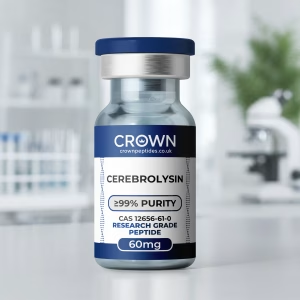
Cerebrolysin Research Peptide
From £32.99
HPLC and MS verified · same-day UK dispatch before 2pm
View Cerebrolysin Research Peptide ›Cerebrolysin vs Semax, Cortexin and Pinealon
Three comparisons are especially useful: a defined synthetic peptide, a rival brain extract, and the bioregulators.
Cerebrolysin vs Semax
These two sit at opposite ends of brain peptide research. Semax is one defined heptapeptide, Met-Glu-His-Phe-Pro-Gly-Pro, built from a fragment of the hormone ACTH. In rats, a single application raised hippocampal BDNF protein 1.4-fold and activation of its receptor trkB 1.6-fold (PMID: 16996037). Cerebrolysin, by contrast, contains no BDNF fragments in the best-known analysis (PMID: 26017115) but is reported to produce growth-factor-like effects through many components at once. Semax suits studies that need one known molecule acting on a known system; Cerebrolysin suits studies of a whole brain-derived peptide fraction. Our Semax peptide guide covers the single-peptide side in depth.
Cerebrolysin vs Cortexin and other brain extracts
Cortexin is a separate brain-derived product, and other brain protein hydrolysates exist under different names. A 2019 randomised, double-blind rat study from the Detroit group compared four of them after embolic stroke: Cognistar, Cerebrolysat, Cortexin and Cerebrolysin, against saline. Only the Cerebrolysin group showed significantly better neurological outcome, compared both with saline and with the other preparations; none of the four changed lesion volume significantly (PMID: 30665068). "Brain-derived peptide mixture", in other words, is not one thing.
Cerebrolysin vs Pinealon and the bioregulators
The Khavinson bioregulator programme in St Petersburg also began with peptide extracts from animal tissues, such as the thymus extract Thymalin, before identifying very short peptides such as the three-residue Pinealon. Both lines of research start from the idea that tissue-derived peptides carry biological signals; the bioregulator work moved towards single defined peptides, while Cerebrolysin research kept the whole mixture. Our article on bioregulator peptides explained and our Pinealon peptide guide tell that side of the story.
Where Cerebrolysin Research Is Heading
The most exciting Cerebrolysin questions are still ahead.
Finding the active peptides. If the growth factors are not in the mix, which peptides are doing the work? The published composition studies give researchers a catalogue to start from, and testing separated fractions in the progenitor cell and Sonic hedgehog assays could narrow the field to a handful of candidate sequences.
Recovery rather than rescue. The most encouraging human signals came from trials pairing Cerebrolysin with rehabilitation or speech therapy, not from trying to save tissue in the first hours. In CERE-LYSE, adding Cerebrolysin to clot-dissolving treatment in 119 patients did not improve disability at 90 days, and the trial was stopped early (PMID: 23009193). That matches the rat data, in which function improved without the infarct shrinking.
Larger independent trials. CARS and ESCAS both asked for larger confirmatory studies, and the Cochrane reviewers called for robust, adequately powered trials with functional outcomes.
Timing and windows. Cell data suggest effects even with long delays, and rat data a window of up to 48 hours. How timing interacts with the brain's own repair phases is a very answerable question.
The Technical Breakdown: Composition, Fractions and Analysis
This section is for readers who want the analytical detail. Everything above makes sense without it.
Amino acids, peptides and size
Cerebrolysin was described by researchers in Graz as roughly 75% free amino acids and 25% peptides below 10 kilodaltons (PMID: 11459078). That is why the same study used an artificial amino acid solution as a control: any effect that the amino acids alone could not reproduce could reasonably be attributed to the peptides.
The Ghent analysis
The 2015 Drug Testing and Analysis study used HPLC with ion trap mass spectrometry and ultra-high-performance liquid chromatography with ion mobility time-of-flight mass spectrometry, matched against the pig protein database with de novo sequencing. It identified 638 unique peptides, mainly from the alpha and beta chains of tubulin, actin and myelin basic protein, with no fragments of GDNF, NGF, BDNF or CNTF. The authors suggested the reported activities probably come from previously unknown "cryptic" peptides (PMID: 26017115).
A deeper look at the light fraction
A 2019 Russian-language study of the lighter peptide fraction, using orbital ion trap mass spectrometry, reported 14,635 peptide sequences from 1,643 porcine neuronal proteins, including fragments of enkephalins, orexin, galanin and nerve growth factor (PMID: 31626174). The difference from the Ghent result on NGF shows how sample, fraction and method change what a mixture analysis finds.
Reading the trial statistics
Many Cerebrolysin trials report a Mann-Whitney estimator: the probability that a randomly chosen patient in one group did better than one in the other. A value of 0.5 means no difference; values above 0.5 favour the active group. CARS reported 0.71 on its primary measure, which its authors called large (PMID: 26564102).
Why Verified Testing Matters for a Peptide Mixture
For a single peptide, testing confirms one known structure. For Cerebrolysin, testing has to answer a harder question: is this batch the same kind of material as the last one? Two digests of brain protein can look identical in the vial yet differ in their peptide make-up, and published analyses show just how many components there are to keep consistent: 638 peptides in one sample analysed in Ghent (PMID: 26017115). That makes batch-level analytical profiles the most important document a researcher has.
What every Crown Peptides batch comes with
Every batch of Cerebrolysin is tested before sale. Because it is a mixture, it does not give the single main HPLC peak or single expected mass of a synthetic peptide; instead, chromatographic and mass spectrometry profiles are used to characterise the batch and check that it is consistent with the expected material from one batch to the next. The batch-specific certificate of analysis, published on our Lab Reports page, is the definitive record of what was found, and the batch number on each vial links it to that certificate. Our guide on how to read a peptide certificate of analysis explains what each section shows.
Stored, packed and dispatched properly
Cerebrolysin is supplied as a freeze-dried (lyophilised) powder in 60mg vials, a form that keeps short peptides stable for storage. Unopened vials are best kept at -20°C, sealed, dry and away from light, and our storage information page has the details. Orders placed before 2pm on a weekday are dispatched from the UK the same day, and UK delivery is free on orders over £100.
A UK company you can talk to
Crown Peptides is a UK company, and we usually reply to enquiries within 24 hours on business days, with WhatsApp available when you want a quicker answer. If you have a question about a Cerebrolysin batch or its certificate, contact us.
Related Compounds Worth Knowing About
Most of Cerebrolysin's neighbours in our range are single, defined peptides, which let researchers compare a whole peptide fraction with individual molecules.
Semax
Semax is a seven-residue ACTH-derived peptide with a well-mapped effect on BDNF and trkB in the rat hippocampus. It is the natural single-molecule comparison for Cerebrolysin's growth-factor-like effects.
Selank
Selank comes from the same Moscow tradition as Semax but is built on tuftsin, an immune peptide, and is studied mainly in stress-response models. Our Selank guide covers its research.
Semax 5mg + Selank 5mg (Blend)
The Semax 5mg + Selank 5mg (Blend) combines the two Moscow peptides in one vial.
Pinealon
Pinealon is a three-amino-acid bioregulator peptide from the Khavinson programme, which, like Cerebrolysin, traces its roots to tissue-derived peptide extracts.
Adamax
Adamax is described by suppliers as an adamantane-modified form of acetylated Semax. Our Adamax guide explains what is and is not yet known about it.
PE-22-28
PE-22-28 is a seven-residue analogue of spadin, studied for its action on the TREK-1 potassium channel in mice.
Browse the full range in our Neurocognitive Research Peptides category, including Cerebrolysin itself, or see how these compounds compare in our roundup of the best peptides for brain research.
Common Questions About Cerebrolysin
What is Cerebrolysin?
Cerebrolysin is a brain-derived peptide preparation made by enzymatic digestion of purified pig-brain proteins. It contains a mixture of short peptides and free amino acids rather than one defined molecule, and it has been studied in cell cultures, animal models and clinical trials in stroke, brain injury and dementia.
What does FPF-1070 mean?
FPF-1070 is a development code for Cerebrolysin found in older research papers. Searching under both names gives the fullest picture of the literature.
Is Cerebrolysin a single peptide?
No. One published analysis identified 638 different peptides in a single sample, mostly fragments of tubulin, actin and myelin basic protein, and a later study of a lighter fraction reported more than 14,000 peptide sequences.
Does Cerebrolysin contain BDNF or NGF?
Not as intact growth factors. The 2015 Ghent analysis found no fragments of BDNF, NGF, GDNF or CNTF. A 2019 Russian study of a lighter fraction reported fragments matching nerve growth factor and several neuropeptides. Its growth-factor-like effects in research models are thought to come from short peptides released during digestion.
What have the human trials found?
Results are mixed. The large CASTA stroke trial was neutral on its primary endpoint, while CARS and the pooled CAPTAIN analysis reported advantages for the Cerebrolysin groups. Cochrane reviewers found little difference in death after stroke, more non-fatal serious adverse events, and rated the vascular dementia evidence as very low quality.
How is Cerebrolysin different from Cortexin?
Both are brain-derived peptide preparations, but they are separate products with different compositions. In a blinded rat stroke study comparing four such preparations, only Cerebrolysin improved neurological outcome compared with saline.
Is Cerebrolysin legal in the UK?
Cerebrolysin is not a controlled drug under the Misuse of Drugs Act 1971, and it has no UK marketing authorisation, although it is an approved medicine in several other countries. Our guide are peptides legal in the UK explains how the rules apply to research materials.
Can I buy Cerebrolysin in the UK?
Yes. Crown Peptides supplies Cerebrolysin in 60mg vials, within our Neurocognitive research peptides category, with every batch tested and its certificate published.
How should Cerebrolysin be stored?
As a freeze-dried powder at -20°C ± 5°C, kept dry, sealed and away from light, and protected from repeated warming and cooling.
A Brain in a Vial, and the Peptides Still Waiting to Be Named
Cerebrolysin is an unusual research material: a whole slice of brain protein chemistry, cut into pieces and kept together. In rats it has been linked to new neurons after stroke, a Sonic hedgehog switch that a single blocker can turn off, and better memory months after head injury. In people, encouraging trial results sit alongside neutral ones, which is what a field still sharpening its questions looks like.
The biggest question is also the most exciting: which of those hundreds of peptides matter? The catalogues exist, the assays are established, and the recovery trials point to where the biology is most promising. For laboratories ready to work on a mixture rather than a single molecule, explore the Cerebrolysin Research Peptide.
References
- Gevaert B, D'Hondt M, Bracke N, et al. Peptide profiling of Internet-obtained Cerebrolysin using high performance liquid chromatography - electrospray ionization ion trap and ultra high performance liquid chromatography - ion mobility - quadrupole time of flight mass spectrometry. Drug Test Anal. 2015;7:835-42. PMID: 26017115
- Hartbauer M, Hutter-Paier B, Windisch M. Effects of Cerebrolysin on the outgrowth and protection of processes of cultured brain neurons. J Neural Transm (Vienna). 2001;108:581-92. PMID: 11459078
- Homberg V, Jianu DC, Stan A, et al. Speech Therapy Combined With Cerebrolysin in Enhancing Nonfluent Aphasia Recovery After Acute Ischemic Stroke: ESCAS Randomized Pilot Study. Stroke. 2025;56:937-947. PMID: 39957612
- Masliah E, Díez-Tejedor E. The pharmacology of neurotrophic treatment with Cerebrolysin: brain protection and repair to counteract pathologies of acute and chronic neurological disorders. Drugs Today (Barc). 2012;48 Suppl A:3-24. PMID: 22514792
- Ziganshina LE, Abakumova T, Nurkhametova D, et al. Cerebrolysin for acute ischaemic stroke. Cochrane Database Syst Rev. 2023;10:CD007026. PMID: 37818733
- Gutmann B, Hutter-Paier B, Skofitsch G, et al. In vitro models of brain ischemia: the peptidergic drug cerebrolysin protects cultured chick cortical neurons from cell death. Neurotox Res. 2002;4:59-65. PMID: 12826494
- Zhang C, Chopp M, Cui Y, et al. Cerebrolysin enhances neurogenesis in the ischemic brain and improves functional outcome after stroke. J Neurosci Res. 2010;88:3275-81. PMID: 20857512
- Zhang L, Chopp M, Meier DH, et al. Sonic hedgehog signaling pathway mediates cerebrolysin-improved neurological function after stroke. Stroke. 2013;44:1965-72. PMID: 23696546
- [No authors listed]. Correction to: Sonic Hedgehog Signaling Pathway Mediates Cerebrolysin-Improved Neurological Function After Stroke. Stroke. 2025;56:e99. PMID: 39869713
- Rockenstein E, Torrance M, Mante M, et al. Cerebrolysin decreases amyloid-beta production by regulating amyloid protein precursor maturation in a transgenic model of Alzheimer's disease. J Neurosci Res. 2006;83:1252-61. PMID: 16511867
- Schauer E, Wronski R, Patockova J, et al. Neuroprotection of cerebrolysin in tissue culture models of brain ischemia: post lesion application indicates a wide therapeutic window. J Neural Transm (Vienna). 2006;113:855-68. PMID: 16362636
- Zhang L, Chopp M, Lu M, et al. Demonstration of therapeutic window of Cerebrolysin in embolic stroke: A prospective, randomized, blinded, and placebo-controlled study. Int J Stroke. 2017;12:628-635. PMID: 28382851
- Zhang Y, Chopp M, Meng Y, et al. Cerebrolysin improves cognitive performance in rats after mild traumatic brain injury. J Neurosurg. 2015;122:843-55. PMID: 25614944
- Zhang Y, Chopp M, Zhang Y, et al. Randomized controlled trial of Cerebrolysin's effects on long-term histological outcomes and functional recovery in rats with moderate closed head injury. J Neurosurg. 2020;133:1072-1082. PMID: 31491768
- Rockenstein E, Adame A, Mante M, et al. The neuroprotective effects of Cerebrolysin in a transgenic model of Alzheimer's disease are associated with improved behavioral performance. J Neural Transm (Vienna). 2003;110:1313-27. PMID: 14628195
- Rockenstein E, Mante M, Adame A, et al. Effects of Cerebrolysin on neurogenesis in an APP transgenic model of Alzheimer's disease. Acta Neuropathol. 2007;113:265-75. PMID: 17131129
- Heiss WD, Brainin M, Bornstein NM, et al. Cerebrolysin in patients with acute ischemic stroke in Asia: results of a double-blind, placebo-controlled randomized trial. Stroke. 2012;43:630-6. PMID: 22282884
- Muresanu DF, Heiss WD, Hoemberg V, et al. Cerebrolysin and Recovery After Stroke (CARS): A Randomized, Placebo-Controlled, Double-Blind, Multicenter Trial. Stroke. 2016;47:151-9. PMID: 26564102
- Guekht A, Vester J, Heiss WD, et al. Safety and efficacy of Cerebrolysin in motor function recovery after stroke: a meta-analysis of the CARS trials. Neurol Sci. 2017;38:1761-1769. PMID: 28707130
- Lang W, Stadler CH, Poljakovic Z, et al. A prospective, randomized, placebo-controlled, double-blind trial about safety and efficacy of combined treatment with alteplase (rt-PA) and Cerebrolysin in acute ischaemic hemispheric stroke. Int J Stroke. 2013;8:95-104. PMID: 23009193
- Bornstein NM, Guekht A, Vester J, et al. Safety and efficacy of Cerebrolysin in early post-stroke recovery: a meta-analysis of nine randomized clinical trials. Neurol Sci. 2018;39:629-640. PMID: 29248999
- Vester JC, Buzoianu AD, Florian SI, et al. Cerebrolysin after moderate to severe traumatic brain injury: prospective meta-analysis of the CAPTAIN trial series. Neurol Sci. 2021;42:4531-4541. PMID: 33620612
- Poon W, Matula C, Vos PE, et al. Safety and efficacy of Cerebrolysin in acute brain injury and neurorecovery: CAPTAIN I-a randomized, placebo-controlled, double-blind, Asian-Pacific trial. Neurol Sci. 2020;41:281-293. PMID: 31494820
- Muresanu DF, Florian S, Hömberg V, et al. Efficacy and safety of cerebrolysin in neurorecovery after moderate-severe traumatic brain injury: results from the CAPTAIN II trial. Neurol Sci. 2020;41:1171-1181. PMID: 31897941
- Gauthier S, Proaño JV, Jia J, et al. Cerebrolysin in mild-to-moderate Alzheimer's disease: a meta-analysis of randomized controlled clinical trials. Dement Geriatr Cogn Disord. 2015;39:332-47. PMID: 25832905
- Alvarez XA, Cacabelos R, Sampedro C, et al. Combination treatment in Alzheimer's disease: results of a randomized, controlled trial with cerebrolysin and donepezil. Curr Alzheimer Res. 2011;8:583-91. PMID: 21679156
- Guekht AB, Moessler H, Novak PH, et al. Cerebrolysin in vascular dementia: improvement of clinical outcome in a randomized, double-blind, placebo-controlled multicenter trial. J Stroke Cerebrovasc Dis. 2011;20:310-8. PMID: 20656516
- Cui S, Chen N, Yang M, et al. Cerebrolysin for vascular dementia. Cochrane Database Syst Rev. 2019;(11):CD008900. PMID: 31710397
- Dolotov OV, Karpenko EA, Inozemtseva LS, et al. Semax, an analog of ACTH(4-10) with cognitive effects, regulates BDNF and trkB expression in the rat hippocampus. Brain Res. 2006;1117:54-60. PMID: 16996037
- Zhang L, Chopp M, Wang C, et al. Prospective, double blinded, comparative assessment of the pharmacological activity of Cerebrolysin and distinct peptide preparations for the treatment of embolic stroke. J Neurol Sci. 2019;398:22-26. PMID: 30665068
- Gromova OA, Torshin IY, Zgoda VG, et al. [An analysis of the peptide composition of a 'light' peptide fraction of cerebrolysin]. Zh Nevrol Psikhiatr Im S S Korsakova. 2019;119:75-83. PMID: 31626174