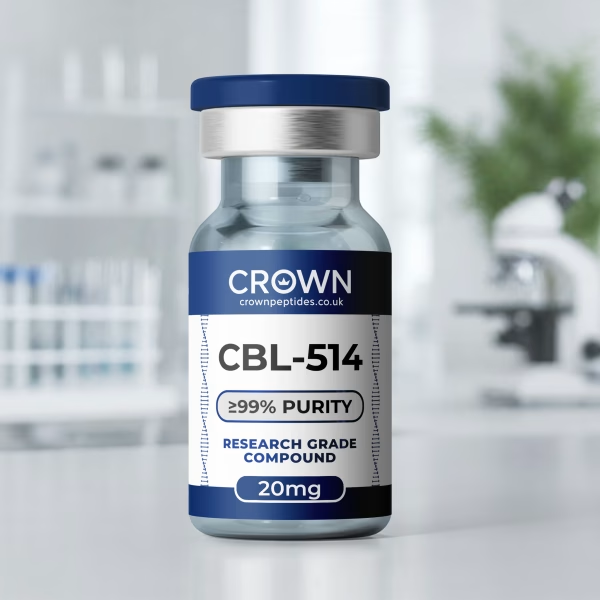
CBL-514 Research Compound
A high-purity small-molecule research compound studied in adipocyte apoptosis and localised adipose tissue research. Supplied in 20mg, with every batch independently tested and dispatched from the UK.
Out of stock
Supplied for laboratory research purposes only — not for human consumption or for medical, veterinary or diagnostic use.
Product Overview
CBL-514 UK is Crown Peptides’ small-molecule adipocyte research compound, supplied in 20mg for laboratory research.
- Studied in research involving adipocyte apoptosis and lipolysis
- Studied in research involving localised subcutaneous adipose tissue volume and thickness
- Studied in research involving lipoma tissue in Dercum disease models and trials
- Studied in published randomised, placebo-controlled trials, with two global Phase 3 trials now under way
- Batch-specific quality documentation available
About CBL-514 UK
CBL-514 is a small-molecule research compound developed by Caliway Biopharmaceuticals in New Taipei, Taiwan. It belongs to a group of compounds studied for their action directly on fat tissue, known in the research literature as injectable lipolysis agents. Where most compounds in metabolic research act on appetite, hormones or whole-body energy use, CBL-514 is studied for a local effect: inside the layer of fat where it is placed, it has been reported to switch on apoptosis, the orderly, programmed death of fat cells (adipocytes), and to promote lipolysis, the breakdown of their stored fat.
Also known as: CBL514, CBL 514, CBL-514 injection lipolysis compound
That makes CBL-514 a very different tool from the compounds usually grouped with it. AICAR and SLU-PP-332 are studied for their effects on energy use across the whole body, and 5-Amino-1MQ for an enzyme that controls how fat cells store energy. CBL-514 is studied for what happens to the fat cells themselves at the point of contact. It sits in the metabolic research area and, as a non-peptide, among our research compounds.
What sets CBL-514 apart in this field is how cell death happens. Older injectable fat-dissolving agents, such as deoxycholic acid, work like a detergent: they break open cell membranes, which can damage surrounding tissue and trigger inflammation. Apoptosis is a controlled process in which the cell packages itself up to be cleared away. Caliway’s published trials describe adipocyte apoptosis with no necrosis or nerve injury observed, which is a large part of why CBL-514 has drawn so much research interest.
CBL-514 Research
CBL-514 has moved quickly from early clinical work into a series of randomised trials published in leading aesthetic and dermatology journals, with Phase 2 and Phase 2b studies completed and two global Phase 3 trials, SUPREME-01 and SUPREME-02, now enrolling in the United States, Canada and Australia. For Dercum disease it holds FDA Fast Track and Orphan Drug designations in the United States and an orphan designation from the European Medicines Agency. A wider look at fat metabolism research is in our article on AOD-9604 vs 5-Amino-1MQ.
- Adipocyte apoptosis and lipolysis
- Localised subcutaneous adipose tissue volume and thickness
- Lipoma tissue in Dercum disease
- Comparison with other injectable lipolysis agents
Where the story starts: targeting fat cells directly
The first published randomised study, a Phase 2a trial, compared three dose levels of CBL-514 placed into abdominal fat over up to four sessions. Ultrasound at follow-up showed that the two higher unit doses significantly reduced both the volume and the thickness of abdominal subcutaneous fat compared with baseline. At the top dose, fat volume fell by about 25%, and the authors attributed the effect to adipocyte apoptosis. (Learn more)
A placebo-controlled Phase 2 trial
In 2025 a single-blind, placebo-controlled Phase 2 study of 76 participants measured abdominal fat by ultrasound. Eight weeks after the final session, 69.6% of the CBL-514 group had lost at least 150 mL of subcutaneous fat, against none in the placebo group, and 60.9% had passed 200 mL. Of those who reached 150 mL, 42.9% did so after a single session. (Learn more)
MRI confirmation in a Phase 2b trial
A 2026 randomised, placebo-controlled Phase 2b trial of 108 adults added MRI measurement and rating scales completed by both clinicians and participants. At 12 weeks, 76.7% of the CBL-514 group improved by at least one grade on the clinician scale, compared with 18.9% on placebo, with near-identical results on the participant scale. MRI showed an average fall in abdominal fat volume of 152.9 mL, or 20.3%, and most responders improved within one or two sessions. (Learn more)
Lipomas and Dercum disease
Dercum disease, also called adiposis dolorosa, is a rare condition marked by multiple painful fatty growths called lipomas. In a randomised Phase 2a study of 12 adults, median lipoma volume fell by up to 59.1% within four weeks, and in September 2026 a placebo-controlled Phase 2 study reported that it had met its primary endpoint, with significantly greater pain reduction than placebo. (Learn more) A 2026 review of new approaches to the condition reported that CBL-514 produced a statistically significant reduction in lipoma size, leading to its Fast Track status. (Learn more)
Placing CBL-514 in its field
A 2026 systematic review of injectable lipolytic agents used outside the chin area covered 25 studies and more than 3,000 participants, including deoxycholic acid, phosphatidylcholine and newer agents such as CBL-514. Across the field, reductions in localised fat were reported in almost 94% of studies, and the authors described injectable lipolytic agents as a promising, minimally invasive approach. (Learn more)
How the research is measured
One reason the CBL-514 trials are well regarded is the way they measure results. The CBL-514 trials used ultrasound to measure the thickness and volume of the fat layer at fixed points, and the Phase 2b trial added MRI, which images the whole abdominal fat layer in three dimensions. Pairing these with rating scales scored separately by clinicians and by participants gives researchers several independent views of the same result, and in the Phase 2b trial they agreed closely.
Taken together, CBL-514 is one of the most closely followed compounds in adipose tissue research: a small molecule with a clear, local mode of action, three published randomised trials in abdominal fat with ultrasound and MRI measurement, an orphan-condition programme in Dercum disease, and two global Phase 3 trials now enrolling. Related metabolic compounds include AOD-9604 and MOTS-c.
Specifications
- Product
- CBL-514
- Classification
- Small-molecule adipocyte-targeting research compound
- Available strength
- 20mg
- Form
- Research material supplied according to product label
- Purity / assay
- batch-specific; refer to Certificate of Analysis
- Verification
- HPLC and Mass Spectrometry where analytically appropriate
- Also known as
- CBL514, CBL 514
- Product Name
- CBL-514
- Developer
- Caliway Biopharmaceuticals, New Taipei, Taiwan
- Research area
- adipocyte apoptosis, lipolysis and localised adipose tissue
- Molecular identity
- confirmed per batch; refer to the batch Certificate of Analysis
Purity and Testing
Crown Peptides CBL-514 will be supplied with batch-specific quality documentation appropriate to the material. For a small molecule, HPLC shows how clean a batch is and how much of the main compound it contains, while mass spectrometry confirms that the molecule in the vial has the expected mass. Together they give researchers the identity and purity information needed before work begins. The Certificate of Analysis should be used as the definitive source for identity, assay, purity and relevant impurity information.
Storage Conditions
- Store unreconstituted material at -20°C ± 5°C in a cool, dry environment
- Prepared research solutions should use validated storage conditions appropriate to the compound and study design
- Protect from unnecessary heat, direct light and repeated temperature fluctuations
Related Compounds
Researchers working with CBL-514 may also be interested in 5-Amino-1MQ, AOD-9604, AICAR, SLU-PP-332, MOTS-c, L-Carnitine, Tesamorelin and NAD+ — other compounds studied in fat metabolism, energy use and metabolic research.
CBL-514 Frequently Asked Questions
About CBL-5149 questions
What is CBL-514?
CBL-514 is a small-molecule research compound developed by Caliway Biopharmaceuticals. It is studied for its action on fat cells, where it has been reported to trigger apoptosis and lipolysis, and it is used in research on localised adipose tissue and lipomas.
Is CBL-514 a peptide?
No. CBL-514 is a small molecule, not a chain of amino acids, which is why we list it as a research compound rather than a research peptide. It is grouped with our metabolic products because it is studied in the same field.
What is an adipocyte?
An adipocyte is a fat cell, the main cell type in adipose tissue. Each one holds a large droplet of stored fat. In adults the number of fat cells stays fairly steady, and they mostly grow or shrink as they fill and empty, which is why compounds that reduce the number of fat cells in one area are of particular research interest.
What is lipolysis?
Lipolysis is the breakdown of stored fat inside a fat cell into fatty acids and glycerol, which are released and used elsewhere. The body runs this process all the time. Injection lipolysis is the research term for compounds placed directly into a fat layer to act on it locally.
How does CBL-514 work?
Published trials describe CBL-514 as inducing adipocyte apoptosis, the programmed and orderly death of fat cells, together with lipolysis, the breakdown of stored fat. The dead cells are then cleared away by the body’s normal processes rather than bursting open.
What is the difference between apoptosis and necrosis?
Necrosis is uncontrolled cell death, in which the cell bursts and spills its contents, causing inflammation. Apoptosis is controlled: the cell shrinks and breaks into neat packages that are cleared away quietly. CBL-514 trials report apoptosis with no necrosis observed.
How is CBL-514 different from deoxycholic acid?
Deoxycholic acid is a bile acid that acts like a detergent, dissolving the membranes of any cells it touches. CBL-514 is studied for a more targeted action on fat cells through apoptosis, which is why it is described as a new kind of injectable lipolysis agent.
How is CBL-514 different from AOD-9604 and 5-Amino-1MQ?
AOD-9604 is a fragment of growth hormone studied for its effect on fat metabolism, and 5-Amino-1MQ blocks the enzyme NNMT inside fat cells. Both are studied for their effects on how fat is stored and used. CBL-514 is studied for its direct, local effect on the fat cells themselves.
Who developed CBL-514?
CBL-514 was developed by Caliway Biopharmaceuticals, a company based in New Taipei, Taiwan. Its research programme covers localised abdominal fat, Dercum disease and cellulite, with trials in the United States, Canada, Australia and Taiwan, including two global Phase 3 trials.
Findings in research models3 questions
What did the Phase 2 trials measure?
They measured changes in abdominal subcutaneous fat by ultrasound and, in the Phase 2b trial, by MRI, alongside rating scales completed by clinicians and participants. In the Phase 2b trial, MRI showed an average fall in abdominal fat volume of 20.3% compared with baseline.
What is Dercum disease, and why is CBL-514 studied in it?
Dercum disease is a rare condition marked by many painful lipomas, or fatty growths, with no standard treatment. Because CBL-514 is studied for removing fat cells locally, painful lipomas were a natural target. A randomised Phase 2a study and a placebo-controlled Phase 2 study have both reported positive results, and CBL-514 holds FDA Fast Track and Orphan Drug designations and an EMA orphan designation for the condition.
Has CBL-514 been studied in cellulite?
Yes. Caliway has run a Phase 2 study of CBL-514 in cellulite, which the company reports met all of its primary and secondary efficacy endpoints.
Buying, testing & storage3 questions
Is CBL-514 legal to buy in the UK?
CBL-514 is not a controlled drug under the Misuse of Drugs Act 1971, and there is no licensed medicine containing it in the UK. It is sold as a research compound for laboratory use only, which is how Crown Peptides supplies it. This is general information, not legal advice.
Where can I buy CBL-514 in the UK?
CBL-514 is supplied by Crown Peptides in 20mg vials, singly or in packs of 3, 5 or 10 with a saving on every vial. Orders ship from the UK, and every batch is independently tested, with its Certificate of Analysis published on this page.
How should CBL-514 be stored once it arrives?
Keep the unreconstituted powder at -20°C ± 5°C, dry and away from light, and avoid repeated warming and cooling. Prepared solutions should follow conditions validated for your study design. Our storage information page covers general handling.
Read the batch certificate before you order
Every batch is published openly — identity, purity and batch number, with no account needed.
View lab reports- Laboratory research only
- Not for human or clinical use
- Not for human or veterinary consumption
Supplied for laboratory research purposes only — not for human consumption or for medical, veterinary or diagnostic use.
Other Research Peptides
 Musculoskeletal researchBPC-157 + TB-500 Blend (Wolverine Stack)5mg / 5mg · 2 strengths ›