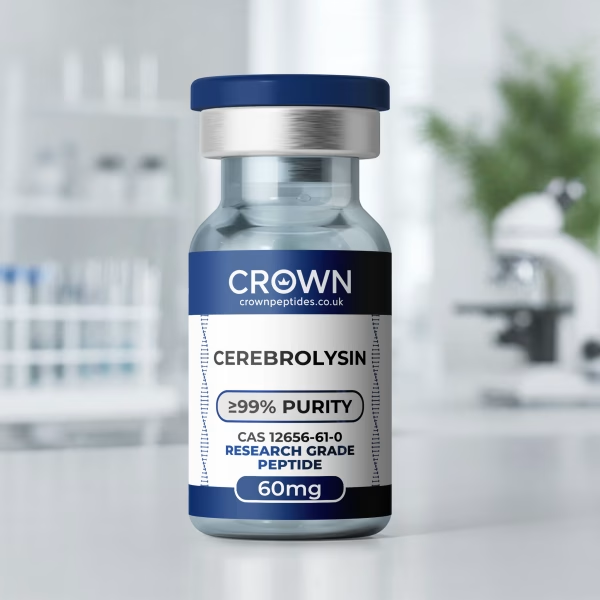
Cerebrolysin Research Peptide
A brain-derived peptide research preparation studied in neurogenesis and experimental stroke research.
In stock
Supplied for laboratory research purposes only — not for human consumption or for medical, veterinary or diagnostic use.
Product Overview
Cerebrolysin UK is Crown Peptides’ brain-derived peptide research preparation, supplied in 60mg for laboratory research.
- Studied in research involving neurogenesis and neural progenitor cells
- Studied in research involving experimental stroke and brain-injury models
- Studied in research involving neurotrophic signalling pathways
- Studied in research involving complex peptide-mixture analysis
- Batch-specific quality documentation available
About Cerebrolysin UK
Cerebrolysin is unlike almost every other compound on our shelves. Rather than a single synthetic peptide with one sequence, it is a preparation made by the controlled enzymatic digestion of purified proteins from pig brain, leaving a mixture of short peptides and free amino acids. It was developed in Austria and is an approved medicine in some countries, but it is not a licensed medicine in the UK. Crown Peptides supplies a freeze-dried research material for laboratory use; it is not the branded medicinal product.
Also known as: Cerebrolysin peptide, porcine brain peptide preparation, FPF-1070, brain-derived peptide mixture.
Cerebrolysin Research
Most Cerebrolysin research falls into two groups: animal and cell studies looking at how damaged brain tissue repairs itself, and clinical trials in stroke and brain injury. A key rodent study from the Henry Ford Hospital group in Detroit found that Cerebrolysin increased the growth of new neural progenitor cells after experimental stroke, and that the effect depended on the Sonic hedgehog signalling pathway (Learn more). Clinical research has followed in stroke, traumatic brain injury and Alzheimer’s disease.
- Neurogenesis and neural progenitor cells
- Experimental stroke and brain-injury models
- Neurotrophic signalling pathways
- Complex peptide-mixture analysis
Sonic hedgehog and new brain cells
In that 2013 study, published in Stroke, Zhang and colleagues worked first with neural progenitor cells taken from the subventricular zone of adult rats, one of the few areas of the adult brain that keeps making new cells. Cerebrolysin increased both the multiplication of these cells and their development into neurons and myelin-forming oligodendrocytes, and it raised levels of Sonic hedgehog and its receptors, Patched and Smoothened. When the team blocked Smoothened with the drug cyclopamine, those effects disappeared.
The same pattern held in rats after embolic stroke. Treatment started 24 hours after the stroke increased new cell production in the subventricular zone and led to more neurons, more oligodendrocytes and more remodelling of nerve fibres around the damaged area, with clear improvements on neurological tests from the third to the fifth week. Blocking the Sonic hedgehog pathway reversed those gains, which is why this study is often cited as evidence for a specific mechanism behind what is otherwise a very complex mixture.
What is actually in the vial?
For decades, Cerebrolysin’s exact chemical make-up was not publicly described. In 2015, a team writing in Drug Testing and Analysis used liquid chromatography and high-resolution mass spectrometry to analyse a sample bought online, and identified 638 different peptides (Learn more). Most came from common structural brain proteins, mainly the alpha and beta chains of tubulin, actin and myelin basic protein.
Just as interesting was what they did not find. There were no fragments of the well-known growth factors often mentioned in connection with Cerebrolysin, such as BDNF, NGF, GDNF or CNTF. The authors suggested that its reported activity may come from previously unknown short peptides released from larger proteins during digestion. This matters for laboratory work: a peptide mixture cannot be checked against one expected mass in the way a single synthetic peptide can, so batch documentation plays an even bigger part.
Stroke recovery: the CARS trial
The CARS trial, published in Stroke in 2016, studied Cerebrolysin alongside a standard rehabilitation programme in patients who had recently had a stroke, starting treatment 24 to 72 hours after onset. At 90 days, arm and hand function, measured with the Action Research Arm Test, was markedly better in the Cerebrolysin group than with placebo, and a combined measure across 12 outcome scales also favoured Cerebrolysin. Fewer than 4% of patients stopped early, and safety was comparable with placebo (Learn more).
Traumatic brain injury: the CAPTAIN trials
The CAPTAIN programme tested Cerebrolysin as an add-on to usual care after moderate to severe traumatic brain injury. A prospective meta-analysis of the two randomised, double-blind trials, covering 185 patients and published in Neurological Sciences in 2021, found a small-to-medium effect in favour of Cerebrolysin across a combined set of functional and neuropsychological scales, statistically significant at both 30 and 90 days, with safety comparable between the groups (Learn more).
Alzheimer’s disease research
Cerebrolysin has also been studied in mild-to-moderate Alzheimer’s disease. A 2015 meta-analysis of six randomised, placebo-controlled trials, published in Dementia and Geriatric Cognitive Disorders, found that Cerebrolysin significantly improved cognitive function at four weeks and global clinical change at four weeks and six months compared with placebo, with a safety profile comparable to placebo (Learn more). Together with the rodent findings on new brain-cell growth, this makes Cerebrolysin one of the most widely studied compounds in neurorecovery research.
Specifications
- Product
- Cerebrolysin
- Classification
- Brain-derived peptide preparation (mixture of short peptides and free amino acids)
- Available strength
- 60mg
- Form
- Research material supplied according to product label
- Purity / assay
- batch-specific; refer to Certificate of Analysis
- Verification
- HPLC and Mass Spectrometry profiling where analytically appropriate
- Also known as
- Cerebrolysin peptide, FPF-1070, porcine brain peptide preparation
- Product Name
- Cerebrolysin
- Source
- Controlled enzymatic digestion of porcine brain proteins
Purity and Testing
Crown Peptides Cerebrolysin will be supplied with batch-specific quality documentation appropriate to the material. Because Cerebrolysin is a mixture of many peptides rather than one defined molecule, it does not give the single main HPLC peak or single expected mass of a synthetic peptide. Instead, chromatographic and mass-spectrometry profiles are used to characterise the batch and check that it is consistent with the expected material.
The batch-specific Certificate of Analysis is the definitive source for the analytical results and specification of the material supplied.
Storage Conditions
- Store unreconstituted material at -20°C ± 5°C in a cool, dry environment
- Prepared research solutions should use validated storage conditions appropriate to the compound and study design
- Protect from unnecessary heat, direct light and repeated temperature fluctuations
Cerebrolysin Frequently Asked Questions
About Cerebrolysin4 questions
What is Cerebrolysin?
Cerebrolysin is a research preparation made by breaking down purified pig-brain proteins with enzymes, leaving a mixture of short peptides and free amino acids. Crown Peptides supplies it as a 60mg freeze-dried research material. It is studied mainly in models of stroke, brain injury and the growth of new brain cells.
Is Cerebrolysin a single peptide?
No, and that is what sets it apart. Products such as Semax or DSIP have one exact sequence. Cerebrolysin contains hundreds of different peptides; one published analysis identified 638 in a single sample, mostly fragments of tubulin, actin and myelin basic protein.
Does Cerebrolysin contain BDNF or other growth factors?
Not as intact growth factors. The 2015 mass-spectrometry study found no fragments of BDNF, NGF, GDNF or CNTF in the sample it analysed. Its neurotrophic-like effects in research models are thought to come from other short peptides released during digestion, rather than from known growth factors.
What does FPF-1070 mean?
FPF-1070 is a code name used for Cerebrolysin in older research papers. If you search the scientific literature, you will find studies under both names, so it is worth searching for each.
Research findings6 questions
What did the Sonic hedgehog study show?
In rats after experimental stroke, Cerebrolysin increased the production of new neural progenitor cells and their development into neurons and oligodendrocytes, with improved neurological test scores from weeks three to five. Blocking the Sonic hedgehog pathway with cyclopamine removed those effects, pointing to that pathway as a key route for its activity in that model.
What has Cerebrolysin shown in brain-injury research?
The CAPTAIN trial series studied it after moderate to severe traumatic brain injury, as an add-on to usual care. A combined analysis of 185 patients found a small-to-medium benefit on functional and neuropsychological measures at 30 and 90 days, with safety similar to placebo.
What did the CARS stroke trial find?
CARS gave Cerebrolysin or placebo alongside rehabilitation, starting one to three days after stroke. At 90 days, arm and hand function was clearly better in the Cerebrolysin group, and a combined measure of 12 outcome scales also favoured it.
How does Cerebrolysin compare with Semax?
They come from opposite ends of peptide research. Semax is a single seven-residue peptide designed from a fragment of the hormone ACTH, so every molecule in the vial is the same. Cerebrolysin is a natural digest containing hundreds of different peptides. Semax suits studies that need one defined molecule; Cerebrolysin suits studies of a whole brain-derived peptide fraction.
What is Cortexin, and is it the same thing?
Cortexin is a separate brain-derived peptide preparation, used mainly in Russia. It is often grouped with Cerebrolysin because both are brain-derived peptide mixtures, but the two are separate products with different compositions.
Is Cerebrolysin a licensed medicine in the UK?
No. It is an approved medicine in some countries, but not in the UK, and the research material supplied by Crown Peptides is not the branded medicinal product. It is sold for laboratory research only. This is general information, not legal advice.
Buying, testing & storage3 questions
Where can I buy Cerebrolysin in the UK?
Cerebrolysin is stocked by Crown Peptides in 60mg vials, available singly or in packs of 3, 5 or 10 with a saving on every vial. Orders ship from the UK, and every batch is independently tested, with its Certificate of Analysis published on this page once stock arrives.
How is a peptide mixture tested?
Differently from a single peptide. A synthetic peptide is usually checked for one main HPLC peak and one expected mass. A mixture like Cerebrolysin produces many peaks, so testing focuses on its overall chromatographic and mass-spectrometry profile and how consistent that profile is from batch to batch.
How should Cerebrolysin be stored?
As a freeze-dried powder it keeps best at -20°C, dry and away from light. Once dissolved, it should be held under storage conditions validated for the study, avoiding repeated warming and cooling. Our storage guide has more detail.
Read the batch certificate before you order
Every batch is published openly — identity, purity and batch number, with no account needed.
View lab reports- Laboratory research only
- Not for human or clinical use
- Not for human or veterinary consumption
Supplied for laboratory research purposes only — not for human consumption or for medical, veterinary or diagnostic use.
Other Research Peptides
 Musculoskeletal researchBPC-157 + TB-500 Blend (Wolverine Stack)5mg / 5mg · 2 strengths ›