Tesamorelin + Ipamorelin Blend UK: Two-Receptor Growth Hormone Research, Mechanism and Study Data
Tesamorelin + Ipamorelin pairs a protected full-length GHRH analogue with a selective ghrelin-receptor agonist. This guide covers GHRH and GHRP synergy research, what each half brings, and what has not yet been studied.
On this page
- What Is the Tesamorelin + Ipamorelin Blend, and Why Pair These Two?
- The Experiment That Showed Two Signals Beat One
- Why the Pairing Makes Sense: Two Receptors, One Cell
- What the Research Has Actually Found
- Tesamorelin + Ipamorelin vs CJC-1295 (No DAC) + Ipamorelin
- The Questions This Pairing Could Help Answer
- The Technical Breakdown: Sequences, Signalling and Pharmacology
- Why Verified Testing Matters for a Two-Peptide Vial
- Related Compounds Worth Knowing About
- Common Questions About Tesamorelin + Ipamorelin
- Two Signals, One Cell, and an Experiment Still Waiting to Be Run
- References
In a Belgrade study of 11 healthy adults, researchers measured how much growth hormone the pituitary released after three different challenges. The brain's own releasing hormone, GHRH, produced a total of about 484 units over two hours. A small synthetic peptide called GHRP-6 produced about 1,435. Then they gave both at once. Simple addition would predict roughly 1,920. The answer came back at 3,772: almost twice the sum of the two (PMID: 7883854).
That kind of result, one plus one making nearly four, is the reason researchers keep pairing a GHRH-type peptide with a ghrelin-receptor peptide. The Tesamorelin + Ipamorelin (Blend) brings together two of the most carefully engineered members of those families: a full-length, chemically protected version of human GHRH, and the first ghrelin-receptor agonist shown to release growth hormone selectively. This guide covers the decades of GHRH-plus-GHRP research behind the idea, what each half brings, how the blend differs from the CJC-1295 pairing and, just as importantly, what has not yet been studied. Tesamorelin + Ipamorelin (Blend) is sold by Crown Peptides strictly for laboratory research use only, and everything below is written for readers interested in the science. Each compound is also available on its own as our Tesamorelin Research Peptide and Ipamorelin Research Peptide, within our Endocrine & Hormonal research peptides range.
What Is the Tesamorelin + Ipamorelin Blend, and Why Pair These Two?
The Tesamorelin + Ipamorelin blend is a single vial holding two different growth hormone peptides that act on two different receptors. Tesamorelin works through the GHRH receptor, the brain's primary instruction to release growth hormone. Ipamorelin works through the ghrelin receptor, a separate switch on the same growth hormone-producing cells. The idea behind putting them together is simple: if two separate signals reach one cell, the response can be larger than either signal alone.
What exactly is in the vial?
Each vial of our Tesamorelin + Ipamorelin (Blend) contains Tesamorelin 10mg and Ipamorelin 3mg, supplied together as a freeze-dried powder. The figures describe the vial's contents only, not how the two should be used or combined in any experiment.
Why do people search for "tesamorelin and ipamorelin together"?
People search for "tesamorelin ipamorelin blend", "tesamorelin + ipamorelin" and "tesamorelin and ipamorelin together" because of a large body of work, going back to the late 1980s, showing that GHRH and ghrelin-receptor peptides amplify each other. Our Tesamorelin vs Ipamorelin comparison sets the two side by side; this guide is about putting them together.
Has the combination itself been studied?
Not yet. When we searched PubMed on 26 October 2026, no published experiment, in cells, animals or people, had tested tesamorelin and ipamorelin together. The few records that mention both names are recent review articles about peptide use, not studies. ClinicalTrials.gov listed no registered trial of the pair either. So everything below about synergy comes from other GHRH and ghrelin-receptor pairings, and everything about each half comes from studies of that compound on its own. We say which is which throughout.
The Experiment That Showed Two Signals Beat One
The story begins with a puzzle that took twenty years to solve.
A peptide with no known receptor
In the 1980s, Cyril Bowers and colleagues had built a synthetic six-amino-acid peptide, later called GHRP-6, that released growth hormone. Nobody knew what it bound to. A Merck team then tested it on rat pituitary cells in a dish. GHRP-6 released growth hormone on its own, and so did GHRH. Together, at their maximal concentrations, they produced a synergistic effect. The cells' internal messenger told the real story: GHRH tripled levels of cyclic AMP inside the cells, while GHRP-6 alone did not change them at all, yet adding GHRP-6 to GHRH boosted the GHRH-driven rise. Blocking the GHRH receptor did not stop GHRP-6. The authors concluded the two peptides worked through different receptors and different mechanisms (PMID: 2541999).
GHRP-6 and GHRH together in people
The following year, Bowers' group tested GHRP-6 in 18 healthy men. It was a potent growth hormone releaser on its own, with average peaks rising from 1.2 micrograms per litre after placebo to 68.7 at the highest amount tested. At the two lower amounts, combining it with GHRH released growth hormone synergistically. Prolactin and cortisol rose about two-fold only at the highest GHRP-6 amount, and LH and TSH did not change. Because the two peptides added up to more than their sum, the authors argued that GHRP-6 must be tapping a separate physiological system that still needed to be described (PMID: 2108187).
The missing receptor, then the missing hormone
In 1996, Merck scientists cloned a receptor in the pituitary and hypothalamus that these synthetic peptides act on, and suggested they were mimicking a hormone nobody had found (PMID: 8688086). In 1999, a Japanese team found it: a 28-amino-acid peptide from the stomach, which they named ghrelin (PMID: 10604470). Two years later, a Kyoto study in healthy men showed that small amounts of ghrelin itself acted synergistically with GHRH on growth hormone release, while producing no synergy for ACTH or prolactin (PMID: 11549707). The synergy that synthetic peptides had revealed was built into the body's own wiring.
Two families, each improved separately
Meanwhile, chemists fixed each family's weakness. Natural GHRH is quickly cut apart in blood by an enzyme called DPP-4, which snips off its first two amino acids (PMID: 2565342); Theratechnologies in Montreal answered that with tesamorelin. Early GHRPs also raised cortisol and prolactin; Novo Nordisk in Denmark found a cleaner answer in Ipamorelin.
Why the Pairing Makes Sense: Two Receptors, One Cell
Here is where it gets interesting. The case for pairing tesamorelin with Ipamorelin rests on four ideas, each backed by research on related compounds.
Two receptors, two internal signals
Growth hormone is made in pituitary cells called somatotrophs. The GHRH receptor on these cells works mainly by raising cyclic AMP. The ghrelin receptor, GHS-R1a, uses a different route based on calcium. In the rat pituitary cell work above, GHRP-6 did nothing to cyclic AMP on its own but amplified the cyclic AMP rise caused by GHRH (PMID: 2541999). In human pituitary tumour cells, the ghrelin receptor's genetic message was found in the same individual cells that made growth hormone (PMID: 10444306). Two signals arriving at one cell by different wires is the cellular basis of synergy.
The hypothalamus is part of the effect
Synergy is not only a pituitary event. In the Belgrade study from our opening, 12 patients whose pituitary had been functionally cut off from the hypothalamus responded normally to GHRH, but their response to GHRP-6 was almost completely blocked, and the combination produced no more than the two responses added together. The authors concluded that GHRP-6 exerts its main action at the level of the hypothalamus (PMID: 7883854). A Turin review described GHRPs as acting at both levels, possibly by counteracting somatostatin, the brain's growth hormone brake (PMID: 9186261).
Each receptor tires on its own
Repeatedly stimulated receptors can become less responsive, and here two receptors behave differently from one. In rat pituitary cells, pre-exposure to GHRP-6 reduced the next response to GHRP-6 but not the response to GHRH, and the effect wore off within an hour of removing the peptide (PMID: 2541999). Cultured human pituitary tumour cells, tested with GHRH and the non-peptide ghrelin-receptor agonist MK-0677, showed the same pattern after 24 hours: each receptor became desensitised to its own agonist, but not to the other (PMID: 10444306). There is an important counterpoint, though. In six healthy men, the synergy between hexarelin and GHRH was lost when both were given a second time within two hours (PMID: 8762732). Separate receptors do not mean unlimited amplification.
Pulse shape and selectivity
The two halves also differ in how they shape the growth hormone signal over time. In healthy volunteers, Ipamorelin produced a single episode of growth hormone release that peaked at about 40 minutes and then faded (PMID: 10496658). Over two weeks in healthy men, tesamorelin raised both the size of the body's natural growth hormone pulses and the background level between them (PMID: 20943777). In those studies a single administration of Ipamorelin produced one short episode of release, while two weeks of tesamorelin lifted the natural pulses; the studies were designed differently, but the contrast is part of what makes the pair conceptually interesting. Selectivity matters too: Ipamorelin was chosen as the ghrelin-receptor half because, unlike GHRP-6 and GHRP-2, it did not raise ACTH or cortisol in pigs (PMID: 9849822).
- Also known as
- Tesamorelin and Ipamorelin blend; Tesamorelin/Ipamorelin. Tesamorelin is also known as TH9507 (brand name Egrifta); Ipamorelin as NNC 26-0161
- Contents
- Tesamorelin 10mg + Ipamorelin 3mg per vial, lyophilised powder
- Tesamorelin
- Human GHRH(1-44) analogue with a trans-3-hexenoyl group on Tyr1; C221H366N72O67S, 5,136 g/mol; CAS 218949-48-5 (PubChem)
- Ipamorelin
- Aib-His-D-2-Nal-D-Phe-Lys-NH2; C38H49N9O5, 711.9 g/mol; CAS 170851-70-4 (PubChem)
- Classification
- Two-peptide research blend: GHRH receptor agonist plus selective ghrelin receptor (GHS-R1a) agonist
- Research status
- Each compound studied on its own in animals and people, tesamorelin through phase 3 trials; no published study of the two together
What the Research Has Actually Found
The evidence comes in three layers: GHRH combined with other ghrelin-receptor peptides, tesamorelin on its own, and Ipamorelin on its own. A fourth layer, the two together, does not exist yet.
GHRH plus GHRP: synergy in people
Hexarelin with GHRH
A London study gave six healthy young men hexarelin, a short GHRH fragment, or both, into a vein. Hexarelin beat GHRH on its own, and the combination produced peak secretion rates significantly greater than the arithmetic sum of the two given separately. When the pair was repeated, the synergy disappeared (PMID: 8762732).
GHRP-6 with GHRH
The Belgrade study in our opening found the same pattern with GHRP-6 in 11 healthy controls, with combined growth hormone output of 3,771.5 against 483.7 for GHRH and 1,434.8 for GHRP-6 alone, measured as area under the curve over 120 minutes (PMID: 7883854).
A combined signal strong enough to be proposed as a diagnostic test
The pairing proved powerful enough to be proposed as a diagnostic test. In a multicentre study of 125 adults with pituitary disease and 125 healthy people, a GHRH plus GHRP-6 challenge produced an average growth hormone peak of 59.2 micrograms per litre in healthy controls and 4.1 in people with growth hormone deficiency. The standard insulin tolerance test gave 14.3 and 0.5. The combined test caused no side effects and was not affected by age, sex or body fat, and the authors proposed it as a convenient and reliable test for adult growth hormone deficiency (PMID: 11030292).
Age is the usual enemy of growth hormone release, so the same group tested 26 people in three age bands, up to 96 years old. Average peaks after the combined challenge were 47.5 micrograms per litre in younger adults, 52.9 in middle-aged people and 76.0 in the very old, with no significant differences between groups. Every single person responded, with the lowest peak at 27.3 (PMID: 9661645).
Combined stimulation over a whole night
A Belgian study took a longer view, in 26 critically ill adults split into four randomised crossover comparisons, with growth hormone sampled through the night. GHRH alone raised mean growth hormone two- to three-fold. GHRP-2 alone raised it four- to six-fold and lifted IGF-1 by 61% within 24 hours. In the six patients who had both, GHRH plus GHRP-2 doubled mean growth hormone again compared with GHRP-2 alone and added a further 40% to IGF-1. The authors described both burst-like and background secretion as moderately increased by GHRH, substantially by GHRP-2 and strikingly by the two together, and cortisol did not change (PMID: 9024260). These were seriously ill patients in intensive care, so the numbers describe that setting.
What decides how big the synergy is?
Synergy is not a fixed number. A Mayo Clinic study infused GHRH and GHRP-2 together in 47 men aged 18 to 74, while carefully controlling their sex hormone levels. The size of the synergy fell with age and with the amount of visceral fat around the abdominal organs, and rose with IGF-1. Visceral fat, IGF-1 and its binding protein IGFBP-3 together explained 60% of the variation between men (PMID: 19240251). That is a fascinating link for this blend, because visceral fat is exactly what tesamorelin's major trials measured, though it is a correlation, not proof that one affects the other. It also adds nuance to the age result above: the Belgrade group found the combined peak preserved in very old people, while the Mayo team, measuring synergy itself under infusion, found it smaller in older men.
What Tesamorelin brings: the GHRH half
Tesamorelin is the full 44-amino-acid sequence of human GHRH with one small addition, a trans-3-hexenoyl group on the first amino acid. In laboratory and animal work, that change made it resistant to DPP-4, slowed its breakdown in rat, dog and human plasma, and markedly raised growth hormone and IGF-1 in pigs, rats and dogs. The same paper reported that dogs given it daily for months showed reversible changes in the liver, kidneys and blood, which the authors put down to prolonged exposure to very high growth hormone and IGF-1 (PMID: 17214611).
What really sets tesamorelin apart as a GHRH half is its human record. In a randomised trial in the New England Journal of Medicine, 412 people with HIV and excess abdominal fat received tesamorelin or placebo daily for 26 weeks. Visceral fat fell by 15.2% with tesamorelin and rose by 5.0% with placebo, IGF-1 rose by 81.0%, and glycaemic measures did not differ significantly between groups (PMID: 18057338). In 13 healthy men, two weeks of tesamorelin raised mean overnight growth hormone, the size of its pulses and background secretion, and lifted IGF-1 by 181 micrograms per litre, while insulin-stimulated glucose uptake was not significantly affected (PMID: 20943777). That pulse finding matters for a two-receptor blend: tesamorelin appears to amplify the body's own rhythm rather than replace it.
Tesamorelin's later trials in liver fat and cognition, and its regulatory history, are covered in full in our Tesamorelin guide.
What Ipamorelin brings: the ghrelin-receptor half
Ipamorelin is a five-amino-acid peptide described by Novo Nordisk in 1998 as "the first selective growth hormone secretagogue". It matched GHRP-6 for growth hormone release in rat cells but, unlike GHRP-6 and GHRP-2, did not raise ACTH or cortisol in pigs, even at more than 200 times the amount needed for half its maximal growth hormone effect. None of the peptides tested affected FSH, LH, prolactin or TSH (PMID: 9849822). That selectivity is why Ipamorelin, rather than its older relatives, is the ghrelin-receptor half here.
Its human pharmacology is compact and predictable. In healthy male volunteers studied across five levels, Ipamorelin showed dose-proportional pharmacokinetics, a terminal half-life of about 2 hours, and a single episode of growth hormone release peaking at 0.67 hours (PMID: 10496658). In adult female rats, 15 days of Ipamorelin increased longitudinal bone growth from 42 micrometres a day to as much as 52 without changing total IGF-1. Revealingly for a two-receptor blend, the pituitary's response to a test of Ipamorelin was marginally reduced afterwards, but its response to GHRH was unchanged (PMID: 10373343). A 12-week rat study found Ipamorelin and GHRP-6 increased bone mineral content through larger bone dimensions, while volumetric bone density stayed the same (PMID: 10828840).
Ipamorelin's discovery, its gut motility trial and its wider pharmacology are told in our Ipamorelin guide.
What has not been studied
Nobody has yet published how tesamorelin and Ipamorelin behave together. There is no data on whether this particular pair is synergistic, on whether either changes how the other is absorbed or cleared, on how the combined growth hormone pulse is shaped, or on what happens with repeated exposure. The synergy studies above used native GHRH or short fragments with GHRP-6, GHRP-2, hexarelin or ghrelin. Similar biology is plausible, but plausible is not data, and that gap is what makes the pair an open research question.
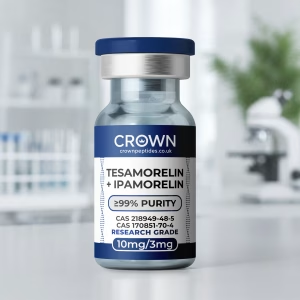
Tesamorelin + Ipamorelin (Blend)
From £79.99
HPLC and MS verified · same-day UK dispatch before 2pm
View Tesamorelin + Ipamorelin (Blend) ›Tesamorelin + Ipamorelin vs CJC-1295 (No DAC) + Ipamorelin
Both blends share the same ghrelin-receptor half. The difference lies entirely in the GHRH half, and it is bigger than the names suggest.
Length: 44 residues against 29
GHRH's first 29 amino acids carry most of its activity, so many analogues are built on that fragment. CJC-1295 is a 29-residue chain with four amino acid substitutions; the version that made its name carries an added group that binds blood albumin, and it was still present in rat plasma beyond 72 hours (PMID: 15817669). The CJC-1295 (No DAC) in our CJC-1295 (No DAC) + Ipamorelin (Blend) is that substituted 29-residue chain without the albumin-binding group. Tesamorelin keeps every one of GHRH's 44 residues and modifies only the first.
Protection: a cap against substitutions
The two analogues solve the DPP-4 problem differently. Tesamorelin caps its first amino acid with a hexenoyl group (PMID: 17214611), while CJC-1295 swaps in different amino acids, including a D-alanine at position 2, the spot where DPP-4 cuts. Unprotected GHRH, including the 29-residue fragment that Sermorelin is based on, is rapidly cut at the 2-3 bond in plasma (PMID: 2565342).
Evidence base
This is the clearest difference. Tesamorelin has randomised human trials, including a 412-person phase 3 study (PMID: 18057338). Most published CJC-1295 work, including the rat study that identified it, concerns the albumin-binding version, so the No DAC form has less direct data of its own. Neither blend has been studied as a combination. Our two-pathway CJC-1295 (No DAC) and Ipamorelin article covers that blend in depth, and Tesamorelin vs CJC-1295 compares the two GHRH analogues directly. The long-acting CJC-1295 (With DAC) is also in our range.
The Questions This Pairing Could Help Answer
Does full-length GHRH synergise like the fragments do? The classic synergy studies used native GHRH or short fragments. Whether a protected 44-residue analogue produces the same amplification with a selective partner like Ipamorelin is a clean, testable question.
How is the combined pulse shaped? In separate studies of different designs, Ipamorelin produced a single, short episode of release and tesamorelin lifted natural pulses and background secretion. Measuring the shape of the combined signal over time would show whether the two halves add up, overlap or reshape each other.
Does selectivity survive the pairing? Ghrelin and GHRH were synergistic for growth hormone but not for ACTH or prolactin. Whether the same clean profile holds for Ipamorelin with tesamorelin has not been measured.
How does repeated exposure play out? Each receptor desensitises to its own agonist rather than the other's, yet the hexarelin-GHRH synergy faded on repeat. Mapping that pattern for this pair would be valuable for the whole field.
Where does visceral fat fit? The Mayo work linked smaller synergy with more visceral fat, and tesamorelin is the GHRH analogue with the deepest visceral fat research. That overlap invites careful study.
How stable are two peptides in one vial? A 44-residue chain and a five-residue chain have very different chemistry, which makes long-term analytical work on the pair worthwhile.
The Technical Breakdown: Sequences, Signalling and Pharmacology
This section is for readers who want the molecular detail. Everything above makes sense without it.
Tesamorelin's structure
Tesamorelin is human GHRH(1-44)-NH2 with a trans-3-hexenoyl group on Tyr1 (PMID: 17214611): trans-3-hexenoyl-Tyr-Ala-Asp-Ala-Ile-Phe-Thr-Asn-Ser-Tyr-Arg-Lys-Val-Leu-Gly-Gln-Leu-Ser-Ala-Arg-Lys-Leu-Leu-Gln-Asp-Ile-Met-Ser-Arg-Gln-Gln-Gly-Glu-Ser-Asn-Gln-Glu-Arg-Gly-Ala-Arg-Ala-Arg-Leu-NH2. Its formula, C221H366N72O67S, gives a molecular weight of about 5,136 g/mol (PubChem). The single sulphur atom belongs to methionine at position 27.
Ipamorelin's structure
Ipamorelin is Aib-His-D-2-Nal-D-Phe-Lys-NH2 (PMID: 9849822), C38H49N9O5, 711.9 g/mol (PubChem). Aib is aminoisobutyric acid, an unnatural residue, and D-2-Nal is the mirror-image form of 2-naphthylalanine. It emerged from a series of compounds lacking the central Ala-Trp dipeptide of GHRP-1, and receptor-antagonist profiling confirmed it acts through the GHRP-type receptor.
Two signalling routes
The GHRH receptor is coupled to cyclic AMP. GHS-R1a acts through a separate, calcium-based route. In rat pituitary cells, the GHRP-6 route left cyclic AMP unchanged on its own but potentiated the GHRH-induced rise, and a GHRH receptor antagonist did not block GHRP-6 (PMID: 2541999). GHRP effects are only blunted by inhibitory signals, including somatostatin, that almost abolish the effect of GHRH (PMID: 9186261).
Pharmacokinetic notes
A population analysis of tesamorelin in 38 people with HIV and healthy subjects fitted a one-compartment model, with plasma clearance estimated at 1,060 litres per hour and volume of distribution at 200 litres; age, body size, race and health status did not predict its kinetics (PMID: 25358450). Ipamorelin's human terminal half-life was about 2 hours, with clearance of 0.078 litres per hour per kilogram (PMID: 10496658). These are figures for each compound on its own; no interaction data exist for the pair.
Anti-doping status
Both compounds are named on the World Anti-Doping Agency Prohibited List under section S2: tesamorelin among GHRH analogues and Ipamorelin among growth hormone secretagogues (Finnish Center for Integrity in Sports, 2026 list).
Why Verified Testing Matters for a Two-Peptide Vial
A blend doubles the testing challenge, because the two peptides could hardly be more different. Tesamorelin is a 44-residue chain built in more than 40 coupling steps, where a chain missing one amino acid can sit very close to the real thing on an HPLC trace, and the hexenoyl cap must be present. Its methionine can oxidise, adding 16 mass units. Ipamorelin is tiny but contains Aib and two D-amino acids, and a wrong mirror-image form at one position would have the same mass but different pharmacology. Mass spectrometry tells the two apart easily, at roughly 5,136 and 712 g/mol, and HPLC separates the two peptides and shows the purity of each.
What every Crown Peptides batch comes with
Every batch is tested before it is sold. HPLC (high-performance liquid chromatography) measures purity by separating the target peptides from related impurities, and mass spectrometry confirms identity by weighing each molecule. Results are published as a batch-specific certificate of analysis on our Lab Reports page, and the batch number on every vial links it to that certificate. Our guide to reading a peptide certificate of analysis explains each figure.
Stored, packed and dispatched properly
The blend is supplied as a lyophilised (freeze-dried) powder, the most stable form for two peptides sharing one vial. Vials are kept cold, sealed and away from light and moisture, which helps protect tesamorelin's methionine from oxidation. Full guidance is on our storage information page. Orders placed before 2pm on a weekday leave our UK base the same day, and UK delivery is free on orders over £100.
A UK company you can talk to
Crown Peptides is based in the UK. We usually reply to enquiries within 24 hours on business days, and WhatsApp is there for quicker replies. If you have a question about a batch, a certificate or a compound, contact us.
Related Compounds Worth Knowing About
The blend sits in a family of growth hormone peptides that reach the pituitary through one receptor or the other. These are its closest relatives in our range.
Tesamorelin
Tesamorelin on its own is the GHRH half of this blend, with one of the deepest human trial records of any GHRH analogue. Studying it alone is the natural control for any two-pathway experiment.
Ipamorelin
Ipamorelin is the selective ghrelin-receptor half: in the original pig studies it released growth hormone without the cortisol rise seen with older GHRPs.
CJC-1295 (No DAC) + Ipamorelin (Blend)
CJC-1295 (No DAC) + Ipamorelin (Blend) pairs the same ghrelin-receptor half with a substituted 29-residue GHRH analogue, making it the closest comparison blend.
Sermorelin
Sermorelin is the unprotected 29-residue GHRH fragment, a useful benchmark for what tesamorelin's full length and hexenoyl cap add.
GHRP-2
GHRP-2 is a potent ghrelin-receptor peptide, and the partner in the GHRH plus GHRP-2 infusion studies described above.
Hexarelin Acetate
Hexarelin Acetate was the ghrelin-receptor partner in the London GHRH synergy study, and it also binds the cardiac receptor CD36.
Browse the whole family, including the Tesamorelin + Ipamorelin (Blend) itself, in our Endocrine & Hormonal research peptides category, or read how combinations like this one are designed and tested in our guide to peptide stacking in research.
Common Questions About Tesamorelin + Ipamorelin
What is the Tesamorelin + Ipamorelin blend?
It is a single vial containing two growth hormone peptides: tesamorelin, a protected full-length GHRH analogue that acts on the GHRH receptor, and Ipamorelin, a selective agonist of the ghrelin receptor. The two receptors sit on the same growth hormone-producing pituitary cells.
Have tesamorelin and Ipamorelin been studied together?
No. As of 26 October 2026, PubMed held no published experiment testing the two together, and ClinicalTrials.gov listed no trial of the pair. The synergy evidence comes from GHRH combined with GHRP-6, GHRP-2, hexarelin and ghrelin.
Why combine a GHRH analogue with a ghrelin-receptor agonist?
Because the two receptor systems amplify each other. In healthy adults, GHRH plus GHRP-6 released almost twice as much growth hormone as the sum of each alone, and similar synergy has been shown with hexarelin, GHRP-2 and ghrelin.
How is it different from CJC-1295 (No DAC) + Ipamorelin?
The ghrelin-receptor half is the same. The GHRH half differs: tesamorelin keeps all 44 residues of human GHRH with a protective hexenoyl cap and has phase 3 human trial data, while CJC-1295 (No DAC) is a 29-residue chain with four substitutions and less direct published data of its own.
Is Tesamorelin + Ipamorelin legal in the UK?
Neither compound is a controlled drug under the Misuse of Drugs Act, so both can be bought legally in the UK for research. Tesamorelin is licensed in the United States as Egrifta, but its European marketing application was withdrawn in 2012, according to the European Medicines Agency (EMA). Ipamorelin has never been licensed as a medicine. Our guide are peptides legal in the UK explains the rules.
Can I buy the Tesamorelin + Ipamorelin blend in the UK?
Yes. Crown Peptides supplies Tesamorelin + Ipamorelin (Blend) as a single vial containing Tesamorelin 10mg and Ipamorelin 3mg, within our Endocrine & Hormonal research peptides category, with every batch HPLC and mass spectrometry tested and its certificate published. Both compounds are also available on their own as Tesamorelin Research Peptide and Ipamorelin Research Peptide.
How should the blend be stored?
As a freeze-dried powder, kept cold, sealed, dry and away from light.
Two Signals, One Cell, and an Experiment Still Waiting to Be Run
For more than thirty years, researchers who have sent a GHRH signal and a ghrelin-receptor signal to the pituitary at the same moment have found the cell answering with more than the two signals should add up to. Synergy showed up in a dish of rat pituitary cells and in healthy men, with GHRP-6, GHRP-2, hexarelin and ghrelin itself. The combined signal stayed strong in people aged 75 to 96 and doubled again overnight in intensive care.
Tesamorelin and Ipamorelin are arguably the most refined members of their two families: the complete natural hormone with a tiny protective cap, and the ghrelin-receptor agonist that releases growth hormone and little else. What they do together is a question still waiting for its first careful study.
If your work sits at the meeting point of the two growth hormone pathways, the Tesamorelin + Ipamorelin (Blend) is one of the most interesting tools in our Endocrine & Hormonal research peptides range, alongside Tesamorelin and Ipamorelin on their own, every batch HPLC and mass spectrometry verified, with its certificate published in full.
References
- Popovic V, Damjanovic S, Micic D, et al. Blocked growth hormone-releasing peptide (GHRP-6)-induced GH secretion and absence of the synergic action of GHRP-6 plus GH-releasing hormone in patients with hypothalamopituitary disconnection: evidence that GHRP-6 main action is exerted at the hypothalamic level. J Clin Endocrinol Metab. 1995;80:942-7. PMID: 7883854
- Cheng K, Chan WW, Barreto A Jr, et al. The synergistic effects of His-D-Trp-Ala-Trp-D-Phe-Lys-NH2 on growth hormone (GH)-releasing factor-stimulated GH release and intracellular adenosine 3',5'-monophosphate accumulation in rat primary pituitary cell culture. Endocrinology. 1989;124:2791-8. PMID: 2541999
- Bowers CY, Reynolds GA, Durham D, et al. Growth hormone (GH)-releasing peptide stimulates GH release in normal men and acts synergistically with GH-releasing hormone. J Clin Endocrinol Metab. 1990;70:975-82. PMID: 2108187
- Howard AD, Feighner SD, Cully DF, et al. A receptor in pituitary and hypothalamus that functions in growth hormone release. Science. 1996;273:974-7. PMID: 8688086
- Kojima M, Hosoda H, Date Y, et al. Ghrelin is a growth-hormone-releasing acylated peptide from stomach. Nature. 1999;402:656-60. PMID: 10604470
- Hataya Y, Akamizu T, Takaya K, et al. A low dose of ghrelin stimulates growth hormone (GH) release synergistically with GH-releasing hormone in humans. J Clin Endocrinol Metab. 2001;86:4552. PMID: 11549707
- Frohman LA, Downs TR, Heimer EP, et al. Dipeptidylpeptidase IV and trypsin-like enzymatic degradation of human growth hormone-releasing hormone in plasma. J Clin Invest. 1989;83:1533-40. PMID: 2565342
- Barlier A, Zamora AJ, Grino M, et al. Expression of functional growth hormone secretagogue receptors in human pituitary adenomas: polymerase chain reaction, triple in-situ hybridization and cell culture studies. J Neuroendocrinol. 1999;11:491-502. PMID: 10444306
- Ghigo E, Arvat E, Muccioli G, et al. Growth hormone-releasing peptides. Eur J Endocrinol. 1997;136:445-60. PMID: 9186261
- Massoud AF, Hindmarsh PC, Matthews DR, et al. The effect of repeated administration of hexarelin, a growth hormone releasing peptide, and growth hormone releasing hormone on growth hormone responsivity. Clin Endocrinol (Oxf). 1996;44:555-62. PMID: 8762732
- Gobburu JV, Agersø H, Jusko WJ, et al. Pharmacokinetic-pharmacodynamic modeling of ipamorelin, a growth hormone releasing peptide, in human volunteers. Pharm Res. 1999;16:1412-6. PMID: 10496658
- Stanley TL, Chen CY, Branch KL, et al. Effects of a growth hormone-releasing hormone analog on endogenous GH pulsatility and insulin sensitivity in healthy men. J Clin Endocrinol Metab. 2011;96:150-8. PMID: 20943777
- Raun K, Hansen BS, Johansen NL, et al. Ipamorelin, the first selective growth hormone secretagogue. Eur J Endocrinol. 1998;139:552-61. PMID: 9849822
- Popovic V, Leal A, Micic D, et al. GH-releasing hormone and GH-releasing peptide-6 for diagnostic testing in GH-deficient adults. Lancet. 2000;356:1137-42. PMID: 11030292
- Micic D, Popovic V, Doknic M, et al. Preserved growth hormone (GH) secretion in aged and very old subjects after testing with the combined stimulus GH-releasing hormone plus GH-releasing hexapeptide-6. J Clin Endocrinol Metab. 1998;83:2569-72. PMID: 9661645
- Van den Berghe G, de Zegher F, Veldhuis JD, et al. The somatotropic axis in critical illness: effect of continuous growth hormone (GH)-releasing hormone and GH-releasing peptide-2 infusion. J Clin Endocrinol Metab. 1997;82:590-9. PMID: 9024260
- Veldhuis JD, Bowers CY. Determinants of GH-releasing hormone and GH-releasing peptide synergy in men. Am J Physiol Endocrinol Metab. 2009;296:E1085-92. PMID: 19240251
- Ferdinandi ES, Brazeau P, High K, et al. Non-clinical pharmacology and safety evaluation of TH9507, a human growth hormone-releasing factor analogue. Basic Clin Pharmacol Toxicol. 2007;100:49-58. PMID: 17214611
- Falutz J, Allas S, Blot K, et al. Metabolic effects of a growth hormone-releasing factor in patients with HIV. N Engl J Med. 2007;357:2359-70. PMID: 18057338
- Johansen PB, Nowak J, Skjaerbaek C, et al. Ipamorelin, a new growth-hormone-releasing peptide, induces longitudinal bone growth in rats. Growth Horm IGF Res. 1999;9:106-13. PMID: 10373343
- Svensson J, Lall S, Dickson SL, et al. The GH secretagogues ipamorelin and GH-releasing peptide-6 increase bone mineral content in adult female rats. J Endocrinol. 2000;165:569-77. PMID: 10828840
- Jetté L, Léger R, Thibaudeau K, et al. Human growth hormone-releasing factor (hGRF)1-29-albumin bioconjugates activate the GRF receptor on the anterior pituitary in rats: identification of CJC-1295 as a long-lasting GRF analog. Endocrinology. 2005;146:3052-8. PMID: 15817669
- González-Sales M, Barrière O, Tremblay PO, et al. Population pharmacokinetic analysis of tesamorelin in HIV-infected patients and healthy subjects. Clin Pharmacokinet. 2015;54:285-94. PMID: 25358450
- Finnish Center for Integrity in Sports (SUEK). Doping agent classes and substances 2026 (WADA Prohibited List). List
- European Medicines Agency. Egrifta (tesamorelin): withdrawal of the marketing authorisation application. EMA