

Research guide
CJC-1295 (No DAC) + Ipamorelin: The Two-Pathway Approach to Growth Hormone Research
Two receptors, two pathways, one growth-hormone axis. Why CJC-1295 without DAC and Ipamorelin are studied together, and what the combination is meant to achieve.
Imagine a building with two front doors. You could knock on one and wait for someone to answer, or you could knock on both at once and have two people rushing to open up. The pituitary cells that release growth hormone are built exactly like that: two separate receptors, two separate signalling systems, one shared exit. CJC-1295 without DAC knocks on one door. Ipamorelin knocks on the other. Knock on both together, and research has long shown the response can be greater than either alone.
That simple idea is why this pairing has become one of the most widely studied combinations in growth hormone research. This guide explains the two pathways, the science behind combining them, what makes each of these particular compounds suited to the job, the surprising finding about where the synergy actually comes from, and how researchers use the blend. Crown Peptides supplies the CJC-1295 (No DAC) + Ipamorelin (Blend) for laboratory research use only.
The Growth Hormone System in Plain English
Growth hormone is made and stored in specialised cells in the front part of the pituitary gland, called somatotrophs. These cells do not release growth hormone steadily. They release it in bursts, most prominently during deep sleep, controlled by three main signals.
The first “go” signal: GHRH
Growth hormone releasing hormone, or GHRH, comes from the hypothalamus, just above the pituitary. It binds the GHRH receptor on somatotrophs and tells them to release growth hormone. It also supports the production of new growth hormone and the health of the cells themselves.
The second “go” signal: ghrelin
Ghrelin, a hormone made mainly in the stomach and best known for signalling hunger, binds a completely different receptor, the growth hormone secretagogue receptor, on the same cells. It also acts in the hypothalamus. It is a second, independent route to growth hormone release.
The brake: somatostatin
Somatostatin, also from the hypothalamus, suppresses growth hormone release. Growth hormone and its downstream partner IGF-1 feed back to raise somatostatin, keeping the whole system in balance. The natural pulses of growth hormone are thought to arise from a rhythmic dance between rising GHRH and falling somatostatin.
With that picture in mind, the logic of the blend becomes obvious. CJC-1295 without DAC mimics the first “go” signal. Ipamorelin mimics the second. Together, they engage both.
Half One: CJC-1295 Without DAC
CJC-1295 without DAC, also called modified GRF(1-29) or Mod GRF 1-29, is a synthetic version of the active portion of GHRH.
From natural hormone to tougher analogue
Natural GHRH is 44 amino acids long, but its first 29 amino acids carry essentially all of its activity. That fragment is the basis of Sermorelin, once an FDA-approved paediatric medicine. The trouble with the natural fragment is that an enzyme called DPP-4 destroys it within minutes by clipping off its first two amino acids.
CJC-1295 without DAC solves that with four amino acid substitutions: a D-alanine at position 2, glutamine at position 8, alanine at position 15 and leucine at position 27. The D-alanine, a mirror-image form of the natural amino acid, blocks DPP-4, while the others protect against further breakdown. The result is a GHRH analogue that lasts considerably longer than natural GHRH but still acts over a short window, typically described as around half an hour.
Why “no DAC” matters here
CJC-1295 also exists in a DAC form, with an extra chemical hook that binds permanently to albumin in the blood and stretches its action to about a week. That version was developed by the Canadian company ConjuChem and characterised in a 2005 Endocrinology study by Jetté and colleagues (PMID: 15817669). In human studies, it raised growth hormone for six days or more after a single injection (PMID: 16352683).
For a combination with Ipamorelin, that week-long signal is the wrong shape. Ipamorelin acts briefly. Pairing it with a GHRH signal that also acts briefly produces a coordinated burst, much closer to the body’s natural pattern, which is why the blend uses the no-DAC form. Our article CJC-1295 with DAC vs without DAC explains the difference in detail.
- Classification
- Research blend combining a short-acting GHRH analogue with Ipamorelin
- Available strength
- 5mg+5mg
Half Two: Ipamorelin
Ipamorelin is a five-building-block peptide that acts on the ghrelin receptor. It was developed by Novo Nordisk in Denmark and introduced in 1998.
Designed for selectivity
Earlier ghrelin receptor agonists such as GHRP-2 and GHRP-6 released growth hormone powerfully but also raised ACTH and cortisol, the body’s stress hormones. Ipamorelin was designed to avoid that. In the 1998 paper in the European Journal of Endocrinology by Raun and colleagues, Ipamorelin released growth hormone with potency similar to GHRP-6, but, unlike GHRP-2 and GHRP-6, it did not raise ACTH or cortisol significantly, even at amounts more than 200 times those needed for growth hormone release (PMID: 9849822). None of the compounds tested affected FSH, LH, prolactin or TSH. The authors called it the first selective growth hormone secretagogue.
A clean, short pulse
In healthy volunteers, a 1999 pharmacokinetic study in Pharmaceutical Research found that Ipamorelin had a terminal half-life of about two hours and produced a single episode of growth hormone release peaking around 40 minutes after infusion, then declining back to baseline (PMID: 10496658). A single clean pulse is exactly the kind of signal that pairs naturally with a short-acting GHRH analogue.
For Ipamorelin’s full story, see our Ipamorelin research guide.
Why Two Pathways Beat One
The central scientific idea behind this blend is synergy: two signals producing a combined effect greater than the sum of their parts.
What the research established
The synergy between GHRH and growth hormone releasing peptides was one of the defining findings of GHRP research in the 1980s and 1990s. A 1998 review in Frontiers in Neuroendocrinology by Camanni, Ghigo and Arvat, summarising more than a decade of work, stated that the growth hormone releasing activity of GHRPs is synergistic with that of GHRH (PMID: 9465289). The review also noted that GHRPs act at both the pituitary and the hypothalamus, possibly involving factors beyond GHRH and somatostatin, and that their effect is reproducible across several routes of administration.
The surprising part: where the synergy happens
You might assume that synergy simply happens inside the pituitary cell, with two receptors boosting each other. Research suggests the picture is more interesting than that. In a 1998 study in the Journal of Clinical Endocrinology and Metabolism, Shimon, Melmed and colleagues at Cedars-Sinai studied human fetal pituitary cells grown in the laboratory (PMID: 9435437). GHRP-6 increased growth hormone release by up to 80% and GHRH by up to 120%. Together, their effect was additive, up to 2.8-fold, but with no further synergy.
That finding is important. If the two signals are merely additive at the level of the isolated pituitary cell, the extra boost seen in living animals and people must come largely from somewhere else, most likely the hypothalamus. Ghrelin receptor agonists are known to act there too, increasing the brain’s own GHRH release and reducing somatostatin, the brake. So when Ipamorelin and a GHRH analogue work together in a whole organism, Ipamorelin is not only knocking on the second door; it is also helping to open the first door wider and easing off the brake. The full synergy is a systems effect, not just a cellular one. It is also a reminder that results from cells in a dish and results from whole animals can differ for very good reasons, and that both kinds of study are needed to understand how a combination really works.
Two internal wiring systems
Inside the somatotroph, the two receptors also use different signalling routes. The GHRH receptor works mainly through cyclic AMP, while the ghrelin receptor works mainly through calcium release. Because they converge on the final release machinery by different paths, their signals combine rather than compete, which contributes to the additive effect seen even at the cellular level.
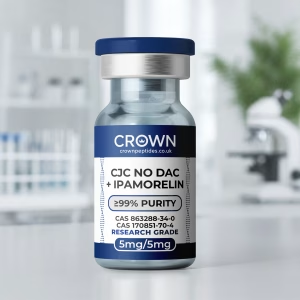
CJC-1295 (No DAC) + Ipamorelin (Blend)
HPLC and MS verified · batch certificate published · dispatched from the UK before 2pm
The Pulse Is the Point
Much of the appeal of this combination comes from what it preserves: the natural rhythm of growth hormone release.
Why rhythm matters
Growth hormone is naturally released in pulses. A 1992 study in the Journal of Clinical Endocrinology and Metabolism by Van Cauter, Thorner and colleagues quantified growth hormone secretion across the day and night in healthy men and examined its relationship with sleep and time of day, reinforcing the importance of sleep-associated pulses in normal secretion (PMID: 1592892). In animal research, the pattern of growth hormone release, pulsed versus continuous, can by itself change which genes are active in tissues such as the liver.
How the blend respects it
Both components of the blend act over short windows. Together, they produce a coordinated burst that then fades, rather than a sustained elevation. Both also work within the body’s feedback loops: they can only push a pituitary that is able to respond, within the limits set by somatostatin and IGF-1 feedback. That is a fundamental difference from supplying growth hormone directly, and it is why this pairing is regarded as a physiological tool for studying the growth hormone axis.
A Short History of Combining the Two Pathways
The two-pathway idea did not begin with this blend. It grew out of the GHRP story itself.
A receptor without a name
In the late 1970s, the American endocrinologist Cyril Bowers found that certain synthetic peptides, derived from fragments of met-enkephalin, released growth hormone without acting on the GHRH receptor. Over the following decade his work produced GHRP-6 and later GHRP-1 and GHRP-2. At the time, nobody knew what receptor they used. When researchers combined these peptides with GHRH in animals and people, the growth hormone response was strikingly larger than with either alone, a clear sign that two separate systems were involved.
From observation to explanation
The 1998 Frontiers in Neuroendocrinology review captured the state of knowledge at the end of that era: GHRPs had no structural resemblance to GHRH, acted through their own specific receptors at both the pituitary and hypothalamus, and worked synergistically with GHRH. The review also pointed out that the existence of a GHRP receptor strongly suggested a natural hormone that fitted it, which had not yet been found. Ghrelin was discovered in Japan the following year, finally explaining what the second door was for.
Refining both halves
Once the logic of combination was established, the next step was improving each half. On the GHRH side, researchers modified the 29-amino-acid fragment to resist breakdown, producing CJC-1295. On the ghrelin side, Novo Nordisk engineered Ipamorelin to strip away the stress hormone effects of earlier GHRPs. The blend is, in effect, the refined version of a combination that researchers have been studying for four decades.
How Age Changes the Picture
The growth hormone system does not stay the same across life, and that shapes how researchers think about the two pathways.
The rise and fall of responsiveness
The same 1998 review noted that the growth hormone response to GHRPs is the same in both sexes but changes with age: it increases from birth to puberty and then decreases with ageing. Natural growth hormone secretion follows a broadly similar arc, peaking around puberty and declining through adulthood, a change sometimes called the somatopause.
Why two signals may matter more with age
Part of the age-related decline is thought to come from the hypothalamus rather than the pituitary itself: less GHRH drive and more somatostatin brake. Because ghrelin receptor agonists act at the hypothalamus as well as the pituitary, and because the review found GHRP activity to be relatively resistant to many of the inhibitory influences that suppress GHRH, the two-pathway approach is of particular interest in research on the ageing growth hormone axis.
What Ipamorelin research adds
Ipamorelin itself has been studied in animal models relevant to ageing tissues. In adult female rats, it increased longitudinal bone growth, and in rats given high-dose glucocorticoids, it counteracted the fall in muscle strength and bone formation, producing a four-fold higher rate of bone formation compared with the glucocorticoid alone (PMID: 11735244). Findings like these help explain why researchers interested in musculoskeletal ageing often include the ghrelin pathway in their designs.
Why This Specific Pairing Became a Research Standard
Many combinations of GHRH analogues and ghrelin receptor agonists are possible. This one became the most popular for clear reasons.
Matched timing
Both act briefly, so their effects overlap neatly in time.
Selectivity
Ipamorelin’s lack of meaningful ACTH and cortisol release keeps the stress hormone system out of the picture, so any observed effect is more cleanly attributable to growth hormone signalling. Pairing a GHRH analogue with GHRP-2 or GHRP-6 instead would bring those extra hormonal effects along.
Durability
CJC-1295 without DAC is tougher than natural GHRH or Sermorelin, thanks to its four substitutions, making it a more practical partner in experiments where the signal needs to survive long enough to be measured reliably.
Two independent entry points
Because each targets a different receptor, researchers can study each pathway alone and then together, cleanly separating their contributions.
Designing Research With the Blend
The combination lends itself to some particularly clean experimental designs.
The four-arm comparison
The most informative design compares four conditions: control, GHRH analogue alone, ghrelin receptor agonist alone, and both together. That lets researchers measure each pathway’s contribution and quantify whether the combination is additive or synergistic in their model. Because Crown Peptides supplies Ipamorelin on its own as well as in the blend, all four arms can be built from matched material.
Timing of sampling
Because both components produce brief responses, growth hormone measurements need frequent sampling around the expected peak. Ipamorelin’s human pharmacokinetic data, with a peak around 40 minutes after infusion, give a useful reference point.
Downstream markers
Growth hormone itself is pulsatile and short-lived, so many studies also measure IGF-1, which integrates growth hormone activity over a longer period. Measuring both captures the immediate and the cumulative effects.
Model choice
The Shimon study shows why model choice matters: isolated pituitary cells capture only part of the interaction, while whole-animal models include the hypothalamic contribution that appears to drive much of the synergy.
Keep the batch constant
Because the blend contains two peptides in fixed proportions, using a single batch across a study, recording lot numbers and storing all vials identically removes a common hidden source of variation. It also makes it much easier to compare results between the single-compound and combined arms of a study.
The Technical Breakdown: Two Receptors, Two Cascades
This section describes the molecular signalling for readers who want it.
The GHRH receptor cascade
The GHRH receptor is a class B G protein-coupled receptor. When CJC-1295 binds, it activates a Gs protein, which switches on adenylyl cyclase to produce cyclic AMP. Cyclic AMP activates protein kinase A, which opens calcium channels in the cell membrane to trigger release of stored growth hormone, and activates the transcription factor CREB, which increases Pit-1 and growth hormone gene expression over the longer term.
The ghrelin receptor cascade
The ghrelin receptor, GHS-R1a, is a class A G protein-coupled receptor. When Ipamorelin binds, it mainly activates a Gq protein, which switches on phospholipase C. That generates IP3, releasing calcium from stores inside the cell, and diacylglycerol, activating protein kinase C. The receptor is also unusual for its high constitutive activity: it signals at a low level even without anything bound.
Where the cascades meet
Both pathways converge on a rise in intracellular calcium, the final trigger for fusion of growth hormone granules with the cell membrane. Calcium entering from outside, through the GHRH-driven route, and calcium released from internal stores, through the ghrelin-driven route, combine to produce a larger signal than either alone.
The hypothalamic amplifier
At the hypothalamus, ghrelin receptor activation increases GHRH neuron activity and appears to reduce somatostatin release. In a living system, that means an Ipamorelin signal both adds its own push at the pituitary and increases the brain’s own GHRH drive while easing the brake, which is the most likely explanation for why whole-organism responses exceed the additive effects seen in isolated pituitary cells.
Why Blend Quality Takes Extra Care
A two-peptide blend brings its own analytical demands. CJC-1295 without DAC is a 29-amino-acid peptide, long enough that deletion impurities differing by a single amino acid are a genuine consideration, and its D-alanine at position 2 must be correct for it to resist DPP-4. Ipamorelin contains unusual building blocks, including alpha-aminoisobutyric acid and two D-amino acids, whose stereochemistry must be right. Both components need to be present at their stated amounts, and each must be identified separately in analysis.
There is also a documented history of lookalikes: in 2018, anti-doping scientists in Cologne reported black market products containing a glycine-extended version of Ipamorelin with one extra amino acid, detectable only by mass spectrometry (PMID: 29864719).
The Crown Peptides standard
Every batch of the CJC-1295 (No DAC) + Ipamorelin (Blend) comes with a batch-specific certificate of analysis. HPLC separates and measures both components, and mass spectrometry confirms each one’s identity by molecular mass. Lot numbers on certificates match those on vial labels. Published certificates are on our Lab Reports page, and our guides to peptide testing and reading a certificate of analysis explain the methods.
Handling and arithmetic
The blend is supplied lyophilised and should be stored cold, dry and away from light. When reconstituting, remember that each component’s concentration is calculated separately from its own labelled amount. Our guides to peptide reconstitution, peptide half-life and the peptide calculator cover the practical side, and Bacteriostatic Water is available alongside. A multi-vial CJC-1295 (No DAC) + Ipamorelin 5mg/5mg x 5 vial bundle is also available for longer studies.
Related Compounds in the Growth Hormone Axis
The blend sits within a larger family of compounds acting at different points in the system.
Other GHRH analogues
Sermorelin is the unmodified GRF(1-29), CJC-1295 with DAC is the week-long version, and Tesamorelin keeps all 44 amino acids of GHRH with a protective group. See CJC-1295 vs Sermorelin and Tesamorelin vs Ipamorelin.
Other ghrelin receptor agonists
GHRP-2 is the most potent of the classic GHRPs and a diagnostic agent in Japan, while GHRP-6 is known for a strong appetite effect. See Ipamorelin vs GHRP-2 and GHRP-2 vs GHRP-6.
Downstream
IGF-1 LR3 lets researchers study the downstream hormone directly. Browse the full group in our endocrine and hormonal research peptides category.
Read the certificate before you order
Every batch is published openly — identity by mass spectrometry, purity by HPLC, and the batch number printed on the vial you receive.
Open the COA libraryCJC-1295 + Ipamorelin Questions, Answered
Why combine CJC-1295 and Ipamorelin?
Because they act on two different receptors that both trigger growth hormone release, through different internal signalling routes. Research on growth hormone releasing peptides has established that their activity is synergistic with GHRH.
Why use the no-DAC version in the blend?
Because it acts over a short window that matches Ipamorelin’s, producing a coordinated burst. The DAC version lasts about a week, which does not pair naturally with a short-acting partner.
Why Ipamorelin rather than GHRP-2 or GHRP-6?
Because Ipamorelin was designed to release growth hormone without significantly raising ACTH and cortisol, keeping the stress hormone system out of the results.
Is the synergy happening in the pituitary?
Only partly. In isolated human fetal pituitary cells, GHRH and a GHRP were additive but not synergistic, suggesting much of the extra boost in living systems comes from the hypothalamus, where ghrelin receptor agonists increase GHRH release and reduce somatostatin.
Does the blend affect appetite?
Ipamorelin acts at the ghrelin receptor, the same receptor as the hunger hormone, so appetite signalling is part of its biology. It was designed for selectivity towards growth hormone release, and its appetite effects are generally described as less prominent than those of GHRP-6.
How long does the combined effect last?
Both components act briefly. Ipamorelin had a half-life of about two hours in human pharmacokinetic work, with growth hormone peaking around 40 minutes, and CJC-1295 without DAC acts over a similarly short window, so the combined response is a burst rather than a sustained rise.
Does the blend replace natural growth hormone release?
No. Both components work through the body’s own release machinery and within its feedback loops, producing pulses of the body’s own growth hormone rather than supplying the hormone directly.
Two Doors, One Coordinated Signal
The CJC-1295 (No DAC) + Ipamorelin blend is built on one of the oldest and best-established ideas in growth hormone research: that the pituitary listens to two different “go” signals, and that the system responds most strongly when both arrive together. One component is a toughened copy of the brain’s own GHRH, kept short-acting on purpose. The other is a precision-engineered ghrelin mimic, designed to release growth hormone without dragging the stress hormones along. Together they open both doors, ease off the brake and produce a coordinated pulse that respects the body’s own rhythm.
For researchers, that makes the blend one of the cleanest tools available for studying how the growth hormone system integrates its signals. Explore the CJC-1295 (No DAC) + Ipamorelin (Blend) from Crown Peptides, every batch HPLC and mass spectrometry verified and dispatched from the UK.
Working with CJC-1295 (No DAC) + Ipamorelin (Blend)
Batch-tested material, published certificates, and same-day dispatch on orders placed before 2pm.
See CJC-1295 (No DAC) + Ipamorelin (Blend)