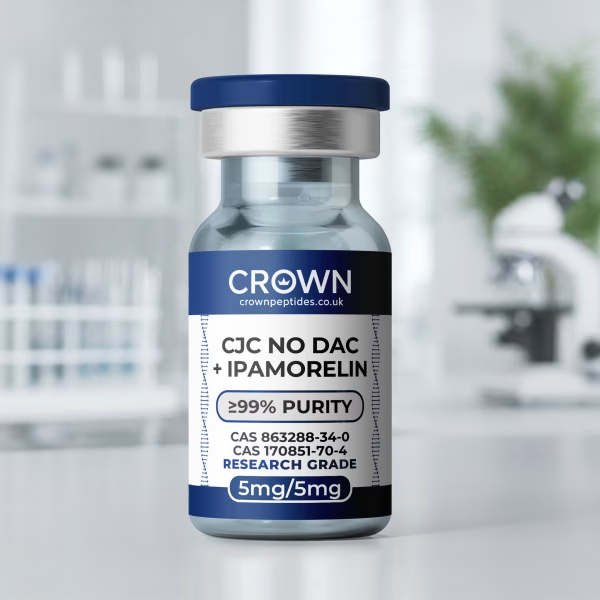
CJC-1295 (No DAC) + Ipamorelin (Blend)
A high-purity research blend studied in growth-hormone research.
In stock
Supplied for laboratory research purposes only — not for human consumption or for medical, veterinary or diagnostic use.
Product Overview
CJC-1295 + Ipamorelin blend UK is Crown Peptides' research blend combining a short-acting GHRH analogue with Ipamorelin, available in 5mg+5mg strength for laboratory research.
- Studied in research involving GHRH receptor signalling
- Studied in research involving ghrelin/GHSR receptor biology
- Studied in research involving growth-hormone secretagogue pathways
- Studied in research involving combined endocrine-signalling models
- Batch-specific quality documentation available
About CJC-1295 + Ipamorelin Blend UK
This blend combines CJC-1295 No DAC, a short-acting GHRH analogue, with Ipamorelin, a selective growth-hormone secretagogue that acts through the ghrelin/GHSR pathway. The pairing is of research interest because the two components engage distinct upstream signalling systems involved in growth-hormone release, alongside related GHRH-axis peptides such as CJC-1295 with DAC.
Also known as: CJC 1295 Ipamorelin, CJC1295 Ipamorelin, Mod GRF 1-29 + Ipamorelin.
CJC-1295 + Ipamorelin Blend Research
Laboratory research on the individual components examines complementary endocrine pathways. CJC-1295 No DAC is associated with GHRH-receptor signalling and pituitary response, while Ipamorelin is studied as the first selective growth-hormone secretagogue (Learn more) acting through the growth-hormone secretagogue receptor. Combined experimental models can therefore examine interactions between GHRH and ghrelin-receptor signalling.
- GHRH receptor signalling
- Ghrelin/GHSR receptor biology
- Growth-hormone secretagogue pathways
- Combined endocrine-signalling models
Two receptors, one pituitary: GHRH and ghrelin signals combined
The somatotroph cells of the anterior pituitary, which make growth hormone, carry two very different receptors, and this blend is built to reach both. The GHRH receptor, the target of the CJC-1295 No DAC component, is coupled to the Gs protein and raises cyclic AMP inside the cell, driving GH release and fresh GH production. The growth-hormone secretagogue receptor, GHSR-1a, the target of Ipamorelin, signals mainly through Gq, phospholipase C and a surge of intracellular calcium. The GHSR also works one level up, in the hypothalamus, where ghrelin-receptor agonists appear to counter the braking effect of somatostatin.
Using both at once has a long pedigree. In 1990, Bowers and colleagues reported in the Journal of Clinical Endocrinology & Metabolism that the hexapeptide GHRP-6 and GHRH(1-44), given together to normal men, released GH synergistically, more than either alone would predict, and concluded that the two act through independent systems (Learn more). The receptor behind that second system was cloned in 1996, and its natural ligand, ghrelin, was identified in 1999. Pairing a GHRH analogue with a ghrelin-receptor agonist in one vial is a direct way to model that cooperation in a single experiment.
Mod GRF 1-29: what No DAC really means
The naming here trips up a lot of people. The CJC component in this blend is tetrasubstituted GRF(1-29), better known as Modified GRF 1-29 or Mod GRF 1-29. It starts from the first 29 amino acids of human GHRH, the same fragment as Sermorelin, and swaps four of them: D-alanine at position 2, glutamine at 8, alanine at 15 and leucine at 27. Each change targets a known weak spot. Position 2 is where dipeptidyl peptidase IV clips the native peptide, the original asparagine at 8 is prone to deamidation, the methionine at 27 is prone to oxidation, and alanine at 15 is associated with stronger receptor activity.
The name CJC-1295 first belonged to ConjuChem’s version of this peptide with one extra lysine carrying a maleimidopropionyl group, the Drug Affinity Complex, which latches on to albumin in the blood. In a human study by Teichman and colleagues, that albumin anchor kept GH raised for six days or more. Mod GRF 1-29 has no anchor, so its activity is measured in minutes rather than days and it delivers a short, pulse-like GHRH signal. For the long-acting version, see CJC-1295 with DAC.
Ipamorelin: the first selective growth-hormone secretagogue
Ipamorelin came out of Novo Nordisk and was described by Raun and colleagues in the European Journal of Endocrinology in 1998. It is a pentapeptide, Aib-His-D-2-Nal-D-Phe-Lys-NH2, built partly from amino acids that do not occur in natural proteins. Its predecessors, such as GHRP-6 and GHRP-2, were potent but untidy: alongside GH, they also raised ACTH and cortisol, the hormones of the stress axis.
Raun’s team tested Ipamorelin in rat pituitary cells, anaesthetised rats and conscious pigs. In pigs its potency was comparable to GHRP-6, yet ACTH and cortisol stayed at levels no different from those seen with GHRH, even when given at more than 200 times its ED50. The authors described it as the first GHRP-receptor agonist with a selectivity for GH release similar to GHRH itself. That clean profile is why Ipamorelin is the usual partner in GHRH combination models: the GH response can be studied with fewer hormonal side-signals muddying the data. There is more on our Ipamorelin page.
Ipamorelin in bone and gut research models
Two lines of animal work show how far Ipamorelin research has reached beyond the pituitary. In bone, a Novo Nordisk study in adult female rats found that 15 days of Ipamorelin increased the rate of longitudinal bone growth, with bigger effects at higher exposure, measured by tetracycline labelling of the tibia, without changing total IGF-I. A longer Swedish study gave adult female rats Ipamorelin or GHRP-6 continuously for 12 weeks and found higher bone mineral content on DXA scans, which closer analysis traced to larger bone dimensions rather than denser bone (Learn more).
The gut is the other branch, because ghrelin is a well-known stimulant of gastrointestinal movement. Ipamorelin was studied in a rodent model of postoperative ileus and then taken into a Phase II trial in 114 patients after bowel resection, reported by Beck and colleagues in the International Journal of Colorectal Disease. The median time to tolerating a solid meal was shorter in the Ipamorelin group, but the difference was not statistically significant, a useful reminder that promising rodent signals do not always carry through.
Specifications
- Product
- CJC-1295 No DAC + Ipamorelin (Blend)
- Classification
- Research blend combining a short-acting GHRH analogue with Ipamorelin
- Available strength
- 5mg+5mg
- Form
- Research material supplied according to product label
- Purity / assay
- 99% (HPLC), batch-specific; refer to Certificate of Analysis
- Verification
- HPLC and Mass Spectrometry where analytically appropriate
- Also known as
- CJC 1295 Ipamorelin, CJC1295 Ipamorelin, Mod GRF 1-29 + Ipamorelin
- Product Name
- CJC-1295 No DAC + Ipamorelin (Blend)
Purity and Testing
Crown Peptides CJC-1295 + Ipamorelin Blend is supplied for controlled laboratory research with batch-specific analytical documentation. High-Performance Liquid Chromatography (HPLC) can assess chromatographic purity, while Mass Spectrometry provides molecular information used to support identity verification.
The batch-specific Certificate of Analysis is the definitive source for the exact purity result, identity data and analytical specification of the material supplied.
Storage Conditions
- Store unreconstituted material at -20°C ± 5°C in a cool, dry environment
- Prepared research solutions should use validated storage conditions appropriate to the compound and study design
- Protect from unnecessary heat, direct light and repeated temperature fluctuations
Related Compounds
Researchers working with the CJC-1295 + Ipamorelin blend may also be interested in CJC-1295 with DAC, Ipamorelin, GHRP-6, Sermorelin and Tesamorelin — other growth-hormone-releasing peptides studied in the same endocrine research pathway.
CJC-1295 + Ipamorelin Blend Frequently Asked Questions
About CJC-1295 No DAC + Ipamorelin7 questions
What is in the CJC-1295 No DAC + Ipamorelin blend?
It combines a short-acting GHRH analogue with Ipamorelin, a ghrelin-receptor growth-hormone secretagogue, supplied by Crown Peptides at 5mg+5mg. Each vial therefore holds equal amounts by mass of Mod GRF 1-29 and Ipamorelin, 10mg of peptide in total. Searches for CJC 1295 Ipamorelin, CJC1295 Ipamorelin or Mod GRF 1-29 + Ipamorelin all lead to this same product.
Why are these peptides paired in research?
They engage different upstream endocrine pathways, allowing researchers to study interactions between GHRH-receptor and GHSR signalling. Earlier human work with GHRH and the related secretagogue GHRP-6 found the combined GH response was greater than either produced alone, and that synergy is what this pairing is designed to explore.
What does No DAC mean?
It indicates that the CJC component does not contain the Drug Affinity Complex used to prolong CJC-1295 with DAC‘s persistence. Without that albumin-binding group, the peptide acts for minutes rather than days.
Where does the name Mod GRF 1-29 come from?
It is short for Modified GRF 1-29: GRF being growth-hormone-releasing factor, and 1-29 the stretch of the hormone it is built on. The peptide was first described in the literature as tetrasubstituted GRF(1-29), after its four amino-acid swaps. “CJC-1295 No DAC” is a later, informal label that grew up because the DAC version was the one originally given the CJC-1295 code.
How is Ipamorelin different from GHRP-6?
Both act on the ghrelin receptor, but Ipamorelin is a five-residue peptide while GHRP-6 has six, and the two behave differently. In the original Novo Nordisk studies, GHRP-6 raised ACTH and cortisol alongside GH, whereas Ipamorelin did not. GHRP-6 remains useful when a broader ghrelin-receptor response is wanted.
Was Ipamorelin developed before ghrelin was discovered?
It was. Ipamorelin was published in 1998, two years after its target receptor was cloned and one year before Japanese researchers identified ghrelin as that receptor’s natural ligand. Like the GHRPs before it, Ipamorelin was designed against a receptor whose own hormone was still unknown.
Has Ipamorelin been studied in people?
Its best-known human study came from gut research rather than endocrinology. A Phase II trial in 114 patients recovering from bowel resection tested whether Ipamorelin shortened the time to tolerating a solid meal; the median time was shorter than with placebo, but the difference did not reach statistical significance.
Blend or single peptides4 questions
Why use the pre-mixed blend instead of two separate vials?
Consistency, mainly. The 1 : 1 ratio by mass is fixed at manufacture and stays the same from vial to vial, both peptides share one lot number, and there is a single reconstitution step instead of two. If your design needs to vary the ratio, separate peptides make more sense.
How does this blend differ from Tesamorelin?
Tesamorelin is a single molecule acting on one receptor: the full 44-residue GHRH chain with a protective cap. This blend uses a 29-residue GHRH analogue plus a second peptide acting on the ghrelin receptor, so it models two pathways at once. Tesamorelin suits work focused purely on the GHRH side.
Could CJC-1295 with DAC stand in for the No DAC component?
Only if the study is about sustained rather than pulse-like signalling. The DAC version binds albumin and keeps GH raised for days, which suits long-exposure designs; the Mod GRF 1-29 in this blend gives a brief, pulse-like signal that suits models built around the natural rhythm of GH release.
Is it worth ordering the blend by the five or ten?
There is just one fill, 5mg of each peptide per vial, so the only real choice is quantity. One vial is enough to trial a method. Boxes of five or ten make sense once a protocol is settled, because every vial in the box shares one batch and one Certificate of Analysis, keeping a run of experiments on matched material.
Structure & identity2 questions
Why do the two peptides in the blend separate so cleanly?
They are very different molecules. Mod GRF 1-29 is a 29-residue chain, C152H252N44O42 at about 3,368 g/mol by calculation from its sequence, while Ipamorelin is just five residues, C38H49N9O5 at about 712 g/mol. On HPLC they interact with the column differently and leave it at different times, so the chromatogram shows two distinct peaks.
The same gap helps mass spectrometry: with an almost five-fold difference in mass, each component gives its own clearly separate signal, so both identities can be confirmed from a single sample of the mixture. The batch-specific Certificate of Analysis records the results for the material supplied.
Why does Ipamorelin contain non-natural amino acids such as Aib and D-2-Nal?
They make the peptide tougher. Aib is aminoisobutyric acid and D-2-Nal is the D-form of 2-naphthylalanine; together with D-phenylalanine, they make Ipamorelin harder for protein-cutting enzymes to recognise than a peptide built only from natural L-amino acids. The same design thinking runs through the GHRP family it descends from.
Read the batch certificate before you order
Every batch is published openly — identity, purity and batch number, with no account needed.
View lab reports- Laboratory research only
- Not for human or clinical use
- Not for human or veterinary consumption
Supplied for laboratory research purposes only — not for human consumption or for medical, veterinary or diagnostic use.
Other Research Peptides
 Musculoskeletal researchBPC-157 + TB-500 Blend (Wolverine Stack)5mg / 5mg · 2 strengths ›