

RESEARCH USE DISCLAIMER
Crown Peptides supplies SNAP-8 as a laboratory research compound only. It is not approved by the FDA, MHRA or EMA for any use, and our products are not intended for human consumption and are not sold, marketed or labelled for the diagnosis, treatment, cure or prevention of any disease.
The short version
- Eight residues, catalogued as acetyl octapeptide-3.
- Mimics the N-terminal end of SNAP-25 and competes for a place in the SNARE complex.
- An extension of Argireline — two extra residues on the earlier hexapeptide.
- The widely quoted 63% wrinkle figure comes from manufacturer efficacy testing, not independent trials.
The Same Target as Botulinum Toxin, Approached Differently
Botulinum toxin works by cutting. It cleaves the SNARE proteins that synaptic vesicles need in order to fuse with the membrane and release acetylcholine, and without that release the muscle fibre never receives its instruction to contract.
SNAP-8 aims at the same machinery and does something quite different to it. Rather than destroying a component, it impersonates one. The peptide mimics the N-terminal end of SNAP-25 — one of the three proteins that assemble into the SNARE complex — and competes with the real thing for its position in that assembly. A complex built with the impostor in place is destabilised rather than destroyed, and a destabilised complex fuses vesicles less efficiently.
Cutting versus crowding out. The endpoint is a reduction in neurotransmitter release; the route there is not the same, and neither is the magnitude.
What the SNARE Complex Does
Every time a neuron signals a muscle, a vesicle full of neurotransmitter has to physically fuse with the cell membrane and empty its contents. That fusion is not spontaneous. It requires a set of proteins — the SNARE complex — to zip together and pull the vesicle against the membrane.
SNAP-25 is one of those proteins, and its N-terminal region is the part that has to slot into place for the complex to form properly. Occupy that slot with something the right shape but the wrong molecule, and the zip does not close cleanly.
This is the mechanism behind an entire class of what the cosmetic literature calls neurotransmitter-inhibiting peptides, of which SNAP-8 is one of the better-known members.
- Classification
- Synthetic acetylated octapeptide also known as Acetyl Octapeptide-3
- CAS Number
- 868844-74-0
- Molecular Weight
- approximately 1073.2 g/mol
- Molecular Formula
- C42H72N16O15S
SNAP-8 and Argireline
SNAP-8 did not appear from nowhere. It is an extension of Argireline — acetyl hexapeptide-3, also written acetyl hexapeptide-8 — which arrived around 2000 and became the most widely used peptide in topical anti-wrinkle formulation.
Argireline is six residues taken from the same SNAP-25 region. SNAP-8 adds two more, alanine and aspartate, extending the mimicked sequence. Both were developed by Lipotec, the Spanish biotechnology company now part of Lubrizol Life Science.
The manufacturer’s position is that the longer sequence binds more effectively, with in vitro and in vivo testing suggesting roughly 30% greater activity than the parent compound. The published Argireline work is more independent: a 2002 study in the International Journal of Cosmetic Science reported around a 30% reduction in wrinkle depth after 30 days of a 10% cream, against placebo.
Reading the 63% Figure Carefully
The number attached to SNAP-8 almost everywhere online is a reduction in wrinkle severity around the eyes of up to 63.13%. It is worth understanding exactly what that figure is before using it.
It originates from manufacturer efficacy testing rather than independent peer-reviewed trial publication, it is an upper bound rather than a mean, and the decimal places imply a precision that a wrinkle-depth measurement across a small cosmetic panel does not really support.
That does not make the mechanism wrong — the SNARE competition is well described and the peptide class is real. But there is a meaningful difference between a supplier’s efficacy data and a controlled trial, and anyone designing formulation research should treat that number as a starting hypothesis rather than an established result.
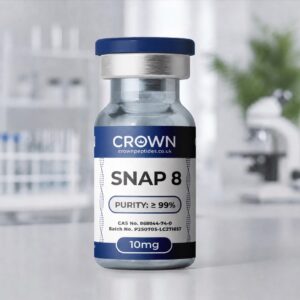
SNAP-8 Research Peptide
HPLC and MS verified · batch certificate published · dispatched from the UK before 2pm
Topical, Not Injectable
SNAP-8 is a topical ingredient. It is formulated into emulsions, gels and serums, typically at low percentages of the active, and the entire published and commercial literature concerns surface application.
This also raises the obvious mechanistic question the field has never fully resolved: how much of a peptide this size crosses the stratum corneum to reach a neuromuscular junction at all. Penetration is the weak point in the argument, and it applies to Argireline equally.
Current Limitations of the Evidence
The mechanism is well characterised at the molecular level. SNARE assembly is thoroughly studied biology, and competitive inhibition by a SNAP-25 mimetic is a coherent proposal.
The clinical evidence is thinner than the marketing suggests. Most figures trace back to manufacturer testing, panels are small, endpoints are surface topography measurements, and the independent literature is dominated by Argireline rather than SNAP-8 itself. Skin penetration remains an open question.
Read the certificate before you order
Every batch is published openly — identity by mass spectrometry, purity by HPLC, and the batch number printed on the vial you receive.
Open the COA libraryFrequently Asked Questions
Is SNAP-8 the same as acetyl octapeptide-3?
Yes. Acetyl octapeptide-3 is the cosmetic ingredient designation. SNAP-8 is a trade name originally registered by Lipotec.
How does SNAP-8 differ from Argireline?
Argireline is six residues; SNAP-8 is the same approach extended to eight, with alanine and aspartate added. Both mimic the N-terminal region of SNAP-25 and compete for the SNARE complex.
Is SNAP-8 the same as botulinum toxin?
No. Both reduce acetylcholine release, but botulinum toxin enzymatically cleaves SNARE proteins, while SNAP-8 competes for a position within the complex. The mechanisms and the magnitude of effect are not comparable.
How is SNAP-8 tested?
Every batch is analysed by HPLC for purity and mass spectrometry for identity, with the certificate published in full and the batch number printed on the vial.
References
- Blanes-Mira C. et al. A synthetic hexapeptide (Argireline) with anti-wrinkle activity. International Journal of Cosmetic Science, 2002; 24(5): 303-310.
- Lipotec / Lubrizol Life Science technical documentation for SNAP-8 (acetyl octapeptide-3).
- Reviews of neurotransmitter-inhibiting peptides in cosmetic science, covering SNARE complex modulation.
Working with SNAP-8 Research Peptide
Batch-tested material, published certificates, and same-day dispatch on orders placed before 2pm.
See SNAP-8 Research Peptide