

RESEARCH USE DISCLAIMER
Crown Peptides supplies AHK-Cu as a laboratory research compound only. It is not approved by the FDA, MHRA or EMA for any use, and our products are not intended for human consumption and are not sold, marketed or labelled for the diagnosis, treatment, cure or prevention of any disease.
The short version
- Ala-His-Lys bound to copper, also catalogued as copper tripeptide-3.
- One amino acid apart from GHK-Cu — alanine replaces glycine at the first position.
- Research concentrates on dermal papilla cells and hair follicle elongation rather than general tissue repair.
- The response is biphasic: effective at picomolar concentrations, inhibitory at higher ones.
What AHK-Cu Actually Is
AHK-Cu differs from GHK-Cu by a single amino acid. Swap the glycine at position one for alanine and you get alanyl-histidyl-lysine, bound to a copper ion in the same way — and that one substitution moves the compound’s research profile from general tissue remodelling toward the hair follicle. It is catalogued in cosmetic ingredient listings as copper tripeptide-3, where GHK-Cu is copper tripeptide-1.
Unlike GHK-Cu, which occurs naturally in human plasma, AHK-Cu is synthetic. It was designed rather than discovered, and designed for a fairly specific question: what happens at the base of a hair follicle.
Dermal Papilla Cells: The Target
At the base of every hair follicle sits a small cluster of specialised fibroblasts called the dermal papilla. These cells decide what the follicle does — whether it grows (anagen), regresses (catagen) or rests (telogen). They secrete the growth factors that instruct the surrounding follicular cells, and their number and health track directly with hair thickness.
Most follicle research eventually arrives at these cells, because follicle miniaturisation is fundamentally a dermal papilla problem. AHK-Cu was built to act on them.
- Classification
- Copper tripeptide research compound
- Available strength
- 100mg
- CAS Number
- 682809-81-0
- Molecular Weight
- approximately 415.9 g/mol
- Molecular Formula
- C15H24CuN6O4
- Sequence
- Ala-His-Lys copper complex (3 amino acids)
What the Research Shows
The central study is Pyo and colleagues, published in Archives of Pharmaceutical Research in 2007, using ex vivo human hair follicle organ culture — real follicles, taken from human tissue and maintained in laboratory conditions.
Over twelve days, follicles treated with AHK-Cu at concentrations between 10⁻¹² and 10⁻⁹ M grew measurably longer than untreated controls, at high statistical significance (p < 0.001). Elongation in culture is the closest laboratory proxy available for extension of the anagen phase. Alongside that, the study reported increased dermal papilla cell proliferation at picomolar to nanomolar concentrations, raised VEGF expression, and an anti-apoptotic effect on outer root sheath cells.
Those concentrations are worth pausing on. Picomolar activity means the compound is doing something at vanishingly small quantities, which argues for a genuine signalling interaction rather than a bulk chemical effect.
The Biphasic Response
The most useful finding in the Pyo data is the one most summaries leave out. Above the effective range, AHK-Cu stops helping and starts hindering. At 10⁻⁸ M, follicle elongation was inhibited by 14.8%. At 10⁻⁷ M, inhibition reached 81.5% — follicles grew barely a fifth of what they otherwise would.
This is a biphasic dose-response, and it is the single most important thing to know about working with this compound. The window is narrow and it is at the low end. Any protocol built on the assumption that a higher concentration produces a stronger effect will produce the opposite.
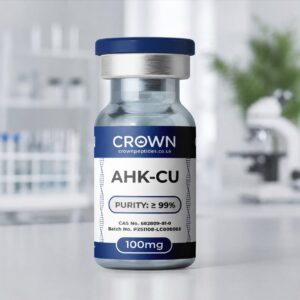
AHK-Cu Research Peptide
HPLC and MS verified · batch certificate published · dispatched from the UK before 2pm
AHK-Cu and GHK-Cu Compared
The two are complementary rather than competing, and the published evidence points in different directions for each.
GHK-Cu has the deeper literature by a wide margin — endogenous, isolated from human plasma in 1973, studied across extracellular matrix remodelling, wound models, inflammation, oxidative stress and gene expression. Its contribution to follicle research is largely environmental: improving the tissue surrounding the follicle, supporting blood supply, remodelling the matrix it sits in.
AHK-Cu has a much narrower literature but a more direct one for this specific question. In the Pyo comparison it produced stronger dermal papilla proliferation than GHK-Cu at equivalent concentrations, and more pronounced follicle elongation.
One improves the neighbourhood; the other works on the building. That is why formulation research frequently uses both.
Current Limitations of the Evidence
The AHK-Cu evidence base is thin, and it is important not to overstate it. The key work is ex vivo — follicles in culture, not people. Demonstrating that a compound elongates cultured follicles and stimulates dermal papilla cells is a genuine mechanistic finding, but it is not the same as demonstrating increased hair density in a clinical population, and the gap between those two things is where a great deal of hair research has historically failed.
There is also far less of it than for GHK-Cu. A single well-regarded 2007 study carries most of the weight, without the volume of independent replication that would settle the question.
Read the certificate before you order
Every batch is published openly — identity by mass spectrometry, purity by HPLC, and the batch number printed on the vial you receive.
Open the COA libraryFrequently Asked Questions
What is the difference between AHK-Cu and GHK-Cu?
One amino acid. AHK-Cu has alanine at the first position where GHK-Cu has glycine. GHK-Cu is naturally occurring with a broad tissue-remodelling literature; AHK-Cu is synthetic with a narrower literature focused on hair follicle signalling.
Is AHK-Cu the same as copper tripeptide-3?
Yes. Copper tripeptide-3 is the cosmetic ingredient designation for the AHK-Cu complex, as copper tripeptide-1 is for GHK-Cu.
Why does more AHK-Cu not mean more effect?
The published dose-response is biphasic. Follicle elongation occurs at picomolar to nanomolar concentrations and is actively inhibited above that range, with 81.5% inhibition reported at 10⁻⁷ M.
How is AHK-Cu tested?
Every batch is analysed by HPLC for purity and mass spectrometry for identity, with the certificate published in full and the batch number printed on the vial.
References
- Pyo H. K. et al. The effect of tripeptide-copper complex on human hair growth in vitro. Archives of Pharmaceutical Research, 2007.
- Pickart L., Margolina A. Regenerative and protective actions of the GHK-Cu peptide. International Journal of Molecular Sciences, 2018.
Working with AHK-Cu Research Peptide
Batch-tested material, published certificates, and same-day dispatch on orders placed before 2pm.
See AHK-Cu Research Peptide