MOTS-c Peptide UK: Research, Mechanism and Study Data
MOTS-c is encoded inside mitochondrial DNA rather than the nucleus, which is what makes it unusual. Sixteen residues, AMPK signalling, and a decade of metabolic research.
On this page
- What Is MOTS-c?
- A Message Hidden in the Mitochondrial Genome
- How MOTS-c Works
- What the Research Has Shown
- The Genetic Variant That Links MOTS-c, Exercise and Diabetes
- Mitochondria as Messengers: The Bigger Picture
- MOTS-c and the FDA Advisory Committee
- Designing Research With MOTS-c
- The Technical Breakdown: The Biology Behind the Peptide
- Why Purity Matters for a 16-Amino-Acid Peptide
- Related Compounds in Mitochondrial and Metabolic Research
- MOTS-c Questions, Answered
- A New Chapter in the Mitochondrial Story
For most of the twentieth century, biology textbooks taught that the tiny genome inside our mitochondria had one modest job: making a handful of proteins for energy production. It was the cell's power station manual, nothing more. Then, in 2015, a team in Los Angeles found a message hidden inside that manual, a short stretch of mitochondrial DNA coding for a 16-amino-acid peptide that travels to muscle, adjusts metabolism, and even enters the nucleus to switch genes on. They called it MOTS-c, and it has changed how scientists think about what mitochondria can do.
This guide tells the MOTS-c story: how it was discovered, how it works, what research in mice and people has shown about metabolism, exercise, ageing and bone, and why a single genetic variant in MOTS-c has become one of the most intriguing findings in the field. Crown Peptides supplies MOTS-c for laboratory research use only.
What Is MOTS-c?
MOTS-c stands for mitochondrial open reading frame of the 12S rRNA type-c. It is a peptide of 16 amino acids with the sequence Met-Arg-Trp-Gln-Glu-Met-Gly-Tyr-Ile-Phe-Tyr-Pro-Arg-Lys-Leu-Arg, and a molecular weight of roughly 2,175.
What makes it extraordinary is where its instructions live. Almost every protein in the body is encoded by DNA in the cell nucleus. MOTS-c is encoded by the separate, much smaller genome inside mitochondria, the structures that produce most of the cell's energy. That makes it one of a small family called mitochondrial-derived peptides, signalling molecules made from mitochondrial DNA.
What does MOTS-c do in research?
In published studies, research has indicated that MOTS-c may improve insulin sensitivity and protect against diet-induced weight gain in mice, enhance physical performance in young, middle-aged and old mice, protect against bone loss in animal models, and help cells adapt to metabolic stress by regulating genes in the nucleus. In humans, exercise has been shown to raise MOTS-c levels in muscle and blood. Each of these findings is covered below with the study named.
A Message Hidden in the Mitochondrial Genome
Why nobody was looking
Mitochondria are thought to descend from bacteria that were engulfed by an ancestral cell more than a billion years ago. Over time, most of their genes moved to the nucleus, leaving human mitochondria with a tiny circular genome of about 16,500 DNA letters. It encodes 13 proteins, all parts of the energy-producing machinery, along with the RNA molecules needed to make them. For decades, that was believed to be the complete list.
The clue from humanin
The first crack in that picture came in 2001, when Japanese researchers led by Ikuo Nishimoto, searching for molecules that protect neurons from Alzheimer's-related damage, found a small protective peptide they named humanin. Their paper in the Proceedings of the National Academy of Sciences described it as a rescue factor that abolished neuronal cell death caused by a wide range of Alzheimer's disease genes and by amyloid beta (PMID: 11371646, PMC33469). To everyone's surprise, its code appeared to sit within a mitochondrial gene for ribosomal RNA, a stretch of DNA thought only to make structural RNA, not peptides. If one peptide could hide there, others might too.
The discovery in Los Angeles
Pinchas Cohen's laboratory at the University of Southern California, with Changhan Lee as lead author, went looking. They searched the mitochondrial genome for short open reading frames, stretches of DNA that could in principle be read into short peptides. Within the gene for the mitochondrial 12S ribosomal RNA they found one encoding a 16-amino-acid peptide, and named it MOTS-c.
Their findings, published in Cell Metabolism in 2015, launched an entire field (PMID: 25738459, PMC4350682). MOTS-c's primary target appeared to be skeletal muscle. Inside cells, it inhibited the folate cycle and the purine synthesis pathway tied to it, which led to activation of AMPK, the cell's master energy sensor. And in mice, MOTS-c treatment prevented both age-dependent and high-fat-diet-induced insulin resistance and prevented diet-induced obesity. The authors concluded that mitochondria may actively regulate metabolism at the level of the whole body through peptides encoded in their own genome.
How MOTS-c Works
MOTS-c's mechanism has turned out to be as unusual as its origin. It works in two phases: first as a metabolic signal, then as a gene regulator.
Step one: the metabolic signal
The 2015 study showed that MOTS-c interferes with the folate cycle, a set of reactions that shuttles one-carbon units around the cell and feeds the production of purines, the building blocks of DNA and RNA. Disrupting that pathway leads to a build-up of a molecule called AICAR, which activates AMPK. AMPK is the cell's fuel gauge: when it senses energy running low, it switches on processes that generate energy, such as taking up glucose and burning fat, and switches off energy-consuming processes. Activating AMPK is one of the main ways exercise itself improves metabolism, which is why MOTS-c is often described as an exercise mimetic in research.
Step two: into the nucleus
In 2018, the same research group reported something even more surprising in Cell Metabolism (PMID: 29983246, PMC6185997). Under metabolic stress, such as glucose restriction or oxidative stress, MOTS-c moved from the cytoplasm into the cell nucleus in an AMPK-dependent way. Once there, it regulated nuclear genes, including genes with antioxidant response elements, working together with the transcription factor NRF2, a master regulator of the cell's stress defences.
That finding was remarkable. It meant a peptide made from mitochondrial DNA could travel to the nucleus and help control the nuclear genome, a two-way conversation between the cell's two genomes that had not been seen before. Research has since extended the idea; a 2025 study in Redox Biology reported that MOTS-c reduced lung injury in an ischaemia-reperfusion model through nuclear translocation and activation of antioxidant genes (PMID: 40403491, PMC12150175).
What the Research Has Shown
Exercise capacity across the lifespan
The most striking MOTS-c study for many readers came in 2021. In Nature Communications, Reynolds, Lee and colleagues reported that MOTS-c significantly enhanced physical performance in young (2-month-old), middle-aged (12-month-old) and old (22-month-old) mice (PMID: 33473109, PMC7817689). MOTS-c regulated nuclear genes involved in metabolism and protein maintenance, affected skeletal muscle metabolism and helped muscle precursor cells adapt to metabolic stress. Intermittent treatment started very late in life, at 23.5 months, the equivalent of an elderly human, increased physical capacity and healthspan in mice.
The human part of the study was just as important. The team found that exercise increases MOTS-c levels in human skeletal muscle and in the bloodstream. MOTS-c is not just a molecule that resembles the effects of exercise in mice; in people, exercise itself appears to call on it.
Ageing muscle in men
A 2020 study in Aging from the University of Auckland, working with the Cohen laboratory, looked at MOTS-c in healthy men of different ages (PMID: 32182209, PMC7138593). Circulating MOTS-c fell with age. But in skeletal muscle, the picture was reversed: men aged 45 to 55 and 70 to 81 had about 1.5-fold higher MOTS-c expression in muscle than men aged 18 to 30. Higher muscle MOTS-c was associated with slow-twitch muscle fibre markers, and in older men, plasma MOTS-c was associated with better muscle quality, measured as leg-press strength relative to thigh size. The authors suggested that the rise in muscle MOTS-c with age may be linked to the shift towards slow-twitch fibres that happens as people age, and that its targets may relate to maintaining muscle quality.
Bone
MOTS-c has also been studied for its effects on bone, one of the tissues the FDA reviewed it for in 2026. In a 2016 study in Biochemical and Biophysical Research Communications, researchers at the Fourth Military Medical University in Xi'an found that MOTS-c suppressed bone loss in ovariectomised mice, a standard model of post-menopausal osteoporosis, through AMPK activation (PMID: 27237975). A 2018 study in the European Review for Medical and Pharmacological Sciences reported that MOTS-c promoted the differentiation of bone marrow stem cells into bone-forming cells through the TGF-beta/Smad pathway (PMID: 30468456).
Metabolism in people
Human observational studies are now mapping MOTS-c levels in different metabolic states. A 2021 study in Biochimica et Biophysica Acta found that plasma MOTS-c was positively associated with abdominal and liver fat in people without diabetes. A 2025 study in Archives of Endocrinology and Metabolism compared MOTS-c levels in people with and without obesity and their relationship with inflammation, insulin resistance and endothelial function. These studies are building the baseline picture of how MOTS-c behaves across human metabolism.
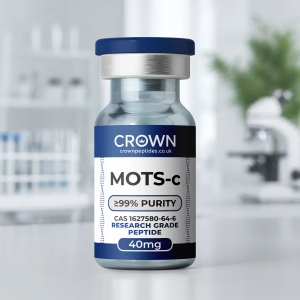
MOTS-c Research Peptide
From £24.99
HPLC and MS verified · same-day UK dispatch before 2pm
View MOTS-c Research Peptide ›The Genetic Variant That Links MOTS-c, Exercise and Diabetes
One of the most elegant pieces of MOTS-c research combines genetics, epidemiology and laboratory work.
Mitochondrial DNA varies between populations. One variant, m.1382A>C, is found almost exclusively in people of East Asian ancestry, and it falls right inside the MOTS-c code. It changes the 14th amino acid of MOTS-c from lysine (K) to glutamine (Q), producing a slightly different peptide known as K14Q-MOTS-c.
In a 2021 study in Aging, Zempo, Cohen and a large international team analysed three cohorts totalling 27,527 people (PMID: 33468709, PMC7880332). Men, but not women, carrying the C variant had a higher prevalence of type 2 diabetes. In one cohort, the increase was seen only in men with the variant who were in the lowest third for physical activity, a gene-exercise interaction the authors called kinesio-genomic.
The laboratory findings matched. In high-fat-fed male mice, normal MOTS-c reduced weight and improved glucose tolerance, but the K14Q version did not. Female mice were unaffected, just as in the human data. In cells, K14Q-MOTS-c showed diminished insulin-sensitising activity. The design is worth pausing on, because it combines three independent lines of evidence: large human population data, controlled animal experiments and cell studies, all pointing the same way. The study provides some of the strongest evidence yet that MOTS-c matters for human metabolism: a naturally occurring change in its sequence appears to change diabetes risk, particularly in sedentary men.
Mitochondria as Messengers: The Bigger Picture
MOTS-c is part of a larger shift in how scientists understand mitochondria. The old view saw them as passive power stations. The new view sees them as signalling hubs that constantly report on the cell's energy state and help coordinate its response.
Mitohormesis
One influential idea is mitohormesis: the notion that mild stress to mitochondria, such as the extra demand of exercise or a temporary shortage of fuel, triggers protective responses that leave cells more resilient than before. It is the cellular version of the old saying about what does not kill you. MOTS-c fits this picture neatly, because it is released under metabolic stress, activates the energy sensor AMPK, and switches on antioxidant defence genes in the nucleus. It may be one of the molecular messengers through which mitochondrial stress becomes cellular strength.
A family of mitochondrial messages
A 2021 review in GeroScience surveyed the whole family of mitochondrial-derived peptides in ageing and age-related disease, covering humanin, the small humanin-like peptides and MOTS-c (PMID: 32910336, PMC8190245). An earlier 2016 review in Free Radical Biology and Medicine by the Cohen and Lee groups focused specifically on MOTS-c as a regulator of muscle and fat metabolism (PMID: 27216708, PMC5116416). Together they describe a field that barely existed two decades ago and is now one of the most active in metabolic biology.
Why muscle is the main target
Skeletal muscle is the body's largest consumer of glucose and one of its biggest metabolic organs, which is why so much insulin sensitivity is decided there. It is also packed with mitochondria. The 2015 discovery paper identified muscle as MOTS-c's primary target, and the 2020 Auckland study found MOTS-c expression in human muscle itself. A peptide that links mitochondrial signals to muscle metabolism sits at exactly the point where whole-body energy balance is shaped.
A peptide inherited from your mother
There is a fascinating consequence of MOTS-c's mitochondrial origin. Mitochondrial DNA is inherited almost entirely from the mother, because the egg supplies the mitochondria to the embryo while the sperm's few mitochondria are normally eliminated. That means the version of MOTS-c a person carries, including variants such as K14Q, is passed down the maternal line, unchanged by the usual reshuffling of genes between generations.
Mitochondrial DNA also accumulates variation along ancient migration routes, forming groups of related sequences called haplogroups that track human ancestry. That is why the m.1382A>C variant is found almost exclusively in East Asian populations. For researchers, it raises intriguing questions about whether MOTS-c variants have shaped how different populations respond to diet and exercise over thousands of years, a question that links ancient human history directly to modern metabolic research.
It also makes MOTS-c unusual among research peptides: one of very few whose natural sequence differs between people in a way that has been linked to a measurable health outcome.
MOTS-c and the FDA Advisory Committee
In July 2026, the US FDA's Pharmacy Compounding Advisory Committee voted 7 to 5, with two abstentions, to recommend adding MOTS-c to the list of substances US compounding pharmacies may use, having reviewed it for obesity and osteoporosis. The recommendation is advisory and requires FDA rulemaking before any change in the US, and it has no bearing on MOTS-c's status in the UK, where it is available as a research material. Our article on the FDA advisory panel vote explains the details.
Designing Research With MOTS-c
MOTS-c's biology suggests several practical considerations for experimental design.
Stress state matters
Because MOTS-c's move into the nucleus is triggered by metabolic stress, the metabolic state of the cells or animals being studied may shape the response. Glucose availability, oxidative stress and exercise status are all variables worth recording or controlling.
Sex matters
The K14Q study found effects in males but not females, in both people and mice. Including both sexes, and analysing them separately, is important in MOTS-c research.
Choose readouts across both phases
Measuring AMPK activation and glucose handling captures MOTS-c's metabolic phase, while measuring antioxidant gene expression and nuclear localisation captures its gene-regulatory phase. Using both gives the fullest picture.
Match the timing
The 2021 performance study used intermittent treatment, and exercise raises natural MOTS-c transiently. Thinking about when MOTS-c is present relative to the measurements, rather than only how much, can make results easier to interpret.
The Technical Breakdown: The Biology Behind the Peptide
This section goes deeper for readers who want the molecular detail.
How a peptide can hide in ribosomal RNA
The MOTS-c code sits inside the gene for 12S ribosomal RNA, a structural component of the mitochondrial ribosome. How the peptide is actually made is still being worked out. One possibility is that it is translated from a short RNA in the cytoplasm using the standard genetic code rather than the slightly different mitochondrial code, and the "c" in MOTS-c originally referred to the cytoplasmic translation hypothesis. The 2020 Auckland study provided evidence that MOTS-c transcription may be regulated independently of the full-length 12S RNA gene, supporting the idea of a dedicated regulatory mechanism.
The folate-AICAR-AMPK route
The folate cycle produces one-carbon units needed for de novo purine synthesis. One intermediate in that pathway, AICAR (5-aminoimidazole-4-carboxamide ribonucleotide), is normally converted onward using a folate-derived one-carbon unit. When MOTS-c inhibits the folate cycle, AICAR accumulates. AICAR is a well-known activator of AMPK, which mimics the effect of low cellular energy. AMPK then phosphorylates a range of targets that increase glucose uptake, fatty acid oxidation and mitochondrial biogenesis.
The nuclear phase
Under stress, MOTS-c enters the nucleus, where the 2018 study showed it binds chromatin and interacts with transcription factors, including NRF2, at antioxidant response elements. Its sequence contains a hydrophobic core and a cluster of positively charged residues at its end, features compatible with interactions with DNA-associated proteins.
What K14Q changes
The lysine at position 14 is part of MOTS-c's positively charged C-terminal cluster. Replacing it with the uncharged glutamine alters that charge pattern, which may explain why K14Q-MOTS-c showed diminished insulin-sensitising activity. It is a striking example of how a single amino acid can change a peptide's biology.
Other mitochondrial-derived peptides
MOTS-c belongs to a growing family. Humanin, discovered in 2001, and the small humanin-like peptides, SHLP1 to SHLP6, are also encoded within mitochondrial ribosomal RNA genes. A 2022 review in Archives of Cardiovascular Diseases discussed mitochondrial-derived peptides as potential new markers of cardiometabolic health, reflecting how rapidly the family is being studied.
Why Purity Matters for a 16-Amino-Acid Peptide
MOTS-c is long enough that synthesis involves 16 separate coupling steps, each of which must work almost perfectly. Failures produce deletion sequences missing a single amino acid, which can sit close to the main peak in an HPLC analysis. MOTS-c also contains two methionines and a tryptophan, amino acids that are vulnerable to oxidation during manufacture and storage.
The K14Q research shows exactly why that matters. A single amino acid change was enough to alter MOTS-c's metabolic activity. A sample containing a significant proportion of altered or truncated peptide could give a misleading result.
The Crown Peptides standard
Every batch of MOTS-c supplied by Crown Peptides comes with a batch-specific certificate of analysis. HPLC confirms purity by separating MOTS-c from related impurities, and mass spectrometry confirms its identity by molecular mass. Lot numbers on certificates match those on vial labels. Published certificates are on our Lab Reports page, and our guides to peptide testing and reading a certificate of analysis explain the methods.
Handling
MOTS-c is supplied as a lyophilised powder and should be stored cold, dry and away from light, with particular care to limit air exposure because of its oxidation-prone residues. Our guides to peptide reconstitution, how long peptides last and the peptide calculator cover the practical side, and Bacteriostatic Water is available alongside.
Related Compounds in Mitochondrial and Metabolic Research
MOTS-c sits at the centre of a network of compounds studied for cellular energy and metabolism.
SS-31
SS-31 is a mitochondria-targeted peptide that binds cardiolipin on the inner mitochondrial membrane. Its clinical form, elamipretide, received accelerated FDA approval in September 2025 for Barth syndrome. Our comparison SS-31 vs MOTS-c sets out the differences.
NAD+
NAD+ is the coenzyme at the heart of cellular energy and sirtuin signalling. See NAD+ vs MOTS-c.
Other metabolic compounds
5-Amino-1MQ inhibits the enzyme NNMT, which influences NAD+ and cellular energy; L-Carnitine controls how mitochondria burn fat; AOD-9604 is a growth hormone fragment studied in fat metabolism; and Methylene Blue is studied for its effects on mitochondrial electron transport. MOTS-c features in the Metabolic Research Bundle, explained in three peptides, one metabolic pathway.
Browse the full range in our metabolic research peptides and ageing and cellular research peptides categories.
MOTS-c Questions, Answered
What does MOTS-c stand for?
Mitochondrial open reading frame of the 12S rRNA type-c, reflecting where its code sits in the mitochondrial genome.
Is MOTS-c made naturally in the body?
Yes. It is encoded in mitochondrial DNA and circulates in the blood. Research has shown that exercise increases MOTS-c levels in human muscle and blood.
Why is MOTS-c called an exercise mimetic?
Because research indicates it activates AMPK, the same energy-sensing pathway exercise activates, and has enhanced physical performance in mice of different ages.
What tissues has MOTS-c been studied in?
Mainly skeletal muscle and fat, reflecting its metabolic role, along with bone in osteoporosis models and, more recently, the lungs in injury models. Its ability to enter the nucleus under stress suggests it may act in many cell types.
Does MOTS-c decline with age?
Circulating MOTS-c fell with age in a 2020 study of healthy men, although MOTS-c expression in muscle was higher in older men than younger ones.
How is MOTS-c different from humanin?
Both are peptides encoded within mitochondrial ribosomal RNA genes, but humanin, discovered in 2001, was first identified as a neuron-protecting factor, while MOTS-c, discovered in 2015, is studied mainly for metabolism, muscle and exercise.
Is MOTS-c a hormone?
It behaves partly like one. It circulates in the blood and acts on distant tissues such as muscle, which is why some researchers describe it as a mitochondrial hormone, or mitokine.
What is K14Q-MOTS-c?
A naturally occurring variant, found mainly in people of East Asian ancestry, that changes one amino acid in MOTS-c. It was associated with higher type 2 diabetes prevalence in less active men and showed reduced activity in laboratory studies.
A New Chapter in the Mitochondrial Story
MOTS-c has rewritten a basic lesson of biology. Mitochondria are not just power stations following orders from the nucleus; they send orders of their own. A 16-amino-acid peptide, hidden in a gene everyone thought made only structural RNA, travels to muscle, adjusts the cell's fuel gauge, enters the nucleus under stress to switch on protective genes, rises when we exercise, and, in one small genetic variant, appears to shape the risk of diabetes in sedentary men.
With so much of that story discovered in the last decade, MOTS-c remains one of the most exciting molecules in metabolic and ageing research. Explore MOTS-c from Crown Peptides, every batch HPLC and mass spectrometry verified and dispatched from the UK.