5-Amino-1MQ: The NNMT Inhibitor, Its Mechanism and the Research Data
5-Amino-1MQ is not a peptide at all. It is a small-molecule NNMT inhibitor, and the distinction changes how it behaves, how it is handled and what the research means.
On this page
- What Is 5-Amino-1MQ?
- NNMT: The Enzyme Nobody Was Watching
- The Harvard Discovery That Put NNMT on the Map
- From Target to Molecule: Designing 5-Amino-1MQ
- Beyond Fat: Ageing Muscle
- Diet, Weight and the Microbiome
- Two Resources, Explained: NAD+ and SAM
- Polyamines: The Hidden Energy-Burning Cycle
- Designing Research With 5-Amino-1MQ
- Why NNMT Keeps Appearing in Other Research Fields
- How 5-Amino-1MQ Differs From Other Metabolic Research Compounds
- The Technical Breakdown: The Chemistry of NNMT Inhibition
- Why Quality Matters for a Small Molecule
- Related Compounds in Metabolic and Cellular Energy Research
- 5-Amino-1MQ Questions, Answered
- A Small Molecule With a Big Junction to Guard
In 2014, a team at Harvard compared fat tissue from mice that were extremely sensitive to insulin with fat tissue from mice that were extremely resistant to it, looking across thousands of genes for the biggest difference. The gene that stood out was not one anyone expected. It belonged to an obscure enzyme best known to toxicologists for tagging vitamin B3 for disposal. That enzyme, nicotinamide N-methyltransferase, or NNMT, has since become one of the more intriguing targets in metabolic research, and 5-Amino-1MQ is the small molecule designed to switch it down.
This guide explains what NNMT does, why an enzyme that seems to handle cellular housekeeping turned out to matter so much for fat cells and ageing muscle, how 5-Amino-1MQ was developed, and what the key studies have found. Unlike most compounds in a peptide catalogue, 5-Amino-1MQ is not a peptide at all; it is a small organic molecule, which makes its story a little different from the rest. Crown Peptides supplies 5-Amino-1MQ for laboratory research use only.
What Is 5-Amino-1MQ?
5-Amino-1MQ is short for 5-amino-1-methylquinolinium. It is built on a quinoline ring, a flat, double-ringed structure found in many biologically active molecules, with a methyl group on its nitrogen, giving it a permanent positive charge, and an amino group at position 5. Its molecular weight is small, around 159 for the charged molecule itself, far smaller than even the shortest peptides in our range.
Its job in research is simple to state: it inhibits NNMT. Understanding why that matters requires a short detour into what NNMT actually does.
What does 5-Amino-1MQ do in research?
In published studies, research has indicated that NNMT inhibitors from the same chemical family as 5-Amino-1MQ can raise NAD+ and SAM levels in fat cells, suppress fat production in cultured fat cells, reduce body weight and fat mass in diet-induced obese mice without reducing food intake, and improve muscle regeneration after injury in aged mice. These findings are covered in detail below, with each study named.
NNMT: The Enzyme Nobody Was Watching
A housekeeping job
Nicotinamide N-methyltransferase does one chemical reaction. It takes nicotinamide, a form of vitamin B3, and attaches a methyl group to it, producing 1-methylnicotinamide, often shortened to 1-MNA. To do this, it borrows the methyl group from S-adenosylmethionine, or SAM, the cell's universal methyl donor.
For decades, NNMT was mainly studied in the liver as part of the body's system for processing and clearing excess nicotinamide and certain drugs. It seemed like a disposal enzyme, clearing away surplus vitamin. Nobody expected it to be a major player in metabolism.
Why that reaction matters more than it seems
Look again at the two ingredients NNMT consumes. Nicotinamide is the main raw material the cell uses to recycle NAD+, the coenzyme at the heart of energy metabolism and of the sirtuin enzymes linked to ageing. SAM is the cell's main source of methyl groups, used to tag DNA and histones and so control which genes are switched on. An enzyme that uses up both is sitting at a junction between energy metabolism and gene regulation. If NNMT is overactive, it could, in principle, drain the cell of both resources at once.
The Harvard Discovery That Put NNMT on the Map
That possibility became a serious research question in 2014, with a study published in Nature by Kraus, Kahn and colleagues at Beth Israel Deaconess Medical Center and Harvard Medical School (PMID: 24717514, PMC4107212).
Finding the gene
Barbara Kahn's group had long studied Glut4, the transporter that lets fat and muscle cells take up glucose in response to insulin. They had mice lacking Glut4 specifically in fat tissue, which were insulin resistant, and mice with extra Glut4 in fat tissue, which were unusually insulin sensitive. Comparing gene activity in the fat of both, they looked for the gene that changed most strongly in opposite directions. It was Nnmt.
What happened when NNMT was switched down
The team found that NNMT expression was increased in the fat and liver of obese and diabetic mice. When they reduced NNMT levels in fat and liver using antisense technology, the mice were protected against diet-induced obesity, because their cells burned more energy.
The mechanism was elegant. Reducing NNMT raised levels of both SAM and NAD+ in fat tissue. The extra SAM increased histone methylation at particular sites, which switched on genes controlling polyamine metabolism, a cycle of molecules whose constant production and breakdown consumes energy. The extra NAD+ supported sirtuin signalling. Fat cells with less NNMT used more oxygen, a direct sign of increased energy expenditure. The authors described NNMT as a novel regulator of histone methylation, polyamine flux and NAD+-dependent SIRT1 signalling, and an attractive target for obesity and type 2 diabetes research.
From Target to Molecule: Designing 5-Amino-1MQ
Antisense technology is a powerful research tool but not a convenient one. Researchers wanted a small molecule that could get into cells and block NNMT directly. That work was led by Stanley Watowich and Harshini Neelakantan at the University of Texas Medical Branch in Galveston.
The methylquinolinium scaffold
The team designed and tested a series of compounds built on the methylquinolinium structure, a shape that resembles NNMT's natural product, 1-methylnicotinamide, and can therefore sit in the enzyme's active site. Among the compounds, those with a primary amine substituent, including 5-amino-1-methylquinolinium, stood out.
The Galveston study in fat cells and obese mice
Their key findings were published in Biochemical Pharmacology in 2018 (PMID: 29155147, PMC5826726).
They get into cells
Using standard laboratory models of membrane permeability, including artificial membranes and Caco-2 cells, a model of the gut lining, the team found that methylquinolinium compounds with primary amine substitutions showed high permeability through both passive and active transport. That matters, because an enzyme inhibitor is useless if it cannot reach the enzyme inside the cell.
They are selective
The inhibitors did not block related enzymes that also use SAM, nor enzymes of the NAD+ salvage pathway. Selectivity is critical here: a compound that blocked every SAM-using enzyme, or interfered with NAD+ recycling, would have very different and far less useful effects.
They change fat cell metabolism
In cultured fat cells, the NNMT inhibitors reduced 1-MNA, the product of NNMT's reaction, confirming the enzyme was blocked. They increased intracellular NAD+ and SAM, exactly as the Harvard work predicted, and suppressed lipogenesis, the process by which fat cells build new fat.
They work in obese mice
Finally, the team treated mice made obese on a high-fat diet with a potent NNMT inhibitor. The treated mice showed significantly reduced body weight and white fat mass, smaller fat cells and lower total cholesterol. Notably, the treatment did not change how much the mice ate and produced no observable adverse effects. The authors concluded that the results validated NNMT as a viable target in obesity and metabolic research, and that increased flux of NAD+ and SAM may explain how the inhibitors work.
Beyond Fat: Ageing Muscle
The Galveston team then asked whether NNMT inhibition might help in a very different setting: muscle ageing.
The problem of tired stem cells
Muscle repair depends on muscle stem cells, also called satellite cells, which sit quietly alongside muscle fibres until injury wakes them. They then multiply, turn into muscle-building cells and fuse into damaged fibres to repair them. With age, these stem cells become increasingly dysfunctional and senescent, which is a large part of why older muscle recovers poorly from injury. The researchers noted that age-related changes include impairment of the NAD+ salvage pathway and dysregulated SIRT1 activity, both of which link back to NNMT.
The aged muscle study
In a study published in Biochemical Pharmacology in 2019, Neelakantan, Watowich and colleagues treated 24-month-old mice, the mouse equivalent of elderly humans, with an NNMT inhibitor after a standardised muscle injury (PMID: 30753815, PMC6469996).
The results were striking. Muscle stem cell proliferation and fusion increased in treated mice, supporting nearly twice the cross-sectional area of regenerating muscle fibres compared with controls, with a shift towards larger fibres. Longer treatment enlarged fibres further. Most importantly, the structural improvement translated into function: peak torque, a measure of muscle strength, was increased by about 70% in treated mice compared with controls. In cultured muscle precursor cells, the inhibitor promoted differentiation into muscle, with supporting changes in the cells' NAD+/NADH balance. The authors described it as the first clear evidence that NNMT inhibitors could enhance aged muscle regeneration by rescuing stem cell function.
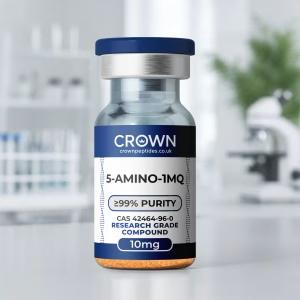
5-Amino-1MQ Research Compound
From £24.99
HPLC and MS verified · same-day UK dispatch before 2pm
View 5-Amino-1MQ Research Compound ›Diet, Weight and the Microbiome
A further study from the same research network, published in Scientific Reports in 2022, used 5-amino-1-methylquinolinium by name (PMID: 35013352, PMC8748953). Dimet-Wiley, Watowich and colleagues studied diet-induced obese mice switched from a high-fat Western diet to a low-fat diet, with or without the NNMT inhibitor.
The combination of 5-Amino-1MQ with the low-fat diet produced dramatic whole-body fat and weight loss, rapidly bringing the mice back to the measures of age-matched lean animals, something the diet switch alone could not achieve in the same timeframe. The team then examined gut bacteria and found that the treated mice developed a distinct microbiome pattern, including decreased Erysipelatoclostridium and increased Lactobacillus. It is an interesting example of how a metabolic intervention can ripple out into the wider biology of the body.
Two Resources, Explained: NAD+ and SAM
Because everything about NNMT comes back to the two molecules it consumes, it is worth understanding each one properly.
NAD+: the energy currency's helper
NAD+ is a coenzyme found in every living cell. It carries electrons in the reactions that break down sugars and fats, delivering them to mitochondria to make ATP. It is also consumed as fuel by the sirtuin enzymes, which regulate metabolism and stress responses, and by PARP enzymes, which repair DNA. Research across many labs has found that NAD+ levels decline with age in several tissues, which is why so much ageing research focuses on keeping its supply topped up. The cell makes most of its NAD+ by recycling nicotinamide, the very molecule NNMT removes.
SAM: the cell's methyl bank
S-adenosylmethionine, or SAM, is made from the amino acid methionine and serves as the donor for almost every methylation reaction in the body. Those reactions put methyl tags on DNA, on histones and on many other molecules, controlling which genes are switched on and how proteins behave. SAM is also needed to make polyamines. When SAM runs low, methylation reactions slow down, and the patterns of gene activity that depend on them can shift.
Why draining both at once matters
An overactive NNMT spends SAM and throws away nicotinamide in a single step. The Harvard work showed this has real consequences in fat tissue: less SAM meant altered histone methylation and gene activity, and less NAD+ meant weaker sirtuin signalling. Blocking NNMT reverses both drains at once, which is why its effects in research have been so broad.
Polyamines: The Hidden Energy-Burning Cycle
One of the most surprising parts of the Harvard study was the role of polyamines, molecules such as spermidine and spermine that are found in every cell and help stabilise DNA and RNA.
Cells constantly make polyamines and constantly break them down again, a cycle controlled by the enzymes ornithine decarboxylase, spermidine-spermine acetyltransferase and polyamine oxidase. Each turn of the cycle costs energy, in the form of ATP and SAM. The Harvard team found that reducing NNMT increased the activity of these enzymes through changes in histone methylation, speeding the cycle up. Faster polyamine cycling meant more energy spent, and fat cells with less NNMT consumed more oxygen in a way that depended on those polyamine enzymes. They even detected increased excretion of diacetylspermine, a polyamine breakdown product, as direct evidence of the faster cycle.
It is an unusual route to increased energy expenditure: not through exercise or heat production, but through a molecular cycle that quietly burns fuel as it turns.
Designing Research With 5-Amino-1MQ
The published work suggests several practical considerations for anyone planning experiments.
Confirm the enzyme is blocked
The most direct readout of NNMT inhibition is a fall in 1-methylnicotinamide, the enzyme's product. Measuring it confirms the compound is working before looking at downstream effects.
Measure both resources
Because NNMT affects NAD+ and SAM together, measuring both, ideally alongside SAH to calculate the methylation index, gives a much clearer picture of what has changed than either alone.
Account for diet
The 2022 study showed that combining NNMT inhibition with a diet change produced effects the diet change alone did not. Diet composition is therefore an important variable to record and control in metabolic studies.
Think about tissue
NNMT levels differ widely between tissues, being high in liver and fat and increased in obese and diabetic states. The same compound may therefore have quite different effects depending on where NNMT is most active.
Why NNMT Keeps Appearing in Other Research Fields
NNMT's position at the crossroads of NAD+ and methylation has drawn attention well beyond fat and muscle.
Cancer biology
In cancer research, NNMT is highly expressed in some tumours and particularly in the connective tissue cells that surround them, called cancer-associated fibroblasts. A 2024 study in the Journal for ImmunoTherapy of Cancer reported that NNMT in these fibroblasts influenced tumour progression and responses to immunotherapy by modulating macrophages in a mouse cancer model (PMID: 39067875, PMC11284830). A 2021 study in the Journal of Obstetrics and Gynaecology reported antiproliferative activity of a small-molecule NNMT inhibitor in HeLa cells. These findings make NNMT a tool of interest in tumour metabolism research, alongside its metabolic role.
The methylation sink idea
Because NNMT consumes SAM, a highly active NNMT can act as what researchers have described as a methylation sink, lowering the methyl groups available for tagging DNA and histones and so reshaping gene expression. That is the same mechanism the Harvard team identified in fat, appearing in a very different context.
How 5-Amino-1MQ Differs From Other Metabolic Research Compounds
Metabolic research has many tools, and it helps to see where 5-Amino-1MQ fits among them.
Versus GLP-1 class compounds
GLP-1 receptor agonists and related multi-receptor agonists act on hormone receptors, largely influencing appetite and insulin release. In the 2018 mouse study, NNMT inhibition reduced weight without changing food intake, pointing to a quite different, cell-level mechanism centred on energy expenditure. Researchers interested in the receptor-based compounds can explore our metabolic research peptides category and our retatrutide vs tirzepatide guide.
Versus NAD+ itself
Supplying NAD+ or its precursors increases the NAD+ supply directly. Inhibiting NNMT works the other way round, by reducing the drain on nicotinamide so more of it can be recycled into NAD+, while also preserving SAM. The two approaches are complementary routes into the same system.
Versus mitochondrial peptides
MOTS-c acts through AMPK and the folate cycle, and SS-31 acts on the mitochondrial membrane. 5-Amino-1MQ acts upstream on the supply of NAD+ and methyl groups. Combining these tools lets researchers probe cellular energy from several angles.
The Technical Breakdown: The Chemistry of NNMT Inhibition
This section goes into the chemistry for readers who want it.
The reaction
NNMT catalyses the transfer of a methyl group from SAM to the pyridine nitrogen of nicotinamide, producing 1-methylnicotinamide and S-adenosylhomocysteine (SAH). SAH is itself an inhibitor of many methyltransferases, so NNMT activity both consumes the methyl donor and generates a molecule that slows other methylation reactions. The ratio of SAM to SAH, often called the methylation index, is a key measure of a cell's capacity for methylation.
Why a quinolinium fits
1-methylnicotinamide is a positively charged, N-methylated pyridine ring. 5-amino-1-methylquinolinium is a positively charged, N-methylated quinoline, essentially a larger, two-ring version of the same shape. It mimics the product of the reaction closely enough to occupy the nicotinamide-binding site, blocking the enzyme. The amino group at position 5 was one of the substitutions that improved both potency and cell permeability in the Galveston team's series.
How a charged molecule gets into cells
Permanently charged molecules usually struggle to cross cell membranes, which are built to keep charged substances out. The 2018 study found that the primary-amine methylquinoliniums crossed membranes through both passive diffusion and active transport, suggesting that cellular transporters help carry them in. That finding was one reason the 5-amino compound became the focus of further research.
The salvage pathway connection
Cells recycle NAD+ mainly through the salvage pathway: enzymes that consume NAD+, such as sirtuins and PARPs, release nicotinamide, which the enzyme NAMPT converts to NMN and then back to NAD+. Every molecule of nicotinamide that NNMT methylates is lost to that recycling loop. Blocking NNMT keeps more nicotinamide available for salvage, which is how NNMT inhibitors raise NAD+ in fat cells.
Why Quality Matters for a Small Molecule
5-Amino-1MQ is not made by peptide synthesis, so its quality challenges differ from those of peptides. The main concerns are closely related chemical impurities from its synthesis, such as positional isomers where the amino group sits at a different point on the ring, and the counter-ion that pairs with its positive charge, commonly iodide or chloride depending on how it is made. A positional isomer could have similar mass but different activity, so a clean HPLC profile matters, and mass spectrometry confirms the core molecule's identity.
The Crown Peptides standard
Every batch of 5-Amino-1MQ supplied by Crown Peptides comes with a batch-specific certificate of analysis showing HPLC purity and mass spectrometry identity, with lot numbers matching those on vial labels. Published certificates are on our Lab Reports page, and our guides to testing and reading a certificate of analysis explain the methods.
Handling
5-Amino-1MQ should be stored cold, dry and away from light, as with other research compounds. Our guides to storage and shelf life, reconstitution and the calculator cover the practical side, and Bacteriostatic Water is available alongside.
Related Compounds in Metabolic and Cellular Energy Research
5-Amino-1MQ connects to several compounds studied for cellular energy and metabolism.
NAD+
NAD+ is the coenzyme whose supply NNMT inhibition protects. Our NAD+ guide and Epitalon vs NAD+ explain its biology.
MOTS-c and SS-31
MOTS-c, a peptide encoded in mitochondrial DNA, and SS-31, a mitochondria-targeted peptide, approach cellular energy from the mitochondrial side. See our MOTS-c guide and SS-31 vs MOTS-c.
Other metabolic tools
L-Carnitine governs how mitochondria burn fat, AOD-9604 is a growth hormone fragment studied in fat metabolism, and Methylene Blue is studied for its effects on mitochondrial electron transport. For muscle regeneration research, BPC-157 and TB-500 are frequently studied. The Metabolic Research Bundle brings several metabolic compounds together.
5-Amino-1MQ Questions, Answered
Is 5-Amino-1MQ a peptide?
No. It is a small organic molecule, 5-amino-1-methylquinolinium, supplied alongside peptides because it is used in the same metabolic research areas.
What does NNMT stand for?
Nicotinamide N-methyltransferase, an enzyme that attaches a methyl group from SAM to nicotinamide, a form of vitamin B3.
How does blocking NNMT affect NAD+?
NNMT uses up nicotinamide, the raw material for recycling NAD+. Research has shown that NNMT inhibitors increase NAD+ levels in fat cells by leaving more nicotinamide available for recycling.
Why is it called 5-Amino-1MQ?
The name is shorthand for its chemical structure: an amino group at position 5 of a quinolinium ring that carries a methyl group at position 1. The "MQ" stands for methylquinolinium, the family of compounds the Galveston team developed.
Is NNMT found in humans?
Yes. NNMT is a human enzyme, highly expressed in the liver and also present in fat tissue. In the Harvard mouse research, NNMT levels were higher in the fat and liver of obese and diabetic animals, which is what first made it a target of interest for metabolic research. The animal studies described here were designed to test whether reducing its activity changes metabolism.
Did NNMT inhibition reduce food intake in mice?
No. In the 2018 study, treated obese mice lost weight and fat without any change in total food intake, pointing to increased energy expenditure rather than reduced eating.
What did research show in ageing muscle?
In aged mice, an NNMT inhibitor increased muscle stem cell activity after injury, nearly doubled the size of regenerating fibres and increased peak muscle strength by about 70% compared with controls.
A Small Molecule With a Big Junction to Guard
NNMT spent decades looking like a minor disposal enzyme. It took a Harvard gene comparison to reveal it as a gatekeeper standing at the junction of two of the cell's most important resources, NAD+ for energy and SAM for gene regulation. 5-Amino-1MQ, designed in Galveston to mimic NNMT's own product and slip into cells, gave researchers a way to close that gate, and the results so far, from leaner mice that ate just as much to aged muscle that repaired itself with renewed strength, have made it one of the more interesting small molecules in metabolic research.
For researchers exploring cellular energy, it offers a route into the NAD+ system that complements every other tool in the field. Explore 5-Amino-1MQ from Crown Peptides, every batch HPLC and mass spectrometry verified and dispatched from the UK.