

Research guide
Cartalax Peptide UK: AED Research, Mechanism and Study Data
Epitalon minus one glycine, named after cartilage and studied in ageing fibroblasts, stem cells and kidney tissue. What the published work on AED actually shows, and where it stops.
Cartilage is one of the strangest tissues in the body. It has no blood supply, no nerves and very few cells. The cells it does have, called chondrocytes, sit alone in a thick, rubbery matrix and maintain it for decades with almost no outside help. When they begin to age, the tissue around them ages too, and because so little reaches them from the bloodstream, it is very hard to influence what happens next. That is why researchers interested in joints, connective tissue and ageing keep looking for signals small enough to get where larger molecules cannot.
Cartalax is one of those signals. It is a three-amino-acid peptide from the same research programme that produced Epitalon and Pinealon, linked by name to cartilage and studied in skin fibroblasts, stem cells and kidney tissue for its effects on cell renewal, matrix enzymes and the genes that mark a cell as old. This guide explains where it came from, how it is thought to work, what the published studies have actually measured, and where the evidence is thin. Cartalax is sold by Crown Peptides strictly for laboratory research use only, and everything below is written for readers interested in the science.
What Is Cartalax, and Why Is a Cartilage Peptide Only Three Amino Acids Long?
Cartalax is a synthetic tripeptide with the sequence Ala-Glu-Asp. In the scientific literature it is almost always written as AED, the one-letter code for alanine, glutamic acid and aspartic acid. Its formula is C12H19N3O8 and its molecular weight is roughly 333 g/mol, which makes it smaller still than Pinealon, the three-amino-acid peptide many readers will already know.
Size is the first thing to understand about it. Most of the peptides people associate with tissue research are much larger. BPC-157 has 15 amino acids. Thymosin beta-4, the parent of TB-500, has 43. Collagen, the main structural protein of cartilage, runs to more than a thousand per chain. Cartalax has three.
That matters because a molecule this small is not trying to do the same job as a growth factor or a structural protein. It is not a building block for new tissue, and it is far too small to grip most cell-surface receptors in the usual way. The idea behind it is different: that very short peptides can act as signals, slipping inside cells and influencing which genes are read. If that idea is right, size stops being a limitation and becomes the point.
Where does the name come from?
The name is a nod to cartilage. Cartalax belongs to a family of short peptides that the Saint Petersburg Institute of Bioregulation and Gerontology designed to capture the activity of tissue extracts, and its parent extract came from cartilage and bone. In Russian literature you will sometimes see it spelled Kartalax. The name describes the tissue it was associated with during development rather than a proven effect on cartilage, a distinction worth holding on to as you read the studies below.
Why do the studies call it AED, T-31 or Cartalax?
Three names for one molecule can make the literature hard to search. AED is the sequence and is what most journal papers use. T-31 is an internal code used in several kidney studies from 2014 and 2015. Cartalax is the name it carries as a product. Anyone reviewing the research should search all three, and should also watch for AEDG, which is a different molecule entirely.
Epitalon Minus One: The Family Tree Behind Cartalax
The quickest way to understand Cartalax is to compare it with its better-known relative. Epitalon has the sequence Ala-Glu-Asp-Gly, or AEDG. Remove the final glycine and you are left with Ala-Glu-Asp. That is Cartalax.
That one-residue difference is more useful than it sounds. Because the two peptides share their first three amino acids, researchers can run them side by side and ask whether a given effect needs the glycine or not. When AED and AEDG behave the same, the active part is probably the shared core. When they behave differently, the glycine is doing something. Several of the studies below were designed exactly this way.
The Khavinson bioregulator programme
Both peptides trace back to Vladimir Khavinson, a Soviet military doctor who began working on what he called peptide bioregulators in the 1970s. His group extracted mixtures of short peptides from specific animal tissues and tested whether each extract helped the matching tissue in older or stressed animals. Over the following decades, after the Saint Petersburg institute was founded in 1992, the group analysed the amino acid content of those extracts and designed short synthetic sequences intended to reproduce their activity. Epitalon came from the pineal extract, Pinealon from a brain cortex extract, and Cartalax from the cartilage and bone line of work. We cover the whole family in bioregulator peptides explained.
Sigumir, the extract behind it
The cartilage-and-bone extract at the start of this story is known as Sigumir, a polypeptide complex prepared from the cartilage and bone of young animals. Russian clinical literature describes its use in older patients with temporomandibular joint problems, including a 2012 report on 62 patients in which it was used as part of a wider treatment programme (PMID: 22708467). Because Sigumir was given alongside prosthetics, physical therapy and other medicines, that report cannot isolate the extract’s own effect. It does explain why the institute later wanted a defined synthetic sequence it could study cleanly, and AED is that sequence.
The close cousins
Cartalax is regularly tested next to a handful of other short peptides from the same programme. KE (Lys-Glu) and KED (Lys-Glu-Asp, known as Vesugen) are the most common comparators. EDL (Glu-Asp-Leu, code T-35) appears in the kidney work. Seeing which peptide does what in the same experiment is one of the more convincing features of this literature, because it shows the effects are not simply a property of any small peptide added to a dish.
- Classification
- Synthetic tripeptide bioregulator research compound
- Available strength
- 20mg (coming soon)
- Molecular Weight
- approximately 333.30 g/mol
- Molecular Formula
- C12H19N3O8
- Sequence
- Ala-Glu-Asp (3 amino acids)
How Could a Three-Amino-Acid Peptide Change What a Cell Does?
This is where most people’s scepticism kicks in, so it is worth going one step at a time. The proposed mechanism for Cartalax is the same one proposed for the rest of the bioregulator family, and it is a chain of four claims, each with a different level of support.
Step one: getting through the membrane
Cells need to absorb small peptides from digested protein, so they carry dedicated transporters for them, including the PEPT family that moves two- and three-amino-acid peptides across membranes. A tripeptide like AED is exactly the size those transporters are built for. That gives a plausible route into the cell without needing a dedicated receptor. Khavinson’s group has also reported that fluorescently labelled short peptides from this family end up in the cytoplasm and nucleus of cultured cells, which we discuss in more detail in our Pinealon research guide.
Step two: reaching DNA
The group’s central claim is that short peptides can bind DNA directly. In 2016 they published computer models of DNA-peptide complexes for 19 short peptides and reported that different peptides favoured different short DNA sequences. AED was predicted to bind the sequence ACCT, the same site as the four-residue peptide KEDW (PMID: 27909961).
Step three: choosing the minor groove
An earlier study focused on AED and EDL in ageing kidney cells and modelled where they might sit on the DNA double helix. Both peptides formed their most energetically favourable complexes in the minor groove of repeated AT sequences (PMID: 25946838). The minor groove is the narrower of the two grooves running around the helix, and it is a well-known binding site for small molecules. The authors proposed that this binding is what shifts the expression of ageing-related genes.
Step four: which genes move?
Measured changes in gene and protein expression are the most concrete part of the story. Across the studies below, AED has been associated with higher levels of the sirtuins SIRT-1 and SIRT-6, collagen I and the growth factor gene IGF1, and lower levels of the ageing markers p16, p21 and p53. Those are measured results. The DNA binding that is supposed to cause them is mostly modelled. That gap is the single most important thing to keep in mind when reading about this family of peptides.
What the Published Research Has Actually Found
The Cartalax literature is smaller than Epitalon’s, and it comes almost entirely from Khavinson’s institute and its collaborators. Most of it is cell culture work, with some rat studies. Here is what has been published.
Ageing skin fibroblasts and the matrix enzymes
Fibroblasts are the cells that build and maintain connective tissue. They make collagen, they make the enzymes that break old matrix down, and they behave in a recognisably older way after many rounds of division in culture. That makes them a practical stand-in for connective tissue ageing, including the cartilage-adjacent tissues Cartalax is associated with.
In a 2016 study, researchers compared KE, KED, AED and AEDG in skin fibroblasts as they aged in culture (PMID: 27259496). They measured four markers by confocal microscopy.
MMP-9 went down
MMP-9 is an enzyme that breaks down extracellular matrix, and its production rises as fibroblasts age. All four peptides reduced it.
Ki-67 and CD98hc went up
Ki-67 marks cells that are actively dividing, and CD98hc is linked to regeneration. Both fall as cultures age, and all four peptides raised them.
Apoptosis split the group
Only AED and AEDG suppressed caspase-dependent apoptosis, the programmed cell death that increases in ageing cultures. KE and KED did not. That is a useful result, because it separates the Cartalax and Epitalon pair from the lysine-containing peptides on one specific measure.
Sirtuins and collagen in replicative ageing
A 2020 study went further into fibroblast ageing, comparing KE and AED for their effects on sirtuins, collagen and inflammatory signals (PMID: 33231794). Sirtuins are enzymes involved in DNA repair, metabolism and the cell’s response to stress, and SIRT-6 in particular has drawn attention in ageing research.
The two peptides did different things. KE mainly reduced inflammatory signals, lowering IL-1, NF-κB and TGF-β, while raising SIRT-6. AED raised SIRT-1, SIRT-6 and collagen I. For a peptide named after cartilage, the collagen result is the one most people notice first. It was measured in skin fibroblasts, not chondrocytes, and that difference matters, but it is the most direct link in the published record between AED and the matrix-building side of connective tissue.
Mesenchymal stem cells and the growth factor gene
Mesenchymal stem cells are the precursor cells that can become bone, fat and cartilage cells, so they are a natural place to look for a peptide associated with cartilage. A 2020 study from Moscow State University and the Saint Petersburg institute tested AED, KED and KE in human bone marrow mesenchymal stem cells aged in two different culture models (PMID: 32399807).
All three peptides raised IGF1 gene expression by roughly 3.5 to 5.6 times in both models. IGF1 codes for insulin-like growth factor 1, a central signal in tissue growth and repair. All three also raised NF-κB gene expression. The study did not test chondrocyte differentiation directly, but it shows AED acting at nanomolar concentrations on gene expression in the very cell type that cartilage comes from.
Stem cells pushed toward nerve cells
A 2019 study with researchers in Chieti, Italy, looked at whether AED, KED, KE and AEDG could steer human periodontal ligament stem cells toward becoming neurons (PMID: 30791821). The clearest effects came from KED alone and from a mixture of all four peptides, which raised the neuronal markers GAP43 and Nestin. It is a reminder that this family’s effects are not tidy, tissue-specific switches. The same peptides turn up in very different cell types, with different results.
Kidney cells and the markers of ageing
Some of the clearest AED data come from kidney tissue, which the institute has studied extensively. In a 2014 study of ageing renal cell cultures, AED and EDL increased cell proliferation, lowered the ageing markers p16, p21 and p53, and raised SIRT-6 in both young and old cultures (PMID: 25946838). This is the same paper that modelled AED binding in the DNA minor groove.
A companion study the same year found that the kidney polypeptide extract and AED (as T-31) both activated cell renewal in ageing kidney epithelium, while EDL mainly affected the matrix enzyme MMP-14 (PMID: 24958378). In 2015, AED also stimulated proliferation and reduced apoptosis in kidney tissue cultures from young and old rats, though less strongly than the whole extract (PMID: 26033601).
From cells to rats
Two rat studies moved beyond the dish. In a model of cisplatin-induced acute kidney injury, AED reduced protein excretion and electrolyte concentration in the urine, although EDL and AEDG normalised a wider set of kidney measures (PMID: 26515176). In older rats without induced injury, AED raised urine output and reduced urinary protein by 1.5 to 2.8 times, and the kidney tissue showed raised antioxidant enzyme activity with no sign of toxicity (PMID: 30607912).
What about cartilage itself?
This is the obvious question, and the honest answer is that the primary cartilage data are hard to find. A PubMed search for AED in combination with cartilage, chondrocytes or osteoarthritis returns no indexed primary studies. The clearest statement comes from a 2023 review by the institute on the ageing chondrocyte, which argues that ageing cartilage cells develop a senescence-associated secretory phenotype marked by lower sirtuin production, disordered matrix remodelling and higher cytokine output. The review states that Sigumir and the AED tripeptide, which it names as Kartalax, have shown efficacy in animal models of osteoarthritis and with oral use in older patients (PMID: 37782637).
That is interesting, because the markers the review lists for ageing chondrocytes (low sirtuins, overactive matrix breakdown, raised inflammation) are the same ones AED has moved in fibroblast and kidney studies. But it is a review, written by the group that developed the peptide, and the underlying cartilage studies are not readily available in indexed journals. For a researcher, that is an opening rather than a conclusion. The question of what AED does to chondrocytes directly is one of the clearest unanswered questions in this field.
What about human data?
There are no published, indexed, randomised controlled trials of synthetic AED in people. Human references in the literature involve the Sigumir extract, used alongside other treatments, or are summarised in reviews rather than published as standalone trials. Cartalax should be thought of as a compound with cell culture and animal data, a well-defined family history and a proposed mechanism that has not yet been confirmed by independent groups.
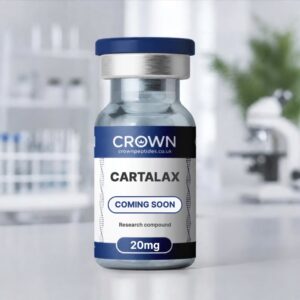
Cartalax Research Peptide
HPLC and MS verified · certificate with every batch · pricing announced when stock arrives
Cartalax vs Epitalon: What Difference Does One Glycine Make?
Because AED is Epitalon without its final glycine, the comparison comes up constantly. The two have been tested side by side in fibroblasts, where both lowered MMP-9, raised Ki-67 and CD98hc, and suppressed apoptosis. In the rat kidney injury model, AEDG normalised a broader set of kidney measures than AED did. In older rats, both had effects on the kidney, but the profiles were not identical.
The research emphasis is also different. Epitalon is best known for telomerase and pineal-related work and sits at the centre of longevity research, which we cover in our Epitalon research guide. Cartalax has been studied more in connective tissue, stem cells and kidney, with a stronger emphasis on matrix enzymes, collagen and sirtuins. If your question is about systemic ageing, Epitalon is the better-documented starting point. If it is about connective tissue cells and the matrix they maintain, Cartalax is the more targeted tool, and running the two together is one of the cleanest experimental designs this family offers.
Cartalax vs Pinealon
Pinealon (EDR) is the other tripeptide in the family and the one with the most neuronal data. The two share the same proposed mechanism, the same institute and similar size, but they have been studied in almost entirely different tissues. Pinealon’s work focuses on neurons and oxidative stress. Cartalax’s focuses on fibroblasts, stem cells and kidney. Neither has been shown to replace the other, and the institute’s own view is that the sequence decides which tissue responds.
How Cartalax Compares With BPC-157, TB-500 and GHK-Cu
Researchers interested in connective tissue usually arrive at Cartalax after reading about the better-known tissue peptides. It helps to be clear about how differently they work.
Cartalax vs BPC-157
BPC-157 is a 15-amino-acid fragment of a gastric protein, studied mostly in injury models of tendon, ligament, muscle and gut, where it has been linked to blood vessel growth and nitric oxide signalling. Cartalax has not been studied in injury models of that kind. Its research is about ageing cells and gene expression rather than acute repair. They answer different questions. Our BPC-157 research guide covers that side of the field.
Cartalax vs TB-500
TB-500 is based on thymosin beta-4, a 43-amino-acid peptide that binds actin and is linked to cell migration. It works on the cell’s structural machinery, not its genes. Combined with BPC-157 it forms the Wolverine Stack, which is aimed at acute repair. Cartalax sits in a different category: a slow, regulatory signal rather than a repair accelerator.
Cartalax vs GHK-Cu
GHK-Cu is the closest comparison. It is also a tripeptide, it is also studied in fibroblasts, and it is also associated with collagen and matrix remodelling. The difference is copper. GHK binds a copper ion, and much of its activity is tied to delivering copper to enzymes involved in matrix building. Cartalax carries no metal and is thought to act through gene regulation. Both raise collagen-related measures in fibroblasts, which makes them a natural pair for comparison studies. See our GHK-Cu research guide for that side of the story.
The Technical Breakdown: Cartalax Structure and Chemistry
This section is for readers who want the chemistry behind the story.
Sequence and charge
The sequence is H-Ala-Glu-Asp-OH. Alanine contributes a small, uncharged methyl side chain. Glutamic acid and aspartic acid each carry a carboxylic acid side chain, and the C-terminus adds another. At neutral pH, those three acid groups are ionised and only the N-terminal amine carries a positive charge, so the molecule has a net charge of about minus two. That makes AED highly water-soluble and strongly acidic, with an isoelectric point well below 4.
Why the charge matters for the DNA model
DNA is itself strongly negatively charged, so a negatively charged peptide binding it needs help. In practice that help comes from metal ions such as magnesium, which can bridge negative groups, and from hydrogen bonding with the edges of the bases in the minor groove. The modelling studies treat these interactions computationally. Whether they happen inside a living nucleus at meaningful levels is still the central open question for the whole family.
Stability
Short peptides with free ends are vulnerable to peptidases, the enzymes that trim peptides from either end, and AED has no protective modifications such as acetylation or amidation. As a dry, lyophilised powder it is stable, but in solution and in biological fluids it should be expected to break down quickly. That is one reason the published cell studies use fresh preparations and nanomolar concentrations.
Concentrations used in published studies
The stem cell and fibroblast work used nanomolar concentrations. For a 333 g/mol molecule, 20mg is about 60 micromoles, which is a very large amount relative to cell culture needs. Getting the dilution maths right matters more than the starting quantity. Our peptide calculator and guide to understanding quantities help with the arithmetic.
Why Purity Matters More Than Usual for Cartalax
A three-residue peptide sounds easy to make, and in one sense it is. The difficulty is that its most likely impurities are also biologically interesting molecules.
If one amino acid fails to couple during synthesis, the result is not a slightly shorter AED. It is a dipeptide such as Ala-Glu or Glu-Asp, a different compound. If a glycine is carried over, you may have AEDG, which is Epitalon. Since the most useful AED experiments compare it directly with AEDG and other close relatives, contamination with any of them makes the comparison meaningless.
What Crown Peptides will check on every batch
Cartalax will be supplied with a batch-specific certificate of analysis. HPLC (high-performance liquid chromatography) measures purity by separating AED from related impurities. Mass spectrometry confirms identity by measuring the molecular mass, which should be about 333 Da, a value clearly different from both AEDG and the possible dipeptides. You can view published certificates on our Lab Reports page. Our guide on how to read a peptide certificate of analysis explains each section, and peptide testing UK covers how testing works across the market.
Handling on arrival
Cartalax arrives as a lyophilised powder and should be stored cold, sealed and dry, as described on our storage information page. Because it dissolves easily, reconstitution is straightforward. Most researchers use Bacteriostatic Water for multi-use vials, and our peptide reconstitution guide walks through the process.
Related Compounds Worth Knowing About
Cartalax sits at the crossroads of two research areas: bioregulator peptides and connective tissue biology. These are the compounds that come up most often alongside it.
Epitalon
The parent sequence, with one extra glycine. Epitalon is the obvious control and comparator for any Cartalax experiment and the best-studied member of the family.
Pinealon
The neuronal tripeptide from the same programme. Useful as a second short-peptide control, since its sequence is different but its size and proposed mechanism are similar.
GHK-Cu and AHK-Cu
Copper tripeptides studied in fibroblasts and matrix remodelling. AHK-Cu differs from GHK-Cu by one amino acid, which makes the pair a neat parallel to the AED and AEDG comparison. Our article on AHK-Cu vs GHK-Cu explains the difference.
BPC-157 and TB-500
The two best-known tissue peptides, aimed at repair rather than ageing. For an overview of how they compare with each other and with newer compounds, see best peptides for joint and tendon research.
NAD+
Cartalax research keeps returning to sirtuins, and sirtuins depend on NAD+ to work. NAD+ is the obvious companion compound for anyone studying the SIRT-1 and SIRT-6 findings above.
For the wider range, browse the musculoskeletal research peptides and ageing and cellular research peptides categories.
Read the certificate before you order
Every batch is published openly — identity by mass spectrometry, purity by HPLC, and the batch number printed on the vial you receive.
Open the COA libraryCommon Questions About Cartalax
Is Cartalax the same as Sigumir?
No. Sigumir is a complex mixture of peptides extracted from the cartilage and bone of young animals. Cartalax is a single, defined synthetic tripeptide, AED, designed to capture part of that extract’s activity. The advantage of the synthetic version is that it can be made reproducibly and verified exactly, which an animal extract cannot.
What is the difference between AED and AEDG?
AED is Cartalax. AEDG is Epitalon. They share the same first three amino acids, and AEDG has a glycine on the end. In side-by-side studies they often move the same markers, but not always, which is what makes the pair useful for working out which parts of the sequence matter.
Has Cartalax been tested on chondrocytes?
Not in any study currently indexed on PubMed. The connective tissue data come from skin fibroblasts and mesenchymal stem cells, and the cartilage claims come from a 2023 review by the developing institute. Direct chondrocyte studies are one of the main gaps in the literature.
Can Cartalax be studied alongside BPC-157 or TB-500?
Nothing published has combined them, but they are mechanistically different enough that a combined design could separate their effects. BPC-157 and TB-500 are studied in acute injury and repair. Cartalax is studied in cellular ageing and gene expression. See our guide to peptide stacking in research before designing anything like that.
Is Cartalax a controlled substance in the UK?
No. Cartalax is not listed under the Misuse of Drugs Act and is not a licensed medicine in the UK, so it can be bought for laboratory research. Our article are peptides legal in the UK explains how UK law treats research peptides.
When will Cartalax be in stock?
Cartalax is listed as coming soon at Crown Peptides, in a 20mg vial. Pricing will be announced when stock arrives and its certificate of analysis has been published.
A Small Signal for a Tissue That Is Hard to Reach
Cartilage keeps its secrets because so little reaches it. That is what makes a three-amino-acid signal an appealing idea. A molecule small enough to slip through transporters, simple enough to make at very high purity and closely related enough to Epitalon to allow clean comparisons is exactly the kind of tool that can answer focused questions.
What the research shows so far is consistent: in ageing fibroblasts, stem cells and kidney cells, AED has been linked to more cell renewal, less matrix breakdown, more collagen I, higher sirtuins and lower ageing markers. What it has not shown yet is just as clear: direct chondrocyte data, independent replication outside the developing institute, and confirmation that the DNA binding modelled on a computer really happens in living cells. Those are not reasons to dismiss Cartalax. They are the most interesting research questions it raises.
If you want to be ready when it lands, keep an eye on Cartalax 20mg Research Peptide. Every batch will come with a certificate confirming its identity by mass spectrometry and its purity by HPLC, dispatched from the UK.
Working with Cartalax Research Peptide
Coming soon to Crown Peptides. Every batch will be HPLC and MS tested, with its certificate published before it goes on sale.
See Cartalax Research Peptide