

Research guide
GHRP-6 Peptide UK: Research, Mechanism and Study Data
GHRP-6 was one of the first growth hormone secretagogues ever synthesised, and much of what came after is a refinement of it. Six residues, and the research that followed.
In 1984, a short paper in the journal Endocrinology described a six-amino-acid molecule that did something no one could explain. It made the pituitary gland release growth hormone, and only growth hormone, in rats, monkeys, lambs, calves and even chicks. It did not work through the hormone that was supposed to control growth hormone release, and it did not act on any receptor anyone knew about. That molecule was GHRP-6, and it started a scientific hunt that would take fifteen years and end with the discovery of the hunger hormone, ghrelin.
GHRP-6 is the original growth hormone releasing peptide, the template from which much of the field was built. This guide tells its story: where it came from, how it works, what research has shown about growth hormone, appetite, bone and, surprisingly, the heart, and how it compares with its younger relatives. Crown Peptides supplies GHRP-6 for laboratory research use only.
What Is GHRP-6?
GHRP-6 stands for growth hormone releasing peptide-6. It is a synthetic hexapeptide, a chain of six building blocks, usually written His-D-Trp-Ala-Trp-D-Phe-Lys-NH2. Two of those building blocks, D-tryptophan and D-phenylalanine, are mirror-image forms of the natural amino acids, and the chain ends in an amidated lysine. Its molecular weight is roughly 873.
GHRP-6 acts on the growth hormone secretagogue receptor, known today as the ghrelin receptor. When it binds, growth hormone-producing cells in the pituitary release a burst of growth hormone, and neurons in the hypothalamus increase the brain’s own growth hormone releasing signal. It also stimulates appetite, much like ghrelin itself.
What does GHRP-6 do in research?
In published studies, GHRP-6 has been shown to release growth hormone across many species, stimulate food intake in rats, increase bone mineral content in rats, and, in a striking study in pigs, reduce the size of heart muscle damage after a heart attack. Each of these findings is covered below with the study named.
A Molecule That Came Before Its Receptor
An accidental discovery
The GHRP-6 story begins in the late 1970s with the American endocrinologist Cyril Bowers at Tulane University. Bowers was studying modified versions of met-enkephalin, one of the body’s own opioid peptides, when he noticed that some of his synthetic molecules made the pituitary release growth hormone. They had essentially no opioid activity. They did not act through GHRH, the hypothalamic hormone that normally drives growth hormone release, which had not even been isolated yet. Something else in the pituitary was responding.
The Endocrinology paper that started a field
Working with the chemist Frank Momany, who used early computer modelling of peptide shapes to guide the design, Bowers refined these molecules into a potent six-amino-acid peptide. In 1984, Bowers, Momany and colleagues described it in Endocrinology (PMID: 6714155).
The findings were remarkable for their specificity. The new hexapeptide produced a dose-related release of growth hormone in laboratory pituitary preparations and in living animals, without releasing LH, FSH, TSH or prolactin, and in limited studies without affecting insulin or glucagon. It was active at very low concentrations in the laboratory. It worked in rats, monkeys, lambs and calves, and under special conditions in chicks, showing it did not depend on a single species. It was active by several routes of administration. After intravenous injection, growth hormone rose within two minutes, peaked at 10 to 20 minutes and usually returned to normal within two hours. The authors concluded the small peptide had the attributes of a hormone acting on the pituitary.
The long search for its receptor
For more than a decade after that paper, GHRP-6 was a key without a known lock. It became the template for a whole family of compounds. A 1998 review in Frontiers in Neuroendocrinology by Camanni, Ghigo and Arvat described how the non-peptide growth hormone secretagogues, including the oral compound MK-0677, were discovered using GHRP-6 as a template (PMID: 9465289). It was while using those compounds that a Merck team finally cloned the receptor in 1996, naming it the growth hormone secretagogue receptor. The review noted that the receptor’s existence strongly suggested a natural hormone that fitted it, one that had not yet been found.
Enter ghrelin
That hormone was discovered in 1999 by Masayasu Kojima, Kenji Kangawa and colleagues in Japan: a 28-amino-acid peptide made mainly in the stomach, which they named ghrelin. It explained why GHRP-6 made animals hungry, because ghrelin is the body’s main hunger signal, and it explained why GHRP-6 released growth hormone, because ghrelin does both. GHRP-6, designed years earlier with no knowledge of ghrelin, had been mimicking it all along. It is one of the neatest examples in modern biology of a synthetic molecule leading scientists to a natural hormone, rather than the other way round, and a reminder of how much can be learned from a compound whose mechanism is not yet understood.
- Classification
- Synthetic hexapeptide growth-hormone secretagogue
- Available strength
- 10mg
- CAS Number
- 87616-84-0
- Molecular Weight
- 873.03 g/mol
- Molecular Formula
- C46H56N12O6
- Sequence
- His-D-Trp-Ala-Trp-D-Phe-Lys-NH2
What GHRP-6 Research Has Shown
Growth hormone release, at every level
GHRP-6’s effect on growth hormone has been confirmed from whole animals down to individual human pituitary cells. In a 1998 study in the Journal of Clinical Endocrinology and Metabolism, Shimon, Melmed and colleagues at Cedars-Sinai found that the ghrelin receptor is present in the human fetal pituitary, and that GHRP-6 increased growth hormone release from cultured human fetal pituitary cells by up to 80% (PMID: 9435437). GHRP-6 also reversed growth hormone suppression caused by IGF-1 or somatostatin, the body’s brakes on release. Combined with GHRH, the effect was additive, up to 2.8-fold. In these fetal cells, GHRP-6 did not change ACTH or prolactin.
The 1998 Camanni review summarised the broader picture: GHRPs are reproducible, dose-related releasers of growth hormone by several routes, their effect is the same in both sexes but rises from birth to puberty and declines with ageing, and their activity is synergistic with GHRH in living systems.
Appetite
GHRP-6 is especially well known for stimulating appetite, and animal research confirms it. In a 2000 study in Neuroscience Letters, Ida and colleagues at Miyazaki University compared several appetite-related peptides in rats and found that GHRP-6, like neuropeptide Y and agouti-related peptide, stimulated food intake in a dose-dependent way over two hours (PMID: 11027848). The study placed GHRP-6 alongside two of the brain’s best-known natural appetite signals, which says a great deal about how strongly it engages the feeding system. That strong appetite effect is one of the main features distinguishing GHRP-6 from more selective relatives such as Ipamorelin, and it makes GHRP-6 a useful tool for studying ghrelin’s role in feeding.
Stress hormones
In the 1998 study that introduced Ipamorelin, Raun and colleagues compared it directly with GHRP-6 and GHRP-2 in pigs (PMID: 9849822). GHRP-6 released growth hormone with potency and efficacy similar to Ipamorelin, and none of the compounds affected FSH, LH, prolactin or TSH. But GHRP-6 and GHRP-2 both raised ACTH and cortisol, while Ipamorelin did not. That stress hormone effect is part of GHRP-6’s research profile and something researchers account for in experimental design.
Bone
In a 2000 study in the Journal of Endocrinology, Svensson and colleagues at Sahlgrenska University Hospital in Gothenburg gave young adult female rats GHRP-6, Ipamorelin, growth hormone or a control continuously for 12 weeks (PMID: 10828840). All three active treatments increased body weight and total bone mineral content in the tibia and vertebrae measured by DXA scanning. Detailed analysis showed the increase came from larger bones, with greater cross-sectional area and volume, much as with growth hormone itself.
The heart: a surprising line of research
One of the most striking GHRP-6 studies came from the Center for Genetic Engineering and Biotechnology in Havana. In a 2007 study in Clinical Science, Berlanga and colleagues studied pigs in which a coronary artery was completely blocked for one hour, simulating a heart attack, followed by 72 hours of restored blood flow (PMID: 16989643). Animals were randomly assigned GHRP-6 or saline.
The results were dramatic. Infarct mass, the amount of dead heart muscle, was reduced by 78% and infarct thickness by 50% in the GHRP-6 group compared with saline. More than half the GHRP-6-treated pigs showed none of the ECG signs of heart muscle death in any lead. Blood markers of heart damage and inflammation, and detailed tissue analysis, confirmed less necrosis. Markers of oxidative stress suggested GHRP-6 protected the heart partly by reducing reactive oxygen species and preserving antioxidant defences, and local IGF-1 expression in the heart was also affected. GHRP-6 did not change mortality during surgery. The authors concluded that GHRP-6 has antioxidant effects that may partly explain its reduction of ischaemic heart damage.
A second receptor in the heart
Why would a growth hormone peptide protect heart muscle? Part of the answer may be a second receptor. In a 2002 study in Circulation Research, Bodart, Ong and colleagues in Montreal searched for the target responsible for the cardiovascular effects of hexarelin, a close relative of GHRP-6 in the same family (PMID: 11988484). They identified CD36, a multifunctional protein found on heart muscle cells and the cells lining small blood vessels, as a binding site for growth hormone releasing peptides in the heart, and showed that the cardiovascular response to hexarelin was missing in hearts lacking CD36. That discovery suggested GHRPs can act in the heart through a route entirely separate from the ghrelin receptor and from growth hormone itself.
The gut
Because ghrelin is made in the stomach and influences how the gut moves, GHRP-6 has also appeared in gastrointestinal research. In a 2009 study in the Journal of Pharmacology and Experimental Therapeutics on postoperative ileus, the temporary shutdown of bowel movement after abdominal surgery, GHRP-6 was used as a reference compound alongside Ipamorelin in rats (PMID: 19289567). A single dose of GHRP-6 decreased the time to first bowel movement after surgery, illustrating how the ghrelin receptor’s reach extends well beyond the pituitary.
More heart research across the family
The cardiac findings for GHRP-6 sit within a broader body of work on the GHRP family and the heart. Hexarelin, a close relative, has been studied extensively in this area. A 2014 review in the Journal of Geriatric Cardiology surveyed hexarelin’s cardiovascular actions (PMID: 25278975, PMC4178518), and a 2017 study in International Heart Journal reported that hexarelin protected rat heart muscle cells from ischaemia-reperfusion injury in living animals through an interleukin-1 signalling pathway (PMID: 28321024). Together with the pig study and the CD36 discovery, this work has made the heart one of the most intriguing secondary research areas for growth hormone releasing peptides.
Growth Hormone, Sleep and Timing
Much of the interest in GHRP-6 and its relatives comes back to the natural rhythm of growth hormone. In healthy people, the largest pulse of the day is closely tied to sleep. A 1992 study in the Journal of Clinical Endocrinology and Metabolism by Van Cauter, Thorner and colleagues quantified growth hormone secretion across day and night in healthy men and examined its relationship with sleep and time of day (PMID: 1592892). Because GHRP-6 produces a short burst, peaking 10 to 20 minutes after intravenous injection in the original 1984 animal studies and returning to baseline within about two hours, it behaves much like a natural pulse rather than a sustained signal. That pulse-like behaviour is part of why researchers value the GHRP family for studying growth hormone physiology.
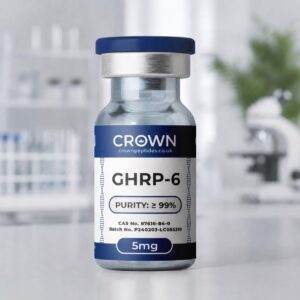
GHRP-6 Research Peptide
HPLC and MS verified · batch certificate published · dispatched from the UK before 2pm
Why GHRP-6 Became the Template for a Whole Class
GHRP-6’s influence stretches well beyond its own research. Once it was clear that a small synthetic peptide could release growth hormone through an unknown receptor, pharmaceutical chemists set out to find molecules that could do the same while being easier to make and able to be taken by mouth. Using GHRP-6 as their reference point, researchers at Merck developed a series of non-peptide compounds, culminating in MK-0677, better known as ibutamoren. Those compounds, in turn, were the bait used to clone the receptor in 1996. In a very real sense, GHRP-6 is the ancestor of every ghrelin receptor agonist that followed, peptide or not, and of the discovery of ghrelin itself.
GHRP-6 Compared With Its Relatives
GHRP-6 is the oldest member of a family, and understanding how it differs from the others helps researchers choose.
GHRP-6 vs GHRP-2
GHRP-2 came later from the same research programme and is more potent at releasing growth hormone; it became a diagnostic agent in Japan under the name pralmorelin. GHRP-6 has the stronger reputation for stimulating appetite. Both raised ACTH and cortisol in the Novo Nordisk comparison. See GHRP-2 vs GHRP-6.
GHRP-6 vs Ipamorelin
Ipamorelin was designed specifically to release growth hormone without the stress hormone effects of GHRP-6 and GHRP-2. In the 1998 comparison, it matched GHRP-6’s growth hormone potency without raising ACTH or cortisol, and its appetite effect is generally described as less prominent. See Ipamorelin vs GHRP-2 for the family comparison.
GHRP-6 vs GHRH analogues
Sermorelin, Tesamorelin and CJC-1295 act on the GHRH receptor, a different door into the same pituitary cells. Because the two pathways combine, GHRPs and GHRH analogues are often studied together; see the two-pathway approach.
Choosing GHRP-6 for a Research Question
When GHRP-6 is the right tool
GHRP-6 suits research on ghrelin receptor biology in its fullest form, including appetite and feeding behaviour, where its strong appetite effect is a feature rather than a side effect. It is the historical reference compound for the whole GHRP class, making it valuable in comparative studies. And its cardioprotection and CD36 research make it of particular interest in cardiovascular models.
When another compound may fit better
If the aim is growth hormone release with minimal stress hormone or appetite effects, Ipamorelin is usually the cleaner choice. If maximum growth hormone potency is the goal, GHRP-2 is typically stronger.
Designing around its effects
Because GHRP-6 influences growth hormone, appetite and, to a degree, ACTH and cortisol, well-designed studies measure all three where relevant, and often include a more selective comparator such as Ipamorelin to separate growth hormone effects from the others.
Account for feeding
Because GHRP-6 stimulates appetite, any study measuring body weight, body composition or metabolism needs to record food intake. Otherwise, it is impossible to tell whether an effect comes from growth hormone signalling or simply from animals eating more. Pair-feeding designs, in which control animals receive the same amount of food, are one way to separate the two.
The Technical Breakdown: Why This Structure Works
This section is for readers who want the chemistry and pharmacology.
Designed by computer, before computers were common
Frank Momany’s contribution was unusual for its time. In the late 1970s and early 1980s, he used conformational energy calculations to predict the three-dimensional shapes of candidate peptides and guide which modifications to try. GHRP-6 was one of the earliest examples of a biologically active peptide shaped in part by computer modelling, a technique now central to drug design.
The role of the D-amino acids
GHRP-6’s D-tryptophan and D-phenylalanine resist the enzymes that normally break down peptides, which are built to recognise natural L-amino acids. Their large aromatic side chains are also thought to be essential for fitting into the ghrelin receptor’s binding pocket. The alternating pattern of aromatic residues gives the molecule a shape that mimics key features of ghrelin’s active region.
Two tryptophans
GHRP-6 contains two tryptophans, one in the D form and one in the L form. Tryptophan is one of the amino acids most prone to oxidation, which is relevant for storage and handling, and its distinctive absorbance of ultraviolet light is useful in HPLC analysis.
The ghrelin receptor signal
At the pituitary, GHRP-6 binding to GHS-R1a mainly activates a Gq protein, which switches on phospholipase C. That generates IP3, releasing calcium from stores inside the cell, and diacylglycerol, activating protein kinase C. The rise in calcium triggers growth hormone release. At the hypothalamus, the same receptor on GHRH neurons and appetite-regulating neurons increases GHRH release, reduces somatostatin and stimulates feeding circuits, including neurons that produce neuropeptide Y and agouti-related peptide.
The CD36 route
CD36 is a scavenger receptor involved in fatty acid uptake and in recognising oxidised lipids. Its identification as a binding site for GHRPs in the heart suggests that some of GHRP-6’s cardiovascular effects may be independent of growth hormone and of the ghrelin receptor, an idea that continues to drive research on the cardiac biology of the whole GHRP family.
Why Verification Matters for GHRP-6
Short peptides with unusual building blocks bring specific quality challenges. GHRP-6’s two D-amino acids must be correct: a version with an L-amino acid in the wrong place would have exactly the same mass but could behave differently, so a clean HPLC profile from reliable synthesis matters. Its tryptophans can oxidise if poorly stored.
GHRP-6 also has a documented history of lookalikes. In 2018, anti-doping scientists in Cologne analysing black market products reported a version of GHRP-6 extended by a single glycine at the front, alongside similar analogues of GHRP-2 and Ipamorelin (PMID: 29864719). Only mass spectrometry reliably catches such changes.
The Crown Peptides standard
Every batch of GHRP-6 supplied by Crown Peptides comes with a batch-specific certificate of analysis showing HPLC purity and mass spectrometry identity confirmation, with lot numbers matching those on vial labels. Published certificates are on our Lab Reports page, and our guides to peptide testing and reading a certificate of analysis explain the methods.
Handling
GHRP-6 is supplied as a lyophilised powder and should be stored cold, dry and away from light, with care to limit air exposure because of its oxidation-prone tryptophans. Our guides to peptide reconstitution, how long peptides last and the peptide calculator cover the practical side, and Bacteriostatic Water is available alongside.
Related Compounds in the Growth Hormone and Appetite Systems
The GHRP family
GHRP-2 and Ipamorelin are GHRP-6’s closest relatives. Our GHRP-2 guide, GHRP-2’s story as a diagnostic drug and Ipamorelin guide cover them in depth.
GHRH analogues and combinations
Sermorelin, Tesamorelin, CJC-1295 with DAC and the CJC-1295 (No DAC) + Ipamorelin (Blend) act on or alongside the GHRH pathway.
Downstream and metabolic
IGF-1 LR3 lets researchers study the downstream hormone, while GHRP-6’s appetite research connects it to the wider metabolic research peptides category. Browse the full group in our endocrine and hormonal research peptides category.
Read the certificate before you order
Every batch is published openly — identity by mass spectrometry, purity by HPLC, and the batch number printed on the vial you receive.
Open the COA libraryGHRP-6 Questions, Answered
What is GHRP-6?
A synthetic six-amino-acid peptide, His-D-Trp-Ala-Trp-D-Phe-Lys-NH2, that releases growth hormone through the ghrelin receptor. It was first described in 1984 and is the original member of the growth hormone releasing peptide family.
Why does GHRP-6 affect appetite?
Because it mimics ghrelin, the body’s main hunger hormone, at the ghrelin receptor. Research in rats has shown it stimulates food intake in a dose-dependent way.
Is GHRP-6 the same as GHRP-2?
No. They are relatives from the same research programme. GHRP-2 is more potent at releasing growth hormone, while GHRP-6 has a stronger appetite effect.
What is the heart research on GHRP-6?
A 2007 study in pigs found GHRP-6 reduced infarct mass by 78% after an induced heart attack, with evidence of reduced oxidative stress. Related research identified CD36 as a possible cardiac binding site for growth hormone releasing peptides.
Why was GHRP-6 so important historically?
Because it was the first well-characterised peptide to release growth hormone through a receptor other than the GHRH receptor. It became the template for later compounds, including the non-peptide secretagogues used to clone the ghrelin receptor in 1996, which led in turn to the discovery of ghrelin in 1999.
How quickly does GHRP-6 act?
In the original 1984 animal studies, growth hormone rose within two minutes of intravenous injection, peaked at 10 to 20 minutes and usually returned to normal within about two hours.
Does GHRP-6 affect other pituitary hormones?
The 1984 paper found no release of LH, FSH, TSH or prolactin. The later Novo Nordisk comparison in pigs found GHRP-6 did raise ACTH and cortisol, which is why more selective relatives such as Ipamorelin were developed.
Is GHRP-6 legal in the UK?
GHRP-6 is not a controlled drug in the UK and is available as a research material. It is on the WADA Prohibited List for athletes. See are peptides legal in the UK for the full picture.
The Peptide That Found a Hormone
GHRP-6 has one of the most unusual origin stories in endocrinology. It was built from opioid fragments, shaped with the help of early computer modelling, and shown in 1984 to release growth hormone through a receptor nobody could find. For fifteen years it pointed at a gap in biology, until the discovery of its receptor and then of ghrelin revealed what it had been imitating all along. Since then it has been shown to release growth hormone from human pituitary cells, to drive appetite, to build bone in rats and, in a striking study in pigs, to shrink the damage of a heart attack.
For researchers, it remains the reference point for the whole class and a uniquely broad tool for studying the ghrelin system. Explore GHRP-6 from Crown Peptides, every batch HPLC and mass spectrometry verified and dispatched from the UK.
Working with GHRP-6 Research Peptide
Batch-tested material, published certificates, and same-day dispatch on orders placed before 2pm.
See GHRP-6 Research Peptide