

Research guide
Eloralintide Peptide UK: Amylin Research, Mechanism and Study Data
A once-weekly amylin analogue built to favour one receptor over the rest. What the preclinical, phase 1 and 48-week phase 2 data on Eloralintide actually show, and what phase 3 still has to answer.
Every time you eat, your pancreas releases two hormones at once. One is insulin, which everyone has heard of. The other is amylin, which almost nobody has. Amylin’s job is quieter: it tells the brain that a meal is under way, slows how quickly the stomach empties and holds back glucagon, the hormone that pushes blood sugar up. For decades it was treated as a footnote to insulin. Over the last few years it has become one of the most closely watched hormones in metabolic research.
Eloralintide is a big part of the reason. It is a long-acting, engineered version of amylin, developed by Eli Lilly under the code LY3841136 and designed to switch on one particular amylin receptor more than the others. In a 48-week phase 2 trial published in The Lancet, it produced average weight reductions of up to 20%, and it is now in phase 3. This guide explains what amylin does, how Eloralintide was built, what each stage of the published research found, and how it compares with the GLP-1 medicines that dominate the conversation. Eloralintide is sold by Crown Peptides strictly for laboratory research use only, and everything below is written for readers interested in the science.
What Is Eloralintide, and Why Is Amylin Suddenly Everywhere?
Eloralintide is a synthetic peptide analogue of amylin, a 37-amino-acid hormone made by the same beta cells in the pancreas that make insulin. It has a molecular weight of roughly 4,526 and the CAS number 2883634-40-8. It is still in development and is not an approved medicine anywhere in the world.
The reason amylin is suddenly everywhere is simple. GLP-1 based medicines such as semaglutide showed that hormone signals from the gut and pancreas can drive large, sustained weight loss. Researchers then asked which other meal-related hormones could do the same thing, perhaps in a different way or with fewer side effects. Amylin was the obvious candidate. It acts in a different part of the appetite system, it is released alongside insulin at every meal, and earlier work had already shown it could reduce food intake.
What does amylin actually do?
Amylin has three main effects. It slows gastric emptying, so food leaves the stomach more gradually. It suppresses glucagon after meals, which helps keep blood sugar steady. And it acts on the brain, particularly the area postrema in the brainstem, to promote satiation, the feeling that a meal is finished. Put together, those effects make amylin a natural brake on how much and how fast we eat.
Why not just use natural amylin?
Human amylin has two practical problems. It clumps together into fibrils, which makes it unstable and impossible to formulate as a drug. And it lasts only minutes in the bloodstream. The first approved amylin-based medicine, pramlintide, solved the clumping problem by borrowing a few amino acids from rat amylin, which does not aggregate. But pramlintide still had to be injected before every meal and produced only modest weight loss. Eloralintide is part of a new generation designed to fix the second problem as well.
From Pramlintide to a Once-Weekly Design
The story of Eloralintide is really a story of engineering. Each change to the amylin template was made to solve a specific problem.
Problem one: amylin falls apart
Eloralintide uses a modified amino acid sequence that resists the aggregation natural human amylin is prone to, and it includes several unusual amino acids that make it harder for enzymes to cut. That gives a molecule that stays soluble and intact.
Problem two: amylin disappears quickly
To keep it in circulation for days rather than minutes, Eloralintide carries a fatty acid chain attached to a lysine side chain. That fatty acid lets the peptide bind albumin, the most abundant protein in the blood. While it is bound to albumin, it is shielded from the kidneys and from enzymes, and it is released slowly over time. This is the same half-life extension strategy used in other once-weekly peptides, and it is why the phase 1 data supported once-weekly dosing.
Problem three: amylin hits more than one receptor
This is the part that makes Eloralintide different, and it needs its own section.
- Classification
- Selective amylin receptor agonist research peptide
- Available strengths
- 5mg and 10mg (coming soon)
- CAS Number
- 2883634-40-8
- Molecular Weight
- approximately 4,526 g/mol
- Molecular Formula
- C201H319N49O65S2
Three Receptors, One Target: How Eloralintide Works
Amylin does not have a single receptor. It acts through a family of receptors built from two parts. The core is the calcitonin receptor (CTR), the same receptor that responds to the hormone calcitonin. When CTR pairs with one of three helper proteins called RAMPs (receptor activity-modifying proteins), it becomes an amylin receptor. CTR with RAMP1 forms AMY1, CTR with RAMP2 forms AMY2, and CTR with RAMP3 forms AMY3. On its own, CTR still responds to some amylin analogues too.
Earlier long-acting amylin analogues were designed to activate the whole set more or less equally, including the calcitonin receptor. Eloralintide was designed to prefer AMY1. In human receptor assays, it activated AMY1 about 12 times more potently than the calcitonin receptor and about 11 times more potently than AMY3 (PMID: 41109426).
Why would selectivity matter?
The leading hypothesis is that different receptors in the brainstem contribute differently to two outcomes: feeling satisfied and feeling unwell. A 2026 review in Pharmacological Research argues that calcitonin receptor engagement, exposure levels and the neural circuits recruited may decide whether reduced food intake reflects normal satiation or an aversive signal such as nausea (PMID: 42586227). If that is right, a molecule that favours AMY1 might reduce food intake with less of the queasiness that limits many appetite-related compounds.
Conditioned taste avoidance: the rat test for nausea
Rats cannot vomit, so researchers use a clever proxy. If a rat is given a new flavour at the same time as a compound that makes it feel unwell, it will avoid that flavour afterwards. This is called conditioned taste avoidance. In Lilly’s preclinical work, Eloralintide produced significantly less taste avoidance in lean rats than a non-selective amylin receptor agonist (PMID: 41109426). That result is a large part of the scientific rationale for the whole selective-AMY1 approach.
What the Published Research Has Actually Found
Unlike many research peptides, Eloralintide has a complete, recent and well-documented development record, from cell assays to a large randomised trial. Here it is in order.
Preclinical: rats and monkeys
The 2025 discovery paper in Molecular Metabolism described the full translational package (PMID: 41109426).
Food intake and body weight
In diet-induced obese rats, Eloralintide reduced food intake and body weight in a dose-dependent way, and the weight lost came mainly from fat mass rather than lean tissue.
Receptor profile across species
In rats, both AMY1 and AMY3 were activated more potently than the calcitonin receptor, so the receptor pattern was not identical to humans. That kind of species difference is a common reason preclinical results do not translate perfectly.
Pharmacokinetics
Both rats and monkeys showed favourable pharmacokinetics, meaning the peptide stayed in circulation long enough to justify moving into people.
Phase 1: the first doses in people
The same paper reported a single-ascending-dose trial in 48 healthy participants with an average BMI of 27.5 (NCT05295940). Single doses ranged from 0.04mg to 12mg. Nine participants in the Eloralintide groups reported 16 adverse events, and 15 of the 16 were mild. Only two participants reported gastrointestinal events. The pharmacokinetics supported once-weekly dosing.
Even a single dose had a measurable effect. Four weeks after one dose, average body weight had fallen 2.5% with 4mg and 4.4% with 12mg, compared with a 0.6% gain on placebo.
Phase 1: twelve weeks of weekly dosing
A multiple-ascending-dose study published in Diabetes, Obesity and Metabolism followed 100 people with obesity or overweight (average BMI 32.6) at three US centres for 12 weeks of weekly injections (PMID: 41559929). Notably, participants started at their assigned dose without the gradual dose escalation usually needed with appetite-related peptides.
By week 12, average weight reduction across the dose groups ranged from 2.6% to 11.3%. Drug exposure rose in proportion to the dose. The most common adverse events were decreased appetite (19%), headache (12%) and fatigue (11%). Gastrointestinal events were relatively infrequent: diarrhoea in 10%, nausea in 8% and vomiting in 4%. There were no deaths, and the one serious adverse event was judged unrelated to the compound.
Phase 2: the 48-week Lancet trial
The defining study so far is a phase 2 trial published in The Lancet in December 2025 (PMID: 41207310, NCT06230523). It enrolled 263 adults across 46 US research centres, all with a BMI of 30 or more, or 27 or more with at least one weight-related condition, and none with type 2 diabetes. Their average starting weight was 109.1kg and average BMI 39.1.
Participants received weekly placebo or Eloralintide at fixed doses of 1mg, 3mg, 6mg or 9mg, or one of two escalation schemes (6mg to 9mg, or 3mg to 9mg), for 48 weeks. The average change in body weight was:
- 1mg: about 9% reduction
- 3mg: about 12% reduction
- 6mg: about 18% reduction
- 9mg: about 20% reduction
- 6mg to 9mg: about 20% reduction
- 3mg to 9mg: about 16% reduction
- Placebo: about 0.4% reduction
The most common adverse events were nausea and fatigue, and both became more frequent at higher doses. Nausea was reported by 11% at 1mg and 64% at 6mg, against 14% on placebo. Fatigue ranged from none at 1mg to 46% in the 6mg to 9mg group, against 12% on placebo. So the low nausea rates seen in the shorter phase 1 study did not fully hold at the higher doses over 48 weeks. The trial was funded by Eli Lilly.
Reading the dose-response curve
Two details in those numbers are worth noticing. First, the curve flattens at the top: 9mg and the 6mg to 9mg escalation landed in the same place, at about 20%, which suggests the trial was approaching the ceiling of what the compound does on its own over 48 weeks. Second, the 3mg to 9mg escalation finished lower, at about 16%, despite reaching the same final dose. A slower climb means less time at the top dose, so less total exposure over the trial. It also hints at a trade-off researchers will be watching in phase 3: starting low may help tolerability, but it may cost some of the effect. Separating dose, time at dose and side effects is exactly the kind of question that controlled laboratory work can sharpen.
Beyond the scales: cardiometabolic markers
A 2026 review in Cardiology in Review pulled together the early data on heart and metabolic markers (PMID: 42745233). Alongside weight loss, the studies reported reductions in blood pressure, lipids and high-sensitivity C-reactive protein, an inflammation marker. The finding that stood out was a fall in pulse rate, which contrasts with the small rise in heart rate seen with GLP-1 receptor agonists. The authors are careful to note that no amylin-based compound has yet completed a cardiovascular outcomes trial, so these are early signals rather than proof of benefit.
Phase 3: where the research is now
Lilly moved Eloralintide into phase 3 in early 2026. Two registered studies are recruiting. The first (NCT07321886) plans to enrol about 1,980 people with obesity, or overweight without type 2 diabetes, testing Eloralintide on its own. The second (NCT07392190) plans to enrol about 900 people with persistent obesity who are already on a weekly incretin medicine, testing Eloralintide added on top. Primary completion for both is expected in 2028.
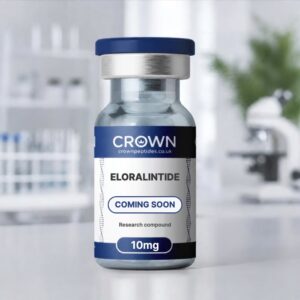
Eloralintide Research Peptide
HPLC and MS verified · certificate with every batch · pricing announced when stock arrives
Eloralintide vs GLP-1 Peptides: Same Goal, Different Route
The comparison everyone wants is with GLP-1 based compounds such as semaglutide and tirzepatide. Both approaches reduce appetite, but they get there through different hormones, different receptors and partly different brain circuits.
GLP-1 is released by the gut and acts on receptors in the pancreas, stomach and brain, especially the hypothalamus. Amylin is released by the pancreas and acts mainly on the brainstem. GLP-1 compounds boost insulin release when blood sugar is high. Amylin does not directly boost insulin, but it does suppress glucagon. That difference is why researchers see the two pathways as complementary rather than competing, and why one of the two phase 3 trials is testing Eloralintide on top of an incretin. If you are new to how GLP-1 peptides changed the field, our article is Ozempic a peptide? is a good starting point.
How big are the effects compared with each other?
Cross-trial comparisons are always rough, because trials differ in who they enrol, how long they last and how they handle dropouts. With that warning, a 2026 network meta-analysis of six amylin-based trials found that high-dose Eloralintide reduced body weight by about 18% more than placebo, compared with about 11.5% for semaglutide 2.4mg in the trials included (PMID: 42175595). The authors described the evidence as sparse and low-certainty, so the ranking should be treated as preliminary.
The side-effect profile looks different
GLP-1 compounds are known for nausea, vomiting and diarrhoea, especially when the dose is increased. A 2026 narrative review comparing new amylin-based compounds noted that Eloralintide, as an AMY1-focused monoagonist, seems to have a distinct pattern of adverse events, with more fatigue, headache and loss of appetite (PMID: 42803913). Understanding why that pattern differs is one of the most active research questions about the whole amylin class.
Where Eloralintide Sits in the New Amylin Class
Eloralintide is not alone. Reviews published in 2026 list a growing group of long-acting amylin-based compounds in clinical development, including petrelintide, MET-233i, AZD6234 and ABBV-295, as well as amycretin (now zenagamtide), a single molecule that activates both amylin and GLP-1 receptors (PMID: 42452898, PMID: 41747885). They differ mainly in how selective they are, how long they last and whether they act on amylin receptors alone or alongside other targets.
Within that group, Eloralintide’s identity is clear: a pure amylin analogue, given weekly, designed to favour AMY1 over the calcitonin receptor. That makes it a particularly useful research tool for one specific question: what happens when you push the amylin pathway on its own, with as little calcitonin receptor activity as possible?
The Technical Breakdown: Eloralintide Structure and Chemistry
This section is for readers who want the molecular detail.
The amylin backbone
Native human amylin is 37 amino acids long, with a disulphide bridge between cysteines at positions 2 and 7 that forms a small ring near the N-terminus, and an amidated C-terminus. Both features matter for receptor activity in natural amylin and in the analogues built from it. Eloralintide is built on that amylin template but substitutes residues along the chain, including non-standard amino acids, to reduce aggregation and resist enzyme cleavage.
The lipid side chain
A fatty acid is attached to a lysine side chain through a linker. This is the albumin-binding feature that gives the molecule its long half-life. It also makes Eloralintide behave somewhat differently from an ordinary water-soluble peptide in the lab: lipidated peptides can stick to some plastics once dissolved, so researchers often use low-binding tubes and check recovery when preparing working solutions.
Molecular identity
With a molecular weight of about 4,526, Eloralintide is a large research peptide. That size, along with the lipid chain and non-standard residues, makes synthesis harder than for short peptides, with more chances for deletion sequences and incomplete modifications. It is the main reason analytical verification matters so much for this compound.
Doses used in the trials
The clinical trials used weekly doses between 1mg and 9mg, with single doses up to 12mg in phase 1. Those figures are useful context for understanding the pharmacology. They are not guidance for laboratory work, where concentrations depend entirely on the assay. Our peptide calculator and understanding quantities guide help with the maths for research solutions.
Why Purity Matters More Than Usual for a Lipidated Peptide
For a short peptide, an impurity is usually a slightly shorter chain. For a large, modified peptide like Eloralintide, the possibilities are wider. A chain can be missing one residue somewhere in the middle. The lipid side chain can be missing or only partly attached. Structural features borrowed from amylin, such as its small N-terminal ring, can be formed incorrectly. Each of those products could look broadly similar on a crude test and behave very differently at the receptor.
For receptor selectivity work in particular, that matters. The entire scientific interest in Eloralintide is its preference for AMY1 over the calcitonin receptor. A contaminant with a different receptor profile could blur exactly the effect you are trying to measure.
What Crown Peptides will check on every batch
Eloralintide will be supplied with a batch-specific certificate of analysis. HPLC measures purity by separating the full-length lipidated peptide from related impurities. Mass spectrometry confirms identity by measuring the molecular mass, which for a molecule this size is the most reliable way to show that the full chain and the lipid modification are both present. Certificates are published on our Lab Reports page. Our guide on how to read a peptide certificate of analysis explains what each section means, and how to tell if peptides are real covers what to watch for when sourcing large peptides.
Handling on arrival
Eloralintide arrives as a lyophilised powder and should be kept cold, sealed and away from moisture, as described on our storage information page. Most researchers reconstitute with Bacteriostatic Water for multi-use vials. Our peptide reconstitution guide walks through the process, and our guide to how long peptides last covers stability once a vial is opened.
Related Compounds Worth Knowing About
Eloralintide is a tool for studying appetite and energy balance from the hormone side. These compounds approach metabolic research from other angles and are often studied alongside it.
MOTS-c
MOTS-c is a peptide encoded by mitochondrial DNA and studied for its effects on how muscle cells handle glucose and energy. Where Eloralintide works on how much energy comes in, MOTS-c is studied for how cells use it.
5-Amino-1MQ
5-Amino-1MQ blocks NNMT, an enzyme active in fat cells. It is a small molecule rather than a peptide and works inside fat tissue rather than through the brain. Our article 5-Amino-1MQ: blocking the enzyme that tells fat cells to store explains the mechanism.
AOD-9604
AOD-9604 is a fragment of growth hormone studied for its effects on fat breakdown, without the growth-promoting effects of the full hormone.
L-Carnitine
L-Carnitine carries fatty acids into mitochondria to be burned. It is the logical companion for any study that looks at fat mass loss and what happens to the released fat.
For an overview of the wider field, see best peptides for weight loss research, or browse the metabolic research peptides and endocrine and hormonal research peptides categories.
Read the certificate before you order
Every batch is published openly — identity by mass spectrometry, purity by HPLC, and the batch number printed on the vial you receive.
Open the COA libraryCommon Questions About Eloralintide
What is the AMY1 receptor?
AMY1 is one of three amylin receptors. It is made when the calcitonin receptor pairs with a helper protein called RAMP1. Eloralintide was designed to activate AMY1 more strongly than the other amylin receptors and the calcitonin receptor on its own, which is what researchers mean when they call it selective.
How is Eloralintide different from pramlintide?
Pramlintide was the first approved amylin analogue. It solved amylin’s tendency to clump, but it lasts only hours and has to be injected before each meal. Eloralintide adds a lipid chain for albumin binding, which supports once-weekly dosing, and it is built to favour the AMY1 receptor. In trials it has also produced much larger weight reductions than pramlintide did.
Is Eloralintide approved as a medicine?
No. Eloralintide is still in clinical development and has not been approved by any regulator. Phase 3 trials began in 2026, with primary results not expected until 2028.
Does Eloralintide affect blood sugar?
Amylin suppresses glucagon after meals and slows gastric emptying, both of which influence blood sugar. However, the phase 2 trial specifically excluded people with type 2 diabetes, so dedicated glucose data in that population are still to come. It is a gap the research has not yet filled.
Is Eloralintide a controlled substance in the UK?
No. Eloralintide is not listed under the Misuse of Drugs Act and, because it is not an approved medicine, it can be bought for laboratory research. Our article are peptides legal in the UK explains how UK law treats research peptides.
When will Eloralintide be in stock?
Eloralintide is listed as coming soon at Crown Peptides in 5mg and 10mg vials. Pricing will be announced when stock arrives and the first certificate of analysis is published.
The Hormone That Was Always There
Amylin has been released alongside insulin after every meal for as long as humans have eaten. What changed is not the biology but the engineering. Eloralintide takes a hormone that clumped, vanished within minutes and acted on several receptors at once, and turns it into a stable, once-weekly molecule that prefers one receptor over the rest.
The results so far follow a clear line: less taste avoidance than a non-selective comparator in rats, weight loss after a single dose in phase 1, and reductions of up to about 20% over 48 weeks in phase 2, with signals on blood pressure, pulse and inflammation along the way. The open questions are equally clear. Does selectivity really protect against nausea at higher doses? What explains the fatigue signal? How does it work alongside incretin-based compounds? And do the cardiometabolic changes hold up in larger, longer studies? Phase 3 will answer some of these. Laboratory research will be needed for the rest.
If you want to be ready when it lands, keep an eye on Eloralintide Research Peptide. Every batch will come with a certificate confirming its identity by mass spectrometry and its purity by HPLC, dispatched from the UK.
Working with Eloralintide Research Peptide
Coming soon to Crown Peptides. Every batch will be HPLC and MS tested, with its certificate published before it goes on sale.
See Eloralintide Research Peptide