

Research guide
Sermorelin Peptide UK Guide: Research, Mechanism and Study Data
Sermorelin is GRF (1-29) - the shortest piece of GHRH that still works. Why twenty-nine residues is the cut-off, and what the research on it shows.
RESEARCH USE DISCLAIMER
Crown Peptides supplies sermorelin as a laboratory research compound only. It is not currently approved by the FDA, MHRA, or EMA for any use, and our products are not intended for human consumption and are not sold, marketed, or labelled for the diagnosis, treatment, cure or prevention of any disease. Nothing in this document should be read as medical advice or as an endorsement of human use. The discussion below summarises published scientific and regulatory literature only, and is intended for researchers and students of endocrinology.
Sermorelin holds a genuinely unusual position among growth hormone-releasing peptides: it is one of the few compounds in this entire research category with a real, completed FDA approval history behind it, rather than being a purely investigational research chemical from the outset. Originally marketed as Geref for paediatric growth hormone deficiency, its branded approval was later withdrawn — not for safety reasons, but for commercial ones — leaving sermorelin in an interesting regulatory position that this article covers in detail.
This article summarises what the published pharmacological and clinical literature shows about sermorelin’s mechanism, its historical paediatric approval, and the considerably thinner evidence base behind its more recent adult research applications, while being clear throughout about what has and hasn’t been directly demonstrated.
What Is Sermorelin Peptide?
Sermorelin (sermorelin acetate) is a synthetic 29-amino-acid peptide corresponding to the biologically active N-terminal fragment of human growth hormone-releasing hormone, commonly referenced in the literature as GHRH(1-29). This fragment retains the full receptor-activating capacity of the complete 44-amino-acid native GHRH molecule while being more practical to synthesise, following the same general fragment-isolation logic that recurs throughout this article series.
Sermorelin was developed by the German pharmaceutical firm EMD Serono and received FDA approval in 1990 (with additional approvals through the 1990s) under the brand name Geref, indicated for the diagnosis and treatment of growth hormone deficiency in children, and separately used as a diagnostic agent to assess pituitary GH secretory capacity in both children and adults.
Why the Geref Brand Was Withdrawn — And Why That Matters
It’s worth being precise about a detail that’s frequently misunderstood or glossed over in secondary sources: sermorelin’s branded product, Geref, was discontinued from the US market in 2008 for commercial reasons — reported as relating to the limited size of the diagnostic testing market and the availability of competing diagnostic approaches — rather than because of any safety or efficacy finding. This is a meaningfully different situation from a drug withdrawn following adverse safety signals, and it’s an important distinction for researchers trying to understand sermorelin’s actual regulatory history rather than assuming discontinuation implies a safety problem that was never actually documented.
Today, sermorelin remains legally available in some jurisdictions through licensed compounding pharmacies as a prescription formulation for adult off-label use, a genuinely different regulatory pathway from the unapproved research-chemical status of most compounds discussed elsewhere in this article series. Crown Peptides supplies sermorelin strictly as a laboratory research compound, separate from any compounded clinical formulation.
Sermorelin Mechanism: How It Stimulates Natural GH Release
Sermorelin acts as an agonist at the GHRH receptor (GHRH-R) on pituitary somatotroph cells, stimulating both the synthesis and pulsatile release of endogenous growth hormone. Because it works upstream — amplifying the hypothalamic signal that naturally triggers GH release, rather than supplying GH directly — the pituitary’s own negative feedback loop via somatostatin and circulating IGF-1 remains intact throughout, meaning sermorelin-stimulated GH release preserves a physiological pulsatile pattern rather than producing the flat, continuous elevation associated with direct recombinant GH administration.
This mechanistic distinction is the same rationale underlying tesamorelin and CJC-1295 (both covered in separate Crown Peptides research reviews): a GHRH analogue amplifies the body’s own regulated signal rather than overriding it, which researchers have proposed as one reason GHRH-axis compounds tend to produce a different, generally more favourable side-effect profile than direct GH replacement, since the risk of supraphysiological GH exposure and its associated downsides (fluid retention, joint pain, insulin resistance) is substantially reduced when the pituitary’s own regulatory ceiling remains in place.
Sermorelin works upstream at the GHRH receptor, stimulating the pituitary’s own pulsatile GH release — mechanistically distinct from direct growth hormone administration, which bypasses this natural regulatory pattern entirely.
Why Only the First 29 Amino Acids Are Needed
It’s worth explaining why sermorelin uses only a fragment of native GHRH rather than the complete 44-amino-acid hormone. Research into GHRH structure-activity relationships established that the N-terminal 29 residues of the native hormone retain essentially the full biological potency needed to activate the GHRH receptor, while the remaining C-terminal portion of the molecule contributes comparatively little additional receptor-activating capacity. This meant researchers could synthesise a considerably shorter, more practical peptide — sermorelin — without meaningfully sacrificing the mechanism they were trying to reproduce, a genuinely elegant piece of structure-activity research that predates and mirrors the same fragment-isolation logic seen in tesamorelin’s own design.
How Sermorelin Fits Among Crown Peptides’ GH-Axis Compounds
It’s worth situating sermorelin relative to the other GHRH-axis compounds Crown Peptides supplies, since it sits at the historical foundation this entire compound family builds on. Tesamorelin adds a specific N-terminal chemical modification for metabolic stability and holds its own FDA-approved indication. CJC-1295 comes in two forms, one using the same albumin-binding stabilisation strategy as tesamorelin’s competitor approach, the other closely mirroring sermorelin’s own shorter-acting profile. Ipamorelin, by contrast, acts on an entirely separate receptor system (ghrelin, not GHRH) and is most commonly studied in combination with one of these GHRH analogues. Sermorelin’s specific role in this landscape is as the original, most extensively historically characterised GHRH(1-29) fragment — the reference point every subsequent modification in this family is measured against.
- Classification
- Synthetic analogue of growth-hormone-releasing hormone 1-29
- CAS Number
- 86168-78-7
- Molecular Weight
- 3357.93 g/mol
- Molecular Formula
- C149H246N44O42S
- Sequence
- GRF (1-29) amide, Tyr-Ala-Asp-Ala-Ile-Phe-Thr-Asn-Ser-Tyr-Arg-Lys-Val-Leu-Gly-Gln-Leu-Ser-Ala-Arg-Lys-Leu-Leu-Gln-Asp-Ile-Met-Ser-Arg-NH2
Why Researchers Are Interested in Sermorelin
Sermorelin’s research interest today spans two genuinely distinct evidence tiers. The first — its historical paediatric growth hormone deficiency application — rests on real, completed FDA-approval-supporting clinical trials, giving sermorelin a substantially more mature paediatric evidence base than almost any other compound discussed in this article series. The second — its more recent adult research applications in age-related GH decline, body composition, and sleep quality — is considerably thinner and more exploratory, and this article is direct about keeping these two evidence tiers separate rather than allowing the strength of one to lend unearned credibility to the other.
Sermorelin as a Diagnostic Tool: A Distinct Historical Application
It’s worth understanding a specific historical use for sermorelin that’s somewhat separate from its therapeutic application: Geref was also approved and used as a diagnostic agent, administered to assess whether a patient’s pituitary gland was capable of producing and releasing an adequate GH response — a functional test of pituitary reserve capacity, rather than a treatment in itself. This diagnostic application relied on the same core GHRH-receptor mechanism discussed throughout this article, but was used clinically to answer a different question (is the pituitary functioning normally?) rather than to treat an established deficiency directly.
Key Areas of Sermorelin Research
Paediatric growth hormone deficiency (the historical, approval-supporting evidence). Multiple controlled clinical trials conducted in the 1980s and 1990s established sermorelin’s efficacy in stimulating GH release and supporting growth in children with GH deficiency, forming the basis of its original FDA approval as Geref. This remains the single strongest, most rigorously demonstrated evidence base for sermorelin in the published literature.
Diagnostic use for pituitary function assessment. Separate from its therapeutic paediatric application, sermorelin (as Geref Diagnostic) was used clinically to test pituitary GH secretory capacity, a distinct historical regulatory application.
Adult-onset growth hormone insufficiency. A 2006 review published in Clinical Interventions in Aging examined sermorelin specifically for adult-onset GH insufficiency, arguing that its physiological stimulation of GH release offered advantages over direct HGH replacement, including preserved pituitary feedback regulation and reduced risk of GH-related adverse effects associated with supraphysiological dosing. The review discussed reported improvements in body composition, sleep quality, and energy, though it’s worth being direct that the adult evidence base underlying these specific claims is considerably thinner than the paediatric GHD literature.
Comparative research against tesamorelin. Because tesamorelin (covered in a separate Crown Peptides research review) is itself a modified, longer-acting GHRH analogue built on the same GHRH(1-29) foundation as sermorelin, comparative pharmacokinetic research is directly relevant: tesamorelin’s added N-terminal chemical modification gives it a longer half-life and metabolic stability advantage, which is part of why its own Phase III trial programme demonstrated more statistically robust effects within defined study periods for its specific approved indication.
Synergistic research with GH secretagogues. Because sermorelin acts through the GHRH receptor while GHRPs and selective secretagogues like ipamorelin act through the separate ghrelin receptor, research combining sermorelin with a secretagogue follows the same dual-pathway rationale discussed in Crown Peptides’ CJC-1295 + Ipamorelin research review, engaging both major GH-stimulating receptor systems simultaneously.
Methodology: distinguishing sermorelin’s two evidence tiers. A recurring theme worth restating: sermorelin’s paediatric GHD evidence is genuinely strong and regulatory-grade, while its adult, off-label research applications rest on a considerably thinner, more exploratory literature. Conflating the two evidence tiers is one of the more common ways this compound’s overall evidence base gets overstated in secondary and commercial sources.
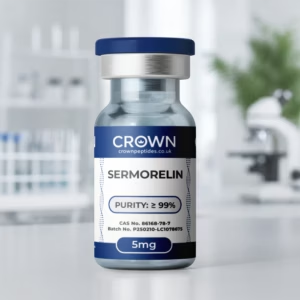
Sermorelin Research Peptide
HPLC and MS verified · batch certificate published · dispatched from the UK before 2pm
Summary of Published Sermorelin Studies
This table illustrates a genuinely two-tiered evidence picture: real, completed, regulatory-grade paediatric trial data sits alongside a considerably thinner, more exploratory adult research literature. Both are real research areas, but they should not be treated as equivalent in strength.
Potential Sermorelin Benefits for GH Axis Research
Based on the published literature, researchers have investigated sermorelin as a tool for studying:
- GHRH receptor pharmacology and pituitary somatotroph physiology
- Physiological, pulsatile GH stimulation as distinct from direct GH replacement
- Pituitary reserve capacity and functional diagnostic assessment
- Comparative pharmacokinetics across GHRH(1-29)-based analogues (sermorelin, tesamorelin, CJC-1295)
- Combination research with ghrelin-receptor-acting secretagogues for dual-pathway GH stimulation
As with the other compounds in this series, this is research investigating a mechanism, and in sermorelin’s specific paediatric application, a genuine historical clinical development programme — not a general demonstration of therapeutic benefit for adult, off-label research uses. None of the above constitutes a demonstrated therapeutic benefit under contemporary regulatory frameworks for any use beyond its original, now-discontinued paediatric indication.
Current Limitations of Sermorelin Research
- The branded product is no longer FDA-approved. Geref’s approval was withdrawn in 2008 for commercial reasons; sermorelin currently holds no active FDA approval for any indication, despite its historical approval history.
- Adult research evidence is considerably thinner than the paediatric literature. Reviews examining adult-onset GH insufficiency have described the evidence as promising but limited, with smaller trial sizes and less rigorous designs than the original paediatric GHD trial programme.
- No long-term modern safety studies exist. Systematic safety reviews have specifically noted the lack of long-term clinical studies involving sermorelin as a limitation researchers should weigh when considering any extended research protocol.
- Comparative potency and half-life are inferior to newer GHRH analogues. Tesamorelin’s added chemical modification gives it superior metabolic stability and a correspondingly more robust Phase III trial outcome for its specific approved indication, a direct comparative limitation for sermorelin research relative to this newer analogue.
- Prohibited in competitive sport. The World Anti-Doping Agency bans sermorelin and other GHRH analogues under its S2 category (peptide hormones, growth factors, and related substances), a relevant regulatory consideration distinct from sermorelin’s general research-use legal status.
Sermorelin Side Effects Reported in Research
Within its original paediatric clinical trial programme, the most commonly reported treatment-related adverse effect was self-limited, transient injection site pain, redness, and/or swelling, reported in approximately 16% of patients according to FDA medical review documentation; other treatment-related adverse effects occurred at rates below 1%. This paediatric safety profile is genuinely well documented by regulatory-grade trial standards.
Because sermorelin works by amplifying the body’s own regulated GHRH signal rather than replacing GH directly, its mechanism is proposed to carry a lower risk of the supraphysiological-exposure-related side effects (fluid retention, joint pain, insulin resistance) associated with direct recombinant GH administration — though this comparative safety advantage is a mechanistic inference rather than something established through dedicated head-to-head adult safety trials. Any research protocol involving human or animal subjects should be developed with appropriate ethical and institutional review, following standard safety monitoring practices for investigational compounds, particularly given the acknowledged absence of long-term modern safety data.
Sermorelin Dosage Used in Published Research
This section is included for methodological context only and should not be interpreted as guidance for use.
The original paediatric Geref clinical trial programme used defined, weight-based subcutaneous dosing schedules under direct medical supervision, evaluated over extended treatment periods to assess growth outcomes in children with confirmed GH deficiency. Adult off-label research and compounded clinical use have reportedly used considerably different dosing approaches, though this specific adult dosing literature is less rigorously documented in peer-reviewed sources than the paediatric trial programme. These figures describe specific, clinically supervised protocols in specific patient populations — they are not a basis for self-directed use in any context.
Researchers designing their own experimental protocols should base dosing decisions on the primary literature relevant to their specific model and objective, in consultation with institutional ethics review as applicable, rather than on secondary summaries such as this one.
Analogues and Future Research Directions
Sermorelin sits at the historical foundation of the GHRH(1-29)-based research family that also includes tesamorelin (a chemically stabilised, longer-acting version with its own FDA approval for a specific indication) and CJC-1295 (which uses a distinct albumin-binding stabilisation strategy for even greater half-life extension, covered in a separate Crown Peptides research review). Understanding sermorelin’s basic GHRH(1-29) structure is genuinely useful context for understanding how each subsequent analogue’s specific modification addresses the same core stability limitation.
- Modern, adequately powered adult trials. Given how much of current sermorelin interest concerns adult applications (body composition, sleep, age-related GH decline), a properly designed, adequately powered modern randomised controlled trial in this specific population remains the single most valuable open research direction.
- Long-term safety characterisation. Given the specifically acknowledged absence of long-term clinical safety data, dedicated extended-duration safety research would address a genuine, clearly identified gap in the literature.
- Direct comparative trials against tesamorelin and CJC-1295. Head-to-head comparison of sermorelin against its longer-acting structural descendants would help clarify whether the added stability of these newer analogues translates into meaningfully different research or clinical outcomes beyond dosing convenience.
- Re-establishing a modern regulatory pathway. Given that Geref’s original withdrawal was commercial rather than safety-related, some researchers have discussed whether a modern regulatory submission, potentially for an adult indication, could be pursued using the substantial historical paediatric safety and mechanistic data as a foundation.
Frequently Asked Questions
Is Sermorelin a Peptide?
Yes, sermorelin is a synthetic peptide composed of a sequence of 29 amino acids. It is specifically designed to mimic the action of naturally occurring growth hormone-releasing hormone (GHRH) in the human body.
What is Sermorelin Peptide Used For?
Sermorelin is primarily used in wellness and anti-aging therapies to naturally boost human growth hormone (HGH) levels, which can improve metabolism, sleep quality, and muscle recovery. It is also prescribed clinically to treat growth hormone deficiencies in both children and adults by safely stimulating the pituitary gland.
What Kind of Peptide is Sermorelin?
Sermorelin is categorized as a growth hormone secretagogue and a GHRH analogue, meaning it acts as a signaling molecule that prompts the body to produce and release its own natural growth hormone. Structurally, it contains only the first 29 amino acids of the naturally occurring 44-amino acid GHRH chain, making it the shortest active fragment capable of activating the pituitary gland.
Is sermorelin the same as HGH?
No. Sermorelin stimulates the pituitary to produce and release its own growth hormone, whereas HGH (human growth hormone) is administered directly. This distinction matters because sermorelin’s mechanism preserves natural pulsatile release and feedback regulation, while direct HGH administration bypasses these regulatory systems.
Is sermorelin legal to purchase for research in the UK?
Sermorelin is not a controlled substance under UK law and is available from suppliers as a research compound, sold explicitly for laboratory use rather than human consumption. Researchers should ensure their institution’s own procurement and ethics policies are followed regardless of a supplier’s terms of sale.
Why Peptide Sourcing Quality Matters for Research Validity
As a 29-amino-acid peptide with a well-defined receptor-binding requirement, sermorelin’s research validity depends on synthesis accuracy in the same way as other GHRH-axis peptides discussed in this article series.
Common failure modes relevant to sermorelin specifically include:
- Truncated or deletion sequences — incomplete coupling during synthesis of this relatively long peptide can leave a proportion of the product missing residues important to receptor binding.
- Inaccurate mass or concentration labelling — without independent mass spectrometry confirmation, there’s no reliable way to verify that a vial contains the peptide and concentration stated on the label.
- Bacterial endotoxin contamination — relevant for any in vivo or cell-culture research, particularly given how directly hormone-cascade research depends on clean, uncontaminated experimental conditions.
- Degradation during storage — as with other peptides in this series, improper storage conditions can silently reduce the concentration of intact, active peptide available for a given experiment.
Given sermorelin’s well-characterised historical pharmacology, independent verification of identity and purity is what allows a given research batch to be meaningfully compared against the substantial existing literature this compound already has behind it.
Read the certificate before you order
Every batch is published openly — identity by mass spectrometry, purity by HPLC, and the batch number printed on the vial you receive.
Open the COA libraryWhy Choose Crown Peptides
Testing is only part of the picture. Crown Peptides was built around a simple idea: a UK researcher ordering a peptide should be able to trust everything about how it reached them — not just the number on a Certificate of Analysis, but who made it, how it was handled, how it travelled, and who they can speak to if they have a question. That’s the standard we hold ourselves to on every order, and it’s worth explaining properly rather than just listing it.
Sourcing You Can Trust
Quality starts long before a product reaches our warehouse. We work directly with one of the world’s largest and most established peptide synthesis manufacturers, chosen specifically for its production standards, consistency, and track record — rather than sourcing opportunistically from whichever manufacturer happens to offer the lowest price that month. That close, ongoing partnership is what allows us to stand behind every batch we sell, because we know exactly how it was made.
Verified Through Independent Testing
We don’t expect researchers to take a manufacturer’s word for it, so we verify every batch independently before it’s listed for sale:
Endotoxin Testing
Every batch is screened for bacterial endotoxin, which matters in particular for any research involving cell culture, immune signalling, or in vivo inflammatory endpoints.
HPLC Purity Analysis
High-performance liquid chromatography is used to assess purity and screen for truncated sequences, deletion products, and synthesis by-products.
Mass Spectrometry Identity Confirmation
MS analysis confirms the molecular weight of the supplied peptide matches intact sermorelin, providing an independent check on identity beyond the label.
Certificate of Analysis
Every batch is supplied with a Certificate of Analysis, and a QR code linking directly to the testing report on crownpeptides.co.uk, so researchers can document exactly what was used in their own experimental records.
Careful Storage and Handling
A product that’s been correctly synthesised and tested can still be let down by poor handling afterward. Once a batch clears testing, we store it under controlled conditions designed to preserve stability and prevent degradation before it ever reaches a researcher’s bench. This matters more for peptides and sensitive research compounds than for most laboratory reagents: temperature excursions, light exposure, and poor stock rotation can all silently reduce integrity long before a vial is opened, in ways that aren’t visible on inspection and can quietly undermine an experiment’s results. We treat that storage window as part of the product, not an afterthought once testing is done.
Packaging and Delivery
Every order is packed in premium, discreet packaging designed to protect the product in transit and arrive intact. Orders placed before 2pm are dispatched the same working day for next-day UK delivery, and we ship to Northern Ireland, the Republic of Ireland, Scotland, England, and across the EU, with international shipping available beyond that. For a researcher working to a study timeline, knowing an order will arrive quickly, safely, and exactly as ordered isn’t a convenience — it’s part of keeping a research schedule on track.
Support That Goes Beyond the Sale
Peptide and research-compound work raises genuine practical questions — around reconstitution, storage, handling, and interpreting a Certificate of Analysis — and we’d rather a researcher ask us directly than guess. Our team is on hand to provide clear, straightforward guidance from product selection through to delivery and beyond, without the evasiveness or upsell pressure that can come with some suppliers in this space. We see that ongoing relationship, not just the transaction, as the actual job.
Regulatory Compliance and Transparency
Crown Peptides is a UK-based company operating in line with MHRA guidance on research chemicals. Every product is clearly labelled for laboratory research use only, sold on the basis that the purchaser is a qualified professional legally able to handle these materials, and never marketed, described, or sold as suitable for human consumption, therapeutic use, or diagnostic application. We’d rather be transparent about what we sell and who it’s for than blur that line to chase a wider customer base — that’s a deliberate choice on our part, not a legal minimum we begrudgingly meet.
Our Commitment
Put simply, our mission is to supply the UK research community with peptides and research compounds of unmatched purity and consistency, backed by a level of service, transparency, and technical support that researchers can actually rely on — from the first email enquiry to the vial arriving on the bench. That standard applies whether an order is a single vial for an independent researcher or a bulk order for a laboratory, and it holds regardless of whether a customer ever finds out how much work sits behind it.
Crown Peptides’ products are supplied strictly for laboratory research and are not sold, labelled, or intended for human consumption, diagnosis, treatment, or prevention of disease. For researchers who want their results to be reproducible and their experimental record defensible, knowing precisely what’s in the vial — and trusting that everyone who handled it got it right — is a basic, non-negotiable starting point.
Ready to order? View batch testing and pricing on crownpeptides.co.uk
References
- “Sermorelin | Reviews, Clinical Trials, and Safety.” Peptides.org. https://www.peptides.org/sermorelin/
- “Sermorelin: Mechanism, Benefits & Clinical Research.” AgeMD. https://agemd.com/longevity/sermorelin-guide
- FDA Medical Review, GEREF/Sermorelin-related NDA documentation. U.S. Food and Drug Administration. https://www.accessdata.fda.gov/drugsatfda_docs/nda/2010/022505Orig1s000MedR.pdf
Working with Sermorelin Research Peptide
Batch-tested material, published certificates, and same-day dispatch on orders placed before 2pm.
See Sermorelin Research Peptide