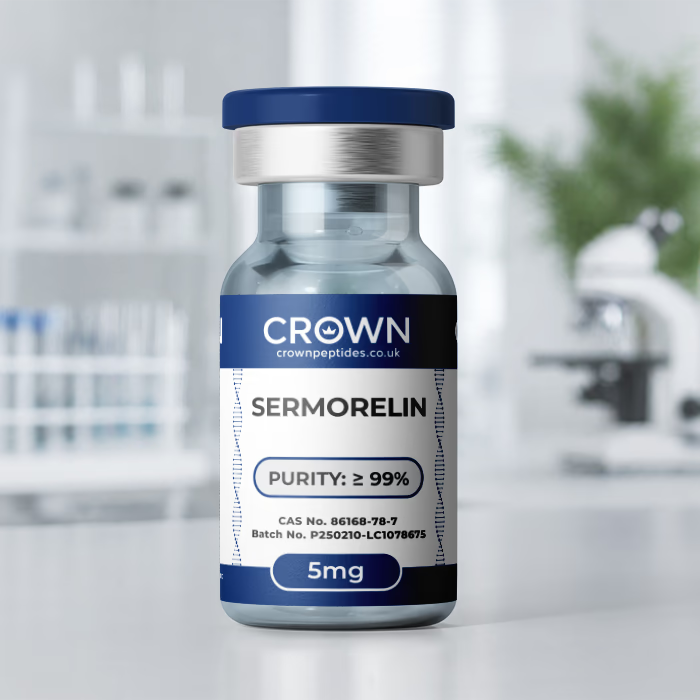
Sermorelin research examines GHRH receptor pharmacology, pituitary somatotroph signalling, growth-hormone release and downstream endocrine feedback, with structure-activity studies mapping the receptor-active region of the GHRH(1-29) sequence in detail (Learn more). Its relatively short sequence allows researchers to study the active N-terminal region of GHRH without using the full endogenous peptide, alongside related growth-hormone-secretagogue peptides such as CJC-1295 with DAC and Ipamorelin.
Found in a tumour: the long hunt for GHRH
For decades endocrinologists were convinced the hypothalamus sent the pituitary a chemical go-signal for growth hormone, yet nobody could pull it out of brain tissue. The quantities were simply too small. The answer came from an unlikely source. A handful of patients had developed acromegaly, the condition of excess growth hormone, not because of a pituitary problem but because tumours in the pancreas were pouring out a releasing factor of their own.
In 1982 two teams working on this tumour material published the structure almost side by side. Roger Guillemin’s group described a 44-residue peptide in Science, while Jean Rivier, Wylie Vale and colleagues at the Salk Institute reported a 40-residue form in Nature. Both proved identical to the hormone later found in the human hypothalamus. Follow-up synthesis then showed that the chain could be trimmed back to its first 29 amino acids, with an amide at the end, and still drive growth-hormone release at full strength. That trimmed sequence is what researchers know today as Sermorelin.
Geref: from diagnostic test to withdrawn medicine
Sermorelin is one of the few research peptides with a genuine regulatory history. Serono developed it as sermorelin acetate under the brand name Geref, and the US Food and Drug Administration first approved it in December 1990 as a small ampoule for diagnostic use. The idea was neat: give a defined GHRH signal and measure whether the pituitary answers with growth hormone. A second application, approved in September 1997, covered larger vials for children with growth-hormone deficiency.
The story then took a commercial turn. The manufacturer told the FDA in 2008 that it was discontinuing Geref, and approval of both applications was formally withdrawn in June 2009. In a later Federal Register notice the agency stated that the products had not been withdrawn for reasons of safety or effectiveness. Crown Peptides supplies the Sermorelin peptide as a characterised research material; it is not the Geref product, which is no longer marketed.
A short life in plasma: the position-2 cut
Sermorelin starts with tyrosine followed by alanine, and that alanine is the problem. Dipeptidyl peptidase-4, a common enzyme in blood and on cell surfaces, recognises an alanine or proline in second place and snips off the first two residues, leaving a fragment that no longer activates the receptor. The Tesamorelin page walks through that enzyme in detail. For Sermorelin, the practical result is activity measured in minutes, which suits experiments looking at a brief, clean GHRH pulse and is exactly the weakness later analogues set out to engineer away.
The cut matters in the lab as well as in the body. Plasma, serum and many cell-culture supplements contain the enzyme, so a sample left standing can quietly fill with the inactive 3-29 fragment. Groups measuring intact peptide therefore tend to keep samples cold, process them quickly and, where the design allows, add a DPP-4 inhibitor to collection tubes.
Somatotrophs, somatostatin and the feedback loop
Inside the anterior pituitary, the cells that make growth hormone, called somatotrophs, carry the GHRH receptor on their surface. When Sermorelin binds, the receptor switches on a G protein that raises cyclic AMP inside the cell. That messenger has two jobs: it prompts the release of stored growth hormone and, over a longer timescale, it steps up the gene activity that refills those stores and supports somatotroph growth.
Sermorelin never acts alone, though. Somatostatin from the hypothalamus works as the brake, and growth hormone itself raises IGF-1, which feeds back to damp the whole axis. How strongly a model responds to Sermorelin therefore depends on how hard that brake is pressed at the time. This makes the peptide a useful probe of pituitary reserve, and it is why genetic models such as the “little” mouse, whose GHRH receptor carries a single disabling amino-acid change, have been so informative about what this pathway controls.