

Research guide
Ipamorelin Peptide UK: Research, Mechanism and Study Data
Ipamorelin releases growth hormone without the cortisol and prolactin that its predecessors carried. Five residues, selective binding, and why that selectivity matters.
Most of the peptides that release growth hormone come with baggage. They nudge up stress hormones, stir up appetite signals, or tug at other pituitary hormones along the way. Ipamorelin was built to be different. When scientists at Novo Nordisk first described it in 1998, they called it “the first selective growth hormone secretagogue”, and more than a quarter of a century later that single word, selective, is still the reason researchers reach for it.
This guide tells the Ipamorelin story from the beginning: the strange hunt for the receptor it acts on, the chemistry that makes it so precise, what published studies have explored in bone, muscle, the gut and beyond, and why it has become the default partner for GHRH analogues in growth hormone research. Crown Peptides supplies Ipamorelin for laboratory research use only.
What Is Ipamorelin?
Ipamorelin is a synthetic peptide made of just five building blocks. It belongs to a family of compounds called growth hormone secretagogues, a mouthful that simply means substances that cause growth hormone to be secreted. More specifically, it is a growth hormone releasing peptide, or GHRP, which acts on the ghrelin receptor.
When Ipamorelin binds to that receptor on specialised cells in the pituitary gland, those cells release a burst of growth hormone. What makes it notable is what does not happen: in the original research, it did not significantly raise ACTH or cortisol, the body’s main stress hormones, and it did not affect other pituitary hormones such as prolactin, the reproductive hormones FSH and LH, or thyroid-stimulating hormone.
What does Ipamorelin do in research?
Published research has shown that Ipamorelin releases growth hormone selectively, and animal studies have indicated it may increase bone growth and bone mineral content in rats, protect muscle strength and bone formation in rats given high-dose glucocorticoids, speed gut recovery in models of postoperative ileus, and reduce chemotherapy-associated weight loss. Each of these is covered in detail below with the specific studies named.
A Receptor Found Before Its Hormone
Ipamorelin’s backstory is one of the odder detours in the history of endocrinology, and it explains a lot about how the compound came to exist.
In the late 1970s, the American endocrinologist Cyril Bowers was experimenting with modified fragments of met-enkephalin, one of the body’s natural opioid peptides. Some of his synthetic peptides turned out to release growth hormone, even though they had no meaningful opioid activity and did not act on the receptor for growth hormone releasing hormone (GHRH). Something else in the pituitary was responding to them, and nobody knew what.
Over the next two decades, that line of work produced a series of increasingly potent growth hormone releasing peptides, most famously GHRP-6 and later GHRP-2. Pharmaceutical companies also created non-peptide versions. It was only in 1996 that a Merck team finally cloned the receptor these drugs acted on, naming it the growth hormone secretagogue receptor. And it was only in 1999 that Japanese researchers isolated the natural hormone that fits it, a 28-amino-acid peptide from the stomach they named ghrelin.
In other words, scientists spent around twenty years designing and refining drugs for a hormone nobody had discovered. Ipamorelin was created towards the end of that period, when the receptor’s power was well understood but its natural purpose was still a mystery.
- Classification
- Selective synthetic growth-hormone secretagogue peptide
- Available strengths
- 5mg and 10mg
- CAS Number
- 170851-70-4
- Molecular Weight
- 711.87 g/mol
- Molecular Formula
- C38H49N9O5
- Sequence
- Aib-His-D-2-Nal-D-Phe-Lys-NH2
The Problem Ipamorelin Was Designed to Solve
The early GHRPs worked, and they worked powerfully. But they were not clean. Alongside growth hormone, they also raised ACTH, the pituitary hormone that tells the adrenal glands to release cortisol, and cortisol itself. Some also raised prolactin. For anyone trying to study growth hormone release in isolation, those extra signals were confounding variables. For anyone thinking about clinical use, they were potential side effects.
At Novo Nordisk in Denmark, a team of medicinal chemists set out to find a GHRP that released growth hormone without the extras. They worked systematically through a series of compounds derived from an earlier peptide called GHRP-1, removing its central two amino acids and modifying the rest. The result was a five-residue molecule they named Ipamorelin.
The paper that defined it
The compound was introduced in a 1998 paper in the European Journal of Endocrinology by Raun and colleagues (PMID: 9849822). The findings were remarkably clear.
In rat pituitary cells grown in the laboratory, Ipamorelin released growth hormone with a potency and maximum effect similar to GHRP-6. Experiments with receptor-blocking compounds confirmed it worked through the GHRP receptor, not the GHRH receptor. In anaesthetised rats, and then in conscious pigs, it again released growth hormone with potency comparable to GHRP-6.
Then came the selectivity tests in pigs. None of the compounds tested affected FSH, LH, prolactin or TSH. GHRP-6 and GHRP-2 both increased ACTH and cortisol. Ipamorelin did not. Its effect on these stress hormones was not significantly different from that of GHRH itself, the body’s own growth hormone releasing signal, even at amounts more than 200 times higher than those needed to release growth hormone. The authors described this as very surprising and concluded that Ipamorelin was the first GHRP-receptor agonist with a selectivity for growth hormone release similar to that of GHRH.
That is the finding that has defined Ipamorelin ever since.
What the Research Has Explored
After its introduction, Ipamorelin was studied across a range of models by Novo Nordisk and academic groups, particularly in Scandinavia. The results give a good picture of what selective growth hormone release can do in living systems.
Growth in length
A 1999 study in Growth Hormone and IGF Research, led by Johansen and colleagues at Novo Nordisk, looked at longitudinal bone growth in adult female rats treated with Ipamorelin for 15 days (PMID: 10373343). Using a clever technique, the team gave the rats tetracycline on three separate days. Tetracycline is incorporated into growing bone and fluoresces under ultraviolet light, leaving a series of glowing bands in the bone whose spacing reveals how fast it grew.
Ipamorelin increased the longitudinal growth rate of the tibia in a dose-dependent way, from 42 micrometres per day in the control group to up to 52 micrometres per day. There was also a pronounced, dose-dependent effect on body weight gain. The pituitary’s growth hormone content was unchanged by the treatment, suggesting the gland was not being depleted.
Bone mineral content
A year later, a Swedish team at Sahlgrenska University Hospital in Gothenburg, led by Svensson and colleagues, published a 12-week study in the Journal of Endocrinology (PMID: 10828840). Young adult female rats received Ipamorelin, GHRP-6, growth hormone itself or a vehicle control continuously via small implanted pumps.
All three active treatments increased body weight and total bone mineral content in the tibia and vertebrae, measured by DXA scans. Detailed analysis after the study showed that the increase came from bigger bones, with greater cross-sectional area and volume, rather than from denser bone. In other words, the growth hormone secretagogues made bones grow, much as growth hormone itself did.
Protecting muscle and bone from glucocorticoids
Glucocorticoids, the class of steroid medicines that includes prednisolone, are known in research to reduce bone formation and muscle strength when given at high doses over long periods. A Danish team at Aarhus University tested whether Ipamorelin could counteract that effect, publishing their results in Growth Hormone and IGF Research in 2001 (PMID: 11735244).
Adult female rats were given a glucocorticoid, Ipamorelin, or both together for three months. In rats receiving both, the maximum contraction strength of the calf muscles was significantly higher and the rate of bone formation on the outer surface of the bone was four times higher than in rats given the glucocorticoid alone. The authors concluded that the decrease in muscle strength and bone formation in glucocorticoid-treated rats was counteracted by the growth hormone secretagogue.
The gut
The ghrelin receptor is not only found in the pituitary. It also appears in the gut and in nerves controlling gut movement, and ghrelin is known to stimulate gastric emptying. That opened a second research avenue for Ipamorelin: postoperative ileus, the temporary shutdown of bowel movement that commonly follows abdominal surgery.
In a 2009 study in the Journal of Pharmacology and Experimental Therapeutics, Venkova, Greenwood-Van Meerveld and colleagues tested Ipamorelin in a rat model of postoperative ileus (PMID: 19289567). A single dose shortened the time to first bowel movement after surgery, and repeated dosing over two days significantly increased faecal output, food intake and body weight gain compared with controls.
That work led to a phase 2 clinical trial in 117 bowel resection patients, published in 2014 in the International Journal of Colorectal Disease (PMID: 25331030). Ipamorelin was well tolerated. Median time to the first tolerated solid meal was 25.3 hours with Ipamorelin against 32.6 hours with placebo, a difference that did not reach statistical significance in this small proof-of-concept study, which the authors noted had enrolled patients with a broad range of underlying conditions.
Pain signalling
The same Oklahoma research group later looked at whether ghrelin receptor activation influences pain sensitivity. In a 2020 study in the Journal of Experimental Pharmacology, they compared Ipamorelin, which acts mainly outside the brain, with a ghrelin mimetic that reaches the brain, in rat models of heightened gut and skin sensitivity without active inflammation (PMID: 32801950, PMC7415447). The work adds to a growing body of research on the ghrelin system’s role in pain signalling.
Weight loss during chemotherapy
One of the most recent Ipamorelin studies, published in Physiology and Behavior in 2024, tested whether ghrelin mimetics could reduce the weight loss that follows the chemotherapy drug cisplatin in ferrets, a standard model for studying nausea and vomiting (PMID: 39043357). Both Ipamorelin and anamorelin, a ghrelin mimetic approved for cancer-related weight loss in Japan, reduced cisplatin-associated weight loss in the delayed phase by around 24%. Neither affected vomiting itself when given outside the brain, which the authors linked to how well each compound reaches the brain.
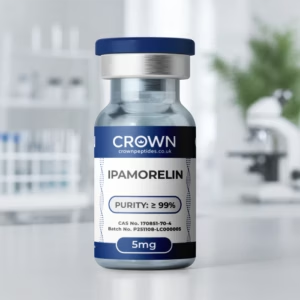
Ipamorelin Research Peptide
HPLC and MS verified · batch certificate published · dispatched from the UK before 2pm
How Ipamorelin Behaves in the Human Body
Ipamorelin’s pharmacokinetics, meaning how it is absorbed, distributed and cleared, were characterised in healthy volunteers in a study published in Pharmaceutical Research in 1999 by Gobburu and colleagues (PMID: 10496658).
The results painted a picture of a short-acting, predictable compound. Its terminal half-life was about 2 hours. Its behaviour was dose-proportional, meaning its blood levels rose in a straight line as the amount given increased. After each infusion, growth hormone was released in a single episode, peaking at around 40 minutes and then declining back to negligible levels.
That single, clean pulse is important. The body naturally releases growth hormone in pulses rather than continuously, and many of growth hormone’s effects are thought to depend on that pattern. Ipamorelin produces a pulse rather than a plateau, which is part of why it is regarded as a physiological research tool.
How the body clears it
Before the human work, Novo Nordisk had already compared Ipamorelin with its relatives in rats, in a 1998 study in Xenobiotica by Johansen and colleagues (PMID: 9879640). Ipamorelin stood out immediately. Its clearance from the blood was about five times slower than that of GHRP-6, and the two left the body by different routes: Ipamorelin was mainly excreted in urine, while GHRP-6 went predominantly into bile. Between 60% and 80% of Ipamorelin could be recovered unchanged, showing a molecule that resists breakdown well for its size. The same study found it could cross the lining of the nose, with an estimated nasal bioavailability of around 20% in rats, which is why nasal forms of related secretagogues have also appeared in the research literature.
A compound anti-doping laboratories know well
Because growth hormone releasing peptides are on the World Anti-Doping Agency Prohibited List, anti-doping scientists have studied how the body processes them in detail. In a 2015 study in Drug Testing and Analysis, researchers working with the Cologne anti-doping laboratory characterised the metabolites of GHRP-1, GHRP-2, GHRP-6, hexarelin and Ipamorelin in urine (PMID: 25869809). Ipamorelin was metabolised extensively and excreted as the parent compound together with a set of breakdown products, which were then built into routine testing methods. For researchers, that body of work is a useful bonus: few peptides have their metabolic fate mapped in such fine detail.
Does Ipamorelin affect appetite?
Searches such as “does Ipamorelin make you hungry” reflect the fact that its receptor is the hunger hormone’s receptor. In research, the picture is nuanced. Ghrelin itself is a strong appetite signal, and GHRP-6 is known for pronounced effects on appetite. Ipamorelin was designed for selectivity towards growth hormone release, but it still acts at the same receptor, and in the rat ileus study repeated dosing increased food intake after surgery. The chemotherapy study in ferrets also points to effects on feeding and weight. Appetite signalling is therefore part of the Ipamorelin research picture, though typically described as less prominent than with GHRP-6.
Ipamorelin Compared With Its Neighbours
Ipamorelin is most often compared with three other compounds: the older GHRPs, the GHRH analogues, and non-peptide secretagogues.
Ipamorelin vs GHRP-2 and GHRP-6
All three act on the ghrelin receptor. GHRP-2 is the most potent of the group and has even been used as a diagnostic agent in clinical medicine. GHRP-6 is strongly associated with appetite signalling. Both raise ACTH and cortisol in research models, which Ipamorelin was specifically designed to avoid. Our comparison Ipamorelin vs GHRP-2 covers the details.
Ipamorelin vs GHRH analogues
Tesamorelin, Sermorelin and CJC-1295 act on a different receptor altogether, the GHRH receptor. Because the two receptors trigger growth hormone release through different internal signalling routes, GHRH analogues and ghrelin receptor agonists are often studied together. See Tesamorelin vs Ipamorelin for the full comparison.
Ipamorelin and CJC-1295
This is Ipamorelin’s most famous partnership. CJC-1295 without DAC, a stabilised GHRH analogue, acts on the GHRH receptor, while Ipamorelin acts on the ghrelin receptor. Studying both at once engages the two main “go” signals for growth hormone release simultaneously. Crown Peptides supplies the pair together as the CJC-1295 (No DAC) + Ipamorelin (Blend), and our article CJC-1295 No DAC and Ipamorelin: the two-pathway approach explains the logic in depth.
The Technical Breakdown: Why Five Building Blocks Work So Well
This section is for readers who want the chemistry. The main story does not depend on it.
The sequence
Ipamorelin’s structure is usually written as Aib-His-D-2-Nal-D-Phe-Lys-NH2. Only two of those five building blocks, histidine and lysine, are standard amino acids in their natural form. The others are deliberately unusual.
Aib at the front
Aib stands for alpha-aminoisobutyric acid, an amino acid with two methyl groups on its central carbon instead of one hydrogen and one side chain. That extra bulk restricts how the chain can twist and makes the front of the peptide much harder for enzymes to attack.
Two D-amino acids in the middle
D-2-Nal is D-2-naphthylalanine, an amino acid with a large, flat double-ring side chain, and D-Phe is D-phenylalanine. Both are D-amino acids, the mirror-image forms of the L-amino acids the body normally uses. Enzymes that break down peptides are built to recognise L-amino acids, so D-forms resist degradation. Their bulky aromatic side chains are also thought to be important for fitting into the ghrelin receptor’s binding pocket.
An amidated lysine at the end
The final lysine carries an amide group in place of the usual free acid end. C-terminal amidation is common in natural peptide hormones and further protects against enzymes that chew peptides from the end.
Why the missing dipeptide matters
Ipamorelin came out of a series of compounds that lacked the central Ala-Trp dipeptide of GHRP-1. Removing it shortened the chain and, as the Novo Nordisk chemists found, changed the pharmacological profile. The precise structural reason Ipamorelin avoids ACTH and cortisol release while its relatives do not remains an interesting question in receptor pharmacology, but the practical outcome is a compound whose selectivity is built into its structure.
The ghrelin receptor signal
When Ipamorelin binds the ghrelin receptor, formally GHS-R1a, the receptor mainly activates a Gq protein, which switches on phospholipase C. That enzyme generates IP3, which releases calcium from stores inside the cell, and diacylglycerol, which activates protein kinase C. The rise in intracellular calcium triggers release of growth hormone granules. The receptor also acts in the hypothalamus to increase GHRH release and reduce somatostatin, the brake on growth hormone.
Why Stereochemistry Makes Quality Control Critical
For most peptides, the big quality question is whether every amino acid is present in the right order. For Ipamorelin, there is an extra dimension: whether every building block has the right three-dimensional orientation.
Two of Ipamorelin’s five residues must be D-amino acids. A version made with L-phenylalanine instead of D-phenylalanine would have exactly the same mass, so a mass spectrometer alone could not tell them apart, but its pharmacology could be quite different. Reliable synthesis with verified starting materials, confirmed by a clean HPLC profile in which such isomers would typically appear as separate peaks, is essential.
There is a second reason for care. In 2018, anti-doping scientists in Cologne analysing black market products reported finding a version of Ipamorelin with an extra glycine attached at the front, as well as similar glycine-extended versions of GHRP-2 and GHRP-6. The finding is a reminder that for short, potent peptides, confirming identity by mass spectrometry is not optional.
How Crown Peptides verifies Ipamorelin
Every batch of Ipamorelin supplied by Crown Peptides comes with a batch-specific certificate of analysis. HPLC confirms purity by separating Ipamorelin from any related impurities, and mass spectrometry confirms its molecular identity. The lot number on the certificate matches the lot number on the vial. You can view our published certificates on the Lab Reports page and learn what each figure means in how to read a peptide certificate of analysis. For a broader look at the methods, see peptide testing UK.
Storage and handling
Ipamorelin is supplied as a lyophilised powder and should be kept cold, dry and away from light. For reconstitution, most researchers use Bacteriostatic Water, adding it slowly and swirling gently. Our guides to peptide reconstitution, how long peptides last and the peptide calculator cover the practical side.
Related Compounds Worth Knowing
Ipamorelin sits at the centre of a network of growth hormone axis compounds. These are its closest neighbours.
The CJC-1295 family
The CJC-1295 (No DAC) + Ipamorelin (Blend) is the most popular Ipamorelin combination, while CJC-1295 with DAC is the long-acting GHRH analogue. The difference between the two CJC forms is explained in CJC-1295 with DAC vs without DAC.
The other GHRPs
GHRP-2 and GHRP-6 are Ipamorelin’s older cousins at the ghrelin receptor, compared in GHRP-2 vs GHRP-6.
The GHRH analogues
Tesamorelin and Sermorelin act on the other main growth hormone receptor, with their differences set out in Sermorelin vs Tesamorelin.
Further down the axis
IGF-1 LR3 is a long-acting analogue of the downstream hormone IGF-1, useful for studying the axis at tissue level. For researchers interested in Ipamorelin’s musculoskeletal findings, BPC-157 and TB-500 are frequently studied in parallel.
You can browse the full range in our endocrine and hormonal research peptides and musculoskeletal research peptides categories.
Read the certificate before you order
Every batch is published openly — identity by mass spectrometry, purity by HPLC, and the batch number printed on the vial you receive.
Open the COA libraryIpamorelin Questions, Answered
What is Ipamorelin used for in research?
Ipamorelin is used to study selective growth hormone release through the ghrelin receptor. Published research has also explored its effects on bone growth, bone mineral content, muscle strength in glucocorticoid-treated animals, gut motility and chemotherapy-associated weight loss in animal models.
Is Ipamorelin a peptide or a SARM?
Ipamorelin is a peptide, a short chain of five amino acid building blocks. SARMs are small non-peptide molecules that act on androgen receptors, which is an entirely different mechanism.
How long does Ipamorelin last?
In a human pharmacokinetic study, Ipamorelin had a terminal half-life of about 2 hours, and growth hormone release peaked around 40 minutes after infusion before returning to baseline.
Is Ipamorelin legal in the UK?
Ipamorelin is not a controlled drug in the UK and is available as a research material. For the full legal picture, see are peptides legal in the UK.
Why is Ipamorelin paired with CJC-1295?
Because the two act on complementary receptors, the ghrelin receptor and the GHRH receptor, which use different signalling routes to trigger growth hormone release.
Precision Is the Point
Ipamorelin exists because a team of chemists decided that releasing growth hormone was not enough; they wanted to release it cleanly. Out of a twenty-year hunt for a mysterious receptor came a five-building-block molecule that switches on growth hormone release without dragging the stress hormones along, and that produces a neat, natural-looking pulse rather than a flood.
That precision is why Ipamorelin has been studied in everything from growing bones to recovering guts, and why it has become the natural partner for GHRH analogues in modern growth hormone research. The open questions, from how its structure delivers such selectivity to how far the ghrelin system’s influence extends, make it as interesting a research tool now as when it was first described. Explore Ipamorelin from Crown Peptides, every batch HPLC and mass spectrometry verified and dispatched from the UK.
Working with Ipamorelin Research Peptide
Batch-tested material, published certificates, and same-day dispatch on orders placed before 2pm.
See Ipamorelin Research Peptide