Research Peptides
A high-purity research blend studied in skin, tissue-repair and inflammation research. Available in 80mg, with every batch independently tested and dispatched from the UK.
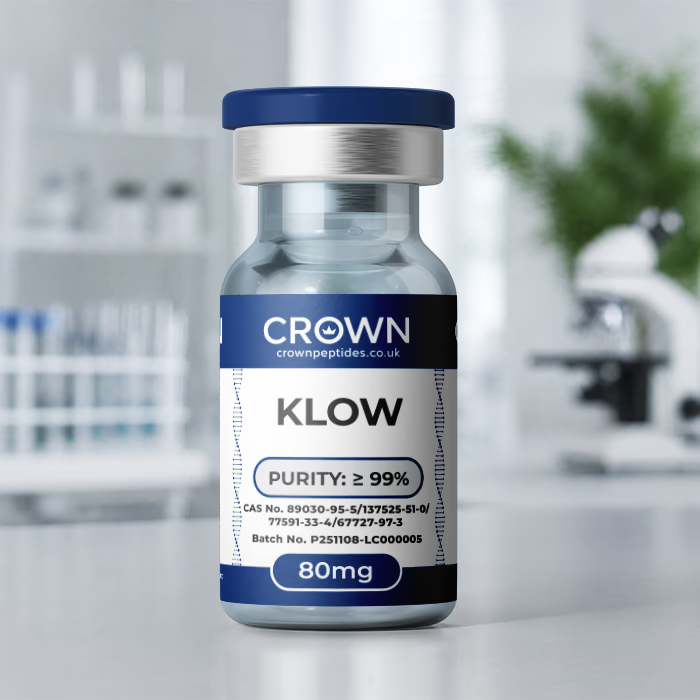
KLOW peptide is Crown Peptides' 80 mg four-compound research blend, supplied in a single vial as GHK-Cu 50 mg, BPC-157 10 mg, TB-500 10 mg and KPV 10 mg. It is also listed as the KLOW blend or KLOW stack — all three names describe this same 80 mg formulation.
Supplied for laboratory research purposes only — not for human consumption or for medical, veterinary or diagnostic use.
GHK-Cu is associated with copper-peptide, fibroblast and matrix-remodelling research (Learn more); BPC-157 with tissue-response, gastrointestinal and vascular models; TB-500 with thymosin-related actin dynamics and cell migration; and KPV with inflammatory and intestinal epithelial research. Together, these research areas explain the scientific interest in bringing all four components into one formulation.
Also known as: KLOW blend, KLOW stack, KLOW peptide, KLOW 80mg.
KPV is the ingredient that turns a three-peptide repair blend into KLOW. It is a tripeptide, lysine–proline–valine, taken from the tail end of alpha-melanocyte-stimulating hormone, and its literature centres on NF-κB and cytokine signalling in epithelial and immune-cell models, including mouse colitis work. In KLOW it contributes 10 mg, the same amount as BPC-157 and TB-500. Its origin, uptake route and full body of findings are covered on the KPV page; here the focus is on what it adds to the blend as a whole.
Tissue-repair research usually describes three overlapping phases: an early inflammatory phase, a proliferative phase in which new tissue and blood vessels form, and a long remodelling phase in which the matrix is reorganised. Three of KLOW’s components are mostly studied in the later two phases, with GHK-Cu linked to matrix building, BPC-157 to vascular and tissue responses and TB-500 to cell migration. KPV is the one that speaks to the first phase.
That division of labour shapes what a KLOW experiment can measure. A single treated sample can be examined against inflammatory readouts, such as NF-κB activation or TNF-α and IL-8 levels, at the same time as collagen, matrix-enzyme and migration endpoints. The inflammatory and reparative sides of a model can then be compared directly rather than across separate experiments run on different days.
Preparing four freeze-dried peptides separately means four weighings, four reconstitutions and four chances for small errors to creep into the final ratio. Weighing 10 mg quantities of fluffy lyophilised powder accurately is harder than it sounds, and each opened vial is another exposure to air and moisture. A pre-combined vial removes most of those steps.
It also locks the composition. Every KLOW vial carries the same 50 : 10 : 10 : 10 mg split, so results from one vial can be set beside results from the next without wondering whether the proportions drifted. And because all four components are analysed together, one batch Certificate of Analysis documents the whole mixture. For studies that need to tease the components apart, all four remain available individually as comparison arms.
On a reversed-phase HPLC column, peptides separate according to how strongly they cling to the oily stationary phase, so a KLOW chromatogram shows several distinct peaks rather than one. As a general rule, the small, water-loving tripeptides (GHK and KPV) tend to come off earlier, while the larger BPC-157 and TB-500 are retained for longer.
Two details help when reading the trace. First, peak size reflects how strongly each molecule absorbs ultraviolet light as well as how much of it is present, so peak areas do not map neatly onto the 5:1:1:1 mass ratio, and a large peptide such as BPC-157, with many more peptide bonds, can produce a bigger signal per molecule than a tripeptide. Second, the acidic conditions commonly used for peptide HPLC can loosen copper from GHK, so the copper peptide may appear partly as free GHK. Mass spectrometry is what ties each peak to a named component.
The ratio on the label is by mass. GHK-Cu makes up 50 of the 80 mg (62.5%), and BPC-157, TB-500 and KPV account for 10 mg (12.5%) each. Mass ratios hide an interesting detail, though, because the molecules differ greatly in size and equal weights do not mean equal numbers of molecules.
KPV weighs 342.43 Da, while BPC-157 weighs around 1,419.5 Da, so 10 mg of KPV contains roughly four times as many molecules as 10 mg of BPC-157. GHK-Cu, at 401.91 Da and with five times the mass, is by far the most abundant molecule in the vial: around 124 micromoles, against roughly 29 micromoles of KPV and 7 micromoles of BPC-157. For anyone planning concentration-response work in cell culture, those molar figures are often more meaningful than the milligram split.
Compound-level reference data. Batch-specific results appear on the Certificate of Analysis.
Work out concentration with the peptide calculatorCrown Peptides KLOW (Blend) is supplied for controlled laboratory research with batch-specific analytical documentation. High-Performance Liquid Chromatography (HPLC) can assess chromatographic purity, while Mass Spectrometry provides molecular information used to support identity verification.
The batch-specific Certificate of Analysis is the definitive source for the exact purity result, identity data and analytical specification of the material supplied.
KLOW peptide contains GHK-Cu 50 mg, BPC-157 10 mg, TB-500 10 mg and KPV 10 mg, giving a total stated content of 80 mg in a fixed 5:1:1:1 ratio by mass. It is also listed as the KLOW blend, KLOW stack or KLOW 80mg.
It brings inflammatory signalling into the blend. KPV is studied in NF-κB and cytokine experiments and in intestinal and epithelial models, territory the other three components only touch on, and it is the reason KLOW reaches 80 mg. The KPV page covers its science in full.
Five-eighths of it. GHK-Cu accounts for 50 of the 80 mg (62.5%), with the remaining 30 mg shared equally between BPC-157, TB-500 and KPV. Because GHK-Cu is also a small molecule, it is the most abundant component by molecule count as well as by weight.
It is the same copper complex of glycyl-L-histidyl-L-lysine. KLOW holds 50 mg per vial, which matches the smaller of the two standalone strengths, and the chemistry and research history of the copper peptide are covered in depth on the GHK-Cu page.
The compound is the same, and the 10 mg in each KLOW vial matches the smallest standalone KPV strength (it is also sold in 30 mg and 50 mg). Buying it separately lets researchers set its concentration independently of the other three peptides.
No. It is a mixture of four separate compounds, so there is no single molecular formula or molecular weight for the blend. Each component has its own: KPV, for example, is C16H30N4O4 and BPC-157 is C62H98N16O22.
Mostly preparation steps and ratio errors. A single reconstitution replaces four separate weighings, and the 5:1:1:1 split is fixed at manufacture rather than rebuilt by hand for every experiment. A single batch report also covers all four components together.
By adding single-peptide arms alongside the blend. Because GHK-Cu, BPC-157, TB-500 and KPV are each available on their own, a design can compare the full blend with each component at the matching amount, or with the blend minus one component.
A broad spread. Inflammatory markers such as NF-κB activity, TNF-α and IL-8 relate mainly to KPV; collagen production and matrix enzymes to GHK-Cu; cell migration and wound-closure assays to TB-500; and vascular and tissue-response measures to BPC-157. Measuring several of these from the same samples is the main reason to work with the combined blend.
Because the four peptides differ so much in size. A milligram of a tripeptide holds far more molecules than a milligram of the 15-residue BPC-157, so KPV and GHK-Cu outnumber BPC-157 by a wide margin even where the weights are equal. Cell-culture work planned in molar terms needs those conversions.
The two tripeptides differ by only about 2 Da (KPV at 342.43 Da, the GHK peptide at 340.38 Da), but that gap is easily resolved by modern instruments. GHK-Cu can also show its copper-bound form near 401.9 Da, and the two peptides break apart into different fragments, so their signals never get confused. Together with HPLC purity data, those masses are what the batch Certificate of Analysis uses to confirm all four components.
KLOW is sold as 80 mg vials singly or in threes and fives. One vial is enough for a pilot run or method development; the larger packs cover longer projects and repeated experiments, and every vial carries its batch details so its matching report can be checked.
Every batch is published openly — identity, purity and batch number, with no account needed.
Supplied for laboratory research purposes only — not for human consumption or for medical, veterinary or diagnostic use.
Each batch undergoes internal analytical verification using chromatographic and spectrometric methods prior to lyophilisation.
• HPLC Analysis
• Mass Spectrometry Confirmation
• Batch Traceability
By purchasing this product you confirm that you are a qualified researcher and that this compound will be used exclusively for laboratory research purposes.
This product is not intended for diagnostic or therapeutic use.
Any human or medical use is strictly prohibited.
Store in a cool, dry, secure and sterile environment away from any unauthorised persons or children.
Disclaimer: All products are sold strictly for laboratory research purposes only. Not for human or veterinary use, consumption, therapeutic, or diagnostic application. None of our products are medicines, and none are presented as such. By purchasing, you confirm you are a qualified professional and legally permitted to handle these materials in compliance with all applicable laws and regulations. Misuse, resale for unauthorised purposes, or unlawful application is strictly prohibited. Crown Peptides UK disclaims all liability for improper use, handling, or regulatory non-compliance.