Register today and get 10% off your first orderRegister for 10% off your first orderRegister now
Crown Peptides

Research Peptides

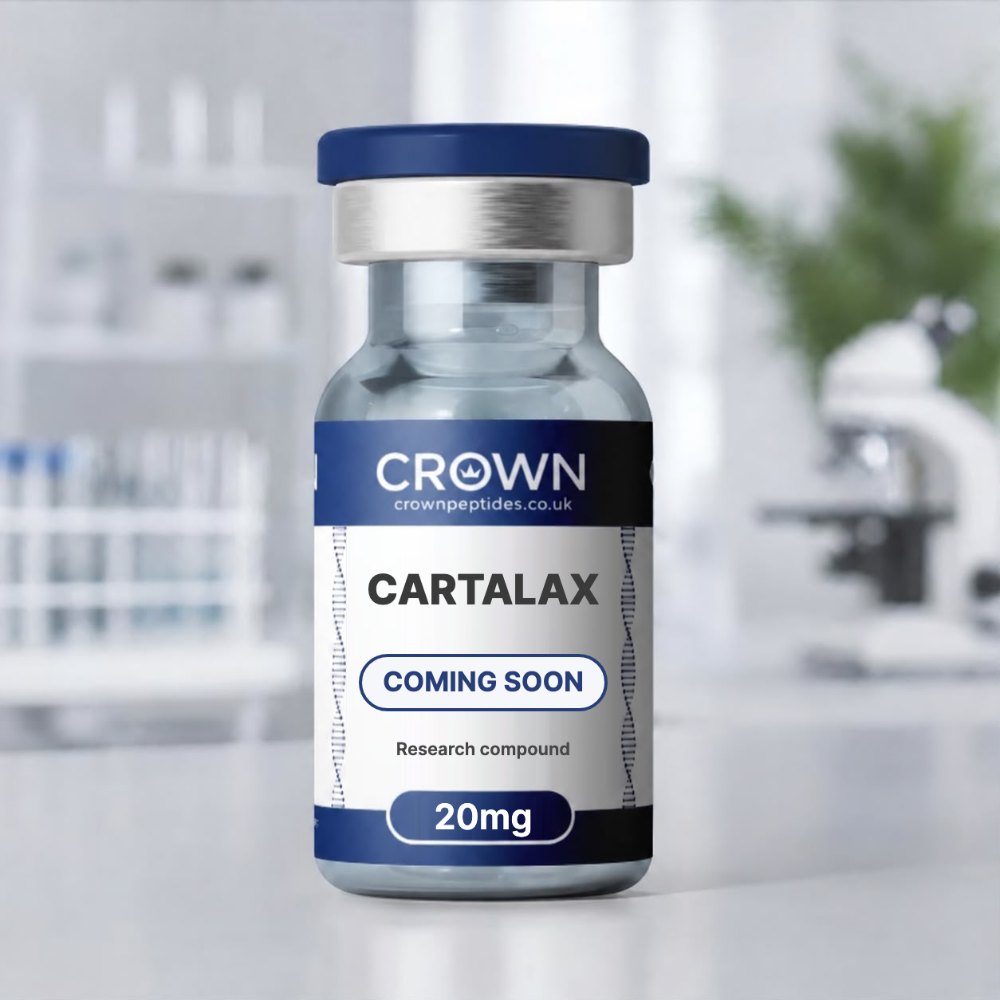
Cartalax Research Peptide

A research tripeptide studied in connective tissue, skin fibroblast and cellular ageing research. Coming soon in 20mg, with every batch independently tested and dispatched from the UK.

All Batches TestedEvery batch, no exceptions
HPLC & MS VerifiedFull certificate published
Same Day PostageOrder before 2pm
UK Based CompanyDispatched from the UK
Product Overview

A research tripeptide studied in connective tissue, skin fibroblast and cellular ageing research. Coming soon in 20mg, with every batch independently tested and dispatched from the UK.

Full Product Specification
Overview

Product Overview

Cartalax peptide UK is Crown Peptides’ synthetic tripeptide bioregulator research compound, coming soon in 20mg for laboratory research.

20mg (coming soon)Available strengthHPLC testedChromatographic purityMS verifiedIdentity confirmedBatch CoADocumentation supplied

Supplied for laboratory research purposes only — not for human consumption or for medical, veterinary or diagnostic use.

Key features

Key Features

  • Studied in research involving connective tissue and cartilage biology
  • Studied in research involving skin fibroblast ageing in culture
  • Studied in research involving gene expression in ageing stem cells
  • Studied in research involving kidney cell renewal models
  • Batch-specific quality documentation available
Background

About Cartalax Peptide UK

Cartalax is a synthetic tripeptide bioregulator composed of alanine, glutamic acid and aspartic acid (Ala-Glu-Asp). It comes from the same short-peptide bioregulator research programme as Pinealon and Epitalon, takes its name from the cartilage and connective tissue research it is associated with, and is used to study how very short peptides influence cell renewal, ageing and gene expression.

Researchers often group the Khavinson bioregulators into two families: natural polypeptide complexes extracted from animal tissues, and short synthetic peptides of two to four amino acids designed to reproduce their activity with a single defined sequence. Cartalax belongs to the second family, which is exactly what makes it so useful in the lab. Every vial contains the same three-residue molecule, so results can be tied to one sequence rather than to a variable extract.

Also known as: Cartalax peptide, AED peptide, AED tripeptide, T-31, Ala-Glu-Asp, H-Ala-Glu-Asp-OH.

Research

Cartalax Research

Research uses Cartalax to study how cells behave as they age, including work on human skin fibroblasts where AED reduced the build-up of the matrix-remodelling enzyme MMP-9 and supported markers of cell renewal (Learn more). This sits within a wider body of bioregulator research into connective tissue, stem cell ageing and kidney cell renewal, alongside related compounds such as GHK-Cu and AHK-Cu.

  • Connective tissue and cartilage biology
  • Skin fibroblast ageing and collagen synthesis
  • Gene expression in ageing stem cells
  • Kidney cell renewal and protection models
Three residues, one clear identity: the AED structure

Cartalax is a tripeptide in the most literal sense. Its sequence reads alanine, glutamic acid and aspartic acid, which is why the research literature usually calls it AED, the sequence written in one-letter code. Alanine contributes a small, uncharged methyl side chain, while glutamic and aspartic acid each carry a carboxylic acid group. At neutral pH both of those groups are ionised, so the molecule carries a net negative charge and dissolves readily in water.

With the formula C12H19N3O8 and a mass of roughly 333, Cartalax is even smaller than Pinealon, its close relative in the bioregulator family. It differs from KED (Lys-Glu-Asp), another tripeptide often tested alongside it, by a single residue: alanine in place of lysine. That one swap removes a positive charge, which is exactly the kind of controlled variable that makes these short peptides useful for asking how sequence drives biological activity.

Skin fibroblasts and the markers of ageing

Fibroblasts are the cells that build and maintain the extracellular matrix in skin and connective tissue, so they are a natural model for Cartalax research. In a study of human skin fibroblasts ageing in culture, AED was tested alongside KE, KED and AEDG. All of the peptides inhibited MMP-9, an enzyme that breaks down matrix proteins and rises as fibroblasts age, and all of them boosted Ki-67 (a proliferation marker) and CD98hc, a marker linked to cell renewal that normally fades with age. AED and AEDG also suppressed caspase-dependent apoptosis, the programmed cell death that increases in older cultures.

A later study took the question further. In human skin fibroblasts undergoing replicative ageing, AED activated the synthesis of sirtuin-1, sirtuin-6 and collagen I (Learn more). Sirtuins are a family of enzymes closely tied to cellular ageing research, and collagen I is the main structural protein of skin and connective tissue, so the authors described the result as evidence of a geroprotective effect in this model.

Gene expression in ageing stem cells

Bioregulator research has long proposed that short peptides act partly at the level of gene expression, and Cartalax has been tested directly on that idea. Researchers compared AED, KED and KE in human bone marrow mesenchymal stem cells aged in two different culture models (Learn more). Expression of IGF1, a gene central to growth and repair signalling, rose 3.5 to 5.6-fold when the peptides were added, and all three peptides stimulated NFκB gene expression in both models. The authors concluded that these peptides, at nanomolar concentrations, modulate the expression of genes known to be involved in cell ageing.

Cartalax has also appeared in neural stem cell work. In human periodontal ligament stem cells, a combination of AED, KED, KE and AEDG increased markers of early neuronal differentiation, including Nestin and GAP43 (Learn more), adding a differentiation angle to the ageing and renewal picture.

Kidney models: renewal in culture and function in vivo

Under its code name T-31, AED was studied in organotypic kidney tissue cultures from young and old rats. It stimulated cell proliferation and reduced apoptosis in kidney cells from both age groups (Learn more), although a polypeptide complex extracted from calf kidney had the larger effect. In a rat model of cisplatin-induced acute kidney injury, AED decreased protein excretion and electrolyte concentrations in the urine, while related peptides restored other measures of kidney function. Together these studies make Cartalax a useful defined sequence for comparing tissue renewal across cell types and ages.

Senescence markers and a possible DNA connection

A further kidney study looked at the molecular brakes that slow ageing cells down. In young and aged renal cell cultures, AED increased cell proliferation, lowered the senescence markers p16, p21 and p53, and raised SIRT-6, a sirtuin whose decline is linked to cellular senescence (Learn more). The same team then built computer models of how the tripeptide might sit against DNA, and found that AED formed its most energetically favourable complexes in the minor groove of AT-rich sequences. They proposed that this kind of direct interaction could help explain how such a small peptide changes the expression of ageing-related genes, an idea that runs through the whole bioregulator literature.

Seen together, the published work on Cartalax follows a consistent thread: in fibroblasts, stem cells and kidney cells, a three-residue sequence shifts markers of renewal, matrix remodelling and senescence in ageing cultures. That consistency across cell types is what keeps AED on the list of short peptides worth studying, and why it is so often tested side by side with its close relatives.

Specifications

Specifications

Product
Cartalax
Classification
Synthetic tripeptide bioregulator research compound
Available strength
20mg (coming soon)
Molecular weight
≈ 333.30 g/mol
Molecular formula
C12H19N3O8
Sequence
Ala-Glu-Asp (3 amino acids)
Form
Research material supplied according to product label
Purity and assay
batch-specific — refer to Certificate of Analysis
Verification
HPLC and Mass Spectrometry where analytically appropriate

Compound-level reference data. Batch-specific results appear on the Certificate of Analysis.

Work out concentration with the peptide calculator
Testing

Purity and Testing

Crown Peptides Cartalax will be supplied with batch-specific quality documentation appropriate to the material. With a sequence only three residues long, every residue counts: a single missing or swapped amino acid would produce a different peptide entirely, which is why HPLC purity and mass spectrometry identity confirmation matter so much for a compound this small. The Certificate of Analysis should be used as the definitive source for identity, assay, purity and relevant impurity information.

Storage

Storage Conditions

  • Store unreconstituted material at -20°C ± 5°C in a cool, dry environment
  • Prepared research solutions should use validated storage conditions appropriate to the compound and study design
  • Protect from unnecessary heat, direct light and repeated temperature fluctuations
Full storage guide
Related

Related Compounds

Researchers interested in Cartalax may also be interested in Epitalon, Pinealon, GHK-Cu, AHK-Cu and BPC-157 — other compounds studied in tissue renewal, connective tissue and cellular ageing research.

Compliance

Research Use Only

  • Laboratory research only
  • Not for human or clinical use
  • Not for human or veterinary consumption
  • Qualified personnel only
Questions

Cartalax Frequently Asked Questions

About Cartalax7 questions
What is Cartalax?

Cartalax is a synthetic tripeptide with the sequence Ala-Glu-Asp and a molecular weight of about 333. It comes from Vladimir Khavinson’s short-peptide bioregulator research programme and has been studied mainly in ageing skin fibroblasts, mesenchymal stem cells and kidney models. Crown Peptides will supply it at 20mg per vial; it is also listed as AED peptide or T-31.

What does “AED” stand for?

It is the sequence in single-letter amino acid code: A for alanine, E for glutamic acid and D for aspartic acid. Most journal papers use AED rather than the name Cartalax, and some older kidney studies use the code T-31, so searching all three terms gives the fullest view of the literature.

Why is it called Cartalax?

Like other bioregulator names, it points to the tissue the peptide is associated with. Cartalax is linked to cartilage and connective tissue research, which fits the published fibroblast work on matrix enzymes and collagen I synthesis. Pinealon, by comparison, takes its name from the pineal gland and brain research it is associated with.

How is Cartalax related to Pinealon and Epitalon?

All three are short synthetic peptides from the same research programme. Pinealon is Glu-Asp-Arg and is studied in neuronal and oxidative stress models. Epitalon is the four-residue Ala-Glu-Asp-Gly, which means Cartalax is effectively Epitalon without its final glycine. That close relationship is why the two are often tested side by side, as AED and AEDG, in the same experiments.

Why do Cartalax studies use skin fibroblasts?

Fibroblasts produce collagen and the other proteins of the extracellular matrix, and they show clear, measurable changes as they age in culture: less proliferation, more matrix-degrading enzymes and more apoptosis. That makes them a practical model for connective tissue ageing, and a good fit for a peptide associated with cartilage and connective tissue.

What are sirtuins and why were they measured?

Sirtuins are enzymes that help regulate gene activity, DNA repair and metabolism, and sirtuin-1 and sirtuin-6 in particular are widely studied in ageing research. Measuring them alongside collagen I let researchers see whether AED affected both the structural output of fibroblasts and the regulatory machinery linked to cellular ageing. In that study, AED raised all three.

Is Cartalax a natural extract or a synthetic peptide?

Cartalax is fully synthetic. It is made by joining three amino acids, alanine, glutamic acid and aspartic acid, in a fixed order, rather than being extracted from animal tissue. That sets it apart from the polypeptide complexes used in earlier bioregulator research, which contain many different molecules and can vary from batch to batch.

Findings in research models4 questions
What did Cartalax do in ageing stem cell cultures?

In human mesenchymal stem cells aged in culture, the short peptides tested, including AED, raised IGF1 gene expression 3.5 to 5.6-fold and stimulated NFκB gene expression. The authors noted that these effects appeared at nanomolar concentrations, which supports the idea that very short peptides can act as signals for gene expression rather than as bulk nutrients.

How did AED compare with KED and KE?

They overlapped in some results and diverged in others. In fibroblasts, all of them lowered MMP-9 and raised Ki-67, but only AED and AEDG suppressed caspase-dependent apoptosis. In a later fibroblast study, KE mainly reduced inflammatory markers, while AED stood out for raising sirtuin-1, sirtuin-6 and collagen I. Those differences are what make side-by-side tripeptide studies informative.

Has Cartalax been studied in the kidney?

Yes. As T-31, AED stimulated proliferation and reduced apoptosis in kidney tissue cultures from young and old rats, and in a rat model of cisplatin-induced acute kidney injury it reduced protein excretion and urine electrolyte concentrations. Related peptides in the same studies, such as EDL, produced broader effects, which gives researchers useful comparison points.

How could a three-residue peptide influence gene expression?

The leading idea in this research field is that very short peptides can enter cells and interact directly with DNA. Computer modelling of AED found that it fits most favourably into the minor groove of AT-rich DNA sequences, and the same group reported that AED lowered the senescence markers p16, p21 and p53 and raised SIRT-6 in ageing kidney cells. The modelling is a proposed explanation rather than a proven mechanism, but it gives researchers a clear hypothesis to test.

Buying, testing & storage4 questions
Is Cartalax legal to buy in the UK?

Cartalax is not a controlled drug under the Misuse of Drugs Act 1971, and it is not a licensed medicine in the UK. It is sold in the UK as a research compound for laboratory use only, which is how Crown Peptides supplies it. This is general information, not legal advice.

Where can I buy Cartalax in the UK?

Cartalax is coming soon to Crown Peptides in 20mg vials, available singly or in packs of 5 or 10 with a saving on every vial. Orders ship from the UK, and every batch is independently tested, with its Certificate of Analysis published on this page once stock arrives.

How far does a 20mg vial go?

Twenty milligrams of a 333-dalton peptide is roughly 60 micromoles, a generous quantity for cell culture work at the nanomolar concentrations used in the published studies. The 5 and 10-vial packs keep a longer project on a single batch, which makes results easier to compare from start to finish.

How should Cartalax be stored once it arrives?

Keep the unreconstituted powder at -20°C ± 5°C, dry and away from light. Short acidic peptides like AED are generally stable as a dry powder, but repeated warming and cooling should be avoided, and prepared solutions should follow storage conditions validated for your study design. Each batch’s Certificate of Analysis documents the material as dispatched.

Read the batch certificate before you order

Every batch is published openly — identity, purity and batch number, with no account needed.

View lab reports

Supplied for laboratory research purposes only — not for human consumption or for medical, veterinary or diagnostic use.

All Batches TestedEvery batch, no exceptions

Each batch undergoes internal analytical verification using chromatographic and spectrometric methods prior to lyophilisation.

• HPLC Analysis
• Mass Spectrometry Confirmation
• Batch Traceability

For Research Use Only

By purchasing this product you confirm that you are a qualified researcher and that this compound will be used exclusively for laboratory research purposes.

Not for Human Consumption

This product is not intended for diagnostic or therapeutic use.

Any human or medical use is strictly prohibited.

Store Safely at All Times

Store in a cool, dry, secure and sterile environment away from any unauthorised persons or children.

Other Research Peptides

2 strengths5-Amino-1MQ research compound UK 10mg and 50mg vial - Crown PeptidesAgeing research

5-Amino-1MQ Research Compound


From£24.99Strength10mg
Add to basket
AHK-Cu 100mg research peptide vial – Crown Peptides UKAgeing research

AHK-Cu Research Peptide


From£29.99Strength100mg
Add to basket
AOD-9604 5mg research peptide vial - Crown PeptidesMetabolic research

AOD-9604 Research Peptide


From£34.99Strength5mg
Add to basket
ARA-290 research peptide UK 10mg vial - Crown PeptidesImmunology research

ARA-290 Research Peptide


From£39.99Strength10mg
Add to basket

Further reading

SUPPORT Mon to Fri, 9am to 5pmDISPATCH Cut-off 2pmEMAIL info@crownpeptides.co.ukWHATSAPP +44 7301 802654

Disclaimer: All products are sold strictly for laboratory research purposes only. Not for human or veterinary use, consumption, therapeutic, or diagnostic application. None of our products are medicines, and none are presented as such. By purchasing, you confirm you are a qualified professional and legally permitted to handle these materials in compliance with all applicable laws and regulations. Misuse, resale for unauthorised purposes, or unlawful application is strictly prohibited. Crown Peptides UK disclaims all liability for improper use, handling, or regulatory non-compliance.

© 2026 Crown Peptides UK, a trading name of Crown Peptides Ltd (company no. 17068950), Suite Ra01, 195-197 Wood Street, London E17 3NU . All Rights Reserved.