

RESEARCH USE DISCLAIMER
Crown Peptides supplies ARA-290 as a laboratory research compound only. It is not approved by the FDA, MHRA or EMA for any use, and our products are not intended for human consumption and are not sold, marketed or labelled for the diagnosis, treatment, cure or prevention of any disease.
The short version
- Eleven residues taken from the helix-B surface of erythropoietin.
- Activates the innate repair receptor without stimulating red blood cell production — EPO’s protective arm, separated from its haematopoietic one.
- A Phase 2b trial in 64 sarcoidosis patients met its primary endpoint on corneal nerve fibre regrowth.
- Development stopped when Araim Pharmaceuticals closed. No Phase III was completed.
What ARA-290 Actually Is
ARA-290 is what happens when you take erythropoietin apart and keep only the half that repairs tissue. EPO protects nerve and other tissue from inflammatory damage, and it also drives red blood cell production — and that second property carries clotting and cardiovascular risk serious enough to rule EPO out as a repair agent. ARA-290, also called cibinetide, is an eleven-residue peptide built from the helix-B surface of the EPO molecule: the tissue-protective region, isolated from the rest.
The result is non-erythropoietic. It does not raise red cell counts. That single design decision is the reason the compound exists.
The Innate Repair Receptor
The reason EPO can be split this way is that it acts on two different receptors. Red blood cell production runs through the classical EPO receptor homodimer. Tissue protection runs through a separate structure called the innate repair receptor, a heterocomplex of the beta common subunit (CD131) and an EPO receptor subunit, signalling through janus kinase 2.
ARA-290 binds the innate repair receptor with high affinity and selectivity, and essentially ignores the classical receptor. Its plasma half-life is short, but because the receptor responds at low nanomolar concentrations, the biological effect outlasts the peptide’s presence in circulation — a point that matters when interpreting dosing schedules in the published trials.
- Classification
- Synthetic erythropoietin-derived 11-amino-acid peptide, also known as cibinetide
- Available strength
- 10mg
- CAS Number
- 1208243-50-8
- Molecular Weight
- 1257.32 g/mol
- Molecular Formula
- C51H84N16O21
- Sequence
- pGlu-Glu-Gln-Leu-Glu-Arg-Ala-Leu-Asn-Ser-Ser
What the Trials Found
ARA-290 has a clinical record that most compounds in this catalogue do not. The central study is a Phase 2b randomised trial, NCT02039687, in 64 patients with sarcoidosis-associated small nerve fibre loss and neuropathic pain. Participants received 1mg, 4mg or 8mg daily by subcutaneous injection, or placebo, for 28 days.
The primary endpoint was change in corneal nerve fibre area, measured by corneal confocal microscopy — a structural measure of whether nerve fibres actually regrew, rather than a questionnaire about how patients felt. At day 28 the placebo-corrected mean change was 697 µm² in the 4mg group, with a 95% confidence interval of 159 to 1236 and a p-value of 0.012. That is roughly a 23% increase in corneal nerve fibre abundance, and the endpoint was met.
The other two arms tell an equally important story. The 1mg group produced a change of 109 µm² with a confidence interval spanning zero, and the 8mg group 431 µm², also spanning zero. The dose-response is not linear: the middle dose outperformed the higher one. Any research design using this compound needs to take that seriously rather than assuming more is more.
Patients with moderate to severe pain at baseline reported a clinically meaningful reduction in pain intensity, and functional capacity improved on the six-minute walk test. No safety issues were reported.
A separate Phase 2 programme examined ARA-290 in type 2 diabetes. A 2015 double-blind placebo-controlled trial published in Molecular Medicine gave 4mg daily by self-injection for 28 days and reported improvements in HbA1c and lipid profiles across a 56-day observation period, alongside improvement in neuropathic symptoms on the PainDetect questionnaire and increased corneal nerve fibre density.
Why Development Stopped
ARA-290 received orphan drug designation for sarcoidosis-associated small fibre neuropathy. It was never submitted for full approval, and Araim Pharmaceuticals, the company behind the programme, closed.
This is worth stating plainly because it is easy to misread in both directions. The development did not stop because a trial failed — the Phase 2b met its primary endpoint. But neither did the compound accumulate the Phase III evidence that would establish efficacy. It sits in an unusual position: better evidenced than most research peptides, and unfinished.
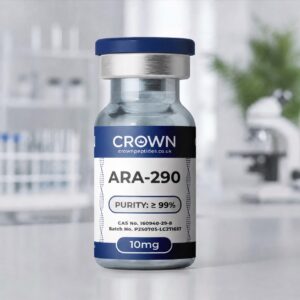
ARA-290 Research Peptide
HPLC and MS verified · batch certificate published · dispatched from the UK before 2pm
Current Limitations of the Evidence
The trials are small. Sixty-four patients is a reasonable Phase 2b but it is not a Phase III, and the longest exposure in the published work is 28 days with observation to 56. Both main programmes came from the same investigator group — Michael Brines and Anthony Cerami as founding scientists, with Albert Dahan at Leiden University Medical Center — so independent replication is limited.
The structural endpoints are a genuine strength, though. Corneal confocal microscopy measures something physical. A trial that reports nerve fibres regrowing is making a harder claim than one reporting that symptom scores improved, and it is harder to explain away.
Read the certificate before you order
Every batch is published openly — identity by mass spectrometry, purity by HPLC, and the batch number printed on the vial you receive.
Open the COA libraryFrequently Asked Questions
Is ARA-290 the same as cibinetide?
Yes. Cibinetide is the international non-proprietary name; ARA-290 is the development code. It also appears as helix-B surface peptide in the literature.
Does ARA-290 raise red blood cell counts like EPO?
No. It was specifically engineered to activate the innate repair receptor while leaving the classical erythropoietin receptor alone, which is the point of the molecule.
What is corneal confocal microscopy measuring?
The density and area of small nerve fibres in the cornea, which serve as an accessible structural proxy for small fibre health elsewhere in the body. It allows nerve regeneration to be measured directly rather than inferred from symptoms.
How is ARA-290 tested?
Every batch is analysed by HPLC for purity and mass spectrometry for identity, with the certificate published in full and the batch number printed on the vial.
References
- Culver D. A. et al. Cibinetide Improves Corneal Nerve Fiber Abundance in Patients With Sarcoidosis-Associated Small Nerve Fiber Loss and Neuropathic Pain. Investigative Ophthalmology & Visual Science, 2017. DOI 10.1167/iovs.16-21291.
- Heij L. et al. Safety and efficacy of ARA 290 in sarcoidosis patients with symptoms of small fiber neuropathy. Molecular Medicine, 2012.
- Brines M. et al. ARA 290, a nonerythropoietic peptide, in patients with type 2 diabetes. Molecular Medicine, 2015.
- Dahan A. et al. Targeting the innate repair receptor to treat neuropathy. Pain Reports, 2016.
Working with ARA-290 Research Peptide
Batch-tested material, published certificates, and same-day dispatch on orders placed before 2pm.
See ARA-290 Research Peptide