

RESEARCH USE DISCLAIMER
Crown Peptides supplies Melanotan I as a laboratory research compound only. It is not sold as, and is not equivalent to, the FDA and EMA-approved pharmaceutical product Scenesse (afamelanotide). Our products are not intended for human consumption and are not sold, marketed, or labelled for the diagnosis, treatment, cure or prevention of any disease. Nothing in this document should be read as medical advice or as an endorsement of human use. The discussion below summarises published scientific and regulatory literature only, and is intended for researchers and students of dermatology and photobiology.
Melanotan-1 is the one melanocortin peptide that made it all the way through. Under the name afamelanotide it is an approved medicine in both the United States and European Union, which means it carries regulatory-grade Phase III human trial data — something almost no research peptide can claim. Thirteen residues, selective for the MC1R receptor, and a development history that ran from a university laboratory in Arizona to a licensed prescription product.
This article is direct throughout about a key distinction: Crown Peptides supplies Melanotan I strictly as a laboratory research compound, separate from the approved pharmaceutical product Scenesse, which is administered only by trained clinicians under specific regulatory conditions.
The short version
- Thirteen residues, selective for the MC1R receptor rather than the wider melanocortin family.
- Under the name afamelanotide it is an approved prescription medicine in the US and EU.
- That approval means it carries Phase III human trial data, which almost no research peptide has.
- Most online discussion concerns cosmetic use, which sits well outside the approved indication.
What Is Melanotan I Peptide?
Melanotan I (known pharmaceutically as afamelanotide, brand name Scenesse) is a synthetic linear tridecapeptide (13 amino acids) analogue of alpha-melanocyte-stimulating hormone (alpha-MSH), featuring two specific amino acid substitutions — norleucine replacing methionine at position 4, and D-phenylalanine replacing L-phenylalanine at position 7 — that substantially increase its metabolic stability and receptor-binding duration compared to native alpha-MSH.
Afamelanotide received European Medicines Agency approval in 2014 (with commercial marketing beginning in 2016) and FDA approval in October 2019, specifically for increasing pain-free light exposure in adults with erythropoietic protoporphyria (EPP), a rare, inherited metabolic disorder that causes extreme, painful photosensitivity. This makes Melanotan I the first alpha-MSH analogue to receive regulatory approval anywhere, and it remains, alongside PT-141, one of only two melanocortin receptor agonists with completed regulatory approval.
Why MC1R Selectivity Was the Key to Reaching Approval
It's worth understanding precisely why Melanotan I, rather than the more potent Melanotan II, was the specific molecule that reached regulatory approval. Melanotan I's two amino acid substitutions increase its stability and duration of MC1R activation while largely preserving its linear structure — a meaningfully different design choice from Melanotan II's cyclic (lactam-ring) structure, which increases potency but does so non-selectively across MC1R, MC3R, MC4R, and MC5R simultaneously. Melanotan I's greater selectivity specifically for MC1R over the other melanocortin receptor subtypes is precisely what gave it a cleaner, more predictable, and more clinically tractable safety profile — avoiding the MC4R-mediated sexual arousal and appetite effects that characterise Melanotan II — which was the practical reason it, rather than its more potent cyclic relative, became the molecule pursued through formal clinical development toward regulatory approval.
Melanotan I Mechanism: Selective MC1R Activation for Photoprotection
Melanotan I acts as a selective agonist at the melanocortin-1 receptor (MC1R) on melanocytes, stimulating eumelanin (dark pigment) production independent of UV exposure. In patients with erythropoietic protoporphyria, this UV-independent eumelanin production is proposed to work through two complementary mechanisms: the increased eumelanin itself absorbs incoming UV and visible light radiation, providing a physical photoprotective shield, while afamelanotide's broader alpha-MSH-derived activity has also been proposed to reduce free radical formation and modulate inflammatory cytokine production, both relevant to the phototoxic reaction EPP patients experience.
This mechanism is mechanistically distinct from conventional sunscreen, which works by absorbing or reflecting UV radiation at the skin surface before it penetrates; Melanotan I instead works by increasing the skin's own endogenous protective pigment production, providing a systemic photoprotective effect from within rather than a topical barrier applied externally.
Melanotan I's linear structure and selectivity specifically for MC1R gave it a cleaner safety profile than Melanotan II's non-selective, multi-receptor cyclic structure — the practical reason it reached regulatory approval as Scenesse.
What Erythropoietic Protoporphyria Is, and Why This Mechanism Matters
It's worth understanding the specific patient population this mechanism was developed for, since it explains why UV-independent pigmentation is such a clinically meaningful intervention for this particular condition. Erythropoietic protoporphyria is a rare, inherited metabolic disorder in which an enzyme deficiency causes a build-up of protoporphyrin, a photosensitising compound, in the skin. When exposed to light — even brief exposure — EPP patients experience severe, often described as excruciating, phototoxic pain, forcing many to avoid nearly all daylight exposure and profoundly affecting quality of life. Because conventional sunscreen cannot fully block the specific wavelengths that trigger this reaction, and because avoiding all light exposure is neither practical nor sustainable, a systemic approach that increases the skin's own endogenous protective pigment offered a genuinely different therapeutic strategy — precisely what afamelanotide's approval-supporting Phase III trials were designed to test.
How Melanotan I Compares to PT-141 and Melanotan II in Crown Peptides' Range
It's worth situating Melanotan I relative to its two structural relatives Crown Peptides supplies. All three derive from the same alpha-MSH parent chemistry, but each was refined toward a different receptor target: Melanotan I toward MC1R selectivity (pigmentation and photoprotection), PT-141 toward sexual-function-relevant receptors via a cyclic structure, and Melanotan II left deliberately non-selective, activating all four receptor subtypes simultaneously. Researchers choosing between these three should think in terms of receptor target first, since the three compounds are not interchangeable substitutes for one another despite their shared chemical ancestry.
- Classification
- Synthetic alpha-MSH analogue closely related to afamelanotide
- Available strength
- 10mg
- CAS Number
- 75921-69-6
- Molecular Weight
- 1646.8 g/mol
- Molecular Formula
- C78H111N21O19
- Sequence
- Ac-Ser-Tyr-Ser-Nle-Glu-His-D-Phe-Arg-Trp-Gly-Lys-Pro-Val-NH2
Why Researchers Are Interested in Melanotan I
Melanotan I's research interest centres primarily on its established, regulatory-grade application in EPP, alongside broader research into photoprotection strategies for other photosensitivity-related dermatological conditions, and a considerably larger informal discussion around its use for cosmetic tanning purposes, which sits outside its approved indication entirely.
The Phase III Trial Data Behind Scenesse's Approval
It's worth examining the specific efficacy data that supported afamelanotide's approval, since it represents genuinely robust evidence by our peptide guides' standards. Two Phase III randomised controlled trials found that afamelanotide-treated EPP patients achieved a median of 69.4 hours of pain-free sun exposure, compared to 40.8 hours in the placebo group — a substantial, statistically meaningful difference in a genuinely debilitating condition where even modest improvements in tolerable light exposure represent a significant quality-of-life benefit. This trial programme is a considerably stronger evidence base than exists for almost any other compound discussed among research peptides, reflecting afamelanotide's status as a fully approved medicine rather than an early-stage research candidate.
Phase III evidence
The confirmatory Phase III trial in erythropoietic protoporphyria measured how long participants could stay in direct sunlight between 10am and 3pm without phototoxic pain. The afamelanotide group managed eight times the median exposure of the placebo group — the result that carried the compound through to approval in both the US and EU.
Phase III confirmatory study in erythropoietic protoporphyria, NCT00979745.
Key Areas of Melanotan I Research
Erythropoietic protoporphyria (the approved indication). Two Phase III randomised controlled trials established afamelanotide's efficacy in significantly extending pain-free light exposure time in EPP patients, forming the basis of its EMA (2014) and FDA (2019) approvals — the single strongest evidence base for any Melanotan I application.
Other photosensitivity disorders. Beyond EPP specifically, afamelanotide has been researched for solar urticaria, polymorphic light eruption, and general photoprotection applications, extending its research relevance across a broader category of photosensitivity-related dermatological conditions, though these applications remain outside its specific approved indication.
Hailey-Hailey disease research. A separate line of research has examined the melanocortin analogue underlying afamelanotide for treating Hailey-Hailey disease, a genetic skin condition, representing a research direction distinct from its primary photoprotection application.
Immunogenicity research. Given afamelanotide's status as a repeatedly administered peptide therapeutic, dedicated research has specifically evaluated the immunogenicity of the compound in EPP patients using ELISA-based antibody detection, an important safety research thread for any peptide intended for long-term, repeated clinical use.
Comparative mechanism research against Melanotan II and PT-141. Because all three compounds derive from the same alpha-MSH parent chemistry, comparative structure-activity research clarifying how Melanotan I's linear structure and specific substitutions produce MC1R selectivity — in contrast to Melanotan II's cyclic non-selectivity and PT-141's cyclic sexual-function selectivity — represents a genuinely instructive area of ongoing melanocortin receptor pharmacology.
Methodology: approved-medicine evidence versus off-label cosmetic use. It's important to keep Melanotan I's approved-indication evidence (EPP, supported by Phase III RCTs) clearly separated from its considerably more informal, off-label cosmetic tanning use, which has not been evaluated through dedicated FDA-reviewed trials for that specific application.
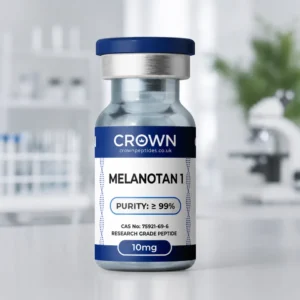
Melanotan-1 Research Peptide
HPLC and MS verified · batch certificate published · dispatched from the UK before 2pm
Summary of Published Melanotan I Studies
This table reflects a genuinely strong evidence position for Melanotan I's one specific approved application: real Phase III randomised controlled trial data supporting a genuine regulatory approval. This should not be conflated with equivalent evidence existing for cosmetic tanning use, which remains an off-label application without dedicated regulatory-grade trial support.
Potential Melanotan I Benefits for Photoprotection Research
Based on the published literature, researchers have investigated Melanotan I as a tool for studying:
- Selective MC1R agonism and its role in UV-independent eumelanin production
- Photoprotective mechanisms in rare, severe photosensitivity disorders such as erythropoietic protoporphyria
- Comparative structure-activity relationships within the melanocortin peptide family (linear versus cyclic structures, receptor selectivity profiles)
- Immunogenicity of repeatedly administered peptide therapeutics in chronic clinical use
- Broader dermatological applications including solar urticaria, polymorphic light eruption, and Hailey-Hailey disease
As with the other compounds in this series, this is research investigating mechanisms, and in Melanotan I's specific case, a genuine approved medical indication — but strictly for erythropoietic protoporphyria. None of the above constitutes evidence of benefit for cosmetic tanning or any other unapproved use.
Current Limitations of Melanotan I Research
- The approved indication is narrow and specific. Scenesse's approval covers increasing pain-free light exposure in adults with EPP only; there is no approved cosmetic tanning indication anywhere in the world.
- Research-grade Melanotan I is not equivalent to the approved product. "Melanotan I" products sold through unlicensed or research channels are compounded or research-grade formulations, not the FDA/EMA-approved product (Scenesse), and have not been evaluated by regulators for safety, efficacy, identity, purity, or potency in that form.
- Approved administration is via clinician-administered implant, not injection. Scenesse is delivered as a 16 mg subcutaneous bioresorbable implant administered by a trained clinician approximately every 60 days — a materially different delivery method, monitoring context, and pharmacokinetic profile from injectable research-grade material.
- Approval was granted under exceptional circumstances with continued monitoring. The EMA authorisation was specifically granted under "exceptional circumstances," requiring ongoing post-authorisation safety and effectiveness monitoring — reflecting the rare-disease context and comparatively limited patient population studied.
- Off-label cosmetic use lacks dedicated regulatory-grade trial support. While Melanotan I's approved-indication evidence is strong, no equivalent large-scale trial has established its safety or efficacy specifically for cosmetic tanning purposes.
Melanotan I Side Effects Reported in Research
Within its approved clinical use, commonly reported side effects have included nausea, facial flushing, headache, and injection or implant site reactions, alongside darkening of existing moles and freckles — a documented effect of increased melanocortin receptor activity requiring baseline and ongoing dermatological monitoring in clinical practice. Scenesse's prescribing information includes specific warnings and precautions regarding hypersensitivity reactions and the need for skin monitoring during treatment.
Immunogenicity research using ELISA-based detection has specifically evaluated whether repeated afamelanotide administration generates anti-drug antibodies in EPP patients, an important consideration for any peptide therapeutic intended for long-term, repeated clinical use. Any research protocol involving human or animal subjects should be developed with appropriate ethical and institutional review, following standard safety monitoring practices for investigational compounds.
Melanotan I Dosage Used in Published Research
This section is included for methodological context only and should not be interpreted as guidance for use.
The approved pharmaceutical product is administered as a 16 mg subcutaneous bioresorbable implant, delivered by a trained clinician approximately every 60 days during periods of increased sun exposure risk, providing sustained release over the treatment period. This clinician-administered implant delivery is entirely distinct from injectable research-grade formulations discussed in secondary and commercial sources. These figures describe a specific, clinically supervised pharmaceutical delivery method — they are not a basis for self-directed use of a research-grade compound in any context.
Researchers designing their own experimental protocols should base dosing decisions on the primary literature relevant to their specific model and objective, in consultation with institutional ethics review as applicable, rather than on secondary summaries such as this one.
Analogues and Future Research Directions
Melanotan I sits alongside Melanotan II and PT-141 within the melanocortin peptide family, each representing a distinct structural refinement of the same shared alpha-MSH-derived chemistry toward a different receptor-selectivity profile and clinical application. Comparative research across this family remains a genuinely active and instructive area of pharmacological study.
- Expanded photosensitivity disorder research. Given afamelanotide's demonstrated mechanism, dedicated trials in other photosensitivity conditions (solar urticaria, polymorphic light eruption) beyond EPP specifically would help clarify the compound's broader applicability within dermatology.
- Long-term immunogenicity and safety monitoring. Given afamelanotide's status as a chronically, repeatedly administered peptide, continued post-authorisation safety monitoring remains a valuable and already actively pursued research direction.
- Comparative structure-activity research within the melanocortin family. Further work comparing Melanotan I's linear, MC1R-selective structure against Melanotan II's cyclic, non-selective structure and PT-141's cyclic, sexual-function-selective structure would sharpen understanding of exactly which structural features drive receptor subtype selectivity.
- Dermatological monitoring protocols for long-term use. Given the documented effect on existing moles and freckles, research refining long-term dermatological monitoring protocols for patients on extended afamelanotide treatment represents a genuinely useful clinical research direction.
Frequently Asked Questions
What's the Difference Between Melanotan 1 and 2?
While both are synthetic peptide analogs of alpha-melanocyte-stimulating hormone (alpha-MSH) that stimulate melanin production, Melanotan 1 has a linear structure and a more targeted receptor profile, generally resulting in a slower, more gradual tanning effect with fewer side effects. Melanotan 2 has a cyclic structure that binds to a broader range of melanocortin receptors, often leading to a faster tan alongside common side effects like nausea, facial flushing, and spontaneous erections.
How Much Bac Water for 10mg Melanotan 1?
A common and convenient amount of bacteriostatic water to add to a 10 mg vial of Melanotan 1 is 1 mL or 2 mL. Using 1 mL simplifies dosage calculations, as each 0.1 mL on a standard insulin syringe will equal 1 mg of the peptide.
How to Mix Melanotan 1?
To mix Melanotan 1, wipe the rubber stoppers of both the peptide vial and the bac water with alcohol swabs, then draw the desired amount of water into a sterile syringe. Slowly inject the water down the inner glass wall of the peptide vial to protect the delicate structure, and gently swirl until the powder is fully dissolved.
How to Reconstitute Melanotan 1?
Reconstitution involves letting the sealed vial reach room temperature, cleaning the top with an alcohol swab, and slowly introducing bacteriostatic water down the inside wall of the vial. Gently swirl the mixture until the lyophilized powder is completely dissolved into a clear solution, taking care never to shake it.
What is Melanotan 1 Used For?
Melanotan 1 is primarily used to stimulate melanogenesis, triggering the skin to produce melanin and create a tan with minimal exposure to ultraviolet (UV) radiation. It is also researched for its potential protective effects against UV-induced skin damage and certain light-sensitivity disorders like erythropoietic protoporphyria.
Why Peptide Sourcing Quality Matters for Research Validity
As a linear 13-amino-acid peptide with two specific stabilising amino acid substitutions, Melanotan I's research validity depends on both correct sequence synthesis and correct incorporation of its defining substitutions (norleucine at position 4, D-phenylalanine at position 7).
Common failure modes relevant to Melanotan I specifically include:
- Incorrect or missing amino acid substitutions — if the specific norleucine and D-phenylalanine substitutions that define afamelanotide's stability and selectivity profile are not correctly incorporated during synthesis, the resulting peptide may behave more like native, rapidly degraded alpha-MSH.
- Truncated or deletion sequences — incomplete coupling during synthesis of this 13-residue peptide can leave a proportion of the product missing amino acids.
- Inaccurate mass or concentration labelling — without independent mass spectrometry confirmation, there's no reliable way to verify that a vial contains the peptide and concentration stated on the label.
- Bacterial endotoxin contamination — relevant for any in vivo or cell-culture research.
For a compound whose approved-medicine status rests on specific, well-characterised structural modifications, independent verification of both sequence and substitution accuracy is a basic precondition for any research finding to reflect the molecule studied in the approval-supporting clinical literature.
Read the certificate before you order
Every batch is published openly — identity by mass spectrometry, purity by HPLC, and the batch number printed on the vial you receive.
Open the COA libraryWhy Choose Crown Peptides
Testing is only part of the picture. Crown Peptides was built around a simple idea: a UK researcher ordering a peptide should be able to trust everything about how it reached them — not just the number on a Certificate of Analysis, but who made it, how it was handled, how it travelled, and who they can speak to if they have a question. That's the standard we hold ourselves to on every order, and it's worth explaining properly rather than just listing it.
Sourcing You Can Trust
Quality starts long before a product reaches our warehouse. We work directly with one of the world's largest and most established peptide synthesis manufacturers, chosen specifically for its production standards, consistency, and track record — rather than sourcing opportunistically from whichever manufacturer happens to offer the lowest price that month. That close, ongoing partnership is what allows us to stand behind every batch we sell, because we know exactly how it was made.
Verified Through Independent Testing
We don't expect researchers to take a manufacturer's word for it, so we verify every batch independently before it's listed for sale:
Endotoxin Testing
Every batch is screened for bacterial endotoxin, which matters in particular for any research involving cell culture, immune signalling, or in vivo inflammatory endpoints.
HPLC Purity Analysis
High-performance liquid chromatography is used to assess purity and screen for truncated sequences, deletion products, and synthesis by-products.
Mass Spectrometry Identity Confirmation
MS analysis confirms both the peptide sequence and the presence of its specific stabilising amino acid substitutions, verifying that the supplied compound matches intact Melanotan I rather than an incompletely modified or degraded variant.
Certificate of Analysis
Every batch is supplied with a Certificate of Analysis, and a QR code linking directly to the testing report on crownpeptides.co.uk, so researchers can document exactly what was used in their own experimental records.
Careful Storage and Handling
A product that's been correctly synthesised and tested can still be let down by poor handling afterward. Once a batch clears testing, we store it under controlled conditions designed to preserve stability and prevent degradation before it ever reaches a researcher's bench. This matters more for peptides and sensitive research compounds than for most laboratory reagents: temperature excursions, light exposure, and poor stock rotation can all silently reduce integrity long before a vial is opened, in ways that aren't visible on inspection and can quietly undermine an experiment's results. We treat that storage window as part of the product, not an afterthought once testing is done.
Packaging and Delivery
Every order is packed in premium, discreet packaging designed to protect the product in transit and arrive intact. Orders placed before 2pm are dispatched the same working day for next-day UK delivery, and we ship to Northern Ireland, the Republic of Ireland, Scotland, England, and across the EU, with international shipping available beyond that. For a researcher working to a study timeline, knowing an order will arrive quickly, safely, and exactly as ordered isn't a convenience — it's part of keeping a research schedule on track.
Support That Goes Beyond the Sale
Peptide and research-compound work raises genuine practical questions — around reconstitution, storage, handling, and interpreting a Certificate of Analysis — and we'd rather a researcher ask us directly than guess. Our team is on hand to provide clear, straightforward guidance from product selection through to delivery and beyond, without the evasiveness or upsell pressure that can come with some suppliers in this space. We see that ongoing relationship, not just the transaction, as the actual job.
Regulatory Compliance and Transparency
Crown Peptides is a UK-based company operating in line with MHRA guidance on research chemicals. Every batch is released against its own certificate of analysis, with HPLC purity and mass-spectrometry identity recorded and the lot number printed on the vial you receive. We'd rather be transparent about what we sell and who it's for than blur that line to chase a wider customer base — that's a deliberate choice on our part, not a legal minimum we begrudgingly meet.
Our Commitment
Put simply, our mission is to supply the UK research community with peptides and research compounds of unmatched purity and consistency, backed by a level of service, transparency, and technical support that researchers can actually rely on — from the first email enquiry to the vial arriving on the bench. That standard applies whether an order is a single vial for an independent researcher or a bulk order for a laboratory, and it holds regardless of whether a customer ever finds out how much work sits behind it.
For researchers who want their results to be reproducible and their experimental record defensible, knowing precisely what's in the vial — and trusting that everyone who handled it got it right — is a basic, non-negotiable starting point.
References
- FDA. SCENESSE (afamelanotide) Prescribing Information and Multi-Discipline Review. U.S. Food and Drug Administration. https://www.accessdata.fda.gov/drugsatfda_docs/nda/2019/210797Orig1s000MultidisciplineR.pdf
- "Afamelanotide for prevention of phototoxicity in erythropoietic protoporphyria." Expert Opinion on Investigational Drugs. https://www.tandfonline.com/doi/full/10.1080/17512433.2021.1879638
- "Afamelanotide." DermNet NZ. https://dermnetnz.org/topics/afamelanotide
Working with Melanotan-1 Research Peptide
Batch-tested material, published certificates, and same-day dispatch on orders placed before 2pm.
See Melanotan-1 Research Peptide