

Most fat-loss research compounds work by turning something up — a receptor, a hormone, a signalling cascade. 5-Amino-1MQ works by turning something off, and the enzyme it shuts down turns out to be one of the more interesting metabolic switches researchers have identified in the past two decades.
That enzyme is nicotinamide N-methyltransferase, or NNMT — a name that means almost nothing to most people, and everything to the small but growing field of researchers studying why fat cells sometimes get stuck in storage mode rather than burning through their reserves. 5-Amino-1MQ is a small-molecule inhibitor built specifically to block that one enzyme, and the downstream effects of doing so are what have made it one of the more talked-about metabolic research compounds in recent memory.
It's worth being upfront about where this compound sits in its research journey, because that context shapes everything else: 5-Amino-1MQ's strongest data currently comes from animal models, not completed human efficacy trials. That doesn't make the science less interesting — it makes it important to describe accurately.
5-Amino-1MQ is sold by Crown Peptides for laboratory research use only and has not been evaluated or approved by the FDA for human treatment.
The short version
- A small-molecule quinolinium, not a peptide — it has no amino acid backbone.
- Inhibits NNMT, an enzyme studied in metabolic regulation.
- Usually supplied as the iodide salt: 286.11 g/mol against 159.21 for the cation.
- That salt distinction matters — 1.89mg of the salt contains 1mg of the active compound.
The Enzyme Nobody Was Watching
NNMT has been known to biochemistry for decades, but for most of that time it sat in the background as a housekeeping enzyme — its job was simply to methylate nicotinamide, tagging it with a methyl group borrowed from a molecule called S-adenosylmethionine, or SAM, as part of routine cellular metabolism. It wasn't until researchers started mapping NNMT activity across different tissue types that its significance became clear: NNMT is markedly overexpressed in the fat tissue of obese animals and humans, and that overexpression tracks closely with metabolic dysfunction.
That correlation raised an obvious question. If an overactive enzyme is associated with fat cells getting stuck in a storage-dominant state, what happens if you block it? 5-Amino-1MQ is the research tool built to answer exactly that question.
Two Resources an Overactive Enzyme Quietly Drains
Understanding why blocking NNMT matters means understanding what the enzyme actually consumes every time it runs. Each methylation reaction NNMT performs uses up a molecule of SAM, the cell's primary methyl donor, and converts nicotinamide into a form that can no longer be recycled back into NAD+, the coenzyme central to virtually every energy-producing pathway in the cell.
Run that reaction too often, as overexpressed NNMT does in dysfunctional fat tissue, and two things happen at once: SAM reserves get consumed faster than they're replenished, and the nicotinamide salvage pathway — the route cells normally use to keep rebuilding their NAD+ supply — gets starved of raw material. Both outcomes push a cell further from active energy metabolism and closer to passive storage.
5-Amino-1MQ's proposed mechanism is straightforward once that picture is in place: by inhibiting NNMT, the compound is studied for leaving more nicotinamide available for the salvage pathway, supporting higher intracellular NAD+ levels specifically within fat cells. Elevated NAD+ is understood to activate Sirt1, a well-characterised metabolic regulator, and enhance AMPK signalling — both pathways associated with increased mitochondrial density and a cellular shift toward burning energy rather than storing it.
- Classification
- Small-molecule NNMT research compound
- Available strengths
- 10mg and 50mg
- CAS Number
- 42464-96-0 (commonly referenced for the iodide form)
- Molecular Weight
- 286.11 g/mol (iodide salt); 159.21 g/mol for the cation
- Molecular Formula
- C10H11IN2 (iodide salt)
Why a Fat Cell Gets "Stuck" in Storage Mode in the First Place
It helps to understand what "storage-dominant" actually means at the cellular level, since it's easy to think of fat cells as passive containers rather than metabolically active tissue. A healthy adipocyte constantly cycles between storing incoming energy as triglyceride and releasing it back out through lipolysis when the body needs fuel — a dynamic balance, not a one-way process. Metabolic dysfunction shifts that balance toward storage: mitochondrial density drops, the cell's capacity to burn through its own reserves for energy declines, and triglyceride accumulates faster than it's released.
NNMT overexpression is one of the molecular changes researchers have found sitting upstream of that shift. Because every NNMT reaction consumes SAM and diverts nicotinamide away from NAD+ production, chronically elevated NNMT activity is thought to gradually starve the cell of the exact resources it would need to run its mitochondria efficiently and burn stored fat — a self-reinforcing loop where reduced energy expenditure and continued fat storage feed into each other. Interrupting that loop at the enzyme level, rather than downstream of it, is the specific logic behind 5-Amino-1MQ's design.
What the Animal Data Actually Shows
5-Amino-1MQ's most substantial evidence comes from diet-induced obesity mouse models, where treated animals showed significant reductions in both body weight and fat mass compared with untreated controls. Two details from that research are worth highlighting specifically: food intake wasn't reduced, and lean mass was preserved. In other words, the weight loss observed wasn't attributable to appetite suppression or muscle loss — researchers attributed it specifically to increased energy expenditure at the level of the fat cell itself, consistent with the proposed NAD+-driven mechanism.
That's a genuinely encouraging preclinical signal, and it's the kind of result that reliably generates interest in moving a compound toward human research. It's equally important to say plainly that completed human efficacy trials for 5-Amino-1MQ don't yet exist in the published literature. Mouse metabolism and human metabolism overlap substantially but aren't identical, and the translation from animal model to human outcome is exactly the gap that separates a promising research compound from a clinically validated one. That gap is real, worth naming directly, and doesn't diminish the value of studying the mechanism now.
It's also worth being specific about the scale of effect reported in these models, rather than leaving "significant reduction" as a vague descriptor. The mouse studies behind 5-Amino-1MQ's core evidence compared treated and untreated diet-induced obesity groups over a defined dosing window, with body composition tracked throughout rather than measured only at the study's end — allowing researchers to see the trajectory of fat-mass change over time rather than a single before-and-after snapshot. That kind of longitudinal tracking is what let the research team attribute the effect specifically to increased energy expenditure, since food intake stayed flat across the same window while fat mass declined.
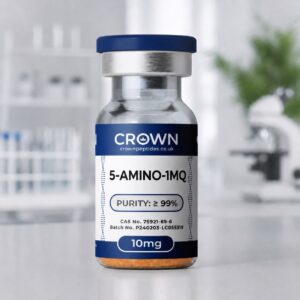
5-Amino-1MQ Research Compound
HPLC and MS verified · batch certificate published · dispatched from the UK before 2pm
Why NAD+ Keeps Showing Up in Metabolic Research
5-Amino-1MQ's mechanism connects it to a much larger research conversation currently playing out across ageing and metabolism science: the central role NAD+ plays in nearly every energy-producing reaction a cell runs. NAD+ levels are well documented to decline with age, and that decline has been linked in various research contexts to reduced mitochondrial function, slower metabolic rate, and diminished cellular repair capacity.
Where most NAD+-focused research compounds work by supplying NAD+ precursors directly — flooding the system with raw material for NAD+ production — 5-Amino-1MQ takes a different route entirely. Rather than adding more fuel, it's studied for removing a specific brake on the salvage pathway that would otherwise keep recycling nicotinamide back into usable NAD+. That's a meaningfully different research angle: conserving and better utilising existing metabolic resources, rather than supplementing them from outside.
The other detail worth sitting with is the lean-mass finding specifically, because it's one of the more scientifically meaningful parts of the dataset. A lot of interventions that produce weight loss in animal models do so partly at the expense of muscle tissue, which is a real limitation when extrapolating toward any eventual human application. 5-Amino-1MQ's preclinical data reporting preserved lean mass alongside reduced fat mass suggests a genuinely fat-selective mechanism, consistent with the adipocyte-specific NAD+ story researchers have proposed, rather than a general metabolic slowdown or wasting effect.
How Researchers Actually Test This
It's worth knowing what these experiments look like in practice. Diet-induced obesity models typically start with animals fed a high-fat diet until they reach a defined obese state, then split into treatment and control groups for a defined dosing period, with body weight, fat mass (usually measured through dual-energy X-ray absorptiometry or similar body-composition imaging), food intake, and lean mass tracked throughout. That combination of measures is what let researchers separate genuine fat-specific metabolic change from the simpler explanation of the animals just eating less.
At the cellular level, NNMT inhibition is typically confirmed through direct enzyme activity assays alongside measurement of intracellular NAD+ and SAM concentrations before and after treatment — verifying that the proposed mechanism is actually happening at the biochemical level, not just inferred from the downstream weight and fat-mass outcomes.
It's also worth understanding the gap between confirming a mechanism at the enzyme level and confirming an outcome at the whole-animal level, since both types of evidence appear in 5-Amino-1MQ's research base and they answer different questions. Enzyme assays confirm the compound is doing what it's designed to do biochemically — inhibiting NNMT and shifting SAM and NAD+ concentrations in the expected direction. Whole-animal body-composition studies confirm that biochemical change actually translates into a measurable physiological outcome. Having both types of evidence, rather than just one, is part of why 5-Amino-1MQ's preclinical case reads as more complete than a compound with only an in vitro mechanism and no functional outcome data to back it up.
Dosage in Research Settings
Because 5-Amino-1MQ's evidence base is animal-only, any dosing figures that exist come from published research protocols rather than human clinical guidance, and they're worth citing precisely rather than rounding into a vague range. In diet-induced obesity mouse studies, the compound has been dosed at roughly 10-20 mg/kg via intraperitoneal injection, with one widely cited protocol using 20 mg/kg administered three times daily subcutaneously across an 11-day study window — figures that describe a laboratory research setting, not a human protocol, and cannot be scaled directly to a person.
That distinction matters more than it might first appear. Mouse-to-human dose conversion isn't a simple matter of adjusting for bodyweight — metabolic rate, drug clearance, and enzyme expression all scale differently between species, which is precisely why regulatory bodies require dedicated human dose-ranging studies before any compound's dosing can be considered established. For 5-Amino-1MQ, that step hasn't happened yet in the published literature, so the mouse-study figures above should be read as a description of how the compound has been studied to date, not a recommendation.
Reported Benefits in the Research Data
Set out plainly, the benefits 5-Amino-1MQ has demonstrated in published research are: reduced body weight and fat mass in diet-induced obese mice, preserved lean mass across the same treatment window, lowered plasma total cholesterol, decreased adipocyte size, and no reduction in food intake — a combination that points researchers toward a genuinely fat-selective, energy-expenditure-driven mechanism rather than appetite suppression or general metabolic slowdown.
Each of those outcomes has a specific research use: body-composition change is the primary endpoint researchers track when evaluating NNMT inhibition, cholesterol and adipocyte-size data support the broader metabolic-health angle of the mechanism, and the unchanged food intake is the detail that lets researchers rule out appetite suppression as the explanation for the weight change.
Safety and Side Effects Reported in Studies
Published mouse studies of 5-Amino-1MQ have not reported observable adverse effects at the doses tested, and the compound's selectivity for NNMT over related methyltransferase enzymes was specifically highlighted by the researchers behind the reversal-of-obesity study as a favourable feature for reducing off-target activity. That said, a clean mouse safety signal is not equivalent to a human safety profile: no published human trials exist to characterise dosing tolerability, side effects, or long-term safety in people, and that gap should be treated as a genuine unknown rather than an assumed non-issue.
Manufactured to Research Standard
5-Amino-1MQ is a small molecule rather than a peptide, but the purity standard that matters is the same: confirming the compound in the vial is exactly what it claims to be, at the stated concentration, without synthesis by-products carried through into the finished product.
Crown Peptides tests every batch of 5-Amino-1MQ for purity and identity confirmation via HPLC and mass spectrometry, with a batch-specific certificate of analysis provided for every order — the same rigour applied across the full catalogue, whether a compound is a well-established research peptide or an earlier-stage small molecule like this one.
Storage guidance: supplied as a stable powder, kept in a cool, dry environment protected from light; once in solution, standard cold-chain handling applies, consistent with other research compounds in this category.
How 5-Amino-1MQ Differs From GLP-1 Research and Older Fat-Loss Compounds
It's worth placing 5-Amino-1MQ against the fat-loss research compounds that get far more mainstream attention, because the mechanism is genuinely not comparable. GLP-1 receptor agonists work primarily by slowing gastric emptying and acting on appetite-regulating centres in the brain — the weight loss they produce is substantially driven by reduced food intake. Older-generation fat-loss compounds, including various stimulant-based approaches, typically work by increasing overall metabolic rate or suppressing appetite through central nervous system pathways, often with a recognisable side-effect profile tied to that stimulant activity.
5-Amino-1MQ's proposed mechanism touches neither of those levers. It isn't studied for appetite suppression, and it isn't a stimulant. Its entire proposed effect operates at the level of a single enzyme inside the fat cell itself, which is precisely why the preclinical data showing unchanged food intake alongside reduced fat mass is such a meaningful detail — it's evidence the mechanism is doing something distinct from the appetite- and stimulant-driven approaches that dominate the broader fat-loss conversation.
That distinctiveness is also why 5-Amino-1MQ tends to come up in research discussions alongside NAD+ and longevity-adjacent compounds rather than alongside classic weight-management drugs — its proposed mechanism sits closer to cellular energy metabolism research than to appetite or hunger-signalling research, even though the visible outcome researchers are ultimately interested in, reduced fat mass, looks similar on paper.
Where 5-Amino-1MQ Fits in a Broader Research Protocol
Set against other metabolic and longevity-adjacent research compounds, 5-Amino-1MQ occupies a specific niche: enzyme inhibition aimed at preserving and redirecting existing NAD+ and SAM resources within fat tissue specifically, rather than the broader systemic energy or growth-hormone-axis effects other compounds in this space are studied for. That specificity is exactly what makes it a useful, distinct tool for researchers examining adipocyte metabolism directly, rather than a general substitute for other metabolic research compounds.
- Mechanism: inhibits NNMT, preserving SAM and supporting NAD+ salvage-pathway activity in fat cells.
- Strongest evidence: diet-induced obesity mouse models showing fat-specific weight loss without reduced food intake or lean mass.
- Evidence gap: no completed human efficacy trials published yet — an early-stage compound by design.
- Distinguishing feature: works by conserving existing metabolic resources rather than supplying new NAD+ precursors.
What Would Need to Happen Next
For 5-Amino-1MQ to move from a promising preclinical compound to one with genuine human evidence behind it, the next logical research steps mirror the standard path most metabolic compounds follow: dose-ranging studies to establish safety and pharmacokinetics in humans, followed by controlled efficacy trials measuring body composition change against placebo over a defined period, ideally paired with direct biomarker tracking of NAD+, SAM, and NNMT activity in human adipose tissue to confirm the mechanism translates the way the mouse data suggests it should.
That's a substantial amount of research still ahead of this compound, and it's worth being realistic about the timeline that kind of validation typically takes — often years rather than months. What the existing animal data does provide is a coherent, mechanistically grounded starting point: a specific enzyme target, a plausible downstream pathway, and functional outcome data showing the mechanism produces a measurable, fat-selective effect in a living organism. That's a meaningfully stronger foundation than a compound with only a theoretical mechanism and no functional testing behind it at all.
Frequently Asked Questions:
What is 5 Amino 1MQ Used For?
5-Amino-1MQ is primarily used in research to combat obesity, reduce body fat, and improve metabolic health by inhibiting nicotinamide N-methyltransferase (NNMT). By blocking this enzyme, it helps boost cellular energy expenditure and prevents fat accumulation without directly altering the central nervous system.
Is 5 Amino 1MQ a Peptide?
No, 5-Amino-1MQ is not technically a peptide; it is a small molecule or quinolinium-based compound rather than a chain of amino acids. However, it is frequently discussed alongside peptides and research chemicals in fitness and longevity communities.
Does 5 Amino 1MQ Need to Be Refrigerated?
Yes, once 5-Amino-1MQ is compounded or prepared into a solution, it should be stored in the refrigerator to maintain stability and prevent degradation. Unopened powder forms should also be kept in a cool, dry, and dark place, often refrigerated or frozen for long-term storage.
How to Reconstitute 5 Amino 1MQ?
Because 5-Amino-1MQ is frequently handled in oral capsule or specialized liquid research formats rather than standard injectable lyophilized powder, reconstitution instructions vary widely by supplier. If working with an injectable research compound version, you would typically wipe the vial stopper, slowly introduce bacteriostatic water down the inner wall, and gently swirl until dissolved.
Is 5 Amino 1MQ Worth It?
Opinions on whether 5-Amino-1MQ is "worth it" depend on individual research goals, as it shows promising preclinical results for targeted fat loss and metabolic support but remains costly and lacks large-scale human clinical trials. Users and researchers weigh its unique mechanism of action against its high financial cost and the limited availability of long-term safety data.
Read the certificate before you order
Every batch is published openly — identity by mass spectrometry, purity by HPLC, and the batch number printed on the vial you receive.
Open the COA libraryThe Bottom Line
5-Amino-1MQ represents a genuinely distinct approach to metabolic research: instead of adding a new signal, it removes a specific brake on a pathway fat cells already have. The animal data is encouraging and mechanistically coherent, and the honest caveat — human trials haven't caught up yet — is exactly the kind of frontier that makes early-stage research compounds worth watching closely.
References
- Neelakantan H, Vance V, Wetzel MD, et al. Selective and membrane-permeable small molecule inhibitors of nicotinamide N-methyltransferase reverse high fat diet-induced obesity in mice. Biochem Pharmacol. 2018. https://pmc.ncbi.nlm.nih.gov/articles/PMC5826726/
Working with 5-Amino-1MQ Research Compound
Batch-tested material, published certificates, and same-day dispatch on orders placed before 2pm.
See 5-Amino-1MQ Research Compound