

Kisspeptin-10 answered a question reproductive endocrinology had been stuck on for decades: something was pulsing the release of GnRH — the hormone at the very top of the reproductive cascade — and nobody could identify what. The answer came from researchers studying a gene originally linked to cancer metastasis suppression, and reproductive biology has not looked at the question the same way since.
That gene was KISS1, and the peptide it encodes — kisspeptin, with Kisspeptin-10 as its shortest biologically active fragment — turned out to be the long-sought master regulator sitting directly upstream of the entire reproductive hormone axis. It's a rare thing in endocrinology: a single signalling molecule whose absence completely halts puberty, and whose presence appears to be obligate for normal reproductive function to occur at all.
Kisspeptin-10 is sold by Crown Peptides for laboratory research use only and is not approved for human consumption.
The short version
- Ten residues, signalling through the GPR54 receptor.
- Discovered as a metastasis suppressor, named after Hershey Kisses.
- Loss-of-function mutations prevent puberty entirely — that is how its role was found.
- Sits upstream of GnRH, making it the trigger for the whole reproductive axis.
An Unexpected Origin in Cancer Research
Kisspeptin's discovery story is genuinely unusual. The KISS1 gene was first identified in the 1990s as a metastasis suppressor gene, studied initially in the context of preventing the spread of melanoma cells — reproductive biology wasn't part of the original research question at all. It was only when researchers identified GPR54 (now more commonly designated KISS1R) as the receptor for the KISS1 gene product that the reproductive connection began to emerge, through a separate and unexpected line of genetic research entirely.
That reproductive connection became unmistakable when researchers identified loss-of-function mutations in either KISS1 or its receptor as the cause of a specific, well-defined clinical condition: complete failure of pubertal development accompanied by hypogonadotropic hypogonadism, occurring without any disruption to other pituitary-axis functions. That specificity — a mutation knocking out reproductive function alone, while leaving every other hormonal axis intact — is exactly the kind of clean genetic evidence that lets researchers pinpoint a single signalling system as the master control point for a specific physiological process.
Precocious Puberty: The Mirror-Image Finding
If loss-of-function mutations in KISS1 or its receptor halt puberty entirely, the logical converse prediction would be that activating mutations should trigger puberty prematurely — and that's exactly what researchers found. Activating mutations of either KISS1 or KISS1R have been documented to cause central precocious puberty, early pubertal onset driven by inappropriately early activation of the same GnRH pulse-generating mechanism.
That dual finding — loss-of-function blocking puberty, gain-of-function accelerating it — is about as clean a piece of genetic evidence as reproductive endocrinology gets for establishing a signalling pathway as a true causal switch rather than merely a correlated or contributing factor. Few physiological control points have this kind of bidirectional genetic confirmation, and it's a major reason kisspeptin signalling is described in the research literature with the kind of confidence usually reserved for only the most thoroughly characterised endocrine pathways.
- Classification
- Bioactive 10-amino-acid fragment of kisspeptin
- Available strength
- 10mg
- CAS Number
- 374675-21-5
- Molecular Weight
- 1302.44 g/mol
- Molecular Formula
- C63H83N17O14
- Sequence
- Tyr-Asn-Trp-Asn-Ser-Phe-Gly-Leu-Arg-Phe-NH2 (YNWNSFGLRF-NH2)
The GnRH Pulse Generator, Finally Identified
That discovery answered a question reproductive endocrinologists had been chasing for years: what, exactly, generates the pulsatile pattern of GnRH release that drives the entire downstream reproductive hormone cascade? GnRH itself isn't released continuously — it's released in discrete pulses, and the frequency and amplitude of those pulses directly shape the ratio of luteinizing hormone (LH) to follicle-stimulating hormone (FSH) released downstream, which in turn governs essentially the entire reproductive hormone system in both sexes.
Kisspeptin neurons in the hypothalamus were identified as the specific cellular population responsible for generating that pulse — the long-sought "GnRH pulse generator" mechanism. Kisspeptin binds to GPR54/KISS1R receptors expressed on GnRH neurons with high affinity, activating Gq/11 proteins and stimulating the phospholipase C (PLC) signalling pathway downstream. Research indicates kisspeptin stimulates over 85% of GnRH neurons within the central nervous system, triggering the release of both LH and FSH from the pituitary in response.
Why Pulse Frequency, Not Just Presence, Matters
One of the more subtle but important aspects of kisspeptin research concerns the specific role of pulse frequency rather than simple hormone presence or absence. GnRH neurons don't respond to a constant, steady kisspeptin signal the same way they respond to a properly timed pulsatile one — the downstream pituitary gonadotrope cells that receive GnRH signalling are themselves sensitive to pulse frequency, with different frequencies favouring LH release over FSH release, or vice versa.
That frequency-decoding relationship is a big part of why researchers describe kisspeptin neurons as a genuine "pulse generator" rather than simply a release trigger. Research into the specific cellular and network mechanisms that give rise to this pulsatile pattern — including the interplay between different kisspeptin neuron subpopulations in distinct hypothalamic nuclei — remains an active area of ongoing investigation, since fully explaining how a stable pulse frequency emerges from a population of individual neurons is a considerably harder question than simply establishing that kisspeptin signalling is required for the process to occur at all.
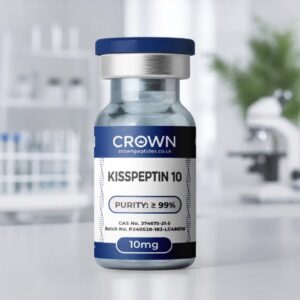
Kisspeptin-10 Research Peptide
HPLC and MS verified · batch certificate published · dispatched from the UK before 2pm
Kisspeptin-10: The Shortest Fully Active Fragment
The full-length kisspeptin peptide, sometimes called metastin, is considerably larger than the fragment most commonly used in research settings. Kisspeptin-10 refers specifically to the shortest C-terminal decapeptide fragment that retains full biological activity at the GPR54/KISS1R receptor — a common pattern in peptide pharmacology, where a smaller, more synthetically manageable fragment of a larger natural peptide preserves the receptor-binding activity of the full molecule, making it a far more practical research tool.
That practicality matters enormously for research purposes: working with a ten-amino-acid fragment rather than the full-length peptide simplifies synthesis, improves batch-to-batch consistency, and makes dosing calculations considerably more straightforward, all while preserving the specific receptor activity researchers are actually interested in studying.
Cross-Species Conservation of the Pathway
Kisspeptin signalling isn't a human-specific curiosity — research spanning fish, rodents, sheep, and primates has documented the same fundamental kisspeptin-GPR54-GnRH pathway operating across an enormous evolutionary range. Studies in chub mackerel, for instance, have examined the kisspeptin system's role in reproductive physiology in a teleost fish species, offering researchers a comparative perspective on how ancient and conserved this signalling architecture actually is.
That cross-species consistency has practical research value beyond simple evolutionary interest: livestock and agricultural research has directly applied kisspeptin receptor agonists to reproductive management questions, with studies documenting increased luteinizing hormone concentrations following kisspeptin receptor agonist administration in anestrous ewes — female sheep outside their normal breeding cycle. That kind of applied agricultural research runs in parallel with, and reinforces, the more clinically focused human reproductive endocrinology research discussed elsewhere in this piece.
What Happens When You Activate the Master Switch
Because Kisspeptin-10 sits so far upstream in the reproductive hormone cascade, its downstream effects ripple through the entire hypothalamic-pituitary-gonadal (HPG) axis. Administration triggers GnRH release, which drives pituitary LH and FSH secretion, which in turn stimulates gonadal hormone production — testosterone in males, oestrogen and progesterone across the menstrual cycle in females. That cascading structure is precisely what makes Kisspeptin-10 such a distinctive research tool: rather than targeting any single downstream hormone directly, it engages the entire axis from its originating control point.
Recent Phase-I clinical research has explored a genuinely interesting pharmacological pattern with daily subcutaneous kisspeptin administration: an early LH surge, followed by sustained testosterone reduction down to castrate levels — a self-limiting mechanism attributed to receptor desensitisation with continuous stimulation. That pattern has drawn research interest as a potential alternative approach to long-acting GnRH agonists, which are already established in androgen-suppression research and clinical contexts, offering a mechanistically distinct route to a broadly similar downstream outcome.
Sex Differences in Kisspeptin Neuron Populations
Research has documented meaningful sex differences within the hypothalamic kisspeptin neuron population, distributed across two anatomically distinct nuclei that appear to serve different functional roles. One population, located in the arcuate nucleus, is thought to be central to the pulsatile, moment-to-moment GnRH release pattern discussed above. A separate population, in the anteroventral periventricular nucleus, shows more pronounced sexual dimorphism and has been implicated specifically in generating the pre-ovulatory LH surge unique to female reproductive cycling — a distinct physiological event from the ongoing pulsatile pattern maintained in both sexes.
That anatomical and functional division adds meaningful nuance to how researchers think about kisspeptin signalling: it isn't a single, uniform system generating one type of output, but rather two at least partially distinct neuronal populations, each contributing a different piece of the overall reproductive hormone regulation puzzle, with sex-specific differences in how each population develops and functions.
Beyond Reproduction: Metabolism and the Kiss1 Connection
Kisspeptin research has expanded considerably beyond pure reproductive endocrinology in recent years. Kiss1-expressing neurons have been shown to sit at a genuine crossroads between reproductive and metabolic regulation — research has documented that IGF-1 acts through Kiss1-expressing cells to influence both metabolism and reproduction simultaneously, reflecting the well-established biological reality that reproductive capacity and metabolic status are tightly linked; the body generally suppresses reproductive function during states of energy deficit, and kisspeptin signalling appears to be one of the mechanisms through which that link is enforced.
That metabolism-reproduction crosstalk research places kisspeptin in an unusual position within endocrinology: a peptide originally identified through cancer research, then established as the master reproductive switch, now increasingly understood as a genuine integration point between energy status and reproductive capacity — a considerably broader physiological role than its initial characterisation suggested.
How Energy Status Talks to Kisspeptin Neurons
The metabolism-reproduction crosstalk mentioned above deserves a closer look, because it illustrates a genuinely elegant piece of physiological wiring. Kisspeptin neurons are positioned to receive signals from metabolic hormones including leptin, the hormone secreted by fat tissue that signals energy sufficiency to the brain. In states of energy deficiency — whether from caloric restriction, excessive exercise, or illness — declining leptin signalling appears to reduce kisspeptin neuron activity, which in turn dials down GnRH pulse generation and, ultimately, suppresses the entire downstream reproductive hormone cascade.
That wiring makes evolutionary sense: reproduction is metabolically expensive, particularly for female mammals carrying and nursing offspring, and an organism in genuine energy deficit benefits from temporarily suppressing reproductive capacity rather than committing scarce resources to it. Kisspeptin neurons, sitting at the literal convergence point between metabolic signalling and reproductive hormone control, appear to be a key part of the biological mechanism that enforces this trade-off — which is precisely why researchers studying conditions like hypothalamic amenorrhea, linked to low energy availability, have taken such a close interest in kisspeptin signalling specifically.
Kisspeptin and Sexual Behaviour Research
A newer and actively developing thread within kisspeptin research examines its effects on sexual behaviour and attraction-related brain activity, distinct from its hormonal signalling role. Clinical research has documented effects of kisspeptin administration on measures of sexual and romantic brain processing, alongside its established hormonal effects — research that draws on kisspeptin signalling within brain regions like the amygdala, which has itself been shown to modulate reproductive hormone secretion through kisspeptin pathways distinct from the primary hypothalamic GnRH pulse generator mechanism.
This behavioural research thread is a good illustration of how a single, well-characterised signalling system can generate genuinely distinct research questions once its receptor distribution is mapped comprehensively — kisspeptin receptors aren't confined to the hypothalamic neurons responsible for GnRH pulse generation, and each additional expression site opens a new, mechanistically related but functionally distinct line of inquiry.
Comparing Kisspeptin Research to GnRH-Targeted Approaches
Kisspeptin's position upstream of GnRH gives it a distinctive pharmacological profile compared with compounds that target GnRH signalling directly. GnRH agonists, widely used in existing clinical and veterinary contexts, work by initially stimulating and then, with continuous exposure, desensitising GnRH receptors on pituitary gonadotrope cells — an approach that produces an initial hormone surge followed by sustained suppression, broadly similar in overall shape to the kisspeptin desensitisation pattern described earlier.
What differs is the point of intervention. GnRH agonists act directly on the pituitary, bypassing the hypothalamic pulse-generating step entirely. Kisspeptin-based approaches instead work through that upstream pulse generator, which some researchers view as offering a more physiologically integrated route into the reproductive axis — engaging the system's natural control point rather than intervening one step downstream of it. Whether that upstream engagement translates into meaningfully different research outcomes compared with established GnRH-targeted approaches remains an active area of ongoing comparative research.
Peripheral Roles: Beyond the Brain
Kisspeptin and KISS1R aren't confined to the central nervous system. Research has documented expression of the kisspeptin/KISS1R system directly within the ovary, with experimental evidence suggesting a role in follicular development, oocyte maturation, steroidogenesis, and ovulation — a direct, local reproductive tissue role operating alongside, and potentially independently of, its central hypothalamic signalling function.
The kisspeptin receptor has also been identified in cardiovascular tissue, with documented inotropic (contractile force-modulating) actions studied across rat, mouse, and human tissue samples — findings that add cardiovascular physiology to the growing list of systems where kisspeptin signalling appears to play a genuine, functionally relevant role, distinct from its headline reproductive axis function.
A Note on Studying an Upstream Master Regulator
Working with a compound positioned this far upstream in a major hormonal cascade carries specific research implications worth understanding. Because Kisspeptin-10 sits above the entire GnRH-LH/FSH-gonadal hormone cascade, its downstream effects are inherently harder to isolate and attribute to a single mechanism than a compound acting at one specific, narrowly defined point in the pathway. Research protocols studying Kisspeptin-10 typically need to track multiple downstream hormone measures simultaneously — GnRH pulse characteristics where measurable, LH and FSH secretion patterns, and eventual gonadal hormone output — to build a complete picture of how the upstream signal propagates through the full cascade.
That multi-point measurement requirement is part of what makes kisspeptin research methodologically more demanding than research on compounds acting at a single, isolated receptor with a direct, easily measured downstream readout — but it's also precisely what makes kisspeptin such a valuable research tool for studying the reproductive axis as an integrated system, rather than as a series of disconnected individual signalling steps.
Dosage in Research Settings
Human dose-response research in healthy men has used intravenous bolus doses of kisspeptin-10 ranging from 0.01 to 3.0 mcg/kg, with LH and FSH elevation detectable from doses as low as roughly 0.3-1.0 nmol/kg, and continuous infusion studies using rates around 1.5-4 mcg/kg per hour sustained over 22.5 hours to characterise the full hormonal response curve. Studies in women have used comparable and in some cases higher doses, with results varying by menstrual cycle phase. These figures describe controlled dosing under direct clinical research supervision with hormone levels tracked by blood sampling, not guidance for use outside that setting.
Reported Benefits in the Research Data
In men, kisspeptin-10 infusion has been shown to raise LH from a baseline mean of roughly 5.4 to 20.8 IU/liter and testosterone from roughly 16.6 to 24.0 nmol/liter over the infusion period, alongside increased LH pulse frequency — a direct, biomarker-confirmed demonstration of its role as an upstream activator of the reproductive hormone axis. In men with type 2 diabetes and mild biochemical hypogonadism, kisspeptin-10 has also been shown to stimulate testosterone and LH secretion, a finding of particular research interest given how common that hormonal pattern is in that patient population.
Side Effects Reported in Studies
Human dose-response and infusion studies of kisspeptin-10 have generally reported the compound as well tolerated at the doses tested, with its defining research finding being sexual dimorphism in response rather than an adverse-event signal — women show a markedly different, cycle-phase-dependent hormonal response compared with the more consistent dose-dependent response seen in men. That dimorphism is itself an important safety and study-design consideration for any research protocol involving both sexes.
Manufactured to Research Standard
Kisspeptin-10's compact ten-amino-acid structure makes it a relatively efficient peptide to synthesise with high fidelity, though verification remains just as essential for a peptide this biologically potent.
Crown Peptides tests every batch of Kisspeptin-10 for HPLC purity and mass spectrometry identity confirmation, with a batch-specific certificate of analysis provided for every order.
Storage follows the standard protocol used across the peptide range: supplied as a lyophilised powder, stable when kept cold and shielded from light and moisture, with reconstituted solution requiring refrigeration and use within the recommended window.
Kisspeptin-10 Compared With Other HPG-Axis Research Compounds
Kisspeptin-10 occupies a genuinely unique position relative to other reproductive-axis research peptides, sitting even further upstream than GnRH itself. Where GnRH analogues act directly on pituitary gonadotrope cells, Kisspeptin-10 acts one step earlier, on the hypothalamic neurons responsible for generating the GnRH pulse pattern in the first place — making it a tool for studying the pulse-generating mechanism itself rather than simply the downstream hormone cascade it drives.
- Origin: shortest fully active C-terminal fragment of kisspeptin/metastin, the KISS1 gene product.
- Receptor: GPR54, also designated KISS1R, a Gq/11-coupled receptor on GnRH neurons.
- Core research finding: obligate regulator of the GnRH pulse generator; loss-of-function mutations halt puberty entirely.
- Downstream cascade: GnRH release → pituitary LH/FSH secretion → gonadal hormone production.
- Expanding research areas: metabolism-reproduction crosstalk, sexual behaviour, ovarian and cardiovascular expression.
Kisspeptin-10 Alongside Other Reproductive-Research Compounds
Crown Peptides' catalogue includes several compounds researchers examine alongside Kisspeptin-10 when studying reproductive and sexual health topics from different mechanistic angles. PT-141, a melanocortin receptor agonist, works through an entirely separate central nervous system pathway tied to sexual arousal, offering a mechanistically distinct route into sexual health research compared with kisspeptin's hormonal-cascade approach. Comparing compounds that intervene at genuinely different points in the broader system — central arousal pathways versus the hormonal axis controlling gonadal hormone production — gives researchers a fuller, more complete picture of reproductive and sexual physiology than any single compound's research profile could offer on its own.
Frequently Asked Questions:
What is Kisspeptin-10?
The shortest C-terminal fragment of kisspeptin (also known as metastin) that retains full biological activity at the GPR54/KISS1R receptor — the master regulator of the GnRH pulse generator controlling the reproductive hormone axis.
What is Kisspeptin 10 Used For?
Kisspeptin-10 is primarily used in research to stimulate the release of gonadotropin-releasing hormone (GnRH), which subsequently triggers the pituitary gland to produce luteinizing hormone (LH) and follicle-stimulating hormone (FSH). It is studied for its role in regulating reproductive health, treating certain types of infertility, and restoring natural hormonal axes.
How to Reconstitute Kisspeptin 10?
To reconstitute Kisspeptin-10, let the vial reach room temperature, wipe the rubber stoppers with alcohol swabs, and draw the desired amount of bacteriostatic water into a sterile syringe. Slowly inject the water down the inner glass wall of the peptide vial, then gently swirl the solution until the lyophilized powder is completely dissolved without shaking.
Is Kisspeptin 10 the Same as HCG?
No, Kisspeptin-10 is not the same as hCG, though both ultimately influence the reproductive system. Kisspeptin-10 acts upstream in the brain by stimulating the hypothalamus to release GnRH naturally, whereas hCG acts downstream as a direct analog of luteinizing hormone to stimulate the gonads directly.
How Long Does Kisspeptin 10 Take to Work?
Kisspeptin-10 typically begins working very quickly after administration, with significant spikes in luteinizing hormone (LH) and testosterone or estrogen occurring within minutes to a few hours. However, the duration of its active signaling is relatively short due to its rapid clearance and short half-life in the bloodstream.
Why Kisspeptin Research Keeps Expanding
It's worth stepping back to appreciate the overall trajectory of kisspeptin research since its initial characterisation. A discovery that began by explaining a single, specific clinical mystery — what drives the GnRH pulse generator — has steadily broadened into a genuinely multi-system research programme touching metabolism, behaviour, cardiovascular physiology, and reproductive tissue biology well beyond the hypothalamus. That kind of expanding research footprint tends to happen specifically when a signalling molecule turns out to sit at a genuine biological crossroads rather than being confined to one narrow function.
For researchers newer to kisspeptin, that breadth is worth keeping in mind: the compound's reproductive axis role remains its best-characterised and most extensively documented function, but treating that as the whole story would mean missing a genuinely active and expanding body of research exploring what else this master regulator turns out to be doing.
Read the certificate before you order
Every batch is published openly — identity by mass spectrometry, purity by HPLC, and the batch number printed on the vial you receive.
Open the COA libraryThe Bottom Line
Kisspeptin-10's research story is a genuine reminder of how unpredictable scientific discovery can be — a peptide first studied for cancer metastasis suppression turned out to be the obligate master regulator of the entire reproductive hormone axis, and research since has continued expanding its known roles into metabolism, sexual behaviour, and tissues well beyond the hypothalamus. Few research peptides carry this combination of mechanistic clarity at their core function and genuinely expanding breadth at the edges.
References
- Jayasena CN, Nijher GM, Abbara A, et al. The effects of kisspeptin-10 on reproductive hormone release show sexual dimorphism in humans. J Clin Endocrinol Metab. 2011;96(12):E1963-E1972. https://pubmed.ncbi.nlm.nih.gov/21976724/
Working with Kisspeptin-10 Research Peptide
Batch-tested material, published certificates, and same-day dispatch on orders placed before 2pm.
See Kisspeptin-10 Research Peptide