

RESEARCH USE DISCLAIMER
Crown Peptides supplies Melanotan II as a laboratory research compound only. It is not approved by the FDA, MHRA, or EMA for any use, and our products are not intended for human consumption and are not sold, marketed, or labelled for the diagnosis, treatment, cure or prevention of any disease. Nothing in this document should be read as medical advice or as an endorsement of human use. The discussion below summarises published scientific and regulatory literature only, and is intended for researchers and students of dermatology and endocrinology.
Melanotan II is a genuinely historically significant compound in melanocortin receptor research — it's the parent molecule from which PT-141 (bremelanotide), an FDA-approved medicine, was subsequently developed, following an unexpected side effect discovered during Melanotan II's own early tanning trials. This article covers what the published pharmacological literature shows about Melanotan II's broad, non-selective melanocortin receptor activity, its research history, and where its evidence honestly stands, including its current FDA safety classification.
This article is direct about a defining feature of this specific compound: unlike more receptor-selective molecules discussed elsewhere in this series, Melanotan II's research interest and its safety profile both stem from the same underlying property — its simultaneous activation of multiple melanocortin receptor subtypes.
The short version
- A cyclic analogue of alpha-MSH, shorter than Melanotan-1.
- Binds several melanocortin receptors rather than selecting for MC1R.
- That broader binding is the main difference from Melanotan-1 in the research.
- Never approved anywhere, unlike its MC1R-selective counterpart.
What Is Melanotan II Peptide?
Melanotan 2 (MT-2) is a synthetic cyclic heptapeptide analogue of alpha-melanocyte-stimulating hormone (alpha-MSH), developed at the University of Arizona in the 1980s by researchers seeking to clarify the physiological roles of the melanocortin receptor family. It was originally intended specifically as a sunless tanning agent, but was subsequently found during early human trials to strongly affect sexual function and appetite as well — a discovery that proved considerably more consequential than the tanning research it originated from.
Melanotan II is a non-selective melanocortin receptor agonist, binding across MC1R, MC3R, MC4R, and MC5R with varying affinity, and has been reported to be up to 1,000 times more potent than endogenous alpha-MSH at these receptors. This is mechanistically distinct from Melanotan I (afamelanotide, covered in a separate Crown Peptides research review), which is a linear peptide with much greater selectivity for MC1R specifically.
The Discovery Story: An Unexpected Side Effect That Led to PT-141
It's worth understanding a genuinely notable piece of research history connected to Melanotan II. During Phase I tanning trials conducted at the University of Arizona in the 1990s, male subjects receiving Melanotan II reported unexpected spontaneous erections and sexual arousal as a side effect of the tanning research — an incidental finding that had nothing to do with the trial's original tanning-focused objective. This observation directly led Palatin Technologies to pursue development of a related compound specifically engineered around this sexual-function activity, ultimately producing PT-141 (bremelanotide), which reached FDA approval in 2019 for hypoactive sexual desire disorder — a genuinely striking example of how an unplanned observation in one research programme can seed an entirely separate, successful drug development effort years later.
This history is directly relevant to understanding Melanotan II's own broad, non-selective mechanism: PT-141 was specifically engineered through cyclisation and structural refinement to narrow this same broad melanocortin activity toward the sexual-function-relevant receptors while reducing the pigmentation-driving MC1R activity — the opposite structural refinement direction from Melanotan I, which instead narrows toward MC1R selectivity specifically.
Melanotan II Mechanism: Non-Selective Melanocortin Receptor Activation
Melanotan II's core mechanism involves direct activation of melanocortin receptors on target cells, most notably MC1R on melanocytes (skin pigment cells), triggering increased tyrosinase enzyme activity and consequently increased eumelanin (dark pigment) production — producing tanning independent of UV exposure, unlike natural sun-tanning, which requires UV-induced DNA damage signalling to trigger the same pigmentation pathway.
What distinguishes Melanotan II mechanistically from more selective compounds is that it simultaneously activates several additional melanocortin receptor subtypes beyond MC1R: MC3R and MC4R, both implicated in appetite regulation and sexual function, and MC1R and MC3R additionally in inflammatory signalling. This broad, multi-receptor activity profile is the direct mechanistic basis for the wide range of effects reported with Melanotan II — and also the direct mechanistic basis for its broader side-effect profile compared to more selective melanocortin agonists.
Melanotan II activates four separate melanocortin receptor subtypes simultaneously — the mechanistic basis for its broad range of reported effects, and also for its broader side-effect profile compared to more receptor-selective melanocortin agonists.
Why the Cyclic Structure Increases Potency — And Broadens Side Effects
It's worth explaining a specific structural detail that connects Melanotan II's potency directly to its side-effect profile. Melanotan II's cyclic (lactam-ring) structure increases its binding affinity to MC1R and MC4R compared to linear melanocortin peptides like Melanotan I, making it considerably more potent — meaning a smaller dose produces an equivalent effect. However, this same structural feature that increases potency also amplifies the practical consequence of Melanotan II's inherent lack of receptor selectivity: because the cyclic structure increases affinity across multiple receptor subtypes simultaneously rather than selectively, greater potency at the intended target (MC1R, for tanning) comes packaged together with greater potency at unintended targets (MC3R, MC4R) as well, which is the direct structural explanation for why Melanotan II reliably produces effects — flushing, spontaneous arousal, appetite suppression — well beyond its originally intended tanning application.
How Melanotan II Compares to Melanotan I and PT-141 in Crown Peptides' Range
It's worth situating Melanotan II relative to its two structural relatives Crown Peptides supplies. All three share the same alpha-MSH parent chemistry, but each represents a different structural refinement toward a different receptor target. Melanotan I is a linear peptide refined toward MC1R selectivity for pigmentation and photoprotection research. PT-141 is a cyclic peptide refined through a different structural strategy toward sexual-function-relevant receptors, deliberately reducing MC1R activity. Melanotan II sits between these as the deliberately non-selective parent cyclic structure both PT-141's development and Melanotan I's selectivity comparisons draw on. Researchers should think of these three as related but genuinely distinct research tools, not interchangeable options within one family.
- Classification
- Synthetic cyclic heptapeptide, alpha-MSH analogue
- Available strength
- 10mg
- CAS Number
- 121062-08-6
- Molecular Weight
- ~1024.2 g/mol
- Molecular Formula
- C50H69N15O9
Why Researchers Are Interested in Melanotan II
Melanotan II's research interest spans several genuinely distinct areas connected by its shared underlying mechanism: UV-independent tanning and photoprotection research, appetite and energy-balance research via MC4R, sexual function research (the specific research thread that produced PT-141), and — more recently — early preclinical research into potential anti-melanoma effects. This breadth is a direct consequence of the same non-selective receptor activation discussed above, making Melanotan II a genuinely useful tool for melanocortin system research generally, even though this same breadth complicates its use as a targeted single-application research compound.
The Foundational 1996 Human Pilot Study
It's worth examining the first human study of Melanotan II in detail, since it remains a frequently cited reference point in this literature. Published by Dorr and colleagues in Life Sciences in 1996, this single-blind, placebo-controlled pilot study involved just three healthy male volunteers, who received subcutaneous Melanotan II at a starting dose of 0.01 mg/kg daily, Monday through Friday, for two consecutive weeks. The study reported increased pigmentation in the face, upper body, and buttocks after just five low-dose injections — a genuinely striking early efficacy signal for UV-independent tanning, though from an extremely small sample that has not been followed by a large, modern randomised controlled trial specifically confirming tanning efficacy at scale.
Key Areas of Melanotan II Research
UV-independent tanning. The foundational human research area for this compound, demonstrating that Melanotan II can stimulate eumelanin production and visible pigmentation without requiring UV exposure — though the strongest human efficacy data remains a small, three-subject 1996 pilot study, and no large randomised controlled trial specifically evaluating tanning efficacy has been published.
Male erectile dysfunction. A placebo-controlled crossover study in 10 men with erectile dysfunction, published by Wessells and colleagues in the Journal of Urology (1998), reported clinically apparent erections in 8 of 10 participants at a 0.025 mg/kg dose — a genuinely notable early efficacy finding that directly motivated the subsequent development of PT-141 as a more selective, better-tolerated derivative.
Appetite suppression and energy balance. Because MT-II activates MC4R, a receptor centrally involved in appetite regulation, chronic administration studies in rats have examined its food-intake-suppressing effects, though this research has also documented that tolerance develops with chronic use — the appetite-suppressing effect diminishes over continued administration, a genuinely important finding for interpreting any long-duration appetite research using this compound.
Preclinical anti-melanoma research. A more recent and genuinely distinct research direction has examined topical Melanotan II application in a B16-F10 melanoma mouse model, finding it inhibited melanoma cell migration, invasion, and colony-forming capability, and reduced tumour progression in vivo, proposed to work through PTEN upregulation and cyclooxygenase-2 inhibition. This is an early-stage, mechanistically interesting finding that should be understood as a genuinely separate research thread from Melanotan II's tanning and sexual-function research, not an extension of those better-known applications.
Methodology: the non-selectivity that defines this compound's entire research profile. Every research area listed above traces back to the same underlying non-selective melanocortin receptor activation. Researchers studying any single application of Melanotan II should account for the likelihood that other receptor-mediated effects (appetite changes, sexual arousal, flushing) are occurring simultaneously alongside whatever specific endpoint is being measured, since this compound simply does not activate one receptor pathway in isolation from the others.
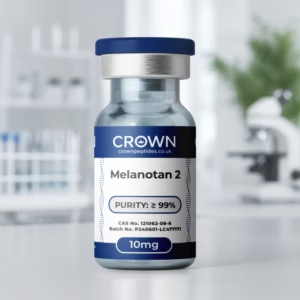
Melanotan-2 Research Peptide
HPLC and MS verified · batch certificate published · dispatched from the UK before 2pm
Summary of Published Melanotan II Studies
This table illustrates a genuinely consistent pattern across this compound's literature: small, often decades-old pilot studies establishing proof-of-concept mechanistic effects across multiple receptor-mediated pathways, without a single large, modern randomised controlled trial confirming any one specific application at scale.
Potential Melanotan II Benefits for Research
Based on the published literature, researchers have investigated Melanotan II as a tool for studying:
- Melanocortin receptor pharmacology across multiple receptor subtypes (MC1R, MC3R, MC4R, MC5R) simultaneously
- UV-independent melanogenesis and photoprotection mechanisms
- MC4R-mediated appetite regulation and tolerance development with chronic administration
- Structure-activity relationships within the melanocortin peptide family, as the parent compound for PT-141's development
- Early-stage preclinical anti-melanoma mechanisms via PTEN and cyclooxygenase-2 pathways
As with the other compounds in this series, this is research investigating mechanisms, not evidence of an established treatment effect. None of the above constitutes a demonstrated therapeutic benefit in humans under any regulatory framework, and Melanotan II is not approved for any indication.
Current Limitations of Melanotan II Research
- No large randomised controlled trial exists for its primary discussed use. Despite widespread commercial interest in tanning applications, no large-scale randomised controlled trial has evaluated Melanotan II's tanning efficacy — the strongest available human data remains a three-subject 1996 pilot study.
- FDA Category 2 safety classification. As of the most recent published guidance, the FDA lists Melanotan II in Category 2 of its interim 503A bulk drug substances list, reflecting the agency's assessment that it presents significant safety risk for compounding purposes, with the agency intending to formally consult its Pharmacy Compounding Advisory Committee regarding the substance's status.
- Non-selectivity is an inherent, unavoidable limitation. Because Melanotan II activates multiple melanocortin receptors simultaneously by design, no research protocol using this compound can isolate a single receptor-mediated effect without accounting for the others occurring concurrently.
- Tolerance develops with chronic use for at least one studied effect. Chronic administration research in rats has specifically documented that Melanotan II's appetite-suppressing effect diminishes over continued use — a genuine limitation for any research protocol relying on sustained effect from repeated administration.
- Documented dermatological case reports of concern. Case reports have described changes in existing moles following unregulated Melanotan II use, a documented dermatological safety concern that has drawn specific clinical attention.
Melanotan II Side Effects Reported in Research
Across its human trial literature, the most consistently reported side effects have included nausea, facial flushing, and yawning, alongside the well-documented spontaneous erections and sexual arousal first observed incidentally during early tanning trials. Because Melanotan II activates MC1R non-selectively alongside other receptor subtypes, dermatological case reports have specifically described changes in the appearance of existing moles following unregulated use, a documented concern that warrants dedicated dermatological monitoring in any research context involving this compound.
The FDA's Category 2 classification for Melanotan II under its interim bulk drug substances list reflects a formal regulatory assessment of significant safety risk, distinct from a specific documented adverse event, but nonetheless a relevant regulatory signal for any research protocol. Any research protocol involving human or animal subjects should be developed with appropriate ethical and institutional review, following standard safety monitoring practices for investigational compounds, with particular attention to dermatological baseline assessment given the documented mole-related case reports.
Melanotan II Dosage Used in Published Research
This section is included for methodological context only and should not be interpreted as guidance for use.
The foundational 1996 pilot study used subcutaneous Melanotan II at a starting dose of 0.01 mg/kg administered daily (Monday through Friday) for two consecutive weeks in three subjects. The 1998 erectile dysfunction crossover trial used a 0.025 mg/kg dose in a placebo-controlled design across 10 participants. These figures describe specific, small-scale clinical pilot studies under direct supervision — they are not validated, large-scale human dosing guidance, and are not a basis for self-directed use in any context.
Researchers designing their own experimental protocols should base dosing decisions on the primary literature relevant to their specific model, in consultation with institutional ethics review as applicable, rather than on secondary summaries such as this one.
Analogues and Future Research Directions
Melanotan II sits within a small but consequential family of melanocortin research peptides that includes Melanotan I (afamelanotide, its more MC1R-selective linear relative, approved as Scenesse for a specific photosensitivity disorder) and PT-141 (bremelanotide, its more sexual-function-selective cyclic derivative, approved as Vyleesi for HSDD). Comparing how each was structurally refined from a shared melanocortin foundation toward a distinct receptor-selectivity profile is a genuinely instructive area of ongoing pharmacological research.
- Large-scale tanning efficacy trials. Given that the strongest existing tanning data comes from a three-subject 1996 pilot study, a modern, adequately powered randomised controlled trial would meaningfully strengthen this specific application's evidence base.
- Further anti-melanoma mechanistic research. Given the genuinely interesting early preclinical finding of anti-melanoma activity via PTEN and cyclooxygenase-2 pathways, dedicated follow-up research distinguishing this effect from Melanotan II's other receptor-mediated activities would be valuable.
- Resolving the tolerance mechanism for chronic appetite effects. Given the documented development of tolerance to Melanotan II's appetite-suppressing effect with chronic administration, research clarifying the specific receptor-level mechanism behind this tolerance could inform broader MC4R-targeted research.
- Dermatological safety characterisation. Given the documented case reports of mole changes with unregulated use, dedicated dermatological safety research would help clarify the scope and mechanism of this specific concern.
Frequently Asked Questions
How Long Does Melanotan 2 Last in the Fridge?
Once reconstituted with bacteriostatic water, Melanotan 2 will typically last for about 3 to 4 weeks when stored consistently in the refrigerator between 36°F and 46°F. Unopened, freeze-dried powder can remain stable in the refrigerator or freezer for months or even years prior to mixing.
How to Reconstitute Melanotan 2?
To reconstitute Melanotan 2, let the vial reach room temperature, wipe the rubber stoppers with an alcohol swab, and use a sterile syringe to draw the chosen amount of bacteriostatic water. Slowly inject the water down the inner glass wall of the peptide vial, then gently swirl the solution until the powder is fully dissolved without shaking.
Is Melanotan 2 Legal?
How Much Bac Water for 10mg Melanotan 2?
A common approach is adding 1 mL or 2 mL of bacteriostatic water to a 10 mg vial of Melanotan 2. Using 1 mL is popular because it makes math straightforward, where each 0.1 mL graduation on a standard insulin syringe equals exactly 1 mg of the peptide.
How to Mix Melanotan 2?
To mix Melanotan 2, wipe the vial tops with alcohol, draw the bac water into a sterile syringe, and slowly inject it down the inside wall of the peptide vial to protect the fragile compounds. Gently swirl the vial until the mixture is completely clear, avoiding any forceful shaking that could degrade the peptide bonds.
Why Peptide Sourcing Quality Matters for Research Validity
As a cyclic heptapeptide whose potency and non-selective receptor activity both depend on its specific lactam-ring structure, Melanotan II's research validity is particularly sensitive to synthesis errors affecting this cyclisation.
Common failure modes relevant to Melanotan II specifically include:
- Incomplete or incorrect cyclisation — if the lactam ring central to Melanotan II's structure is not correctly formed during synthesis, the resulting product may have substantially altered potency and receptor-binding characteristics compared to the compound studied in the published literature.
- Truncated or deletion sequences — incomplete coupling during synthesis of this seven-residue peptide can leave a proportion of the product missing amino acids.
- Inaccurate mass or concentration labelling — without independent mass spectrometry confirmation, there's no reliable way to verify that a vial contains the peptide and concentration stated on the label, which matters particularly given how dose-sensitive this compound's multi-receptor activity profile is.
- Bacterial endotoxin contamination — relevant for any in vivo or cell-culture research.
Given Melanotan II's documented regulatory safety concerns, independent verification of identity, purity, and correct cyclic structure is a particularly important precondition for any research protocol using this compound.
Read the certificate before you order
Every batch is published openly — identity by mass spectrometry, purity by HPLC, and the batch number printed on the vial you receive.
Open the COA libraryWhy Choose Crown Peptides
Testing is only part of the picture. Crown Peptides was built around a simple idea: a UK researcher ordering a peptide should be able to trust everything about how it reached them — not just the number on a Certificate of Analysis, but who made it, how it was handled, how it travelled, and who they can speak to if they have a question. That's the standard we hold ourselves to on every order, and it's worth explaining properly rather than just listing it.
Sourcing You Can Trust
Quality starts long before a product reaches our warehouse. We work directly with one of the world's largest and most established peptide synthesis manufacturers, chosen specifically for its production standards, consistency, and track record — rather than sourcing opportunistically from whichever manufacturer happens to offer the lowest price that month. That close, ongoing partnership is what allows us to stand behind every batch we sell, because we know exactly how it was made.
Verified Through Independent Testing
We don't expect researchers to take a manufacturer's word for it, so we verify every batch independently before it's listed for sale:
Endotoxin Testing
Every batch is screened for bacterial endotoxin, which matters in particular for any research involving cell culture, immune signalling, or in vivo inflammatory endpoints.
HPLC Purity Analysis
High-performance liquid chromatography is used to assess purity and screen for truncated sequences, deletion products, and synthesis by-products.
Mass Spectrometry Identity Confirmation
MS analysis confirms both the peptide sequence and the correct cyclic (lactam-ring) structure of the supplied compound, verifying that it matches intact Melanotan II rather than an incompletely cyclised or degraded variant.
Certificate of Analysis
Every batch is supplied with a Certificate of Analysis, and a QR code linking directly to the testing report on crownpeptides.co.uk, so researchers can document exactly what was used in their own experimental records.
Careful Storage and Handling
A product that's been correctly synthesised and tested can still be let down by poor handling afterward. Once a batch clears testing, we store it under controlled conditions designed to preserve stability and prevent degradation before it ever reaches a researcher's bench. This matters more for peptides and sensitive research compounds than for most laboratory reagents: temperature excursions, light exposure, and poor stock rotation can all silently reduce integrity long before a vial is opened, in ways that aren't visible on inspection and can quietly undermine an experiment's results. We treat that storage window as part of the product, not an afterthought once testing is done.
Packaging and Delivery
Every order is packed in premium, discreet packaging designed to protect the product in transit and arrive intact. Orders placed before 2pm are dispatched the same working day for next-day UK delivery, and we ship to Northern Ireland, the Republic of Ireland, Scotland, England, and across the EU, with international shipping available beyond that. For a researcher working to a study timeline, knowing an order will arrive quickly, safely, and exactly as ordered isn't a convenience — it's part of keeping a research schedule on track.
Support That Goes Beyond the Sale
Peptide and research-compound work raises genuine practical questions — around reconstitution, storage, handling, and interpreting a Certificate of Analysis — and we'd rather a researcher ask us directly than guess. Our team is on hand to provide clear, straightforward guidance from product selection through to delivery and beyond, without the evasiveness or upsell pressure that can come with some suppliers in this space. We see that ongoing relationship, not just the transaction, as the actual job.
Regulatory Compliance and Transparency
Crown Peptides is a UK-based company operating in line with MHRA guidance on research chemicals. Every batch is released against its own certificate of analysis, with HPLC purity and mass-spectrometry identity recorded and the lot number printed on the vial you receive. We'd rather be transparent about what we sell and who it's for than blur that line to chase a wider customer base — that's a deliberate choice on our part, not a legal minimum we begrudgingly meet.
Our Commitment
Put simply, our mission is to supply the UK research community with peptides and research compounds of unmatched purity and consistency, backed by a level of service, transparency, and technical support that researchers can actually rely on — from the first email enquiry to the vial arriving on the bench. That standard applies whether an order is a single vial for an independent researcher or a bulk order for a laboratory, and it holds regardless of whether a customer ever finds out how much work sits behind it.
For researchers who want their results to be reproducible and their experimental record defensible, knowing precisely what's in the vial — and trusting that everyone who handled it got it right — is a basic, non-negotiable starting point.
Ready to order? View batch testing and pricing on crownpeptides.co.uk
References
- Dorr, R.T. et al. "Evaluation of melanotan-II, a superpotent cyclic melanotropic peptide in a pilot phase-I clinical study." Life Sciences. https://pubmed.ncbi.nlm.nih.gov/8637403/
- Wessells, H. et al. "Melanotan II induces penile erection via a central mechanism." Journal of Urology. https://pubmed.ncbi.nlm.nih.gov/9598437/
- "Topical MTII Therapy Suppresses Melanoma Through PTEN Upregulation and Cyclooxygenase II Inhibition." PMC. https://www.ncbi.nlm.nih.gov/pmc/articles/PMC7013727/
- "Melanotan II." DermNet NZ. https://dermnetnz.org/topics/melanotan-ii
Working with Melanotan-2 Research Peptide
Batch-tested material, published certificates, and same-day dispatch on orders placed before 2pm.
See Melanotan-2 Research Peptide