

Most combination peptide blends get built by throwing popular names into one vial and hoping the overlap works out. GLOW is a more disciplined idea than that: three peptides, each addressing a genuinely different mechanism, combined specifically because those three mechanisms cover different stages of the same underlying repair process rather than duplicating each other.
The blend pairs GHK-Cu, BPC-157, and TB-500 — a collagen-signalling copper peptide alongside two tissue-repair peptides working through entirely separate pathways. Understanding why those three specifically, and in what proportions, is the key to understanding what GLOW actually represents as a research tool.
GLOW is sold by Crown Peptides for laboratory research use only and has not been evaluated or approved by the FDA for human treatment.
The short version
- A 70mg blend: GHK-Cu 50mg, BPC-157 10mg, TB-500 10mg in one vial.
- All three are studied around matrix remodelling and tissue response.
- Designed so one vial covers what would otherwise take three.
- The individual compounds have evidence; the blend itself has not been trialled as a formulation.
Three Mechanisms, Not Three Overlapping Copies
The logic behind GLOW's formulation starts with a simple observation: skin and tissue repair isn't one process, it's several running in sequence and in parallel. Collagen and elastin need to be produced and organised. Blood supply needs to reach the site of repair. Cells need to migrate into place and reorganise damaged structure. A blend built around a single mechanism, however well-studied, only addresses one part of that picture.
GLOW's three components map onto three distinct parts of it. GHK-Cu is studied for stimulating collagen and elastin production and broader tissue-remodelling signalling. BPC-157 is studied for angiogenesis — building the vascular supply that repair depends on. TB-500 is studied for actin regulation and cell migration — helping the right repair cells physically reach the site once blood supply and structural signalling are in place. Three genuinely different jobs, addressed by three peptides chosen specifically because their mechanisms don't overlap.
GHK-Cu: The Foundation of the Blend
GHK-Cu anchors GLOW for good reason — it's one of the most extensively studied research peptides in existence, with real human clinical trial data behind it rather than exclusively preclinical evidence. First identified in human plasma in 1973 by biochemist Loren Pickart, who noticed its levels decline steadily with age, GHK-Cu has accumulated five decades of research into its role in collagen and elastin production, wound healing, antioxidant activity, and gene-expression regulation.
Human trial data backing GHK-Cu includes a head-to-head study showing a 70% collagen increase in treated volunteers, outperforming both vitamin C and retinoic acid, and a randomised trial in 60 women reporting a 31% reduction in wrinkle depth alongside a 28% improvement in elasticity over twelve weeks. That depth of human evidence is precisely why GHK-Cu is formulated as the dominant component in most GLOW preparations — a common formulation includes roughly 50mg of GHK-Cu alongside smaller amounts of the other two peptides, reflecting its role as the foundation the blend is built around rather than an equal partner among three.
- Classification
- 70mg multi-peptide research blend containing GHK-Cu 50mg, BPC-157 10mg and TB-500 10mg
BPC-157 and TB-500: The Repair-Support Layer
The other two components in GLOW are dosed as complementary support to that foundation, typically around 10mg each in a standard formulation. BPC-157 contributes its angiogenic, VEGF and nitric-oxide driven mechanism — supporting the vascular supply that any tissue-remodelling process depends on to receive oxygen, nutrients, and circulating repair signals. TB-500 contributes actin-regulation and cell-migration support, helping the cells responsible for laying down new collagen and remodelling tissue actually reach the site where GHK-Cu's signalling is happening.
That layered structure — one dominant, extensively evidenced foundation peptide supported by two targeted repair mechanisms — is a deliberate design choice, not an arbitrary combination. It reflects the same complementary-mechanism logic used elsewhere in multi-peptide research: rather than escalating the dose of a single ingredient, combine compounds with genuinely different, non-overlapping targets addressing different stages of the same biological process.
What's Actually Been Tested — and What Hasn't
It's important to be precise about the evidence picture here. Each of GLOW's three individual components carries substantial research behind it on its own — GHK-Cu with genuine human trial data, BPC-157 and TB-500 with extensive preclinical research across multiple tissue types. What hasn't been directly tested is the specific three-peptide combination itself as a unified blend. No published study has compared GLOW as a complete formulation against its individual ingredients or a placebo.
That's worth stating plainly rather than glossing over: the combination logic is mechanistically sound and grounded in real evidence for each individual peptide, but the blend-specific data hasn't caught up to the individual-ingredient data yet. That's a common and honest position for combination formulations to occupy generally — it doesn't undermine the rationale behind the blend, but it's a meaningfully different evidence category from a single peptide with its own dedicated clinical trials.
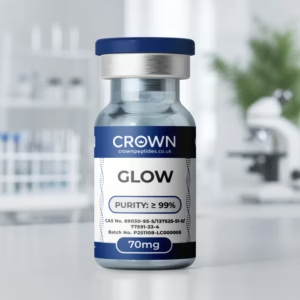
GLOW Research Peptide
HPLC and MS verified · batch certificate published · dispatched from the UK before 2pm
The Origins of Combination Peptide Thinking
GLOW's design philosophy didn't emerge in a vacuum — it reflects a broader shift in how peptide research protocols have evolved over the past several years. Early peptide research tended to focus heavily on single compounds studied in isolation, testing one mechanism against one outcome measure at a time. As the individual evidence base for compounds like GHK-Cu, BPC-157, and TB-500 matured independently, researchers increasingly began asking a logical follow-up question: if three well-characterised, non-competing mechanisms are each individually associated with supporting tissue repair, does combining them produce effects that are additive, or even synergistic, compared with any one alone?
That question is genuinely difficult to answer definitively without a dedicated combination trial, but it's a reasonable one to ask, and it's the same logic that underlies combination approaches throughout pharmacology more broadly — multi-drug regimens for infections, cancer, and cardiovascular disease all rest on the same basic principle of targeting a condition through several non-redundant mechanisms at once rather than maximising a single pathway. GLOW's three-peptide structure is a research-peptide expression of that same general strategy.
Reading GHK-Cu's Discovery Story in More Depth
It's worth spending a bit more time on GHK-Cu's background, since its unusually strong human evidence base is the entire reason it anchors this blend. Pickart's original 1973 observation — that a naturally occurring copper-binding peptide fragment in human plasma appeared to decline steadily with age, tracking a similar trajectory to slowing tissue repair capacity — launched a research programme that has run continuously for five decades, output that few research peptides can match in either volume or consistency.
That sustained research attention is precisely why GHK-Cu was a logical anchor for any serious combination formulation: a compound with this much accumulated evidence, including genuine randomised controlled human trials, offers a considerably more solid foundation to build a blend around than a compound whose evidence base is still developing. GLOW's structure — one deeply evidenced foundation peptide, supported by two well-characterised but comparatively newer research compounds — reflects that underlying evidence hierarchy directly in its formulation ratios.
How GLOW Differs From KLOW
GLOW is often discussed alongside KLOW, a related four-peptide blend, and the difference between them is straightforward once GLOW's structure is understood. KLOW takes the same three-peptide foundation — GHK-Cu, BPC-157, and TB-500 — and adds a fourth component, KPV, layering inflammation control on top of the collagen, vascular, and cell-migration signalling the other three provide.
The choice between the two comes down to whether inflammation control is a specific research variable of interest. GLOW's three-peptide structure is the more focused option for researchers specifically interested in the collagen-vascular-migration sequence on its own; KLOW's addition of KPV is aimed at research contexts where excess inflammatory signalling is itself a variable worth addressing alongside that core sequence — scalp or skin-barrier research being a common example.
Why Sequencing Matters in Tissue Repair Research
It's worth explaining why the "sequence" framing behind GLOW's design matters so much, since it's easy to treat tissue repair as a single undifferentiated process rather than a series of distinct phases. Wound and tissue repair generally proceeds through recognisable, overlapping stages: an initial response involving local signalling and vascular changes, a proliferative phase where new cells migrate in and begin rebuilding structure, and a remodelling phase where that new tissue is reorganised into its final, functional form.
A compound that only addresses one of those phases, however effectively, leaves the others to proceed at whatever pace the body's own baseline signalling allows. GLOW's structure is built around influencing multiple phases at once — BPC-157's vascular support relevant early in that sequence, TB-500's migration support relevant to the proliferative phase, and GHK-Cu's broad remodelling and collagen-signalling activity relevant throughout, but particularly to the later structural phase. That phase-spanning coverage is the core rationale distinguishing a genuinely complementary blend from one built around redundant or overlapping mechanisms.
How Researchers Actually Study These Mechanisms
Each of GLOW's components is validated through different experimental approaches, reflecting their different mechanisms. GHK-Cu's collagen-signalling activity is measured through fibroblast culture studies and, in its strongest evidence, randomised human trials tracking collagen density and wrinkle depth directly. BPC-157's angiogenic activity is assessed through vascular density counts and VEGF expression in healing tissue. TB-500's actin-regulation activity is measured through cell-migration assays, commonly a scratch assay tracking how quickly cells close a gap in cultured tissue.
That diversity of measurement tools is part of why a unified trial testing all three together as a single blend is more methodologically complex than testing any one component alone — a rigorous comparison would need to track collagen, vascular, and migration endpoints simultaneously to capture the blend's full proposed effect, rather than any single measure in isolation.
The 2026 Regulatory Backdrop Behind GLOW's Components
It's worth noting that two of GLOW's three components have picked up genuinely positive regulatory momentum recently, which is encouraging context for the blend as a whole. In April 2026, the FDA removed both BPC-157 and TB-500 (along with GHK-Cu's injectable form) from its restricted Category 2 bulk drug substances list, following withdrawal of the nominations that had originally placed them there. That was followed in July 2026 by a favourable, advisory recommendation from the FDA's Pharmacy Compounding Advisory Committee for BPC-157 and TB-500's inclusion on the more permissive Category 1 list, passing 8–6 with one abstention.
None of that constitutes approval of GLOW as a formulation, or of any individual component for human treatment — these are compounding-substance list changes specific to the U.S. regulatory system, and formal rulemaking following the July vote is still pending. But it's real, verifiable momentum for two of the three peptides this blend is built around, adding to the broader case that this specific combination of compounds continues to draw serious, sustained attention from researchers and regulators alike.
What a Combination-Specific Trial Would Need to Look Like
It's worth being concrete about what would actually need to happen for GLOW to move from a mechanistically grounded combination to one with dedicated clinical backing. A rigorous trial would need to compare the full three-peptide blend against each individual component alone, and ideally against placebo, tracking collagen density, vascular markers, and cell-migration-relevant outcomes simultaneously — a considerably more complex trial design than testing any single peptide in isolation, given the need to capture three distinct mechanisms of action within one study.
That complexity is a large part of why combination-specific trials remain rarer than individual-peptide trials across this entire research field, not just for GLOW specifically. It's a genuine gap worth naming honestly, and exactly the kind of research question that becomes more tractable as interest in combination peptide protocols continues to grow.
Dosage in Research Settings
Each component of GLOW has its own separately published dosing literature rather than a single unified blend protocol: BPC-157 research has typically used around 10 mcg/kg in animal models, TB-500/thymosin beta-4 dosing varies by study design and tissue target, and GHK-Cu has been studied across a range of topical concentrations from roughly 0.1-0.5%. Those figures describe how each individual compound has been dosed in laboratory research settings, not a validated combined protocol for the blend as a whole, since no published trial has tested all three compounds together as a single formulation.
Reported Benefits in the Research Data
Individually, each compound's research base points toward complementary repair-related mechanisms: BPC-157's angiogenic, blood-vessel-forming activity; TB-500's actin-binding role in cell migration and wound closure; and GHK-Cu's broad gene-expression effects on collagen, elastin, and tissue remodelling. The rationale for combining them rests on that mechanistic complementarity rather than on a completed trial of the three-way combination itself.
Side Effects and Safety Data
Each individual peptide in this blend has its own preclinical safety data — favourable in animal toxicology studies for all three — but none of the three have completed human trials, and no published research has specifically evaluated the safety of combining all three together. Researchers working with this blend are therefore working from the individual compounds' separate safety records rather than a combination-specific dataset.
Manufactured to Research Standard
A three-peptide blend raises the manufacturing bar rather than lowering it — each individual peptide still needs its own synthesis verification, and the combination itself needs confirmation that the correct ratio of all three components is present and stable in the finished vial.
Crown Peptides tests every batch of GLOW for HPLC purity and mass spectrometry identity confirmation across all three component peptides, with a batch-specific certificate of analysis provided for every order.
Storage guidance follows the standard used across the peptide range: supplied as a lyophilised powder, stable when kept cold and protected from light and moisture, with reconstituted solution requiring refrigeration and use within the recommended window.
Understanding the Practical Trade-Offs of a Combination Product
There are genuine practical benefits and trade-offs worth weighing honestly when considering a combination product like GLOW rather than sourcing each peptide individually. On the benefit side, a pre-formulated blend removes the calculation and measurement complexity of combining three separate reconstituted peptides in correct proportion — a meaningful convenience factor, particularly for protocols intended to run consistently over an extended period.
On the trade-off side, a fixed-ratio blend removes the flexibility to adjust each component's dose independently, which matters for research designs specifically interested in isolating or varying one mechanism's contribution relative to the others. A researcher wanting to test, for instance, whether doubling the BPC-157 component changes outcomes while holding GHK-Cu and TB-500 constant would need to work with the individual peptides separately rather than the fixed blend. Neither approach is universally better — the right choice depends entirely on whether the research question calls for a consistent, convenient combination or granular control over each individual variable.
Why This Specific Trio and Not a Different Combination
It's worth addressing directly why GLOW settled on these three peptides rather than substituting in other well-known research compounds. The answer comes back to mechanism non-overlap. Adding a second angiogenesis-focused compound alongside BPC-157, for instance, would risk redundant signalling through the same pathway rather than expanding coverage into a genuinely different one. Adding a second collagen-focused compound alongside GHK-Cu would raise the same concern from a different angle.
GHK-Cu, BPC-157, and TB-500 were selected specifically because each occupies genuinely separate mechanistic territory — collagen and broad tissue remodelling, vascular formation, and cell migration, respectively — while all three converge on the same overall goal of supporting tissue repair from different angles. That non-redundancy is the actual design principle behind the blend, not simply a matter of combining three popular names.
Choosing Between GLOW and the Individual Peptides
For researchers deciding whether to reach for GLOW or the individual peptides separately, the practical consideration is straightforward: GLOW offers convenience and a pre-established ratio grounded in each component's individual evidence, while sourcing GHK-Cu, BPC-157, and TB-500 separately offers full control over dosing and the ability to isolate any one mechanism's contribution independently.
- Composition: GHK-Cu (foundation, ~50mg), BPC-157 and TB-500 (support, ~10mg each) in a common formulation.
- Individual evidence: strong for all three components separately; GHK-Cu with genuine human trial data.
- Blend-specific evidence: not yet directly tested as a unified formulation.
- Best suited for: research questions spanning collagen signalling, vascular repair, and cell migration together.
Is GLOW more effective than GHK-Cu alone? No direct published comparison exists — GHK-Cu alone has the deepest individual evidence base of the three, including human trial data, but that doesn't automatically mean it outperforms the blend for every research question. The blend's value proposition rests on covering additional mechanisms GHK-Cu alone doesn't address, not on any single component being individually superior.
Quick Answers
What exactly is GLOW? A three-peptide combination blend containing GHK-Cu, BPC-157, and TB-500, formulated around collagen signalling supported by two complementary tissue-repair mechanisms.
How is GLOW different from KLOW? GLOW is the three-peptide base (GHK-Cu, BPC-157, TB-500). KLOW adds a fourth peptide, KPV, for additional inflammation-control research.
Has GLOW itself been clinically tested? Each individual peptide has substantial research behind it, but the specific three-peptide combination hasn't been directly tested as a unified formulation in a dedicated clinical trial.
Why isn't GLOW dosed in equal parts? A common formulation weights GHK-Cu more heavily (around 50mg) given its deeper evidence base, with BPC-157 and TB-500 included at lower, complementary doses (around 10mg each).
What This Means for a Research Protocol
For a researcher weighing GLOW against a single-peptide approach, the practical framing comes down to the scope of the research question. A protocol narrowly focused on collagen density or wrinkle-depth outcomes specifically has good reason to work with GHK-Cu alone, where the deepest and most direct human evidence already exists. A protocol interested in the fuller repair sequence — vascular supply, cell recruitment, and structural remodelling together — has good reason to consider the broader mechanism coverage GLOW's three-peptide structure is specifically designed to provide.
That's not a case for one approach being definitively superior to the other in the abstract. It's a case for matching the tool to the question — the same principle that runs through nearly every comparison in peptide research, and one that applies just as directly to choosing between a combination blend and its individual components as it does to choosing between any two single compounds.
Read the certificate before you order
Every batch is published openly — identity by mass spectrometry, purity by HPLC, and the batch number printed on the vial you receive.
Open the COA libraryThe Bottom Line
GLOW represents a genuinely disciplined approach to peptide combination: three mechanisms, each addressing a different stage of tissue repair, weighted according to the strength of each component's individual evidence rather than combined arbitrarily. That's a meaningfully different proposition from a blend built purely on name recognition, and it's exactly why GLOW continues to draw serious research interest.
References
- Japjec M, Horvat Pavlov K, Petrovic A, et al. Stable Gastric Pentadecapeptide BPC 157 as a Therapy for the Disable Myotendinous Junctions in Rats. Biomedicines. 2021;9(11):1547. https://pubmed.ncbi.nlm.nih.gov/34829776/
- Cushman DM. Thymosin Beta-4 and TB-500 in Tissue Healing, Regeneration, and Musculoskeletal Repair: A Scoping Review. Appl Sci. 2026;16(12):6202. https://www.mdpi.com/2076-3417/16/12/6202
- Pickart L, Margolina A. Regenerative and Protective Actions of the GHK-Cu Peptide in the Light of the New Gene Data. Int J Mol Sci. 2018;19(7):1987. https://pmc.ncbi.nlm.nih.gov/articles/PMC6073405/
Working with GLOW Research Peptide
Batch-tested material, published certificates, and same-day dispatch on orders placed before 2pm.
See GLOW Research Peptide