
RESEARCH USE DISCLAIMER
Crown Peptides supplies CJC-1295 with DAC as a laboratory research compound only. It is not approved by the FDA, MHRA, or EMA for any use, and our products are not intended for human consumption and are not sold, marketed, or labelled for the diagnosis, treatment, cure or prevention of any disease. Nothing in this document should be read as medical advice or as an endorsement of human use. The discussion below summarises published scientific literature only, and is intended for researchers and students of endocrinology and pharmacology.
CJC-1295 with DAC is a modified growth hormone-releasing hormone (GHRH) analogue engineered for a specific purpose: dramatically extending how long a GHRH-mimetic peptide remains active in circulation. Where native GHRH and even some stabilised analogues last minutes to hours, CJC-1295 with DAC has been reported to sustain elevated growth hormone levels for up to roughly a week from a single dose — a genuinely unusual pharmacokinetic profile among research peptides generally.
This article covers what the published research shows about CJC-1295 with DAC's mechanism, its albumin-binding stabilisation strategy, and where the evidence honestly stands, including the important distinction between this DAC-conjugated form and the shorter-acting CJC-1295 without DAC (covered in a separate research review alongside its Ipamorelin combination).
The short version
- A GHRH analogue carrying a drug affinity complex that binds serum albumin.
- That binding extends the half-life from minutes to days.
- Four substitutions protect it from enzymatic breakdown.
- Often confused with CJC-1295 without DAC, which behaves very differently.
What Is CJC-1295 with DAC?
CJC-1295 is a synthetic analogue of growth hormone-releasing hormone (GHRH), engineered with amino acid substitutions designed to resist enzymatic degradation. The “with DAC” designation refers to a Drug Affinity Complex — a chemical modification, attached via a linker, that causes the peptide to covalently bind to circulating albumin (a highly abundant blood protein) once injected. This albumin-binding mechanism is the key differentiator from CJC-1295 without DAC, and it is what gives the DAC-conjugated form its dramatically extended duration of action.
Human research has reported that CJC-1295 with DAC produced a two- to ten-fold increase in average growth hormone levels for up to six days following a single administration, with IGF-1 levels remaining elevated for approximately nine to eleven days, and in some reports, at least two weeks — reflecting the sustained, slow-release pharmacokinetics that the DAC modification is specifically designed to produce.
Why DAC Was Developed: Solving GHRH's Stability Problem
It's worth understanding the specific engineering problem CJC-1295 with DAC was designed to solve. Native growth hormone-releasing hormone (GHRH) has a functional half-life measured in minutes, rapidly broken down by the enzyme dipeptidyl peptidase IV (DPP-IV) and other plasma proteases, which severely limits its usefulness as a research or therapeutic tool without extremely frequent dosing. Researchers wanted a way to extend GHRH's functional presence in circulation without simply increasing dose frequency to impractical levels.
The solution researchers arrived at was Drug Affinity Complex (DAC) technology: attaching a maleimide-based chemical linker to a modified GHRH(1-29) sequence, engineered specifically to form a stable, essentially irreversible covalent bond with a free cysteine residue on circulating human serum albumin. Because albumin itself has a long natural half-life in blood (around 19 days), covalently tethering the GHRH analogue to it effectively "borrows" albumin's stability, transforming a molecule that would otherwise last minutes into one lasting days. This is a genuinely elegant piece of pharmaceutical engineering, and understanding the logic behind it explains why CJC-1295 with DAC behaves so differently in research contexts compared to unmodified GHRH or even other stabilised analogues.
CJC-1295 DAC Mechanism: How Albumin Binding Extends Half-Life
CJC-1295 with DAC works through the same fundamental mechanism as other GHRH analogues discussed among research peptides: it binds to GHRH receptors on pituitary somatotroph cells, stimulating synthesis and release of growth hormone, which in turn drives hepatic and peripheral IGF-1 production. What's distinctive is how the DAC modification changes the peptide's pharmacokinetics rather than its receptor pharmacology — by covalently binding to albumin, the peptide is protected from rapid enzymatic clearance and effectively uses the body's own albumin turnover rate (which is naturally slow) as its elimination pathway, rather than being cleared at the rate a free peptide normally would be.
This is mechanistically distinct from tesamorelin's stabilisation strategy (covered in a separate Crown Peptides research review), which resists degradation through a specific N-terminal chemical modification rather than through albumin binding. Both approaches address the same underlying problem — native GHRH's very short half-life — but through different chemistry, and the resulting pharmacokinetic profiles differ meaningfully: tesamorelin supports once-daily dosing in its studied and approved use, while CJC-1295 with DAC's albumin-binding mechanism is specifically designed to support much less frequent administration.
CJC-1295 with DAC uses a maleimide linker to covalently bind circulating albumin, creating a slow-release reservoir that extends its functional half-life from minutes to days compared to native GHRH.
CJC-1295 with DAC vs Without DAC: A Critical Distinction
It's worth being precise about a naming confusion that recurs constantly in this research space. "CJC-1295" without further qualification can refer to either the DAC-conjugated, long-acting version discussed throughout this article, or a separate, unmodified variant (sometimes called CJC-1295 without DAC, or by its alternative research designation) that lacks the albumin-binding modification and behaves pharmacokinetically much more like native GHRH, with a half-life of only around 30 minutes. These two versions are frequently confused in commercial listings and casual discussion, but they are pharmacologically distinct research tools with very different dosing implications, and should never be assumed interchangeable. This article concerns specifically the DAC-conjugated, long-acting version.
- Classification
- Long-acting synthetic growth-hormone-releasing hormone analogue
- Available strength
- 5mg
- CAS Number
- 863288-34-0
- Molecular Weight
- 3704.25 Da
- Molecular Formula
- C167H272N48O47
Why Researchers Are Interested in CJC-1295 with DAC
CJC-1295 with DAC's extended pharmacokinetic profile makes it a useful research tool for studying sustained, rather than pulsatile, GHRH receptor stimulation — a genuinely different experimental condition from the naturally pulsatile GH release pattern that most other GHRH-axis research (including native GHRH physiology itself) is built around. This raises its own interesting research question: whether sustained, non-pulsatile GHRH receptor activation produces the same downstream effects as the body's natural pulsatile pattern, or whether the pattern of stimulation itself matters for the physiological response.
Sustained GH Release: A Departure from Physiological Pulsatility
It's worth understanding a genuine mechanistic trade-off that distinguishes CJC-1295 with DAC from GH secretagogues designed to preserve natural pulsatility. Growth hormone is naturally released from the pituitary in discrete pulses rather than continuously, and this pulsatile pattern is thought to matter for how target tissues respond to GH signalling over time. Because CJC-1295 with DAC maintains a stable, sustained presence in circulation for days at a time rather than being cleared and re-administered around a pulsatile schedule, it produces a comparatively flattened, continuous elevation in GH and IGF-1 levels rather than reproducing the body's natural pulsatile release pattern.
This is a meaningful point of contrast with GHRPs (like ipamorelin or GHRP-6) or shorter-acting GHRH analogues, which are more commonly dosed specifically to work with the body's natural pulsatile rhythm rather than override it. Whether this sustained-elevation profile carries different research or safety implications compared to pulsatile GH stimulation is a genuinely open and actively discussed question in this literature, rather than a settled point in either direction.
Key Areas of CJC-1295 DAC Research
Sustained GH and IGF-1 elevation, human pharmacokinetic study. The foundational human study, published in the Journal of Clinical Endocrinology & Metabolism, characterised CJC-1295 with DAC's prolonged GH and IGF-1 elevation profile in healthy adults following single-dose administration.
Comparative pulsatility research. Because CJC-1295 with DAC produces sustained rather than pulsatile GH elevation, it has been used as a comparative research tool alongside pulsatile GHRH analogues and secretagogues to examine whether release pattern itself affects downstream physiological outcomes.
Body composition and metabolic research. As with other GH-axis peptides, preclinical and mechanistic research has examined CJC-1295 with DAC's downstream effects on protein synthesis, tissue repair signalling, and metabolic function, extrapolated from the broader GH/IGF-1 axis literature rather than from dedicated CJC-1295-with-DAC-specific trials in most cases.
Methodology: distinguishing DAC from non-DAC research. It's important to keep the DAC and non-DAC forms of CJC-1295 clearly separated when reading this literature, since they have meaningfully different pharmacokinetic profiles and are often discussed interchangeably in secondary sources despite representing distinct dosing considerations for any research protocol.
The Broader GHRH-Analogue Research Landscape
CJC-1295 with DAC belongs to a broader category of research compounds engineered specifically to extend GHRH's brief natural half-life, a research direction driven by the same basic recognition: native GHRH's rapid degradation makes it impractical as a standalone research or clinical tool without some form of stabilisation. Different research programmes have approached this stabilisation problem differently — tesamorelin uses an N-terminal chemical modification resistant to DPP-IV degradation, while CJC-1295 with DAC uses the albumin-binding approach described throughout this article. Comparing these different engineering solutions to the same underlying stability problem is itself a useful lens for understanding peptide drug design more broadly, since it illustrates how the same target (extending a peptide's functional half-life) can be approached through genuinely different chemical strategies, each with its own trade-offs in mechanism, dosing frequency, and evidence maturity.
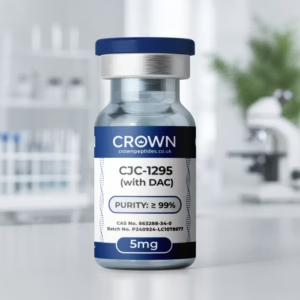
CJC-1295 (With DAC) Research Peptide
HPLC and MS verified · batch certificate published · dispatched from the UK before 2pm
Summary of Published CJC-1295 with DAC Studies
The evidence picture here is narrower than for some other GH-axis peptides in this series: the core human pharmacokinetic finding is genuinely well documented, but much of what's discussed about CJC-1295 with DAC's downstream physiological effects is extrapolated from the broader GH/IGF-1 literature rather than from dedicated trials of this specific, long-acting formulation.
Potential Research Applications
Based on the published literature, researchers have investigated CJC-1295 with DAC as a tool for studying:
- Sustained, non-pulsatile GHRH receptor stimulation as a distinct experimental condition from natural pulsatile GH release
- Albumin-binding drug delivery strategies for extending peptide half-life
- Comparative pharmacokinetics across GHRH analogue stabilisation strategies (DAC albumin-binding vs. N-terminal modification approaches like tesamorelin)
- Downstream GH/IGF-1 axis effects under prolonged receptor activation conditions
As with the other compounds in this series, this is research investigating a mechanism and a pharmacokinetic profile, not evidence of an established treatment effect. None of the above constitutes a demonstrated therapeutic benefit in humans under any regulatory framework.
Current Limitations of CJC-1295 DAC Research
- No FDA approval or completed Phase III programme. Unlike tesamorelin or sermorelin, CJC-1295 with DAC has not been through a full regulatory approval pathway, and its evidence base is considerably thinner in terms of large-scale human trial data.
- Whether sustained (non-pulsatile) GH elevation carries the same safety profile as pulsatile release is not fully established. Because natural GH release and native GHRH activity are pulsatile, and much of the safety reasoning around GHRH analogues (versus direct GH administration) rests on preserving that pulsatile pattern, a sustained-release compound like CJC-1295 with DAC represents a genuinely different physiological condition worth separate scrutiny rather than assuming it inherits the same favourable profile.
- Limited independent human trial data beyond the foundational pharmacokinetic study. Much of the broader claimed benefit profile for CJC-1295 with DAC is extrapolated from general GH/IGF-1 axis research rather than from dedicated trials of this specific compound.
Side Effects Reported in Research
The foundational human pharmacokinetic study reported that CJC-1295 with DAC was generally well tolerated in the healthy adult population studied. As with other GH-axis peptides discussed among research peptides, injection site reactions are commonly reported with subcutaneous GHRH analogue administration generally.
Because CJC-1295 with DAC produces sustained rather than pulsatile GH elevation, and because it has not been through the same extensive safety review as an approved medicine, any research protocol involving human or animal subjects should be developed with appropriate ethical and institutional review, following standard safety monitoring practices for investigational compounds.
Dosing Used in Published Research
This section is included for methodological context only and should not be interpreted as guidance for use.
The foundational human pharmacokinetic study evaluated single-dose administration of CJC-1295 with DAC, characterising the resulting GH and IGF-1 response profile over the following days. Because of its extended pharmacokinetics, published discussion of CJC-1295 with DAC dosing frequency differs substantially from CJC-1295 without DAC or other shorter-acting GHRH analogues — these figures describe a specific clinical pharmacokinetic study and are not a basis for self-directed use in any context.
Researchers designing their own experimental protocols should base dosing decisions on the primary literature relevant to their specific model, in consultation with institutional ethics review as applicable, rather than on secondary summaries such as this one.
Related Compounds and Comparative Research
CJC-1295 with DAC is one of several GHRH-axis research compounds in the Crown Peptides catalogue, alongside CJC-1295 without DAC (typically combined with Ipamorelin, covered in a separate research review), tesamorelin, and sermorelin. Each uses a distinct stabilisation or delivery strategy, and comparative research clarifying the practical differences in downstream physiological effect — not just pharmacokinetics — across this compound family remains a genuinely useful open research direction.
Frequently Asked Questions
How Much Bac Water for 2mg CJC-1295?
A common volume of bacteriostatic water to add to a 2 mg vial of CJC-1295 is 1 mL or 2 mL. Using 1 mL makes dosage math straightforward, as each 0.1 mL mark on a standard insulin syringe will equal 200 mcg of the peptide.
How to Administer CJC 1295?
CJC-1295 is typically administered via a subcutaneous injection into fatty tissue, usually around the abdomen, using a fine insulin syringe. The injection site should be thoroughly cleaned with an alcohol swab beforehand, and sites should be rotated regularly to prevent localized irritation.
Can You Mix Ipamorelin with CJC 1295?
Yes, you can easily mix ipamorelin and CJC-1295 together in the same syringe for a single injection. Because they stimulate the growth hormone pathway through different complementary receptors, combining them is a very common practice in research protocols.
Can You Stack CJC 1295 and Ipamorelin?
Yes, stacking CJC-1295 and ipamorelin is extremely common because they work synergistically to enhance growth hormone release. While ipamorelin triggers a direct pulse via the ghrelin receptor, CJC-1295 extends and amplifies that release by signaling the pituitary gland through growth hormone-releasing hormone pathways.
Does CJC 1295 Need to Be Refrigerated?
Yes, once reconstituted with bacteriostatic water, CJC-1295 must be stored in the refrigerator between 36°F and 46°F to maintain its stability and potency. Unopened, freeze-dried powder can also be refrigerated or frozen for long-term storage, but it must always be protected from direct light and heat.
Why Peptide Sourcing Quality Matters for Research Validity
CJC-1295 with DAC's functional profile depends specifically on its DAC modification remaining intact and correctly attached — a batch with incomplete or incorrect DAC conjugation would behave more like a standard short-acting GHRH analogue, with a substantially different pharmacokinetic profile than the compound described in the published literature.
Common failure modes relevant to CJC-1295 with DAC specifically include:
- Incomplete DAC conjugation — if the albumin-binding modification is incompletely or incorrectly attached during synthesis, the resulting peptide may lack the extended half-life that defines this specific compound, regardless of the amino acid sequence otherwise being correct.
- Truncated or deletion sequences — as with any longer peptide, incomplete coupling during synthesis can leave a proportion of the product missing residues.
- Inaccurate mass or concentration labelling — without independent mass spectrometry confirmation, there's no reliable way to verify that a vial contains correctly modified CJC-1295 with DAC at the labelled concentration rather than a mixture including unmodified or degraded peptide.
For a molecule whose entire pharmacological identity depends on a specific chemical modification holding up through synthesis, storage, and delivery, independent verification is the only way to know whether a given batch actually reflects the long-acting compound studied in the literature.
Read the certificate before you order
Every batch is published openly — identity by mass spectrometry, purity by HPLC, and the batch number printed on the vial you receive.
Open the COA libraryWhy Choose Crown Peptides
Testing is only part of the picture. Crown Peptides was built around a simple idea: a UK researcher ordering a peptide should be able to trust everything about how it reached them — not just the number on a Certificate of Analysis, but who made it, how it was handled, how it travelled, and who they can speak to if they have a question. That's the standard we hold ourselves to on every order, and it's worth explaining properly rather than just listing it.
Sourcing You Can Trust
Quality starts long before a product reaches our warehouse. We work directly with one of the world's largest and most established peptide synthesis manufacturers, chosen specifically for its production standards, consistency, and track record — rather than sourcing opportunistically from whichever manufacturer happens to offer the lowest price that month. That close, ongoing partnership is what allows us to stand behind every batch we sell, because we know exactly how it was made.
Verified Through Independent Testing
We don't expect researchers to take a manufacturer's word for it, so we verify every batch independently before it's listed for sale:
Endotoxin Testing
Every batch is screened for bacterial endotoxin, which matters in particular for any research involving cell culture, immune signalling, or in vivo inflammatory endpoints.
HPLC Purity Analysis
High-performance liquid chromatography is used to assess purity and screen for truncated sequences, deletion products, and synthesis by-products.
Mass Spectrometry Identity Confirmation
MS analysis confirms both the peptide sequence and the presence of the DAC modification, verifying that the supplied compound matches the albumin-binding, long-acting structure studied in the published literature rather than an unmodified or degraded variant.
Certificate of Analysis
Every batch is supplied with a Certificate of Analysis, and a QR code linking directly to the testing report on crownpeptides.co.uk, so researchers can document exactly what was used in their own experimental records.
Careful Storage and Handling
A product that's been correctly synthesised and tested can still be let down by poor handling afterward. Once a batch clears testing, we store it under controlled conditions designed to preserve stability and prevent degradation before it ever reaches a researcher's bench. This matters more for peptides and sensitive research compounds than for most laboratory reagents: temperature excursions, light exposure, and poor stock rotation can all silently reduce integrity long before a vial is opened, in ways that aren't visible on inspection and can quietly undermine an experiment's results. We treat that storage window as part of the product, not an afterthought once testing is done.
Packaging and Delivery
Every order is packed in premium, discreet packaging designed to protect the product in transit and arrive intact. Orders placed before 2pm are dispatched the same working day for next-day UK delivery, and we ship to Northern Ireland, the Republic of Ireland, Scotland, England, and across the EU, with international shipping available beyond that. For a researcher working to a study timeline, knowing an order will arrive quickly, safely, and exactly as ordered isn't a convenience — it's part of keeping a research schedule on track.
Support That Goes Beyond the Sale
Peptide and research-compound work raises genuine practical questions — around reconstitution, storage, handling, and interpreting a Certificate of Analysis — and we'd rather a researcher ask us directly than guess. Our team is on hand to provide clear, straightforward guidance from product selection through to delivery and beyond, without the evasiveness or upsell pressure that can come with some suppliers in this space. We see that ongoing relationship, not just the transaction, as the actual job.
Regulatory Compliance and Transparency
Crown Peptides is a UK-based company operating in line with MHRA guidance on research chemicals. Every batch is released against its own certificate of analysis, with HPLC purity and mass-spectrometry identity recorded and the lot number printed on the vial you receive. We'd rather be transparent about what we sell and who it's for than blur that line to chase a wider customer base — that's a deliberate choice on our part, not a legal minimum we begrudgingly meet.
Our Commitment
Put simply, our mission is to supply the UK research community with peptides and research compounds of unmatched purity and consistency, backed by a level of service, transparency, and technical support that researchers can actually rely on — from the first email enquiry to the vial arriving on the bench. That standard applies whether an order is a single vial for an independent researcher or a bulk order for a laboratory, and it holds regardless of whether a customer ever finds out how much work sits behind it.
For researchers who want their results to be reproducible and their experimental record defensible, knowing precisely what's in the vial — and trusting that everyone who handled it got it right — is a basic, non-negotiable starting point.
References
- Teichman, S.L. et al. “Prolonged Stimulation of Growth Hormone (GH) and Insulin-Like Growth Factor I Secretion by CJC-1295, a Long-Acting Growth Hormone-Releasing Hormone Analog, in Healthy Adults.” The Journal of Clinical Endocrinology & Metabolism. https://academic.oup.com/jcem/article/91/3/799/2843306
- “CJC-1295.” PubChem, National Center for Biotechnology Information. https://pubchem.ncbi.nlm.nih.gov/compound/CJC-1295
Working with CJC-1295 (With DAC) Research Peptide
Batch-tested material, published certificates, and same-day dispatch on orders placed before 2pm.
See CJC-1295 (With DAC) Research Peptide