All Batches Purity Tested
HPLC & MS Verified
Same Day Postage before 2pm
UK Based
We publish the evidence, not just the number
Anyone can print a purity figure on a label. We publish the report it came from. Every batch is tested by HPLC for purity and mass spectrometry for identity, and the certificate goes up against that batch number before the product is listed.
Check any batch in seconds
Pick your peptide to open its full Certificate of Analysis, with HPLC purity and mass spectrometry identity for that batch.
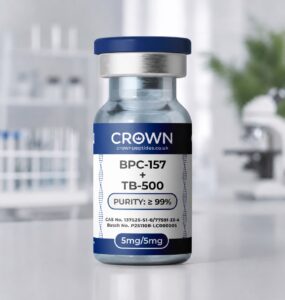
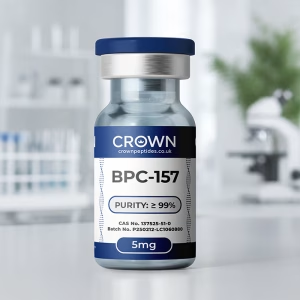
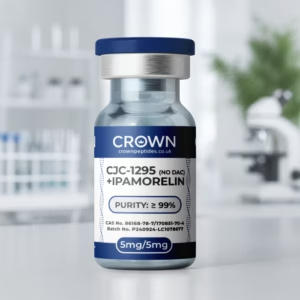
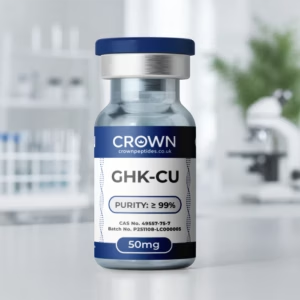
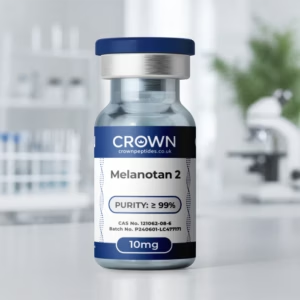
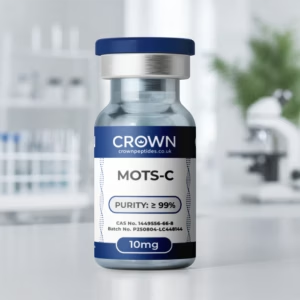
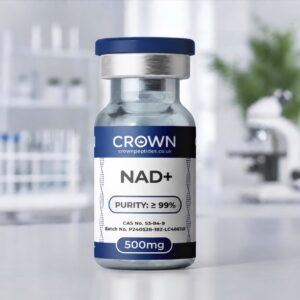
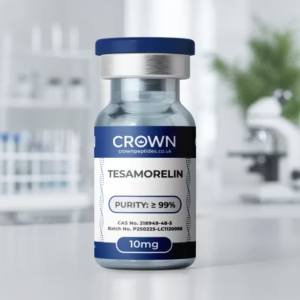
Every batch has a published certificate. Scan the QR code on any bottle to jump straight to its report.
Inside a certificate
What each part proves
Five sections, five different questions. Pick one to see what it tells you, in plain terms, and what to check on your own report.
01Product identity
Product identity
Matching your certificate to the vial in your hand.
Every batch we produce is given its own number, and its certificate is filed against that number. That means any vial can be traced back to the exact report for the material inside it.
The top section of the certificate is there so you can line the two up in seconds. Take the vial, look at the label, and check it against the header of the report.
What to match up:
- Product name — the compound, written in full
- Batch or lot number — the unique code for that production run
- CAS number — the international reference number for that chemical
- Manufacturing date — when the batch was made
When those line up, you know the results you are reading describe the material you are holding. That traceability is the whole point of publishing every report against its batch number.
02Purity percentage
Purity percentage
What the figure measures, and how to read it.
Purity tells you what proportion of the material is the compound you ordered. It is measured by HPLC and expressed as a percentage, calculated from that specific batch.
Peptide synthesis is a multi-step process, and a small amount of closely related material is a normal part of it — mostly shorter sequences and traces of the solvents used in production. Purification removes the great majority of it, and testing is how we confirm how much was removed.
What the thresholds mean in practice:
- ≥80% — suited to early-stage or non-quantitative work
- ≥95% — the standard for most analytical research
- ≥98% — high-purity work where small differences affect results
Our batches typically come back at 99% or higher, and the figure is always published with the method and batch number beside it so you can see exactly where it came from.
03HPLC chromatograms
HPLC chromatograms
How the purity figure is produced, step by step.
HPLC stands for high-performance liquid chromatography. The name is a mouthful, but the idea behind it is straightforward.
The sample is dissolved and pushed through a long, tightly packed column under pressure. Different substances travel through that column at different speeds, so they arrive at the far end at different moments, separated from one another rather than mixed together.
A detector sits at the exit and records everything that passes. Each time something comes through, it draws a peak. The result is a chart with one peak for every substance the instrument found, spread across time.
How to read the chart:
- The tall peak is the target compound
- The smaller peaks are the related substances that purification works to minimise
- The area under each peak shows how much of that substance is present
The purity percentage is the area of the main peak as a share of the total. A well-purified batch produces one clear, dominant peak with very little around it.
04Mass spectrometry
Mass spectrometry
Confirming the compound is exactly what it should be.
HPLC answers how much. Mass spectrometry answers what, and running both is what makes a certificate complete.
Every peptide has a molecular weight determined by its sequence, a number unique to that compound. Mass spectrometry measures that weight directly by turning the sample into charged particles and reading their mass with very high precision.
When the measured weight matches the weight calculated from the sequence, the identity of the compound is confirmed.
What appears on the certificate:
- Expected molecular weight — calculated from the sequence
- Observed molecular weight — what the instrument measured
- Pass confirmation — the two agreeing within tolerance
Together the two tests give you a full picture: the right compound, and how much of it is there.
05Reading a report
Reading a report
What a complete, batch-specific certificate looks like.
A certificate is most useful when every figure on it can be traced back to a single production run. That is how ours are produced, and it is a good standard to hold any report to.
A complete report shows:
- A batch number that matches the vial, so the results and the material are linked
- A date recording when the testing was carried out
- The methods used, named rather than implied
- Precise figures such as 98.17% or 99.21%, reported as measured
- Its own chromatogram, because every run is its own measurement
Small differences between batches of the same compound are entirely normal and a sign of genuine testing. Sequence length, purification efficiency, raw material and instrument tolerances all move the figure slightly, which is exactly why we publish each batch on its own terms rather than quoting a single number across the range.
Purity and Quality
Purity confirmed by HPLC on every batch, typically 99% or higher, with the result printed on the bottle.
Certificate of Analysis
Scan the QR code on any bottle and that batch’s own report opens on our site. No account, no request form.
Secure and Discreet Delivery
Order before 2pm and it leaves the same day, tracked and signed, in plain outer packaging.
Quality begins long before a peptide reaches the laboratory. This is the route every batch takes before it reaches you.
Synthesis
Made by one of the world’s largest and most respected peptide synthesis manufacturers.
Verification
HPLC for purity and mass spectrometry for identity, on every batch.
Documentation
A dated Certificate of Analysis, published openly against the batch number.
Storage and dispatch
Controlled storage, then secure packing and same-day UK dispatch.
From controlled storage environments to secure packaging and fulfilment procedures, every step is designed to help preserve product stability and integrity.
More About Us