

Research guide
Tesamorelin vs Ipamorelin: Two Doors Into the Same Growth Hormone System
One of these peptides is a licensed medicine in the United States, backed by a trial published in the New England Journal of Medicine.
One of these peptides is a licensed medicine in the United States, backed by a trial published in the New England Journal of Medicine. The other was designed in a Danish pharmaceutical lab and described in its very first paper as “the first selective growth hormone secretagogue.” Both make the pituitary gland release growth hormone. And yet they do it by knocking on completely different doors.
That difference is why Tesamorelin and Ipamorelin are compared so often, and why the most interesting answer to “which is better?” is usually “for what?” This guide explains where each compound came from, how each one works, what the major studies measured, and how researchers choose between them or study them together. Both are supplied by Crown Peptides for laboratory research use only.
Why the Pituitary Has Two Doors
Before comparing the peptides, it helps to understand the system they both act on, because once you see it the comparison almost explains itself.
Growth hormone is made and stored in specialised cells in the anterior pituitary gland called somatotrophs. These cells do not release growth hormone continuously. They release it in bursts, most prominently during deep sleep, under the control of signals arriving from the brain and the body.
Door one: the GHRH receptor
The first signal comes from the hypothalamus, just above the pituitary. It is a hormone called growth hormone releasing hormone, or GHRH, and it binds to the GHRH receptor on somatotrophs. This is the main “go” signal for growth hormone release, and it also supports the production of new growth hormone and the health of the somatotroph cells themselves. Tesamorelin knocks on this door.
Door two: the ghrelin receptor
The second signal is a hormone called ghrelin, made mostly in the stomach and best known as the hunger hormone. Ghrelin binds to the growth hormone secretagogue receptor, a completely separate receptor on the same somatotroph cells, and it also acts in the hypothalamus. Stimulating this receptor triggers growth hormone release through a different internal signalling route. Ipamorelin knocks on this door.
The brake
There is also a brake. The hypothalamus releases somatostatin, which suppresses growth hormone release. Growth hormone and its downstream partner IGF-1 feed back to increase somatostatin, keeping the system in balance. Both Tesamorelin and Ipamorelin work within this feedback system rather than overriding it, which is a key reason they are studied as physiological tools rather than as substitutes for growth hormone itself.
Tesamorelin: The Full-Length Hormone, Armoured
Tesamorelin is a synthetic analogue of GHRH. What makes it distinctive among GHRH analogues is that it keeps the full 44-amino-acid sequence of the natural human hormone rather than trimming it down.
A small chemical helmet
Natural GHRH is destroyed within minutes in the bloodstream, largely because an enzyme called dipeptidyl peptidase-4 (DPP-4) cuts off its first two amino acids. Tesamorelin’s designers solved this with a single addition: a trans-3-hexenoyl group, a short fatty acid chain, attached to the very first amino acid of the sequence. It acts like a helmet over the vulnerable front end, protecting it from DPP-4 while leaving the rest of the hormone exactly as nature made it.
That makes Tesamorelin an interesting middle path between the other GHRH analogues. Sermorelin uses only the first 29 amino acids with no protection. CJC-1295 uses 29 amino acids with four substitutions and, in its DAC form, an albumin-binding group. Tesamorelin keeps the complete natural sequence and changes only its front end.
From Montreal to FDA approval
Tesamorelin was developed by the Canadian company Theratechnologies, based in Montreal, which took it through a full clinical programme. It was approved by the US Food and Drug Administration in November 2010 under the brand name Egrifta, for reducing excess abdominal fat in people with HIV-associated lipodystrophy, a condition in which some antiretroviral therapies lead to fat accumulating around the internal organs. It remains the only GHRH analogue currently marketed as a medicine in the US.
- Classification
- Synthetic growth-hormone-releasing hormone analogue
- Available strengths
- 10mg and 20mg
- CAS Number
- 218949-48-5
- Molecular Weight
- 5135.86 g/mol
- Molecular Formula
- C221H366N72O67S
- Sequence
- trans-3-hexenoyl-Tyr-Ala-Asp-Ala-Ile-Phe-Thr-Asn-Ser-Tyr-Arg-Lys-Val-Leu-Gly-Gln-Leu-Ser-Ala-Arg-Lys-Leu-Leu-Gln-Asp-Ile-Met-Ser-Arg-Gln-Gln-Gly-Glu-Ser-Asn-Gln-Glu-Arg-Gly-Ala-Arg-Ala-Arg-Leu-NH2
The Trials That Put Tesamorelin on the Map
Tesamorelin has one of the strongest clinical research records of any compound in a research peptide catalogue. Three trials in particular show how broad its research profile has become.
The NEJM trial on visceral fat
In 2007, Falutz, Grinspoon and colleagues published a pivotal randomised, placebo-controlled trial in the New England Journal of Medicine (PMID: 18057338). They enrolled 412 people with HIV who had accumulated abdominal fat and assigned them to tesamorelin or placebo for 26 weeks. The primary endpoint was the change in visceral adipose tissue, the deep fat surrounding the internal organs, measured by CT scan.
Visceral fat fell by 15.2% in the tesamorelin group and rose by 5.0% in the placebo group. Triglycerides fell and the ratio of total cholesterol to HDL cholesterol improved significantly. IGF-1 levels rose by 81.0% in the tesamorelin group. There were no significant differences between groups in glucose or insulin measures. That trial, together with a second phase 3 study, formed the basis of the FDA approval.
Liver fat
More than a decade later, the same Boston research group extended Tesamorelin’s research into the liver. In a randomised, double-blind trial published in The Lancet HIV in 2019, Stanley, Grinspoon and colleagues studied 61 people with HIV and non-alcoholic fatty liver disease over 12 months (PMID: 31611038, PMC6981288).
Hepatic fat fraction fell by an absolute 4.1% more in the tesamorelin group than in the placebo group, a relative reduction of 37% from baseline. After 12 months, 35% of participants receiving tesamorelin had liver fat below the 5% threshold used to define fatty liver, compared with 4% on placebo. Fasting glucose and glycated haemoglobin did not differ between groups. The authors called for further studies on long-term effects on liver tissue, and the trial opened up a whole new direction for GHRH research.
The brain
Perhaps the most surprising Tesamorelin research is in cognition. GHRH, growth hormone and IGF-1 all decline with age, and all have known effects on the brain. A team at the University of Washington tested whether restoring the GHRH signal might affect cognitive function in older adults.
In a randomised, double-blind, placebo-controlled trial published in Archives of Neurology in 2012, Baker and colleagues enrolled 152 adults aged 55 to 87, including 66 with mild cognitive impairment, and followed them for 20 weeks (PMID: 22869065, PMC3764914). The intent-to-treat analysis showed a favourable effect of GHRH on cognition that was comparable in adults with mild cognitive impairment and healthy older adults, with the strongest effect on executive function and a trend towards improvement in verbal memory. IGF-1 rose by 117% while staying within the physiological range, and percentage body fat fell by 7.4%. A follow-up analysis by the same group in JAMA Neurology looked at changes in brain levels of GABA, an inhibitory neurotransmitter, as a possible mechanism.
The authors called for longer trials, but the study remains one of the most cited examples of a growth hormone axis peptide being studied for brain health.
Ipamorelin: The Selective Secretagogue
Ipamorelin comes from an entirely different lineage. It belongs to a family of synthetic peptides called growth hormone releasing peptides, or GHRPs, which were first developed in the late 1970s and 1980s, largely through the work of Cyril Bowers, before anyone knew what receptor they acted on. The ghrelin receptor itself was only identified in 1996, and ghrelin, its natural partner, in 1999.
A drug that found its receptor before its hormone
The GHRP story is one of the stranger detours in endocrinology. In the late 1970s, Cyril Bowers and colleagues were modifying fragments of met-enkephalin, one of the body’s natural opioid peptides, when they noticed that some of their synthetic peptides released growth hormone. They had no opioid activity to speak of, and they did not act on the GHRH receptor either. Something else was responding.
Over the following years the work produced a series of increasingly potent synthetic peptides, including the six-amino-acid GHRP-6 in the early 1980s, followed by GHRP-1 and GHRP-2. Drug companies then developed non-peptide versions that could be taken by mouth, most famously the Merck compound MK-677. It was while using that compound as bait that a Merck team led by Andrew Howard finally cloned the receptor in 1996, naming it the growth hormone secretagogue receptor. At that point it was still an orphan: a receptor with synthetic drugs that fitted it but no known natural partner.
The partner turned up three years later. In 1999, Masayasu Kojima, Kenji Kangawa and colleagues in Japan isolated a 28-amino-acid peptide from rat stomach that activated the receptor, and named it ghrelin, from a root word meaning “grow”. Researchers had spent two decades studying drugs for a hormone that nobody had yet discovered. Ipamorelin was designed in the middle of that story, when scientists knew exactly what the receptor could do but not yet what nature used it for.
The problem Ipamorelin solved
The early GHRPs, such as GHRP-6 and GHRP-2, were powerful growth hormone releasers, but they were not tidy. Alongside growth hormone, they also raised ACTH and cortisol, the body’s main stress hormones, and in some cases prolactin. For researchers who wanted to study growth hormone release specifically, those extra effects were unwanted noise.
Scientists at Novo Nordisk in Denmark set out to find a cleaner molecule. The result was Ipamorelin, a five-amino-acid peptide described in a 1998 paper in the European Journal of Endocrinology by Raun and colleagues, titled with confident simplicity: “Ipamorelin, the first selective growth hormone secretagogue” (PMID: 9849822).
What the Novo Nordisk paper found
Ipamorelin was identified through a major chemistry programme as part of a series of compounds lacking a central dipeptide found in an earlier GHRP. In rat pituitary cells, it released growth hormone with potency and efficacy similar to GHRP-6. Studies using receptor antagonists confirmed it worked through the same GHRP-type receptor, the receptor now known as the ghrelin receptor. In anaesthetised rats and in conscious swine, it again released growth hormone with potency comparable to GHRP-6.
The headline finding came from the swine studies. None of the secretagogues tested affected FSH, LH, prolactin or TSH. GHRP-6 and GHRP-2 both raised ACTH and cortisol. Ipamorelin did not, and in the authors’ words this was very surprising: its effect on ACTH and cortisol was not significantly different from that of GHRH itself, even at doses more than 200 times higher than those needed for growth hormone release. The authors concluded that Ipamorelin was the first GHRP-receptor agonist with a selectivity for growth hormone release similar to GHRH.
Ipamorelin and the gut
Because the ghrelin receptor also plays a role in gut motility, Ipamorelin was later explored for postoperative ileus, the temporary slowing of the bowel after abdominal surgery. Rodent studies showed promising effects on gut motility. A phase 2 proof-of-concept trial published in the International Journal of Colorectal Disease in 2014 by Beck and colleagues enrolled 117 bowel resection patients (PMID: 25331030). Ipamorelin was well tolerated, and median time to the first tolerated solid meal was 25.3 hours compared with 32.6 hours on placebo, though that difference did not reach statistical significance. The authors noted the study was small and enrolled patients with a broad range of underlying conditions. It remains a useful demonstration of how far ghrelin receptor research extends beyond growth hormone.
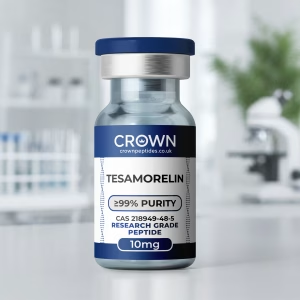
Tesamorelin Research Peptide
HPLC and MS verified · batch certificate published · dispatched from the UK before 2pm
Tesamorelin vs Ipamorelin: Side by Side
With both stories told, the key differences come into focus.
Receptor and mechanism
Tesamorelin binds the GHRH receptor and works through the cyclic AMP signalling pathway. Ipamorelin binds the ghrelin receptor and works mainly through a calcium-based signalling pathway. Same cell, same end product, different doors and different wiring.
Size and structure
Tesamorelin is a 44-amino-acid peptide with a fatty acid group at its front end, making it one of the largest peptides in a typical research catalogue. Ipamorelin is just five amino acids, several of them unnatural or modified, designed for stability and selectivity.
Selectivity
Both are notably selective for growth hormone. GHRH analogues are inherently specific to the growth hormone axis. Ipamorelin earned its reputation by matching that GHRH-like specificity within the GHRP family, which is what set it apart from GHRP-2 and GHRP-6.
Clinical and regulatory record
Tesamorelin has completed phase 3 trials and holds FDA approval for a specific indication, with a substantial body of published human research across fat distribution, liver fat and cognition. Ipamorelin reached phase 2 clinical development for postoperative ileus but was not licensed, and its research strength lies in its precise pharmacological characterisation.
Research focus
Tesamorelin’s literature is dominated by body composition, visceral fat, liver fat and brain research. Ipamorelin’s literature centres on selective growth hormone release, receptor pharmacology and gastrointestinal motility.
Which One Fits a Research Question?
Autocomplete data shows people asking which of the two is better for muscle growth or fat loss, and whether they should be combined. For researchers, the useful framing is which tool answers which question.
When Tesamorelin fits
Tesamorelin suits research built around the GHRH pathway, especially where existing human data matters. Its trials on visceral fat, liver fat and cognitive function give researchers a strong clinical backdrop for preclinical work on body composition, hepatic fat metabolism or growth hormone effects on the brain. It is also the natural choice for studying the full-length GHRH molecule rather than a fragment.
When Ipamorelin fits
Ipamorelin suits research on the ghrelin receptor, selective growth hormone release, or gut motility, and any study where avoiding cortisol and ACTH effects is important to keep the data clean. Its small size and well-characterised pharmacology also make it a practical reference compound.
Why they are so often studied together
Because the two act on different receptors that use different internal signalling routes, stimulating both at once is a well-established approach in growth hormone research. GHRH-pathway activation and ghrelin-pathway activation have been shown in the wider literature to produce a larger combined growth hormone response than either alone. That is the reasoning behind “Tesamorelin and Ipamorelin” appearing as a frequent search, and behind the popularity of the related CJC-1295 (No DAC) + Ipamorelin (Blend), which pairs Ipamorelin with a different GHRH analogue.
The Technical Breakdown: Two Signalling Routes Inside One Cell
This section goes deeper into the cell biology. It is not essential for the comparison, but it explains why the “two doors” picture holds up at the molecular level.
The GHRH route
The GHRH receptor is a class B G protein-coupled receptor. When Tesamorelin binds, the receptor activates a Gs protein, which switches on adenylyl cyclase. That enzyme converts ATP into cyclic AMP, and cyclic AMP activates protein kinase A. Protein kinase A then does two things. In the short term it opens calcium channels and triggers release of stored growth hormone granules. In the longer term it activates the transcription factor CREB, which increases production of Pit-1, a factor that drives growth hormone gene expression and somatotroph growth.
The ghrelin route
The ghrelin receptor, formally GHS-R1a, is a class A G protein-coupled receptor. When Ipamorelin binds, it mainly activates a Gq protein, which switches on phospholipase C. That enzyme generates two messengers: IP3, which releases calcium from stores inside the cell, and diacylglycerol, which activates protein kinase C. The surge in intracellular calcium drives growth hormone release. The ghrelin receptor is also unusual in having high constitutive activity, meaning it signals at a low level even without anything bound to it.
Where they meet
Both routes converge on calcium, which is the final trigger for release of growth hormone granules. Because they get there by different pathways, activating both at once can amplify the calcium signal more than either alone. The ghrelin pathway also acts at the hypothalamus to increase GHRH release and reduce somatostatin, effectively opening door one a little wider while knocking on door two.
Why Ipamorelin avoids cortisol
The ACTH and cortisol responses seen with GHRP-2 and GHRP-6 are thought to involve actions on the hypothalamic-pituitary-adrenal axis beyond the somatotroph. Ipamorelin’s structure appears to avoid engaging those pathways at meaningful levels, which is what the 1998 swine data captured. The precise structural basis is still a subject of interest for receptor pharmacologists.
Why Tesamorelin keeps the whole sequence
The first 29 amino acids of GHRH carry most of its receptor-binding activity, but the remaining 15 contribute to its overall behaviour, stability and how it sits on the receptor. By keeping all 44, Tesamorelin preserves the native hormone as completely as possible, which is part of what made it attractive as a clinical candidate.
Why Quality Control Looks So Different for These Two
These two peptides sit at opposite ends of the size spectrum, and that shapes how they are made and tested.
Tesamorelin, at 44 amino acids plus its hexenoyl group, requires more than 40 separate coupling steps during synthesis. Each step has a small failure rate, so deletion sequences, chains missing a single amino acid, are a genuine manufacturing consideration. They can be very close to the target peptide on an HPLC trace, and the attached fatty acid group must be present and correctly placed for the molecule to be Tesamorelin at all. Mass spectrometry, which weighs the molecule precisely, is essential for confirming both.
Ipamorelin, at five residues, is quicker to make but contains non-standard building blocks, including aminoisobutyric acid and D-amino acids, which are the mirror-image forms of natural amino acids. A peptide with the wrong stereochemistry at one position can have the same mass but very different pharmacology. Here, a reliable synthesis process and a clean HPLC profile matter just as much as the mass result.
How Crown Peptides verifies every batch
Every batch of Tesamorelin and Ipamorelin supplied by Crown Peptides comes with a batch-specific certificate of analysis. HPLC measures purity by separating the target peptide from related impurities, and mass spectrometry confirms the molecular identity. Lot numbers on certificates match those on vial labels. Published certificates are available on our Lab Reports page, and our guide to reading a certificate of analysis explains every figure.
For handling, both are supplied lyophilised and should be stored cold and dry. Tesamorelin, being a longer peptide, can take a little longer to dissolve fully and benefits from gentle swirling rather than shaking. Our guides to peptide reconstitution and peptide half-life cover the practical detail, with Bacteriostatic Water available alongside.
Related Compounds Across the Growth Hormone Axis
Tesamorelin and Ipamorelin are two of a family of compounds that act at different points in the same system. These are the neighbours most worth knowing.
The other GHRH analogues
Sermorelin is the 29-amino-acid fragment that became an FDA-approved paediatric medicine, while CJC-1295 with DAC is the long-acting, albumin-binding version. Compare them in Sermorelin vs Tesamorelin and CJC-1295 vs Sermorelin.
The other ghrelin receptor agonists
GHRP-2 is highly potent and has been used as a diagnostic agent, while GHRP-6 is known for its strong effect on appetite signalling. See Ipamorelin vs GHRP-2 and GHRP-2 vs GHRP-6.
Combined and downstream compounds
The CJC-1295 (No DAC) + Ipamorelin (Blend) brings both doors together in one vial, explained in the two-pathway approach. Further down the axis, IGF-1 LR3 lets researchers study the downstream hormone directly. For Tesamorelin’s metabolic side, MOTS-c and AOD-9604 are relevant neighbours, and the wider metabolic research peptides category is worth browsing.
You can explore the full group in our endocrine and hormonal research peptides category, and read our individual guides on Tesamorelin and Ipamorelin.
Read the certificate before you order
Every batch is published openly — identity by mass spectrometry, purity by HPLC, and the batch number printed on the vial you receive.
Open the COA libraryTesamorelin and Ipamorelin Questions, Answered
Is Tesamorelin the same as Ipamorelin?
No. Tesamorelin is a 44-amino-acid GHRH analogue that acts on the GHRH receptor. Ipamorelin is a five-amino-acid ghrelin receptor agonist. Both lead to growth hormone release, but through different receptors and signalling pathways.
Is Tesamorelin the same as HGH?
No. Human growth hormone is a 191-amino-acid protein. Tesamorelin signals the pituitary to release the body’s own growth hormone and works within its normal feedback controls.
Which has more human research?
Tesamorelin, by a wide margin, thanks to its phase 3 programme, FDA approval and later trials on liver fat and cognition.
Why is Ipamorelin called selective?
Because in the original 1998 research it released growth hormone without significantly raising ACTH or cortisol, unlike earlier GHRPs such as GHRP-2 and GHRP-6, and without affecting other pituitary hormones.
Can Tesamorelin and Ipamorelin be studied together?
Yes, and this is common in research design, because they act on complementary receptors. Studying each alone and in combination lets researchers separate the contribution of each pathway.
Two Doors, Endless Questions
The growth hormone system is one of the most elegantly regulated in the body, with two separate “go” signals, a brake and a feedback loop all converging on one type of cell. Tesamorelin and Ipamorelin each open one of its doors. One is the full natural hormone, protected with a tiny chemical helmet and proven in trials spanning fat, liver and brain. The other is a compact, precision-engineered molecule that showed researchers how to release growth hormone cleanly through the ghrelin receptor.
Understanding both is the key to asking sharp questions about the whole axis, whether that means studying each pathway in isolation or watching what happens when both doors open at once. Explore Tesamorelin and Ipamorelin from Crown Peptides, every batch HPLC and mass spectrometry verified, dispatched from the UK.
Working with Tesamorelin Research Peptide
Batch-tested material, published certificates, and same-day dispatch on orders placed before 2pm.
See Tesamorelin Research Peptide